Your Microservices Are Too Chatty
You built microservices to escape the monolith. But now you have a different problem.
Service A needs data from Service B. Service B needs confirmation from Service C. Service C needs to notify Service A. They are constantly calling each other. Waiting for each other. Failing with each other.
One service slows down by 200 milliseconds. Every dependent service slows down. The entire system slows down.
This is not microservices. This is a distributed monolith.
You have the complexity of distributed systems without the benefits of true independence.
The solution is not better infrastructure. It is a different communication pattern: Event-Driven Architecture.
See how we build event-driven systems for complex applications:
The Problem: Synchronous Communication Is a Bottleneck
How Traditional Microservices Communicate
Service A calls Service B via HTTP/REST. Service A waits for Service B's response. Service B might call Service C. Service B waits for Service C.
This is synchronous communication. Every service waits for the service it calls.
The problems:
| Problem | Impact |
|---|---|
| Cascading failures | Service C fails → Service B fails → Service A fails |
| Latency accumulation | Service C: 100ms, Service B: 100ms, Service A: 100ms → Total: 300ms+ |
| Tight coupling | Service A cannot change without coordinating with Service B |
| Scaling inefficiency | Scale Service A? Service B and C must also scale |
| Blocking | Service A does nothing while waiting for responses |
Real example from an e-commerce platform:
User places order → Order Service calls Payment Service (200ms) → Payment Service calls Fraud Service (150ms) → Fraud Service calls Inventory Service (100ms) → Inventory Service confirms → Response returns to User
Total time: 450ms + network latency. User waits. System is busy. Every service is coupled to every other service.
Learn more about our approach to modern architecture:
The Solution: Event-Driven Architecture (EDA)
What Is Event-Driven Architecture?
In EDA, services do not call each other directly. They emit events when something happens. Other services react to those events when they are ready.
Before (Synchronous):
Service A → "Hey Service B, process this data right now and tell me when you are done." Service A waits.
After (Event-Driven):
Service A → "Something happened. Here is an event." Service A continues working. Service B sees the event later. Service B processes when ready.
The Key Components
| Component | Role | Example |
|---|---|---|
| Event Producer | Service that emits an event | Order Service emits "OrderPlaced" event |
| Event | Record of something that happened | { eventType: "OrderPlaced", orderId: 123, total: 5000 } |
| Event Broker/Queue | Stores events until consumed | Kafka, RabbitMQ, AWS SQS |
| Event Consumer | Service that reacts to events | Payment Service consumes "OrderPlaced" and processes payment |
How the E-commerce Example Changes
Synchronous (Before):
Order Service → waits → Payment Service → waits → Fraud Service → waits → Inventory Service
Event-Driven (After):
-
Order Service emits "OrderPlaced" event to queue
-
Order Service immediately returns "Order received" to user
-
Payment Service consumes "OrderPlaced" from queue (processes payment)
-
Payment Service emits "PaymentProcessed" event
-
Fraud Service consumes "PaymentProcessed" (runs fraud check)
-
Inventory Service consumes "OrderPlaced" (reserves inventory)
No service waits for another. No cascading failures. Each service works independently.
See which industries benefit from event-driven architecture:
Synchronous vs. Event-Driven: A Direct Comparison
| Aspect | Synchronous (REST/gRPC) | Event-Driven (EDA) |
|---|---|---|
| Communication pattern | Request-Response | Publish-Subscribe |
| Services call each other | Yes, directly | No, via events |
| Waiting | Caller waits for response | Caller does not wait |
| Coupling | Tight (services know about each other) | Loose (services only know about events) |
| Failure handling | Cascading | Isolated |
| Scalability | Must scale together | Scale independently |
| Latency | Sum of all service latencies | Event producer latency only |
| Debugging | Easier traceability | More complex (event trails needed) |
| Best for | Simple workflows, real-time responses | Complex workflows, resilience, scale |
The Hybrid Approach: Many systems use both. Synchronous for real-time user interactions. Event-Driven for background processing and cross-service communication.
Read about our event-driven architecture implementations:
The Evolution: Micro-Frontends Go Event-Driven
What Are Micro-Frontends?
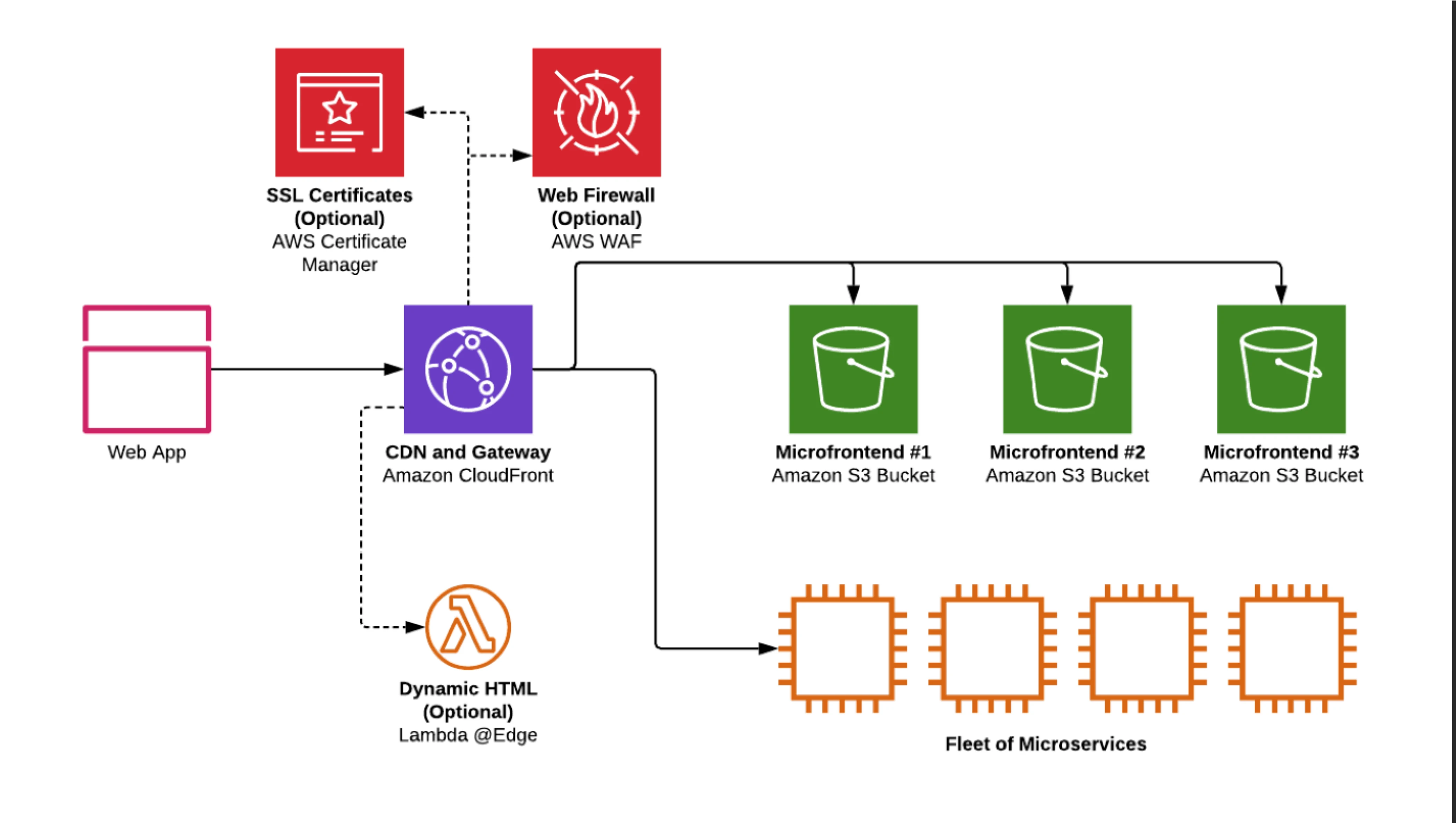
Just as microservices break the backend into independent services, micro-frontends break the frontend into independent components. Each team owns a vertical slice: product browsing, cart, checkout, user profile.
The Problem with Micro-Frontends
Different frontend components need to communicate. Cart needs to know when an item is added. Checkout needs to know when cart is updated. User profile needs to know when an order is placed.
Traditional approach: Global state management (Redux, Vuex). Tight coupling. One component changes state. All components potentially affected.
The Event-Driven Solution for Frontends
Micro-frontends communicate via events, not shared state.
Before (Shared State):
// Cart component updates shared store
store.dispatch('addItem', item)
// All components subscribed to store re-render
After (Event-Driven):
// Cart component emits event
window.dispatchEvent(new CustomEvent('cart:itemAdded', { detail: item }))
// Checkout component listens for event
window.addEventListener('cart:itemAdded', (event) => {
  updateTotal(event.detail)
})
Benefits for frontends:
| Benefit | Why It Matters |
|---|---|
| True independence | Components do not share state. They share events. |
| Loose coupling | Change Checkout component without touching Cart. |
| Better performance | Only interested components react to events. |
| Easier debugging | Event trail shows what happened when. |
| Framework agnostic | React component can emit event consumed by Vue component. |
Real example: A large e-commerce platform with 12 micro-frontend teams. Cart team uses React. Checkout team uses Vue. User profile team uses Angular. Events make them work together without shared state or framework compatibility issues.
Event-Driven Microservices: The 2026 Standard
Why EDA Is Becoming Mandatory in 2026
| Driver | Why It Demands EDA |
|---|---|
| AI integration | AI services are slow. Synchronous calls would block everything. Events allow async AI processing. |
| Real-time requirements | Users expect instant UI updates. Synchronous backends cannot keep up. Event-driven systems update asynchronously without blocking. |
| Scale demands | Synchronous systems hit limits at high scale. Event-driven systems scale horizontally. |
| Cloud costs | Synchronous systems waste compute cycles waiting. Event-driven systems use resources only when processing. |
Common Event-Driven Patterns
Pattern 1: Event Notification
Service emits event to notify others. Does not expect response.
Use case: "Order placed" → Inventory service reserves stock, Email service sends confirmation, Analytics service records data.
Pattern 2: Event-Carried State Transfer
Event includes the data another service needs. Consumer does not need to call back.
Use case: "UserUpdated" event includes user name, email, preferences. Profile service updates without calling User service.
Pattern 3: Command Query Responsibility Segregation (CQRS)
Separate models for writes (commands) and reads (queries). Events synchronize them.
Use case: Order service handles writes. Reporting service maintains optimized read model updated via events.
Pattern 4: Saga Pattern
Distributed transaction across multiple services. Each step emits event. Next step reacts.
Use case: Booking system: Reserve hotel → Confirm flight → Charge payment → Send confirmation. If any step fails, compensating events undo previous steps.
Not sure which pattern fits your system?
Get a free consultation:
Case Study: How a Logistics Platform Reduced Latency by 85% with EDA
Client: Logistics platform in Delhi NCR. 200+ microservices. 1 lakh+ shipments per day.
The problem before EDA:
-
Synchronous REST calls between tracking, payment, notification, and analytics services
-
Average request latency: 1.2 seconds
-
Cascading failures: Tracking service slowdown affected entire platform
-
Peak hour timeouts: 15% of requests failed
-
Scaling: Required scaling all services together
The EDA implementation:
-
Migrated to event-driven architecture using Apache Kafka
-
Order service emits "ShipmentCreated" event
-
Tracking, payment, notification, analytics services consume events independently
-
Implemented Saga pattern for cross-service transactions
-
Event sourcing for complete audit trail
The result after 6 months:
| Metric | Before (Synchronous) | After (Event-Driven) | Change |
|---|---|---|---|
| Average request latency | 1,200ms | 180ms | -85% |
| Peak hour timeout rate | 15% | 0.3% | -98% |
| Cascading failures | Regular | None | -100% |
| Scaling cost | Required scaling all services | Scale only busy services | -60% cost |
| Developer productivity | Blocked by coordination | Teams work independently | +40% |
Technical outcomes:
-
Tracking service slowdown no longer affects payments
-
New customer notification service added in 2 days (no changes to existing services)
-
Complete audit trail via event store (regulatory requirement)
"Synchronous microservices gave us distributed monolith. Event-driven gave us true independence. The difference is night and day." — CTO
See more case studies in our portfolio:
Event-Driven Architecture for Micro-Frontends: A Case Study
Client: Large Indian e-commerce platform with 15 frontend development teams.
The problem before event-driven micro-frontends:
-
Shared Redux store across all components
-
Any team's change could break any other team's component
-
Deployment coordination required (cannot deploy Cart without testing Checkout)
-
Performance degraded as more components listened to store
The event-driven solution:
-
Removed shared Redux store
-
Implemented event bus for cross-component communication
-
Each component maintains its own local state
-
Components emit events for actions (cart:added, checkout:started)
-
Components listen only to relevant events
The result:
| Metric | Before (Shared State) | After (Event-Driven) | Change |
|---|---|---|---|
| Cross-team coordination | Required for every deployment | No coordination needed | -90% |
| Component coupling | High (via shared store) | None (events only) | Complete decoupling |
| Performance (re-renders) | All components on every change | Only relevant components | -70% |
| Time to add new component | 2 weeks (integrate with store) | 2 days (listen to events) | -85% |
Developer feedback:
"We used to be afraid to touch the shared store. Now we own our components completely. The event bus is the only contract. It is liberating." — Frontend Lead
The Governance Shift: Event Contracts and Schema Registry
With many services producing and consuming events, governance becomes critical.
The Problem: Event Sprawl
Service A emits "OrderCreated" with fields {orderId, customerId, total}. Service B expects "OrderCreated" with fields {orderId, customerId, total, currency, items[]}. Mismatch. Failure.
The Solution: Schema Registry
A central service stores and validates event schemas.
| Component | Role |
|---|---|
| Schema Registry | Stores event schemas (Avro, Protobuf, JSON Schema) |
| Validator | Ensures events match registered schemas |
| Versioning | Tracks schema changes over time |
| Compatibility Check | Prevents breaking changes (e.g., removing required fields) |
Event Contract Example (Avro Schema)
{
  "type": "record",
  "name": "OrderCreated",
  "fields": [
    { "name": "orderId", "type": "string" },
    { "name": "customerId", "type": "string" },
    { "name": "total", "type": "double" },
    { "name": "currency", "type": "string", "default": "INR" },
    { "name": "timestamp", "type": "long" }
  ]
}
Why this matters:
-
Producers and consumers have a shared contract
-
Breaking changes are caught before deployment
-
New services can discover what events exist
-
Governance without central control
Learn about our event governance framework:
Choosing Your Event Broker
The event broker is the heart of your EDA system.
| Broker | Best For | Strengths | Weaknesses |
|---|---|---|---|
| Apache Kafka | High-volume, persistent events | High throughput, event replay, exactly-once | Operational complexity |
| RabbitMQ | Reliable routing | Mature, flexible routing, easy to operate | Lower throughput than Kafka |
| AWS SQS/SNS | Serverless, AWS ecosystem | Fully managed, no operations | Vendor lock-in |
| Redis Pub/Sub | Low-latency, ephemeral events | Very fast, simple | No persistence, no replay |
| NATS | Cloud-native, high performance | Lightweight, fast, simple | Fewer features than Kafka |
Our recommendation:
| Use Case | Recommended Broker |
|---|---|
| Financial transactions, audit trails | Kafka (event replay needed) |
| Simple task queues, microservices communication | RabbitMQ |
| Serverless AWS environment | SQS/SNS |
| Real-time notifications, ephemeral events | Redis Pub/Sub |
| High-performance, cloud-native | NATS |
Implementation Roadmap: From Synchronous to Event-Driven
Phase 1: Identify Boundaries (Weeks 1-2)
-
Map current service dependencies
-
Identify which calls are synchronous but could be async
-
Define event schemas for first use case
Phase 2: Add Event Producer (Weeks 3-4)
-
Deploy event broker (start with RabbitMQ or Kafka)
-
Modify one service to emit events alongside existing synchronous calls
-
No consumer yet. Just produce events.
Phase 3: Add First Consumer (Weeks 5-6)
-
Modify dependent service to consume events instead of synchronous calls
-
Run both patterns in parallel for safety
-
Compare results
Phase 4: Migrate and Remove (Weeks 7-8)
-
Remove synchronous call after validation
-
Add more consumers
-
Expand to additional services
Phase 5: Optimize (Ongoing)
-
Implement dead letter queues for failed events
-
Add monitoring and alerting
-
Implement schema registry
Total time for first workflow: 6-8 weeks.
Start your EDA migration today:
Pro Tips for EDA Success
1. Start with non-critical workflows. Do not migrate payment processing first. Start with analytics, logging, or notification workflows that are easier to recover.
2. Design events for consumers, not producers. Events should contain what consumers need. Do not make consumers call back to get more data.
3. Make events immutable and append-only. Never change an event after it is emitted. If you need to correct, emit a new "OrderCorrected" event.
4. Implement dead letter queues. Events that fail processing go to DLQ for manual inspection. Do not lose events.
5. Add idempotency keys. The same event may be delivered twice. Consumers must handle duplicates gracefully.
6. Monitor lag. How far behind are consumers? High lag indicates problems.
7. Document event schemas. New team members need to discover what events exist. Use schema registry or documentation.
Join our team and help build event-driven systems:
Common EDA Mistakes to Avoid
| Mistake | Why It Is Bad | What To Do Instead |
|---|---|---|
| Making events too fine-grained | Floods the system, hard to track | Emit meaningful business events, not every database change |
| No schema validation | Events drift over time, services break | Use schema registry |
| Ignoring idempotency | Duplicate events cause double processing | Add idempotency keys |
| No monitoring | Cannot detect lag or failures | Monitor consumer lag and error rates |
| Events without context | Consumers need to call back for data | Include necessary data in the event |
| Synchronous event processing | Defeats purpose of EDA | Process events asynchronously |
| No dead letter queue | Failed events are lost forever | DLQ for all event streams |
Frequently Asked Questions
Q1: Do I need to replace all synchronous calls with events?
No. Use synchronous for real-time user interactions (login, checkout). Use events for cross-service communication, background processing, and eventual consistency.
Q2: How do I handle distributed transactions with events?
Use Saga pattern. Each step emits event. Next step reacts. If step fails, compensating events undo previous steps.
Q3: Is EDA more complex than synchronous communication?
Initially, yes. You need event brokers, schema registries, dead letter queues, and monitoring. The complexity pays off at scale. For small systems, synchronous may be simpler.
Q4: What is event sourcing?
Event sourcing stores state as a sequence of events, not just current state. To get current state, replay events. Provides complete audit trail and time travel debugging.
Q5: How do I debug an event-driven system?
Use distributed tracing (OpenTelemetry, Jaeger, Zipkin). Each event gets a trace ID. Follow it across producers, brokers, and consumers.
Q6: Can micro-frontends really use EDA?
Yes. Use browser-native Custom Events or simple event bus. No global state needed. Each component listens to events it cares about.
Q7: What is the best event broker for a startup?
Start with RabbitMQ (easy to operate) or AWS SQS/SNS (serverless). Migrate to Kafka when you need high throughput or event replay.
Q8: How do I prevent event storms (cascading events)?
Set time-to-live on events. Implement circuit breakers. Use event schemas to prevent unnecessary events.
Q9: Is EDA suitable for real-time applications?
For user-facing real-time, use synchronous or WebSockets. For background real-time (system reacting to events), EDA is excellent.
Q10: What is the ROI of migrating to EDA?
Most teams report 50-80% reduction in cascading failures, 2-3x increase in developer productivity (no coordination between services), and 40-60% lower scaling costs.
Synchronous microservices were a step forward from the monolith. But they introduced new problems: tight coupling, cascading failures, and coordinated scaling.
Event-Driven Architecture solves these problems. Services stop calling each other. They start reacting to events. They become truly independent. They scale individually. They fail without bringing down their neighbors.
Micro-frontends are following the same path. Shared global state is being replaced by event buses. Components stop sharing state. They start sharing events.
The future is not services calling services.
The future is services reacting to events.
Is your architecture ready for 2026?
Limited-Time Offers
| Offer | Code | Valid For |
|---|---|---|
| Free EDA readiness assessment | EDAFREE | Your current architecture analysis |
| 20% OFF first event-driven migration | EDA20 | New clients |
| Free event broker selection consultation | EDABROKER | 30-minute strategy call |
| Pilot migration discount | EDAPILOT | First workflow migration |
"Event-Driven Architecture and Micro-Frontends – Innovative AI Solution Delhi"
Contact Us
Phone: +91 7464 099 059 / +91 96899 67356
Email: info@innovativeais.com
Address: Netaji Subhash Place, Pitampura, Delhi – 110034
Website: https://innovativeais.com/
"Synchronous services call each other. Event-driven services react to each other. One is a conversation. The other is a broadcast. Choose wisely."
— Founder, Innovative AI Solution (Est. 2020)
Related services: to apply this in your business, explore our web development and API development and integration.