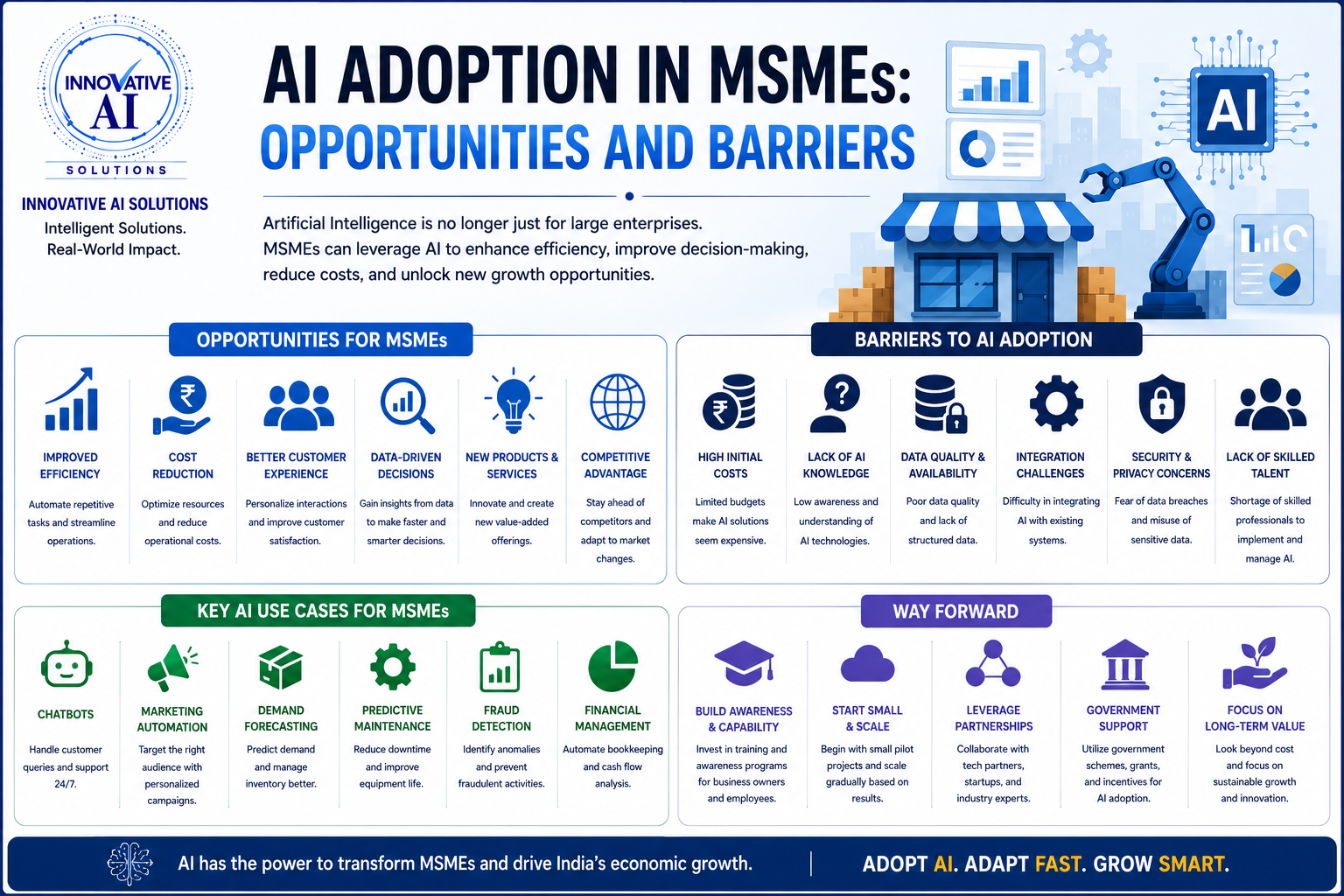
The Digital Reality—Where MSMEs Stand Today
The Adoption Numbers
| Metric | Value |
|---|---|
| MSMEs viewing AI as central to future growth | 57% |
| MSMEs that have integrated AI into operations | 25% |
| Digital Maturity Index (2026) | 60.8 (up from 58.0 in 2025) |
| MSMEs with online presence | 80% |
| Women-led MSMEs DMI | 61.6 |
Source:
The Vi Business MSME Growth Insights Study 2026—based on insights from over 250,000 MSMEs across 16 sectors—reveals a sector in transition. The Digital Maturity Index rose to 60.8 in 2026, driven by stronger adoption of cybersecurity (46.3% now deploy cyber defence solutions), workplace technologies (Digital Workplace index rose to 65.7), and digital operations .
However, the sector remains deeply uneven. Manufacturing, agriculture, telecom, and logistics continue to trail more digitally advanced industries like financial services (DMI 67.3) and IT/ITeS (66.2) . Telangana (68.3), Karnataka, and Maharashtra lead the states, while one-fifth of MSMEs remain completely offline .
The Adoption Gap
The PayNearby MSME Digital Index Report 2026 found that while 90% of last-mile MSMEs have heard of AI, and 71% have used AI tools to automate business operations, 26% remain unsure about which AI features could best support their businesses . The gap between awareness and effective application is significant.
Step 3: The Opportunity—What AI Can Deliver
Productivity at Scale
AI shifts the equation from reactive to predictive . For an auto-components manufacturer, an edge AI-enabled camera on the production line can detect defects instantly as components move through production—reducing scrap, rework, and wasted material. For a retail merchant, automated analysis of ordering trends enables inventory calibration ahead of seasonal pressure rather than scrambling to respond to it .
Many MSME promoters now describe AI as operating as a de facto co-founder in day-to-day decision-making . Instead of seeing it as a futuristic add-on, they embrace it as a tool for everyday operational decisions.
The Data Opportunity
India's ecosystem of over 63 million MSMEs is data-rich but intelligence-poor. Platforms like UPI, the GST network, digital logistics trackers, and e-commerce platforms capture billions of data points daily. However, crucial operational information remains siloed across physical invoices, independent logistics receipts, and unorganized spreadsheets .
AI's role is to turn fragmented data into integrated intelligence. When ecosystem partners manage data consolidation on behalf of small businesses, MSMEs can transition from reactive management to predictive execution .
Step 4: The Barriers—Why Adoption Lags
The Structural Hurdles
A 2025 ScienceDirect study identified several key barriers to AI adoption in Indian MSMEs :
| Barrier | Category | Role |
|---|---|---|
| Lack of top management support | Organizational | Driver |
| Change resistance from employees | Organizational | Driven |
| Price of automation | Organizational | Driver |
| Lack of knowledge about AI | Technological | Driven |
| Lack of resources | Technological | Driven |
| Uncertainty about future benefits | Environmental | Driver |
| Perception of job loss | Environmental | Driven |
| Lack of perseverance | Organizational | Driven |
Source:
The study found that price of automation, uncertainty about future, and lack of top management support act as drivers that exacerbate other bottlenecks. MSMEs, with inherently limited resources, can prioritize their focus on the barriers with the highest driving power .
The Cost Gap
A staggering 91% of MSMEs believe AI should be democratically available and affordable, but 59% remain excluded from mainstream AI adoption due to high costs associated with tools, computer infrastructure, and workforce training . Private AI investment in India stands at approximately $1.2 billion, compared with $109 billion in the US and $9.3 billion in China .
The Skills Deficit
Over 70% of India's workforce lacks formal vocational training, a skills deficit more pronounced in rural districts . Only 25% of real estate firms qualify as AI leaders, compared with 40% across industries, reflecting a broader leadership gap across sectors .
The Data Fragmentation Problem
Widespread lack of high-quality, structured data hampers AI model development across India's SME sector . For MSMEs operating on thin margins, the absence of clean, accessible data makes AI integration impractical.
Step 5: The Path Forward—What's Working
Government and Policy Support
The IndiaAI Mission—a US$1.2 billion public-private partnership over five years—is funding AI infrastructure, foundational models, and compute access, including the provision of over 18,700 GPUs . The Union Budget 2025-26 allocated ₹2,000 crore to support AI innovation, workforce training, and Centres of Excellence focused on MSME-relevant applications .
A study jointly undertaken by NISG and Athena Infonomics under MeitY and the IndiaAI Mission will cover over 350 MSME manufacturing factories, developing a practical roadmap to accelerate AI adoption in sectors such as textiles, pharmaceuticals, and electronics .
Edge AI and Cluster-Led Deployment
The World Economic Forum has identified Edge AI as the most viable pathway for real-time, shop-floor transformation. Edge AI runs intelligence directly on or near the machine, not in a distant cloud server—generating insights in real time without requiring continuous connectivity .
Cluster-led deployment models are critical to scaling adoption. MSMEs rarely operate alone—they operate in clusters (automotive components, textiles, food processing, electronics). Ecosystem stakeholders converge on peer learning as the single most important factor motivating MSMEs to try new technologies . Industry bodies like NASSCOM and CII are enabling MSME cluster pilots through Centres of Excellence and smart manufacturing testbeds .
India-First AI Tools
India-first AI tools are designed for local realities—lightweight, multilingual, mobile-first, and capable of running on basic devices . Examples include:
-
Shunya.ai: AI-driven platform for automated shipping rate comparisons, delivery routing, and order tracking
-
PixelYatra: First generative AI design tool with Hindi-language prompts
-
UPI: Built around local realities and scaled through simplicity and collaboration
Step 6: Strategic Recommendations
For Policymakers
| Recommendation | Rationale |
|---|---|
| Scale cluster-based AI adoption labs | Peer learning is the single most important factor in adoption |
| Expand subsidized compute access | IndiaAI Compute Portal has expanded to 38,000+ GPUs; costs below ₹100/GPU hour |
| Invest in language-first AI tools | 22 scheduled languages require localized delivery |
| Create targeted incentives for first-time AI users | Low awareness and high upfront cost remain key barriers |
For Technology Providers
| Recommendation | Rationale |
|---|---|
| Design for Indian realities—cost-efficiency, multilingual, mobile-first | 91% of MSMEs need affordable, accessible tools |
| Deploy edge AI for shop-floor transformation | Real-time decisions require local processing |
| Integrate AI into existing operational layers | Expecting MSMEs to hire ML engineers is impractical |
For MSMEs
| Recommendation | Rationale |
|---|---|
| Start with one bounded use case | Prove value before scaling |
| Join cluster-based adoption initiatives | Peer learning reduces risk |
| Leverage India-first, low-cost AI tools | Reduce upfront investment |
| Prioritize data governance early | AI is only as reliable as its data |
Step 7: Frequently Asked Questions
Q1: How many MSMEs have adopted AI in India?
25% have integrated AI into business operations and workflows. 57% view AI as central to future growth . Overall AI adoption among MSMEs stands at 15%, with awareness and interest significantly outpacing actual uptake .
Q2: What is the biggest barrier to AI adoption?
Cost and affordability. 59% of MSMEs remain excluded from mainstream AI adoption due to high costs of tools, infrastructure, and workforce training . Price of automation, uncertainty about future, and lack of top management support are the primary drivers of other bottlenecks .
Q3: Can small MSMEs afford AI?
Yes—with the right approach. India-first AI tools offer freemium models, subscription-based pricing, mobile-first deployment, and bundled platforms. The IndiaAI Compute Portal has reduced GPU usage costs to below ₹100/hour . Shared infrastructure models are also emerging .
Q4: What is Edge AI and why does it matter?
Edge AI runs intelligence directly on or near the machine, not in a distant cloud server. It generates insights in real time without requiring continuous connectivity—critical for MSMEs in environments with intermittent internet .
Q5: How can Innovative AI Solutions help?
We help MSMEs identify, implement, and scale AI solutions tailored to their budgets, workflows, and language needs—from edge AI deployment to India-first tool integration.
Step 8: Final Tagline
"India's AI future will not be measured by the sophistication of its frontier models. It will be measured by how much of that capability reaches the 63 million businesses that form its economic spine. Equipping this segment with embedded intelligence, sound data infrastructure, and accessible automation is the foundation for India's growth agenda" .
Short version:
AI adoption in MSMEs—opportunities and barriers in 2026. The $500 billion opportunity, the adoption gap, the barriers (cost, skills, data, leadership), and the path forward (Edge AI, clusters, India-first tools).
Hashtags:
#MSME #AIAdoption #DigitalIndia #EdgeAI #IndiaAI #MSMEGrowth #InnovativeAISolutions
Contact Us
Phone: +91 7464 099 059 / +91 96899 67356
Email: info@innovativeais.com
Address: Netaji Subhash Place, Pitampura, Delhi – 110034
Website: https://innovativeais.com
Related services: to apply this in your business, explore our AI development services and RAG development.