The Big Question
"Should we build an in-house AI team, or should we engage AI consultants? Which approach actually delivers results?"
The honest answer:
It depends on your AI maturity, your urgency, and your long-term strategy — but for most enterprises, the smartest path is a deliberate sequence, not a permanent binary choice .
Here is the truth:
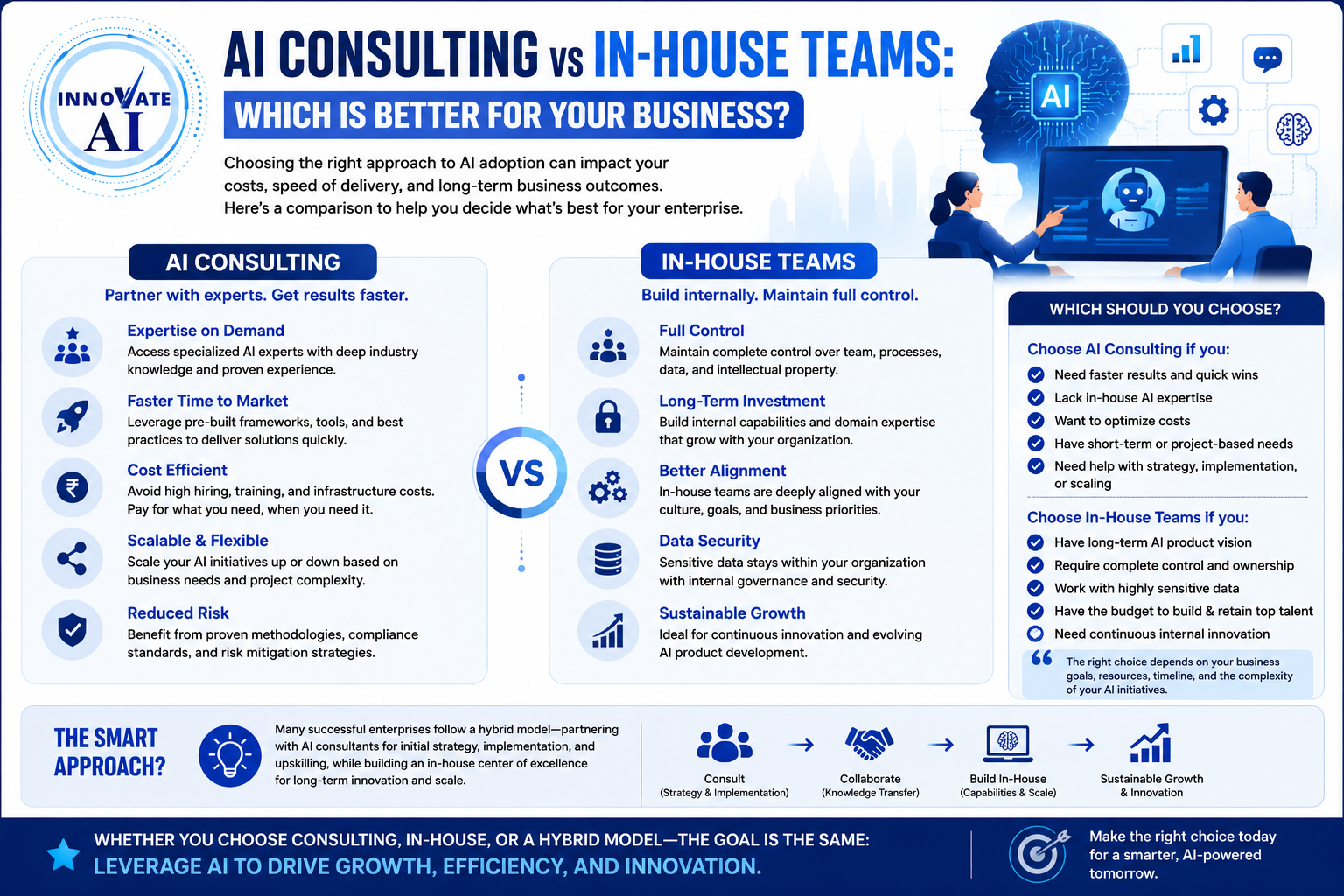
The decision between consulting and in-house is not about superiority. It is about fit . Enterprises that rush into building large AI teams without clear use cases often struggle to generate ROI. Likewise, companies that rely entirely on consultants may face challenges building internal expertise . The most effective path is often a hybrid: consultants design and implement the foundation, internal teams gradually take ownership .
Step 3: The In-House AI Team — What It Provides and What It Costs
The Strengths
An in-house AI team offers several compelling advantages:
| Strength | What It Means |
|---|---|
| Deep institutional knowledge | Internal engineers understand your data, systems, and organizational context in ways an external team must spend time learning |
| Long-term ownership | Internal teams can maintain, iterate, and expand AI systems over years without dependency on external contracts |
| Competitive moat potential | Proprietary AI capability built on unique data can create durable competitive advantages that external implementations cannot replicate |
| Cultural integration | AI becomes embedded in how the organization thinks and operates |
The Challenges
| Challenge | The Real Cost |
|---|---|
| High talent acquisition cost | AI engineers and data scientists command premium salaries. Beyond salary, recruitment and retention are significant challenges |
| Slow initial ramp-up | Building a high-performing AI team can take 6–12 months before meaningful output appears |
| Architectural blind spots | Without prior enterprise AI experience, internal teams often learn through trial and error |
| Governance gaps | Responsible AI, bias mitigation, and compliance frameworks require deep cross-industry expertise |
| Scalability risk | If one or two key engineers leave, progress may stall |
The Numbers
| Metric | Reality |
|---|---|
| Time to first production deployment | 9–18 months |
| Annual run cost (5–10 person team) | $800K–$2.5M |
| Hiring timeline for senior AI talent | 4–8 months |
| First 2–3 deployments | Will face avoidable mistakes that experienced practitioners have already solved |
The costs of building in-house go well beyond salary. Hiring timelines are long. Assessment is hard. Delivery maturity takes time to build . A senior ML engineer costs ₹25–45 LPA in Indian GCCs, but the opportunity cost of delayed delivery can dwarf the salary expense.
Step 4: The AI Consulting Model — Speed and Structure
The Strengths
AI consulting firms bring capabilities that are hard to replicate internally:
| Strength | What It Means |
|---|---|
| Speed to first value | A consultancy that has shipped similar systems before can shortcut months of exploration |
| Immediate access to specialized expertise | Consultancies bring multidisciplinary teams — ML engineers, data scientists, AI architects — eliminating long hiring cycles |
| Cross-industry pattern recognition | They have seen what works in financial services, what fails in manufacturing, and which vendor choices cause integration headaches |
| De-risking the first project | An experienced partner has made and learned from mistakes on other people's budgets |
| Flexible cost structure | A project engagement has a defined start and end. If the first use case does not deliver, you stop |
The Challenges
| Challenge | The Real Cost |
|---|---|
| Dependency risk | If knowledge transfer is poor, the client holds a system nobody internally understands |
| Ongoing cost without permanence | Consultancy rates are higher per hour than equivalent salaries |
| Context takes time to build | Even the best external team takes weeks to understand your data and domain |
| Misaligned incentives | Some consultancies are incentivised to make work complex or recommend their own tooling |
The Numbers
| Metric | Reality |
|---|---|
| First production use case delivery | 6–16 weeks |
| Project cost for first use case | $150K–$500K |
| Proof-of-value timeline | Weeks, not months |
| Ramp-up period | Days to weeks |
An AI consulting firm can deliver a working prototype quickly (not slideware), document the work properly, and actively involve any internal technical staff you already have . The goal should be to prove business value, identify data and infrastructure gaps, and establish what kind of AI capability your organization actually needs long-term .
Step 5: The Hybrid Model — What Most Enterprises Actually Choose
The most common pattern in enterprise AI programs is a three-phase progression :
Phase 1: External-Led (0–12 Months)
| What Happens | Why |
|---|---|
| An AI consulting firm delivers the first 1–3 production use cases | Speed to value, risk reduction |
| The enterprise team observes, participates, and begins hiring | Knowledge transfer |
| The consulting firm's job is to produce working systems and transfer architecture knowledge | Build internal capability |
Phase 2: Collaborative (12–24 Months)
| What Happens | Why |
|---|---|
| The internal team takes increasing ownership of delivery | Capability building |
| Consultants provide specialized expertise (advanced model development, MLOps infrastructure, security architecture) that hasn't yet been hired for internally | Targeted support |
Phase 3: Internal-Led with Selective External Expertise (24–36 Months)
| What Happens | Why |
|---|---|
| The internal team owns delivery | Full capability |
| External firms are engaged for specific capability gaps — a specialized architecture review, a particular domain expertise, a surge capacity need | Efficiency |
This progression typically takes 18–36 months depending on the organization's hiring velocity and AI investment level . The consulting firm's role shifts from doing to advising to occasionally filling gaps.
This hybrid approach provides the best of both worlds: faster implementation, internal capability development, and long-term sustainability . Many enterprises adopt this structure: consultants design architecture and roadmap, implement first high-impact use cases, knowledge transfer occurs throughout, internal teams gradually assume operational ownership, and consultants provide oversight or managed support .
Step 6: Decision Framework — Which Path Is Right for You?
When In-House AI Teams Make Sense
Building internally works best when :
| Situation | Why |
|---|---|
| AI is core to your product or competitive advantage | Competitors who own that capability internally will iterate faster |
| You already have mature data infrastructure | The foundation is in place |
| Leadership commits to long-term AI investment | You can weather the 9–18 month ramp-up |
| Regulatory sensitivity demands full control | Data sovereignty, compliance |
| You can genuinely attract and retain the talent | Senior ML engineers are scarce and expensive |
When AI Consulting Makes Sense
Engaging consulting services is ideal when :
| Situation | Why |
|---|---|
| AI maturity is low or moderate | You need structured expertise |
| Speed to market is critical | Consultants can deliver in 6–16 weeks |
| Governance frameworks are lacking | Consultants bring cross-industry expertise |
| First few use cases need rapid ROI | Prove value before scaling |
| You lack internal expertise | Hiring is slow and expensive |
| Leadership needs to show the board a working result this quarter | Speed is genuinely valuable |
The Decision Checklist
Use this list to map your situation honestly :
-
Is AI core to the product you sell or central to a critical operational process? If yes, long-term internal ownership is the destination, even if you need a consultancy to get there.
-
Do you have internal technical staff who can absorb knowledge? If yes, a consultancy with strong knowledge-transfer practice can accelerate your path. If no, you will remain dependent indefinitely.
-
How urgent is first value? If you need a working result in the next quarter, a consultancy is almost certainly faster than hiring.
-
How mature is your data infrastructure? If your data is siloed or poorly governed, the first phase of any AI programme is really a data engineering programme .
-
What is your budget shape? A fixed project budget favours a consultancy engagement. A recurring headcount budget favours in-house.
Step 7: Cost Comparison — The Real Economics
| Cost Element | AI Consulting | In-House AI Team |
|---|---|---|
| First use case delivery | $150K–$500K (project-based) | $300K–$800K (team build + time) |
| Time to first production deployment | 6–16 weeks | 9–18 months |
| Annual run cost (ongoing) | $200K–$1M+ (managed services) | $800K–$2.5M (team of 5–10) |
| Ramp-up period | Days to weeks | 6–12 months to productivity |
| Flexibility | High (scope-based) | Fixed (headcount) |
| Knowledge retention | Exits with the firm | Stays in the organization |
When calculating cost, include the cost of delay. If an internal team takes 18 months to deliver what a consulting team can deliver in 6 months, the opportunity cost matters . Total cost of ownership often reveals that consulting may appear expensive per project, but reduces hiring risk, time to ROI, failed pilot costs, and architecture rework expenses .
Step 8: The India Context — Labour Costs and Talent Scarcity
In India, the cost equation has its own dynamics. A senior AI engineer in India costs ₹18–40 LPA, compared to $150K–250K in the US. The labour arbitrage is real, but the talent scarcity is also real.
| Factor | India Reality |
|---|---|
| Senior ML engineer salary | ₹18–40 LPA (GCCs) |
| Senior ML engineer salary (IT services) | ₹12–24 LPA |
| AI talent availability | High demand, limited supply |
| Hiring timeline | 3–6 months for senior roles |
The talent shortage in India is acute. Senior ML engineers, data scientists with strong software engineering skills, and MLOps specialists are among the scarcest profiles in the market . They are expensive, they receive multiple offers, and they choose employers partly based on the quality of the problems they get to work on. If your organisation can offer interesting challenges, good data infrastructure, and a culture where this work is valued, you have a real chance of building something durable. If you cannot, the in-house route will be slow, frustrating, and ultimately more expensive than it appears on a headcount plan .
Step 9: Frequently Asked Questions
Q1: Is it better to build an in-house AI team or hire consultants?
The best choice depends on AI maturity, urgency, and budget. Enterprises with low AI maturity often benefit from structured AI consulting services to accelerate implementation and reduce risk . For most enterprises, the smartest path is a deliberate sequence: consultants first, internal ownership over time .
Q2: Are AI consulting services more expensive than in-house teams?
While consulting may appear costly upfront, it often reduces long-term expenses by shortening time-to-value and preventing architectural mistakes . A consulting firm can deliver in 6–16 weeks; an internal team takes 9–18 months to reach similar output quality .
Q3: Can enterprises combine in-house teams with consultants?
Yes, a hybrid model is common. Consultants establish architecture and governance while internal teams gradually take ownership . Most enterprise AI programs use a consulting-first model for speed to value, then transition to internal ownership over 18–36 months .
Q4: What risks come with building AI internally?
Talent shortages, architectural errors, slow ramp-up time, and governance gaps are common risks . A small internal team (one or two key people) means that a departure can halt your entire AI programme .
Q5: What is the biggest mistake enterprises make with AI consulting?
Choosing a partner that does not prioritise knowledge transfer. A bad consultancy engagement ends with the client holding a system nobody internally understands and a dependency on the same vendor forever . Knowledge transfer should be a contractual requirement, not an afterthought.
Q6: How can Innovative AI Solutions help?
We help enterprises navigate the build-vs-buy decision, design hybrid AI strategies, and build internal capability through structured knowledge transfer. Based in Delhi, serving clients across India.
Step 10: Final Tagline
"The question of in-house AI team vs AI consultancy comes up in almost every organisation that takes AI seriously. It sounds like a binary choice — hire or outsource — but the most honest answer is: it depends, and for most organisations the smartest path is a deliberate sequence rather than a permanent either/or . The goal of every consulting engagement should be to make itself unnecessary over time. An AI consulting firm can deliver a first production use case in 6–16 weeks. An in-house team typically takes 9–18 months to reach equivalent output quality. The difference is not capability — it is timing and structure."
Short version:
AI consulting vs in-house teams — which is better for your business? A 2026 guide to the real trade-offs, cost comparison, decision framework, and hybrid approach that most enterprises actually choose.
Hashtags:
#AIConsulting #InHouseAI #AIStrategy #EnterpriseAI #AIBuildVsBuy #DigitalTransformation #InnovativeAISolutions
Contact Us
Phone: +91 7464 099 059 / +91 96899 67356
Email: info@innovativeais.com
Address: Netaji Subhash Place, Pitampura, Delhi – 110034
Website: https://innovativeais.com
About the Author
Abhishek Kumar
Founder & CEO, Innovative AI Solutions
5+ years building enterprise AI solutions. Based in Delhi, serving clients across India.
Related services: to apply this in your business, explore our AI development services.