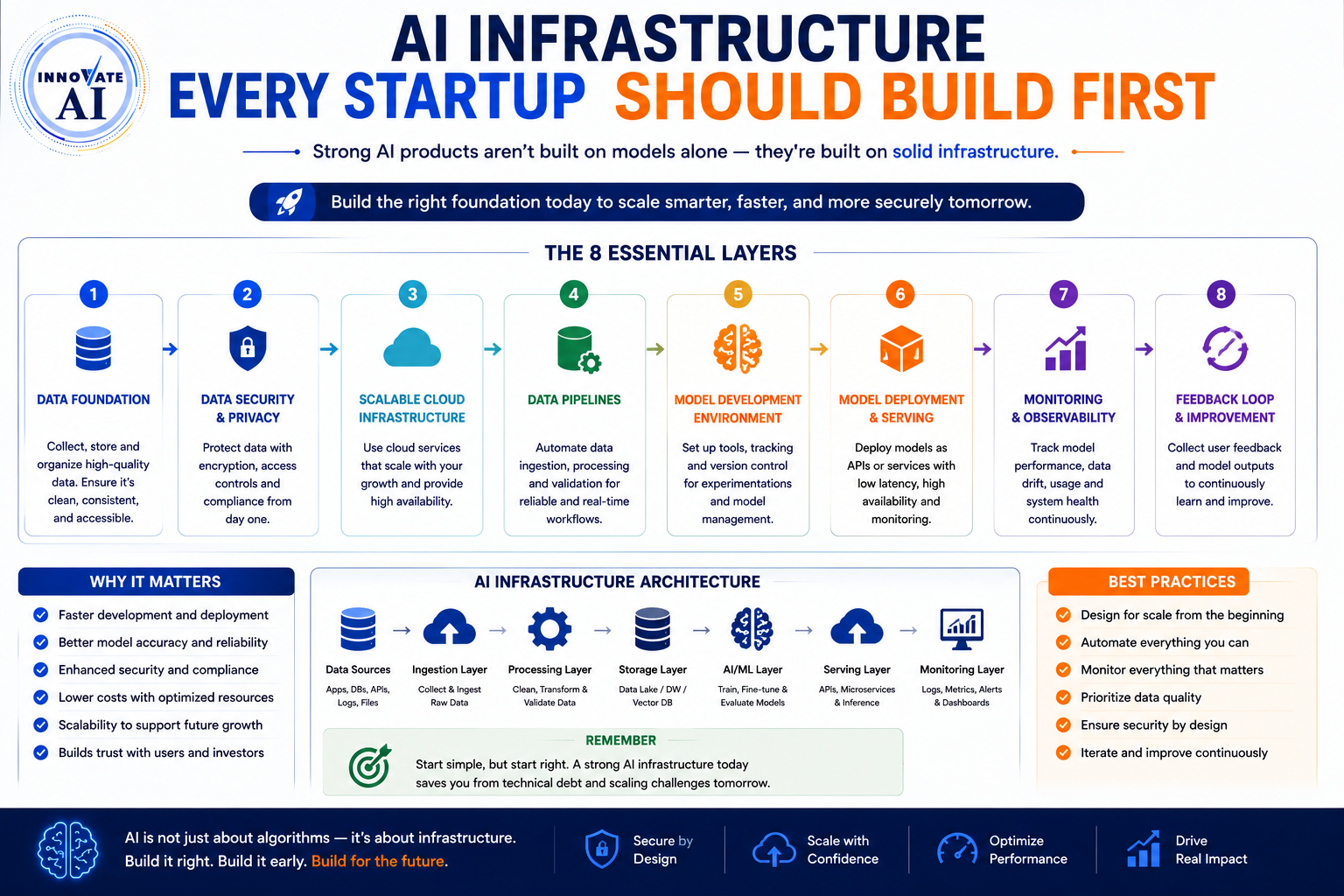
The Big Question
What happens when you pour all your energy into building a brilliant AI model, launch to enthusiastic users, and then get hit with an $800,000 cloud invoice before you've hit $250,000 in revenue?
This isn't a hypothetical. This is the new reality of the AI era. The old SaaS playbook of "build a great app, charge monthly, and let infrastructure fade into the background" doesn't hold up when your core cost scales directly with usage.
The difference between an AI startup that scales and one that stalls isn't model accuracy or flashy demos. It's the "invisible engine"—the data pipelines, deployment workflows, and monitoring systems that users never see but absolutely rely on.
Why Infrastructure Matters From Day One
80% of AI startups never move beyond the pilot phase. The primary reason? Neglecting infrastructure foundations in the early days.
In the AI era, the value chain has shifted dramatically. While the public imagination remains captivated by applications, the real economic value is accumulating at the infrastructure layer:
| Layer | Where Value Used to Be | Where Value Is Now |
|---|---|---|
| Hardware/Chips | A cost to be managed | A strategic moat |
| Cloud Platforms | Utility infrastructure | Priority GPU access is gold |
| Models | Proprietary advantage | Commoditizing fast |
| Applications | Where margins were highest | Compressed margins; usage costs eat revenue |
When you don't own the infrastructure or the models, your defensibility has to come from elsewhere—and the choices you make about your stack determine whether you can build that defensibility.
The First Layer: Model and Compute Infrastructure
Start With the Brain
The model layer is where the intelligence lives—the part that interprets inputs, generates outputs, and makes probabilistic decisions. This is the one layer you can't avoid building first.
Your first decision is open vs. closed models:
-
Closed models (API-based): Low upfront cost, easy to start, but costs scale linearly and can spiral quickly
-
Open models (self-hosted): Higher upfront investment, lower marginal cost at scale, and more predictable long-term economics
The practical recommendation for early-stage startups: Start with closed models to validate product-market fit, but design for the ability to switch. Your architecture should allow you to route across providers, fine-tune open-source backups, and negotiate contracts with leverage.
Inference Optimization: The Crisis Most Founders Ignore
Inference optimization is currently the highest-momentum category in AI infrastructure because every AI company running models in production faces the same cost and latency problem simultaneously.
The problem is urgent:
-
Inference and compute tied to API usage can create bills that outpace revenue
-
Longer prompts increase cost, slow responses, and may cause hallucinations
Startups building inference optimization capabilities have a structural advantage: the market is large, the problem is urgent, and the solutions require deep systems-level expertise that application-layer founders don't have time to build themselves.
The Second Layer: Data and Context Infrastructure
The Data Pipeline That Makes AI Work
Today's AI products rarely train models from scratch. Instead, product delivery relies on feeding the right context—knowledge, instructions, and data—into prompts. At scale, your pipeline must handle four critical tasks:
-
Continuously ingest and chunk new content (documents, files, user data)
-
Embed and index those chunks in a vector store and update them dynamically
-
Retrieve and rank the most relevant snippets in real time
-
Log and evaluate which snippets improve outputs, then use feedback to refine retrieval
RAG and Vector Databases
Even as LLMs get bigger context windows, Retrieval-Augmented Generation (RAG) isn't going away. For everyday Q&A, lean, ranked context remains more efficient and effective than dumping everything into a context window.
Your vector database choice matters. For early-stage startups, open-source options like Chroma or Qdrant provide production features without enterprise pricing. The distinction between public and private environments is important—consider running separate instances for development vs. production workloads.
The Storage Reckoning
Approximately 80-90% of the world's digital information is unstructured. And most of what startups do for their AI pipelines—processing, security, and governance—occurs on-premise, while training and inference typically happen in the cloud. This creates data gravity, latency, and governance challenges.
The trend is toward unified storage architectures that can handle diverse demands on a single platform. Leading practitioners recommend building AI pipelines that perform advanced pre-processing—like extracting vector embeddings—directly at the edge, while seamlessly transferring data to compute resources in the cloud.
The Third Layer: Orchestration and Observability
The Orchestration Layer: Making AI Think
The orchestration layer is the "nervous system" of an AI-native stack. It's where reasoning, decision-making, and coordination happen. Instead of reacting to human input, this layer enables the system to break a problem down into multiple steps and decide what action to take next.
This layer includes:
-
Autonomous and semi-autonomous AI agents
-
Chains and routing for complex tasks
-
Context memory that persists across interactions
Evaluation and Observability: The Most Underfunded Category
The most underfunded category in the AI infrastructure stack is evaluation and observability for production AI systems.
Most AI infrastructure investment flows toward compute, inference, and agent orchestration. The tooling for understanding how models actually behave in production—detecting drift, measuring hallucination rates, running systematic red-team evaluations—is significantly underdeveloped relative to the production deployment needs that exist today.
This is a massive opportunity for early-stage startups. Every enterprise that has moved an AI product into production has discovered that the gap between benchmark performance and production performance is real and consequential.
End-to-End Monitoring
Basic server metrics like CPU and memory usage don't tell the full story. You also need to track:
-
Ingestion latency (how quickly new data becomes available)
-
Index freshness (is your vector store up to date?)
-
Snippet hit rates (is retrieval working?)
-
User experience metrics (response time, error rates, conversion)
The Fourth Layer: Security and Governance
Guardrails Aren't Optional
Security lapses—prompt injection, biased outputs, data leaks—can quickly become brand or legal crises. Build safeguards into your infrastructure from the beginning:
-
Content moderation for user inputs and AI outputs
-
Role-based data controls that respect existing permissions
-
Ingestion-time data minimization (store only what you need)
The Trust Imperative
More users want to know when they're interacting with AI and how their data is used. Add features like:
-
Data source disclosures (where information came from)
-
Confidence scores (how certain the AI is)
-
Simple "About this AI" sections for transparency
These design choices build trust—especially when the model isn't perfect.
The Fifth Layer: The Economics Layer
Price for Usage, Not Access
That $800,000 cloud bill story happened because the founder was charging like a SaaS company but operating like a compute company. In AI, usage drives cost, which means flat-rate subscriptions don't work.
Founders must embrace pricing models that align value delivered with cost incurred:
-
Per-output or per-token billing
-
Compute-aware pricing tiers
-
Charging for high-cost features (image generation, live inference)
Track gross margin by feature, not just by customer. Some use cases may be unprofitable even if customers love them.
The Build vs. Buy Decision
Build vs. buy decisions come up at every startup phase. The real question is: Which parts of the stack create differentiation, and which can be outsourced?
| Approach | When to Use |
|---|---|
| Buy | When speed matters and your team lacks deep infrastructure expertise (managed vector DBs, prompt evaluation tools, observability) |
| Build | When the logic is core to your value proposition (domain-specific retrieval, fine-tuned models) |
| Hybrid | Buy general-purpose infrastructure; build business-critical elements in-house |
Making smart trade-offs protects engineering bandwidth for what matters most: delivering user value.
The India Advantage: Infrastructure Support
India is rapidly building the infrastructure needed to support AI startups at scale:
-
GPU Access: Under the IndiaAI Mission, more than 10,000 GPUs are being deployed, with access available at subsidized rates—reportedly less than $1 per hour, among the lowest globally
-
Sovereign AI Models: The government has selected Sarvam AI to build India's first homegrown sovereign LLM, providing dedicated compute infrastructure for development
-
AI-Native Cloud: Companies like Neysa Networks are building India's first AI-native cloud infrastructure, with GPU-as-a-Service, MLOps, and observability capabilities
-
Massive Capacity Investment: AM Group is developing a $25 billion AI platform that will deploy 500,000 high-performance chips across 1GW of capacity, powered entirely by renewable energy
-
Edge AI Silicon: Indian startups like Netrasemi are building domain-specific Edge AI System-on-Chips optimized for vision and video analytics—reducing dependence on foreign hardware
The message is clear: India is not just consuming AI infrastructure—it's building it.
Implementation Roadmap: The First 90 Days
Phase 1: Foundation (Weeks 1-4)
-
Define your use case and performance requirements: Sub-second response times, or several-second latency?
-
Choose your model strategy: Open vs. closed, and design for flexibility
-
Select core infrastructure: Vector database, storage, orchestration framework
-
Establish governance: Security, compliance, and data controls from day one
Phase 2: Build the Pipeline (Weeks 5-8)
-
Implement context pipeline: Ingest, chunk, embed, index, retrieve
-
Set up observability: Monitor ingestion latency, index freshness, snippet hit rates
-
Automate key workflows: Start with high-leverage repetitive work
-
Implement guardrails: Content moderation, role-based controls
Phase 3: Scale and Measure (Weeks 9-12+)
-
Monitor costs closely: Track gross margin by feature
-
Optimize inference: Reduce latency and cost per token
-
Implement feedback loops: Use production data to improve retrieval and performance
-
Plan for scale: What breaks at 10x, 100x, 1000x?
Frequently Asked Questions
Q1: What's the biggest mistake AI startups make with infrastructure?
Neglecting infrastructure until they try to scale. 80% of AI startups never move beyond pilot phase—not because models fail, but because infrastructure can't keep up.
Q2: How much should I spend on AI infrastructure early?
Start lean but plan for scale. The "build vs. buy" decision should be based on what's core to your differentiation. Buy general-purpose infrastructure; build business-critical elements.
Q3: Why is inference optimization so important?
Every AI company running models in production faces the same cost and latency problem. Longer prompts increase cost and slow responses. Optimization is urgent because the problem is universal.
Q4: What's the most underfunded category in AI infrastructure?
Evaluation and observability for production AI systems. The tooling for understanding model behavior in production is significantly behind deployment needs.
Q5: What's the best pricing model for an AI startup?
Usage-based pricing that aligns value delivered with cost incurred. Per-output billing, compute-aware tiers, or charging for high-cost features.
Q6: How can Innovative AI Solutions help?
We help early-stage AI startups design, build, and operationalize production-grade infrastructure—from model selection and data pipelines to observability and cost optimization. Based in Delhi, serving clients across India.
Why Delhi is a Great Hub for AI Development
Delhi is emerging as a significant hub for AI development, backed by concrete government support and infrastructure. The recent Delhi Budget 2026-27 allocated ₹8.20 crore for two Artificial Intelligence centres of excellence (AI-CoEs), functioning as hubs for research, innovation, and startup incubation.
The city's AI infrastructure is expanding rapidly. Under the IndiaAI Mission, more than 10,000 GPUs are being deployed at subsidized rates—reportedly less than $1 per hour, among the lowest globally . The government has also announced a ₹350 crore startup policy over five years, aiming to support the emergence of at least 5,000 startups by 2035, with key focus areas including AI and machine learning.
The AI ecosystem in Delhi combines: cost-effective infrastructure, government support, a growing talent pool, and proximity to the country's business decision-makers.
What We Offer at Innovative AI Solutions
After five years of building AI solutions for businesses, we've developed a practical approach that focuses on what actually works:
-
Infrastructure Strategy: We help you assess your AI readiness and design a scalable architecture
-
Model Selection and Optimization: We help you choose the right model strategy and optimize inference costs
-
Data Pipeline Design: We help you build ingestion, embedding, and retrieval pipelines
-
Observability and Evaluation: We help you implement production monitoring and model evaluation
-
Security and Governance: We help you establish guardrails, compliance, and trust frameworks
-
Cost Management: We help you align pricing with usage and track margin by feature
Our approach is built on the reality that infrastructure isn't a cost center—it's a strategic advantage.
Final Thought
In 2026, dropping in a state-of-the-art model is easy. Building a reliable, delightful, and scalable product is the hard part. The decisions you make about infrastructure in your first 90 days determine whether your AI startup becomes an enterprise or becomes a cautionary tale.
The shift is clear: from building flashy demos to building invisible engines that scale.
Contact Us:
Phone: +91 7464 099 059 / +91 9689967356
Email: info@innovativeais.com
Address: Netaji Subhash Place, Pitampura, Delhi – 110034
Website: https://innovativeais.com
About the Author
Abhishek Kumar
Founder & CEO, Innovative AI Solutions
5+ years building AI systems for enterprises. Based in Delhi, serving clients across India.
Hashtags: #AIInfrastructure #AIStartups #AIScaling #StartupStrategy #AIOps #EnterpriseAI #InnovativeAISolutions
Related services: to apply this in your business, explore our AI development services and RAG development.