The Big Question
What happens to your company's knowledge when experienced employees leave? When decisions made in meetings disappear into digital oblivion? When every new hire spends months "ramping up" because organizational context exists only in people's heads?
These questions have haunted businesses forever. But now, something has changed. AI agents—digital employees that never forget—need access to your company's knowledge to be effective. And they're forcing organizations to finally solve the knowledge management problem that's existed since the first office was built.
The answer? AI Knowledge Vaults—centralized repositories where company context becomes a living, compounding asset accessible to both humans and AI.
The Knowledge Crisis Every Business Faces
Let me describe a scenario that might sound familiar.
A key engineer or product manager leaves your company. They take with them years of context: why certain decisions were made, what customers really meant in that feedback call, the unwritten rules of how things actually work. Their institutional knowledge walks out the door.
Meanwhile, new hires spend months "ramping up." They read outdated documents, ask colleagues for context, and slowly piece together the organization's story. At a high-speed company, there's no room for "catching up slowly next quarter." You either keep up, or you become an additional cost to the organization's operation.
The problem is structural. As experienced employees retire or move on, the loss of decades of collective knowledge threatens operational continuity, efficiency, and innovation. Traditional documentation methods are fragmented, requiring significant manual effort to compile, interpret, and apply.
This isn't just a startup problem. Industrial giants like ABB face the same challenge—a generation of skilled workers retiring and taking their invaluable expertise with them. Sanjit Shewale, Global Head of Digital at ABB's Process Industries, explains: "As experienced employees retire, the loss of decades of collective knowledge threatens operational continuity, efficiency and innovation if not properly addressed."
What Is an AI Knowledge Vault?
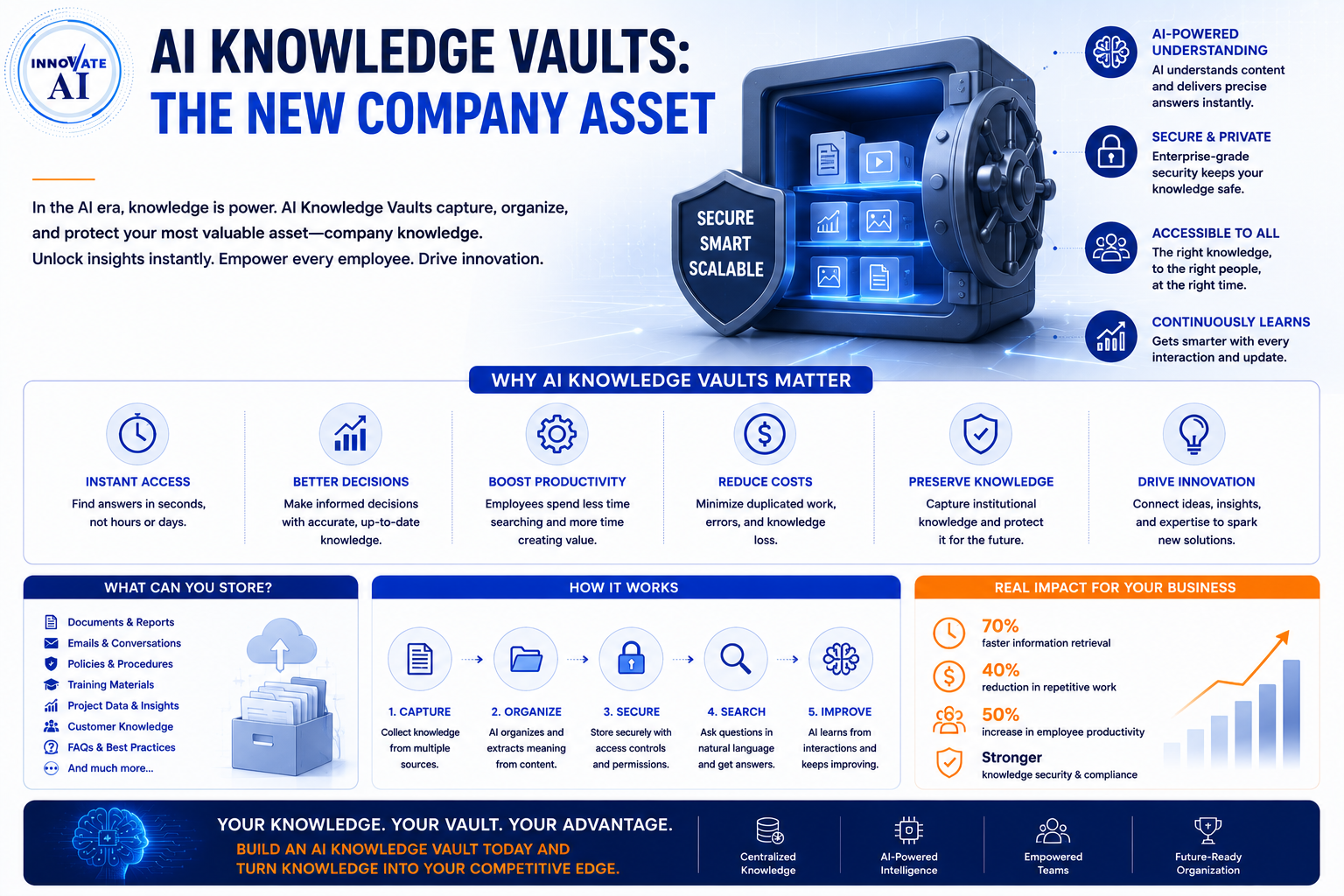
An AI Knowledge Vault is a centralized, governed repository where companies store, organize, and operationalize their collective knowledge. Unlike traditional documentation (which is static and often outdated), knowledge vaults are designed to be:
-
Dynamic: Continuously updated from real-world operations, meetings, and decisions
-
Accessible: Available through natural language conversations to both humans and AI agents
-
Governed: With permissions, version history, audit trails, and review workflows
-
Operational: Agents can read from it, update it, and apply it to workflows
How the Technology Works
At its core, a Knowledge Vault uses a vector database and semantic search engine. Unlike a traditional database that stores exact copies of images, documents, and text, the Knowledge Vault stores data as numerical representations—or vectors—that capture the meaning and context of information.
When you upload content to a Knowledge Vault, it extracts text and converts it into vectors, positioning it based on semantic meaning. This enables more intelligent searches based on the meaning behind words, rather than just matching keywords.
Platforms like HubSpot, Contentstack, and Box are building these capabilities into their ecosystems. For example:
-
HubSpot's Breeze Knowledge Vault: Stores brand guidelines, product specs, help center articles, and historical content. AI can query this vault to generate brand-aligned content.
-
Box's Company Brain: Uses Box as a governed content layer with permissions, version history, and auditability. Developers and business users access the same source of truth through different interfaces.
-
ABB's Industrial Knowledge Vault: Developed with Microsoft, captures and structures industrial expertise, transforming it into step-by-step workflows accessible through natural language.
The Personal Knowledge Base to Company Brain Evolution
Andrej Karpathy, former Tesla AI lead and OpenAI founding member, wrote a viral post about "personal LLM knowledge bases"—folders filled with notes, research, customer calls, strategy docs, and operating principles that AI agents can organize, summarize, and turn into action.
This setup works brilliantly for individuals. A personal knowledge base gives an AI agent durable memory and turns scattered information into a compounding asset.
But the moment AI becomes a team workflow, the personal vault breaks.
Teams need to know:
-
Who can access specific information?
-
Who can update it?
-
Which version is current?
-
How do we review agent-generated changes?
-
Can outputs be traced back to source material?
A shared company brain—a governed repository of company context, product knowledge, customer information, operating rules, and generated outputs—solves these problems.
Why Governance Matters
The moment company knowledge becomes a team workflow, governance becomes critical. Consider these scenarios from Box's analysis of the problem:
-
A local folder works when one person owns the context. It doesn't work when the founder, engineer, customer success lead, product lead, and sales teammate all need the same source of truth.
-
It doesn't work when some people should edit product principles while others should only generate outputs from them.
-
It doesn't work when a customer-facing answer needs to cite sources, go through human review, and leave an audit trail.
-
It doesn't work when every teammate has copied yesterday's version of the company brain into their own agent workspace.
Different teammates use different tools: Claude Code, Codex, or whatever comes next. The company brain shouldn't have to change as the agent changes—it should keep compounding.
Key Governance Requirements
Enterprise-grade Knowledge Vaults must include:
-
Permissions and Access Controls: Who can see, edit, or use specific information
-
Version History: Track changes and revert when needed
-
Collaboration: Multiple people and agents working from the same source
-
Review and Approval Workflows: Human oversight before outputs are deployed
-
Auditability: Trace outputs back to source materials
-
Role-Based Access: Different access levels for different roles and functions
Real-World Examples
The Startup Company Brain
Box describes a concrete example of a small AI-native startup building a triage assistant for CPG brands. The team creates a shared /Company Brain folder. Inside are folders for company context, product knowledge, customer knowledge, agent operating rules, and generated outputs.
The founder updates a product principle: for retailer deductions under $500, the agent may auto-triage, but it must require human approval before dispute submission.
The engineer opens an agent against the folder. The agent reads the company brain, updates the PRD, the AI agent instructions, and the human approval checklist. Those changes sync back into the vault.
Later, the customer success lead asks for a one-page onboarding guide for a new CPG customer. The guide reflects the latest product decision, uses current positioning, follows approval rules, and saves the generated output back to the /Outputs folder.
The founder isn't emailing around a new rule to multiple teammates. The company brain does the work.
ABB's Industrial Knowledge Vault
ABB, a global industrial technology leader, launched its Industrial Knowledge Vault to solve the knowledge loss problem in manufacturing environments.
The solution can:
-
Store, retain, and safeguard critical expertise from retiring workers
-
Transform knowledge into step-by-step workflows through natural language input
-
Create structured procedures in seconds, eliminating manual document parsing
-
Provide real-time guidance and decision support to field workers
-
Continuously learn from real-world operations, refining workflows over time
The measurable results from ABB's benchmark testing are impressive:
-
85% effort reduction in workflow creation
-
45% increase in overall team productivity
-
90% reduction in human errors
The Strategic Imperative: Building an Asset You Own
The companies that will win in the AI era are building knowledge vaults—assets that compound over time. This is a strategic shift, not just a technology implementation.
As Microsoft CEO Satya Nadella recently argued, businesses risk being "hollowed out" by foundation models—not of factories or jobs alone, but of the institutional knowledge that gives whole industries their edge.
What's at Risk
Companies are spending heavily on AI tokens, but they're not necessarily building an asset they own. The work isn't captured, the learning is lost, and the most valuable part—tacit knowledge, workflows, and decision logic that make a company different—can end up being exploited by the frontier models they're paying to use.
Telstra CEO Vicki Brady describes the next frontier of AI as the ability to capture a company's human "secret sauce": the judgment, interaction, and decision-making that often sits outside formal systems.
What's Possible
A continuously updated knowledge vault creates new organizational capabilities:
-
Instant Onboarding: New hires read the company brain on day one and start contributing on day two
-
AI Agents That Actually Work: Agents access the same context layer rather than operating in isolation
-
Institutional Memory: Decisions, rationale, and context are preserved even as people leave
-
Compound Learning: Every interaction makes the system smarter and more valuable
Building Your Knowledge Vault: A Practical Guide
Phase 1: Foundation (Weeks 1-4)
-
Audit Existing Knowledge Assets: Identify where company knowledge currently lives—documents, wikis, Slack, email, meeting recordings
-
Define Governance Rules: Establish permissions, version control, and review workflows
-
Select a Platform: Choose a solution that supports permissions, version history, and AI integration
-
Start Small: Create one vault for a specific function or team. Learn from the pilot.
Phase 2: Populate (Weeks 5-8)
-
Upload Core Documents: Brand guidelines, product specs, customer FAQs, operating principles
-
Connect to Live Sources: Integrate meeting transcripts, Slack discussions, and customer call recordings
-
Establish Update Mechanisms: Define who updates what and how often
-
Build Initial Agent Skills: Create reusable agent capabilities that call the vault
Phase 3: Operationalize (Weeks 9-12+)
-
Connect to Workflows: Integrate the vault into daily operations—onboarding, content creation, decision support
-
Measure Impact: Track time saved, accuracy improved, and new capabilities unlocked
-
Expand: Roll out to additional functions and teams
-
Continuous Improvement: Refine content, skills, and governance based on real-world usage
Frequently Asked Questions
Q1: What is an AI Knowledge Vault?
A centralized, governed repository where companies store and operationalize their collective knowledge for both humans and AI agents.
Q2: How is it different from a traditional wiki?
A knowledge vault is dynamic, accessible through natural language, governed with permissions and audit trails, and operational—agents can read, update, and apply it.
Q3: What technology powers knowledge vaults?
Vector databases that convert content into numerical representations capturing meaning and context, enabling semantic search.
Q4: Why do I need a company brain instead of personal knowledge bases?
Personal vaults work for individuals but break for teams. Teams need a shared source of truth with permissions, version history, and review workflows.
Q5: What's the strategic value of a knowledge vault?
It preserves institutional knowledge, accelerates onboarding, makes AI agents effective, and creates a compounding asset that grows in value over time.
Q6: How can Innovative AI Solutions help?
We help businesses design, build, and operationalize AI knowledge vaults—from platform selection and governance design to content population and agent integration. Based in Delhi, serving clients across India.
Why Delhi is a Great Hub for AI Development
Delhi is emerging as a significant hub for AI development, backed by concrete government support and infrastructure. The recent Delhi Budget 2026-27 allocated ₹8.20 crore for two Artificial Intelligence centres of excellence (AI-CoEs), functioning as hubs for research, innovation, and startup incubation.
The city's AI infrastructure is expanding rapidly. Under the IndiaAI Mission, more than 38,000 high-end GPUs have been onboarded and are available at approximately ₹65 per hour—roughly one-third of the global average cost. This makes AI development remarkably cost-effective compared to other tech hubs.
The government has also announced a ₹350 crore startup policy over five years, aiming to support the emergence of at least 5,000 startups by 2035, with key focus areas including artificial intelligence, machine learning, and automation.
The AI ecosystem in Delhi combines: cost-effective infrastructure, government support, a growing talent pool, and proximity to the country's business decision-makers. For businesses looking to develop practical AI solutions, it's becoming an increasingly attractive location.
What We Offer at Innovative AI Solutions
After five years of building AI solutions for businesses, we've developed a practical approach that focuses on what actually works:
-
Knowledge Vault Strategy: We help you assess your knowledge assets and design a vault architecture that works for your organization
-
Platform Selection and Implementation: We help you choose and deploy the right platform for your needs
-
Governance and Compliance: We help you establish permissions, review workflows, and audit trails
-
Content Population and Integration: We help you connect the vault to live sources—meetings, Slack, customer calls
-
Agent Integration: We help you build reusable agent skills that leverage the vault
-
Organizational Change Management: We help you shift from fragmented knowledge to a shared, living company brain
Our approach is built on the reality that knowledge is your most valuable asset—and AI is the key to preserving and amplifying it.
Final Thought
The first wave of AI knowledge bases made individuals more productive. The next wave will help entire teams operate from the same trusted context. That shared company brain may become one of the most important operating advantages for AI-native companies.
When context is systematized, onboarding is no longer just a lengthy adaptation process, and AI is no longer just a collection of isolated tools. The value of enterprise AI may ultimately lie not in how many agents you deploy, but in whether you can first establish a trustworthy, readable, and reusable knowledge foundation.
The knowledge crisis is real. But the solution is finally within reach.
Contact Us:
Phone: +91 7464 099 059 / +91 9689967356
Email: info@innovativeais.com
Address: Netaji Subhash Place, Pitampura, Delhi – 110034
Website: https://innovativeais.com
About the Author
Abhishek Kumar
Founder & CEO, Innovative AI Solutions
5+ years building AI systems for enterprises. Based in Delhi, serving clients across India.
Hashtags: #AIKnowledgeVaults #CompanyBrain #KnowledgeManagement #EnterpriseAI #AIAssets #AIStrategy #InnovativeAISolutions
Related services: to apply this in your business, explore our AI agent development and AI development services.