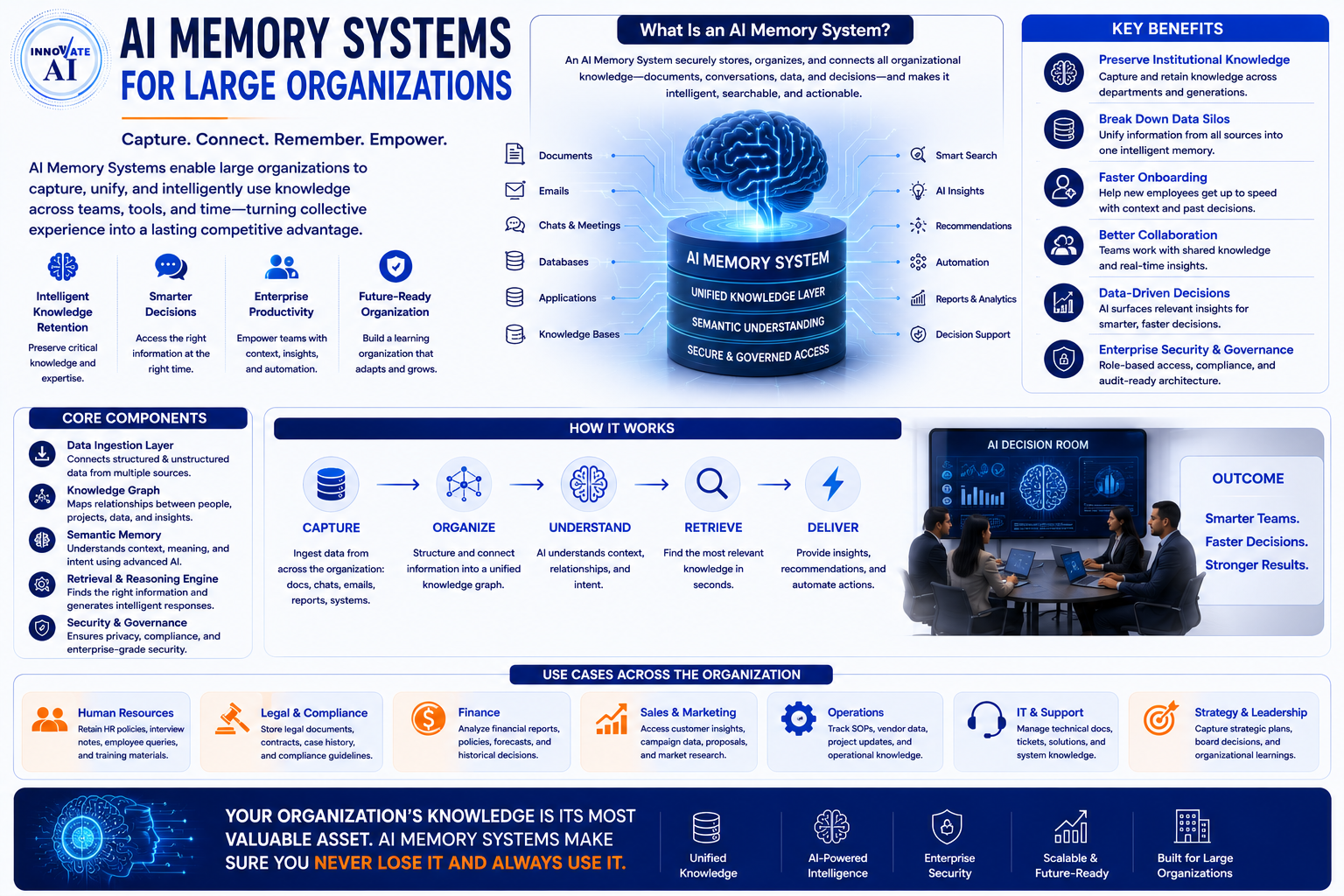
The Big Question
What happens when every AI agent in your organization starts each day with no memory of what happened yesterday? When the support agent can't remember a customer's previous issues? When the operations agent routes requests to people who left the company months ago? And when every new hire has to rediscover knowledge that already exists somewhere in the organization?
This isn't a hypothetical problem. It's happening right now in enterprises deploying AI at scale. And the solution—AI memory systems—is rapidly becoming a production requirement.
The Memory Crisis in Enterprise AI
Why Agents Can't Remember
Large language models are fundamentally stateless—each input prompt produces an output response, leaving the model unchanged with no retention of the interaction. While this offers benefits like reproducibility, it creates significant challenges :
-
Computational inefficiency: All queries require full recomputation from scratch, wasting AI hardware on repeated work
-
Context window limitations: Long multi-turn conversations require reintroducing entire chat histories, causing attention errors and massive cost
-
No long-term learning: Models cannot self-improve from deployment experience without full retraining
-
Isolated agents: No mechanism for cross-agent knowledge sharing
Most agents treat memory as a bolt-on—a vector store consulted at retrieval time, a chat history table glued on beside it. This stack holds together for a demo. It falls apart from the moment an enterprise team asks questions that actually matter: Who owns the memory? Where is it governed? How do we isolate tenants? How do we audit what the agent learned?
The Five Memory Silos
Research has identified five structural challenges arising from what experts call the "memory governance gap" :
-
Memory silos across agent workflows: The enrichment agent discovers a prospect is evaluating three vendors. The outbound agent, executing hours later, sends a generic cold email. Each workflow acts on the same entities but shares no context.
-
Governance fragmentation across teams and tools: Sales builds AI outreach with one prompt. Support runs a bot with compliance rules copied from a Notion doc. When legal updates policy, no mechanism propagates it to the 14 agent configurations across three teams.
-
Unstructured memory as a dead end: Free-text memories can be retrieved and pasted into a prompt—but beyond that, they're terminal. They can't be filtered, routed, synchronized to a CRM, or aggregated across thousands of entities.
-
Context redundancy in autonomous execution: Each step of an autonomous agent may invoke governance routing independently. Without session awareness, the same compliance policy is re-injected every step, consuming context window capacity.
-
Silent quality degradation: Schemas age. Models update. New workflows produce data the schema wasn't designed for. No per-property accuracy monitoring exists. The organization discovers the problem when a CRM field has been wrong for three months.
What AI Memory Systems Actually Do
The Four Memory Types
A practical taxonomy for agent memory used in enterprise design covers four types :
| Memory Type | What It Stores | Example |
|---|---|---|
| Working Memory | Active state the agent is reasoning over right now | Running conversation, scratchpad at inference |
| Semantic Memory | Durable facts about users, entities, and the world | User preferences, canonical definitions, reference data |
| Episodic Memory | Specific past experiences the agent can recall | What happened in a prior session, how a similar task resolved |
| Procedural Memory | Behavioral rules and learned procedures | How to handle customers, which tools to prefer, what not to do |
These are not four different systems. They're four access patterns over the same underlying state, which makes a unified memory core the right architectural answer .
The "Agent Unconscious"
There's been a shift away from stateless agents toward something persistent: systems that retain knowledge between sessions, consolidate experience in the background, and maintain a layer of latent context that shapes behavior without being explicitly loaded into any single prompt .
Practitioners are calling this the "agent unconscious" —the accumulated weight of prior experience that operates beneath the surface of active thought.
This architectural shift solves a critical problem: context pollution. Filling a context window with everything that might be relevant degrades reasoning rather than improving it. A pointer-and-retrieval architecture keeps active context lean while giving the agent access to a knowledge base far larger than any single prompt could hold .
How Memory Systems Work: The Architecture
Oracle AI Agent Memory
Oracle recently introduced a governed, unified memory core built on Oracle AI Database . Unlike fragmented stacks (vector store, chat log, extraction scripts, isolation logic), this provides:
-
Production-grade recall: On LongMemEval, a standard academic benchmark, Oracle AI Agent Memory scores 93.8% (469 of 500) , with 100% on single-session assistant recall, 96% on temporal reasoning, and 95% on knowledge-update tasks
-
Bounded per-turn cost: In an 80-turn scripted conversation, memory held per-request input around 1,300 tokens while a flat-history baseline grew past 13,900—roughly 9.5x more tokens per request
-
Better answers: Despite the flat-history baseline's information advantage, memory won 48 turns to flat history's 13 (3.7x more wins) in an impartial evaluation
The system is built on Oracle AI Database, which combines vector similarity search, relational querying, and graph-aware data access in one governed engine with backups, replication, encryption, fine-grained access control, and audit .
Amazon Bedrock + Neptune + Mem0
TrendMicro implemented company-wise memory combining Amazon Bedrock, Amazon Neptune (graph database), and Mem0 :
-
Amazon Neptune stores a company-specific knowledge graph representing organizational relationships, processes, and data
-
Mem0 manages short-term conversational memory and long-term persistent knowledge
-
Amazon Bedrock orchestrates the AI agent workflows
The architecture captures user messages, extracts entities and relationships, embeds them, searches against both vector stores and graph databases, and updates memory through a closed-loop process .
The result: when a customer asks "Who recognized Kublai as ruler?" the AI can ground its reasoning in structured triples like (Ilkhans, recognized, Kublai) and respond accurately rather than vaguely .
The Dual Memory Model
A governed memory architecture uses a dual memory model :
Open-set memory: Atomic, self-contained facts stored as vector embeddings. The extraction enforces completeness, self-containment, coreference resolution, temporal anchoring, and atomicity. Before insertion, candidates exceeding a similarity threshold (default 0.92) are skipped, preventing near-duplicate accumulation.
Schema-enforced memory: Typed property values extracted according to organizational schemas defining properties with names, descriptions, types (text, number, date, boolean), and extraction hints. Before extraction, the system selects relevant properties using embedding similarity, preventing hallucination from hundreds of irrelevant properties.
Both are processed in a single extraction pass with automated quality gates .
Consolidation and "Dreaming"
Memory systems don't just store—they consolidate. The leaked Claude Code source code revealed KAIROS, an undocumented background daemon explicitly modeled on human sleep memory consolidation. After 24 hours of inactivity or five sessions, the agent enters what the codebase calls "Dream Mode"—reviewing memory files, pruning contradictions, consolidating learnings from recent interactions .
Anthropic subsequently productized this pattern as Dreaming, one of three capabilities in Claude Managed Agents. The mechanism is a background process that reviews past sessions, identifies patterns in failures and successes, and automatically updates agent memory between runs. Wisedocs reports 50% faster document reviews with this approach .
The Human Element: Capturing Organizational Expertise
Adobe's Five-Layer Approach
Adobe is solving an age-old problem: how to scale the expertise of the best people across the organization. The answer isn't just applying AI to content—it's training AI to think like top experts .
Adobe's five-layer approach for designing AI pilots:
-
The foundational AI model (a particular LLM or diffusion model)
-
Subject-matter-specific knowledge: Proprietary institutional knowledge accessed from internal content
-
How an expert would approach a problem
-
What an expert would never do —the mistakes they've learned to avoid
-
Generating effective prompts based on all previous layers
As E.A. Rockett, Adobe's Vice President of Legal Technology & Product Innovation, explains: "Creating this foundation gives you a solid structure. Now, somebody who may not be an expert can start doing runtime stuff, asking AI questions as if the expert were in the room" .
The Talent Strategy Angle
Rockett believes AI adoption's biggest impact could be in attracting and retaining top performers: "AI players want to be at a place where they get to play with cutting edge technology. Whatever cost optimizations, efficiency, and productivity you thought you could scrape up from technology is nothing compared to the value of an A player walking out the door" .
Sentra: Living Memory of Your Company
Sentra is building a "living memory of your company as work happens"—not just what was decided, but why, what alternatives were considered, and how decisions connect across teams and time .
The results: leaders get weekly synthesis of where teams are drifting, new hires ramp in days instead of weeks, and status updates and decision logs are automated .
Governance: The Critical Gap
The Governance Challenge
An agent that rewrites its own memory based on accumulated experience can no longer be said to be fully described by its initial configuration. Its behavior at week twelve is a function of eleven weeks of interaction history that no single person may have reviewed in full .
The security perimeter around agentic systems was designed for something whose behavior could be fully characterized by its configuration. That assumption no longer holds .
What Must Be Governed
Enterprise-grade memory systems must include :
-
Permissions and Access Controls: Who can see, edit, or use specific memories
-
Version History: Track changes and revert when needed
-
Auditability: Trace outputs back to source materials
-
Data Boundaries: What can AI access across the organization
-
Human Accountability: Who's responsible for memory-influenced decisions
The EU AI Act and Capability Disclosure
The EU AI Act requires capability disclosure and deployment accountability. But there's no mechanism for capturing what an agent's activation state was during the session that produced a given output . Anthropic's internal research claims Claude Sonnet 4.5 has measurable internal "emotion vectors"—activation patterns corresponding to states like "desperate" and "calm" that causally influence behavior. Enterprise deployers have no visibility into which internal states are active during any given session .
Implementation Roadmap: The First 90 Days
Phase 1: Foundation (Weeks 1-4)
-
Audit existing agent deployments: Where are agents operating without memory? What silos exist?
-
Define memory governance: Permissions, audit trails, data boundaries
-
Select a platform: Oracle AI Database, Amazon Bedrock, or an open-source option (Mem0, HippocampAI)
-
Start small: One workflow, one team, bounded use case
Phase 2: Populate (Weeks 5-8)
-
Capture expert knowledge: Use a five-layer approach to encode expertise
-
Connect to live sources: Meetings, Slack, customer calls
-
Establish update mechanisms: Who updates what and how often
-
Build initial memory retrieval skills
Phase 3: Operationalize (Weeks 9-12+)
-
Connect to workflows: Integrate memory into daily operations
-
Measure impact: Accuracy improved, time saved, new capabilities
-
Enable consolidation: Implement dreaming/consolidation pipelines
-
Continuous improvement: Refine content, skills, governance
Frequently Asked Questions
Q1: What is an AI memory system?
A governed, persistent infrastructure that enables AI agents to retain context, accumulate knowledge, and improve over time across sessions and workflows .
Q2: Why do enterprise AI agents need memory?
Without memory, agents are stateless—every interaction starts from scratch. Memory enables personalization, learning from past outcomes, cross-agent knowledge sharing, and continuous improvement .
Q3: What are the four types of agent memory?
Working memory (active state), semantic memory (durable facts), episodic memory (past experiences), and procedural memory (behavioral rules). These are access patterns over the same underlying state .
Q4: What is "dreaming" in AI memory systems?
A background consolidation process that reviews past sessions, prunes contradictions, consolidates learnings, and updates agent memory between runs—modeled on human sleep memory consolidation .
Q5: What are the governance challenges with AI memory?
Agents that rewrite their own memory can't be fully described by their initial configuration. Internal states (like "emotion vectors") can influence behavior invisibly. Audit frameworks don't yet capture these dimensions .
Q6: How can Innovative AI Solutions help?
We help organizations design, build, and operationalize AI memory systems—from governance design and platform selection to expert knowledge capture and memory consolidation pipelines. Based in Delhi, serving clients across India.
Why Delhi is a Great Hub for AI Development
Delhi is emerging as a significant hub for AI development, backed by concrete government support and infrastructure. The recent Delhi Budget 2026-27 allocated ₹8.20 crore for two Artificial Intelligence centres of excellence (AI-CoEs), functioning as hubs for research, innovation, and startup incubation.
The city's AI infrastructure is expanding rapidly. Under the IndiaAI Mission, more than 38,000 high-end GPUs have been onboarded and are available at approximately ₹65 per hour—roughly one-third of the global average cost. This makes AI development remarkably cost-effective compared to other tech hubs.
The government has also announced a ₹350 crore startup policy over five years, aiming to support the emergence of at least 5,000 startups by 2035, with key focus areas including artificial intelligence, machine learning, and automation.
The AI ecosystem in Delhi combines: cost-effective infrastructure, government support, a growing talent pool, and proximity to the country's business decision-makers. For businesses looking to develop practical AI solutions, it's becoming an increasingly attractive location.
What We Offer at Innovative AI Solutions
After five years of building AI solutions for businesses, we've developed a practical approach that focuses on what actually works:
-
Memory System Strategy: We help you assess your AI estate and design a memory architecture
-
Platform Selection: We help you choose Oracle, AWS, or open-source solutions
-
Governance Design: We help you establish permissions, audit trails, and accountability
-
Expert Knowledge Capture: We help you encode organizational expertise using a layered approach
-
Consolidation Pipelines: We help you implement dreaming/consolidation for continuous improvement
-
Change Management: We help your organization shift from stateless to memory-aware AI
Our approach is built on the reality that memory isn't a feature—it's the foundation for enterprise AI.
Final Thought
When a Cursor agent deleted a production database and its backup in a single session, the agent did not malfunction. It operated within the permissions it had been given, without the constraints that should have bounded them . This is what happens when agents lack memory of what they've done and governance of what they can do.
The infrastructure for memory consolidation, skills indexing, and session-persistent learning is maturing quickly. But the infrastructure for auditing what an agent's memory contains, what behavioral patterns it has consolidated, and whether its latent knowledge is consistent with its authorization scope does not yet exist in a standard form .
Enterprises deploying agents at scale are making an implicit bet that the organizational value captured in the agent unconscious will exceed the risk of operating systems whose full behavioral envelope can no longer be characterized from their configuration alone .
That bet might be the right one. But it's worth acknowledging that it is, indeed, a bet—and that the governance frameworks adequate to managing it aren't yet built.
Contact Us:
Phone: +91 7464 099 059 / +91 9689967356
Email: info@innovativeais.com
Address: Netaji Subhash Place, Pitampura, Delhi – 110034
Website: https://innovativeais.com
About the Author
Abhishek Kumar
Founder & CEO, Innovative AI Solutions
5+ years building AI systems for enterprises. Based in Delhi, serving clients across India.
Hashtags: #AIMemory #EnterpriseAI #AgenticAI #AIMemorySystems #OrganizationalMemory #AIStrategy #InnovativeAISolutions
Related services: to apply this in your business, explore our AI development services and AI agent development.