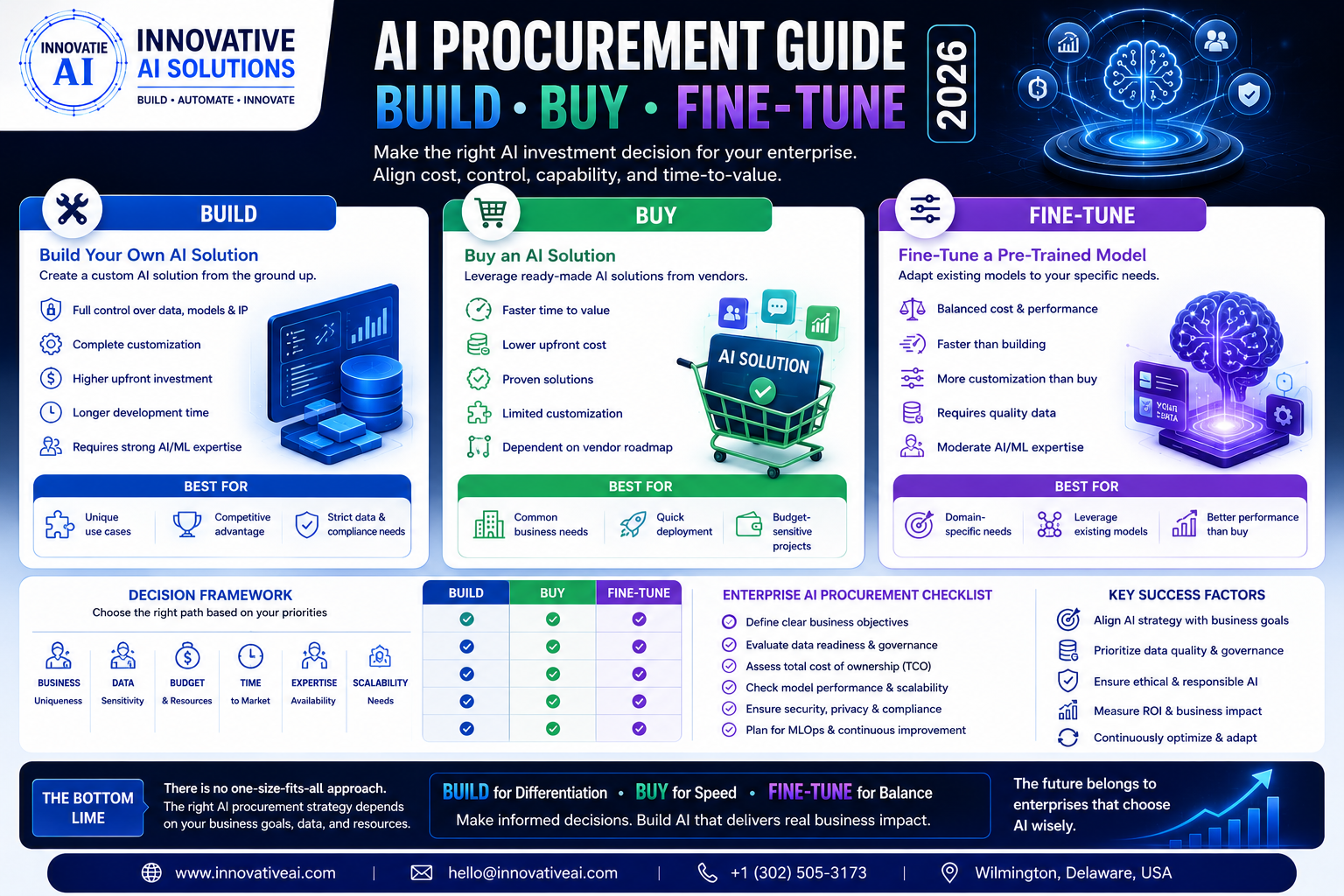
The Big Question
Let me start with a question that every enterprise leader must answer in 2026.
"Should we build our own AI, buy from a vendor, or fine-tune an existing open-source model? How do we avoid becoming another statistic in the 95% of AI projects that fail?"
The honest answer:
The binary choice is dead. The winning strategy is a hybrid approach — buy the commodity, build the differentiation.
Here is the truth:
The build vs. buy vs. fine-tune decision is not a simple choice about technology. It is a decision about where to place your competitive differentiation in a rapidly commoditizing intelligence market . Organizations that succeed are those that start by buying to learn, then build where it matters, and treat model weights and infrastructure as disposable commodities.
Step 3: The Three Strategic Paths
The industry is coalescing around three strategic archetypes, each with distinct trade-offs :
Path 1: The Takers (Buy)
Organizations that take the "buy" path operate at speed and on standardization, using embedded AI within existing SaaS platforms such as Microsoft Copilot, Salesforce Einstein, and ServiceNow AI . This strategy works for non-core functions where you seek market parity, not differentiation.
Best for: Standard business functions (finance, HR, accounting), low-differentiation use cases, time-to-value critical deployments, teams without dedicated AI infrastructure.
Trade-offs: Convenience comes with dependency — you are vulnerable to price hikes, vendor lock-in, and the risk that competitors have identical capabilities .
Path 2: The Makers (Build from Scratch)
The rarest breed — training proprietary foundation models from scratch. This path demands immense capital for GPU clusters, specialized talent, and rigorous data governance . The economic barrier is brutal: training a frontier-scale model runs between $10 million and $100 million or more .
Best for: Frontier AI labs, national AI programs, organizations that require complete provenance over every training token for regulatory compliance .
Trade-offs: Compute and data burden is not proportionate to the performance gain over a well-tuned open-weight model for almost everyone else .
Path 3: The Shapers (Fine-Tune Open-Weight Models)
The sweet spot for most enterprises — buy foundation models via API but build the surrounding cognitive architecture . Fine-tuning an open-weight foundation model (Llama, Mistral, Falcon) on proprietary domain data delivers production-grade performance at a fraction of the cost .
Best for: Regulated industries, proprietary domains, organizations with proprietary data that is their competitive moat.
Economics: 1,000 to 10,000 times less than training from scratch, reaching production in two to six months . A LoRA-based fine-tune can complete on a single GPU in hours .
Trade-offs: The data operations burden is high — the training dataset must be carefully designed, edge cases and refusal scenarios must be included, and annotation guidelines must produce consistent labeling across annotators .
Step 4: The Layer-by-Layer Decision Framework
The insight that resolves the build/buy binary is architectural decomposition. An AI agent is not a monolithic thing — it is a stack of five distinct layers, each with its own differentiation economics :
Layer 1: Foundation Model
| Description | Default Verdict |
|---|---|
| The underlying LLM (GPT-4o, Claude, Gemini, Llama). Determines reasoning quality, context window, cost per token, and data residency options. | Buy via API |
Layer 2: Orchestration
| Description | Default Verdict |
|---|---|
| The framework managing agent execution: task decomposition, tool routing, multi-agent coordination, retry logic, and state management. | Hybrid (Open-source + config) |
Layer 3: Tool Integrations
| Description | Default Verdict |
|---|---|
| Connectors exposing external systems (CRM, ERP, databases, APIs) to the agent. Generic integrations are commoditized; custom integrations require build effort. | Buy standard, build custom |
Layer 4: Domain Logic
| Description | Default Verdict |
|---|---|
| The business rules, decision heuristics, and domain knowledge encoded into the agent's behavior. This is your differentiation. | Build |
Layer 5: Observability
| Description | Default Verdict |
|---|---|
| Logging, tracing, evaluation, and monitoring for agent behavior. Mature platforms exist; building from scratch is rarely justified. | Buy |
The framework in one sentence: Buy your commodities, hybridize your connective tissue, and build only what encodes a durable competitive advantage .
Step 5: The Economics of Each Path
Training from Scratch
| Dimension | Cost |
|---|---|
| Compute cost | $10M–$100M+ |
| Data ops burden | Extremely high, full pre-training corpus |
| Time to first output | 12–24+ months |
| IP / data control | Full |
Fine-Tuning Open-Weight Models
| Dimension | Cost |
|---|---|
| Compute cost | $5K–$500K |
| Data ops burden | High, curated domain dataset required |
| Time to first output | 2–6 months |
| IP / data control | Full (on-prem possible) |
Managed Partner (Buy)
| Dimension | Cost |
|---|---|
| Compute cost | API / usage-based |
| Data ops burden | Low internal, partner absorbs most burden |
| Time to first output | 4–12 weeks |
| IP / data control | Shared / contractual |
The GPU Economics
While buying GPUs pays off for nonstop workloads after 14 months, renting is far cheaper for occasional use. With Nvidia's Blackwell architecture promising massive performance gains, current hardware may become obsolete before recouping its costs, making infrastructure investment tough for smaller companies .
Step 6: The Regulatory Wild Card
The EU AI Act introduces a critical dynamic. Organizations that build custom models may be classified as "Providers," triggering stringent obligations in high-risk domains such as employment or credit scoring. By contrast, buying compliant solutions lets you remain a "Deployer" with lighter responsibilities .
In healthcare, HIPAA compliance adds another layer: the safest path is to buy HIPAA-compliant infrastructure layers from providers like AWS or Google, then build application logic on top .
Step 7: The Build vs. Buy Decision Matrix
Based on the latest research, leading enterprises are applying a four-tier decision framework :
Tier 1: Integrate and Activate
For functions already running on major enterprise platforms (sales, service, finance, HR), the dominant choice is activating the agentic layer within existing vendor agreements.
Best for: 60–70% of AI use cases .
Tier 2: Buy and Configure
For functions not served by existing platforms, or where specific industry requirements demand specialized capability, acquiring specialist AI products and configuring them against enterprise data is the preferred path.
Best for: Document intelligence, specific compliance tooling, domain-specific prediction models.
Tier 3: Build with Platforms
For genuine competitive differentiation — proprietary data assets, unique process IP, or core product capability — organizations build on top of platform primitives (Azure OpenAI, AWS Bedrock, Vertex AI) rather than from the model layer up.
Best for: Proprietary data, unique workflows, core product differentiation.
Tier 4: Build from Scratch
Reserved for AI-native companies, frontier research teams, and cases where the AI capability is the product.
Best for: Less than 5% of enterprise AI use cases .
Step 8: Common Failure Modes to Avoid
The "Data Ops" Trap
The most common failure mode in enterprise fine-tuning is launching training before annotation guidelines, edge case coverage, and alignment data requirements have been properly designed . Organizations that treat data operations as a planning input consistently outperform those that treat it as an execution detail .
The "Agent Swamp" Problem
Without absolute system boundaries, localized software agents from different vendors will inevitably trigger execution conflicts, flooding networks with recursive API tool calls .
The "Integration Debt" Trap
Custom-built AI systems must integrate with ERP, CRM, data lakes, compliance tooling, and identity systems that have accumulated over decades. The integration bill frequently exceeds the model development cost by 3–5x .
The "Shadow AI" Risk
If your sanctioned internal tool is slower, less capable, or more restricted than free consumer alternatives, adoption will crater, and employees will route around it entirely .
Step 9: Implementation Roadmap — 90 Days
Phase 1: Assessment (Weeks 1-4)
| Action | Output |
|---|---|
| Map your AI use cases by differentiation and integration complexity | Decision matrix |
| Assess data readiness (quality, governance, accessibility) | Data maturity assessment |
| Evaluate vendor-native agent capabilities in your existing platforms | Platform capability map |
| Define success metrics (time to value, cost, differentiation) | KPI framework |
Phase 2: Decision (Weeks 5-8)
| Action | Output |
|---|---|
| Apply the layer-by-layer decision framework | Build/buy/hybrid decision for each layer |
| Select foundation models (buy via API) | Model selection |
| Plan domain logic build | Build roadmap |
| Establish governance and compliance framework | Security framework |
Phase 3: Pilot (Weeks 9-16)
| Action | Output |
|---|---|
| Start with a low-risk, bounded use case | Working pilot |
| Buy to learn, validate the business case | Early ROI data |
| Build only the differentiation layer | Proprietary capability |
| Scale if successful, pivot if not | Informed scaling decision |
Step 10: Frequently Asked Questions
Q1: Should we build or buy AI capabilities?
The answer is hybrid. Buy the commodity layers (foundation models, observability, generic tool integrations). Build only where you have durable competitive advantage — your proprietary data, unique workflows, and domain logic .
Q2: How do we know if we should fine-tune or use a managed API?
Fine-tune when you have proprietary domain data that creates competitive advantage, need output consistency, or require data sovereignty. Use a managed API for rapid deployment, non-differentiating tasks, or when you lack the engineering capacity to manage a fine-tuning pipeline .
Q3: What is the most common mistake in AI procurement?
Launching training before data operations are ready — annotation guidelines, edge case coverage, and alignment data requirements must be designed before any training begins . Organizations that treat data operations as a planning input consistently outperform those that treat it as an execution detail .
Q4: How much should we budget for AI integration?
The integration bill frequently exceeds the model development cost by 3–5x . Factor integration, governance, and maintenance into your total cost of ownership calculations.
Q5: What about the EU AI Act impact?
If you build custom models, you may be classified as a "Provider" with stringent obligations. Buying compliant solutions lets you remain a "Deployer" with lighter responsibilities . For regulated industries, this regulatory arbitrage makes buying the only viable option for high-risk AI systems .
Q6: How can Innovative AI Solutions help?
We help enterprises navigate the build/buy/fine-tune decision — from use case mapping and data readiness assessment to architectural design and implementation.
Step 11: Final Tagline
"The question is no longer 'Do we build or buy?' but 'Where do we place our competitive differentiation in a rapidly commoditizing intelligence market?' The winning strategy is not choosing one path — it is composing intelligence: buying commodity layers, hybridizing connective tissue, and building only what encodes a durable competitive advantage."
Short version:
AI procurement guide — build, buy, or fine-tune? The 2026 hybrid framework for enterprise leaders. Layer-by-layer decision framework, economics, and implementation roadmap.
Hashtags:
#AIProcurement #BuildVsBuy #EnterpriseAI #AIGovernance #AIStrategy #DigitalTransformation #InnovativeAISolutions
Ready to Make the Right AI Procurement Decision?
The gap between experimentation and enterprise-scale deployment is not a technology problem — it is a decision framework problem. Let us help you build the right architecture.
Contact Us
Phone: +91 7464 099 059 / +91 96899 67356
Email: info@innovativeais.com
Address: Netaji Subhash Place, Pitampura, Delhi – 110034
Website: https://innovativeais.com
About the Author
Abhishek Kumar
Founder & CEO, Innovative AI Solutions
5+ years building enterprise AI systems. Based in Delhi, serving clients across India.