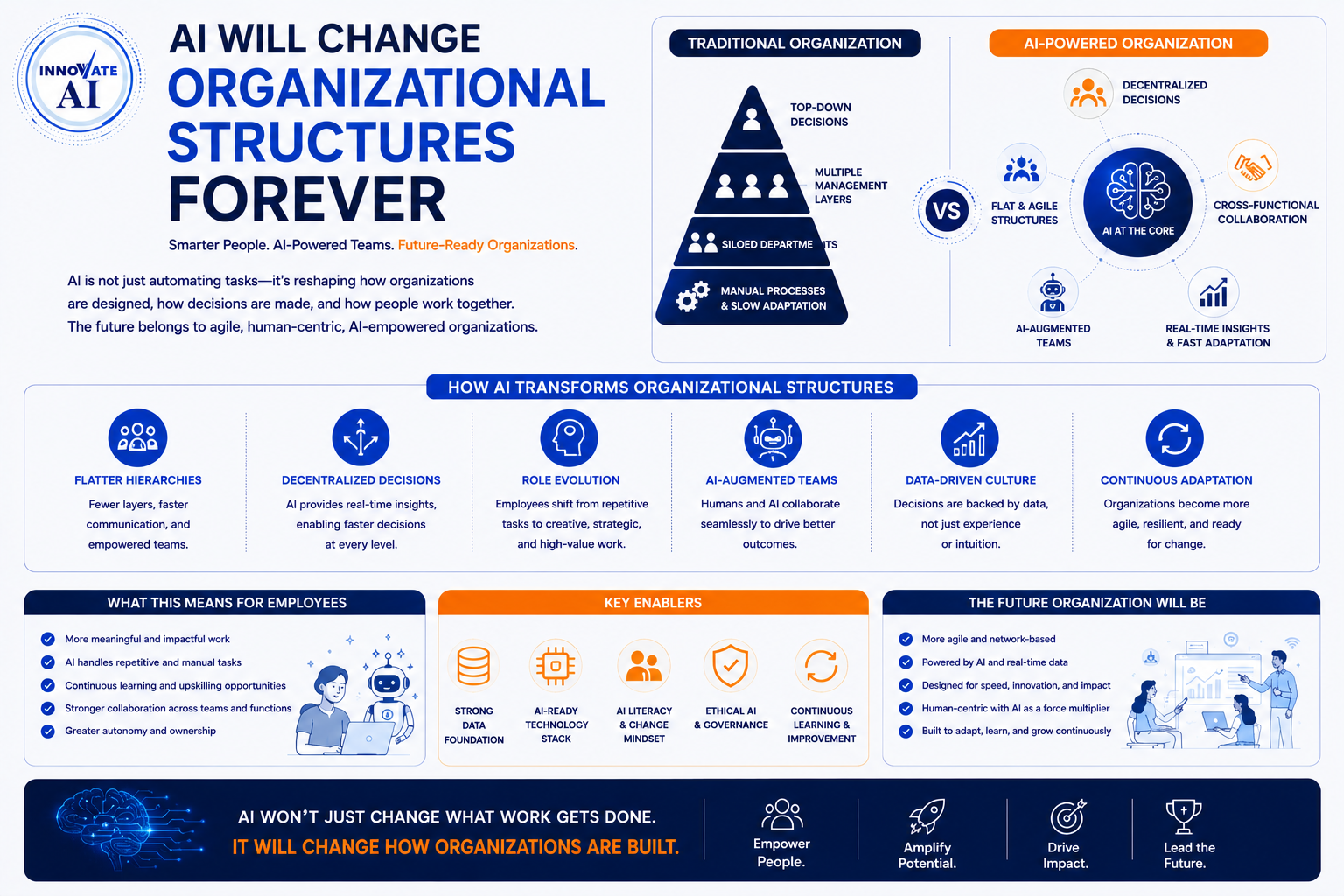
The Big Question
What happens when an organization no longer needs people to pass information upward and instructions downward? What happens when artificial intelligence can see, summarize, compare, and surface organizational reality faster than a management chain? And if hierarchy was built to solve a human constraint, what should remain when that constraint begins to disappear?
This isn't theoretical speculation. It's happening right now.
The Constraint That Created Hierarchy
The pyramidal hierarchy did not emerge only from a desire for control, although it often enabled control. It emerged from a hard cognitive problem: human beings can coordinate only a limited number of direct relationships before information becomes unmanageable. Organizational theorists have long described this as the "span of control." Beyond a certain point, coherence breaks down .
The solution that every large human organization adopted was the same: add layers. But each layer compresses information flowing upward and distributes instructions downward. The pyramid is, in this sense, a lossily compressed communication network built from human neurons .
That compression solved one problem while creating another. With every relay, the signal degrades. Managers shade information to protect themselves. By the time a report reaches the top, it often bears only a family resemblance to ground truth, and the CEO is working from a picture of the company that has been sanitized, simplified, and politically processed at every stage .
The Great Flattening
The premise of hierarchy was that there was no other way to aggregate organizational information at scale. That premise dissolved quietly over the past two decades and is now weakening rapidly .
Today, employees generate continuous digital traces: messages, code commits, document revisions, calendar records, and patterns of collaboration. Feeding this data stream into large language models produces something genuinely new: a real-time organizational world model, more current than a quarterly report and less dependent on human intermediaries .
If the information-relay function that once justified middle management has been automated, then the pipes are no longer needed.
Business leaders are calling it "the Great Flattening" . As AI agents enter the workforce, consulting firms are predicting a new wave of delayering and organizational change . Traditional hierarchies are being compressed, and in some cases, eliminated entirely.
A Corporate Experiment in Real Time
A recent experiment by a large digital-payments company brought this issue into public view. The company reduced its workforce by nearly 40%. It abolished all formal titles: Vice Presidents, Directors, Managers, all gone. It compressed its management layers to two or three, with a stated ultimate ambition of zero .
And crucially, it named the replacement: not a new organizational chart, but an AI system—a real-time intelligence layer that would do what managers had always done: aggregate information, surface truth, and enable decisions, but without the distortion, politics, or career incentives that make human relay stations unreliable .
In a subsequent public statement, the company's chief executive put the logic starkly: "The most important thing we can do is get rid of the noise between the people doing the work and the people making decisions about it. AI can be that connection. Humans were never good at it anyway" .
This is not a minor organizational adjustment. It is a claim about the nature of management itself.
The New Architecture: Circles, Not Pyramids
In this redesigned structure, the organizational center of gravity is not a person at the apex of a pyramid. It is an AI intelligence system that holds the continuously updated factual state of the company. Everyone works in relation to this system. Information no longer flows through ranks but is available simultaneously to those who need it .
Within this structure, people occupy roles defined entirely by their relationship to outputs rather than to other people :
-
Builders: those who make things. Their core competency is judgment of what is worth building. Taste, in other words, as a professional skill.
-
Directly Responsible Individuals: those who own outcomes, specifically the outcomes that customers experience. They assemble the teams they need, disband them when the work is done, and carry personal accountability for the result.
-
On-Field Coaches: those who are what senior leaders become when their job is no longer to review slide decks and approve budgets. They work at the front lines. Their authority is earned from demonstrated mastery.
Notably, the traditional role of "manager" no longer exists, as coordination has been transferred to the AI layer .
What This Looks Like in Practice
AI-Native Teams Replacing Large Departments
In one AI-first healthcare company, a team of 10 software engineers was replaced with a three-person unit overseeing AI agents . The unit consists of a product owner, a software engineer who can effectively prompt AI coding tools, and a systems architect who ensures integration with the company's broader tech ecosystem .
McKinsey is deploying thousands of AI agents to support consultants with tasks such as building decks, summarizing research, and verifying the logic of arguments. Around 40% of the company's revenue now comes from advising on AI and related technologies .
The Rise of "Megamanagers"
Instead of a large pyramid of junior analysts and mid-level managers, leaner consulting teams are emerging—led by experienced generalists, supported by technical specialists who build and refine agents that can be deployed across multiple projects .
The next era of work may shift toward "megamanagers"—individuals managing larger teams and broader scopes of responsibility than before .
"You're going to have teams which are manager-heavy—where everybody is a manager, sometimes manager of humans, but always manager of agents" .
The 50-to-100 Agents, Two-to-Three People Ratio
In early examples, a client company building an agent factory supporting multiple business workflows can have about 50 to 100 AI agents managed by just two or three people .
When Hierarchy Remains Necessary—And When It Becomes Toxic
A serious analysis must acknowledge that hierarchy is not always obsolete. It remains appropriate when :
-
Information cannot be automatically aggregated
-
Tasks are highly standardized and benefit from unified command discipline
-
Operating environments are stable enough that predictable process outperforms adaptive self-organization
-
Workforce composition does not support the high degree of individual self-management that non-hierarchical models demand
In steel manufacturing, traditional banking operations, logistics networks, and public health bureaucracies, the pyramid remains an efficient coordination mechanism. Dismissing it wholesale would be a category error .
Hierarchy becomes counterproductive when :
-
AI can aggregate information in real time, eliminating the relay function
-
Value creation depends on creative judgment that hierarchical approval chains systematically delay and dilute
-
Competitive environments change faster than organizational structures can process
-
The scarce resource is human ingenuity rather than standardized execution
In these conditions, hierarchy does not merely add overhead. It actively destroys value by inserting distortion, delay, and political filtering between reality and decision .
The Human Contribution
This transition poses a question that every generation of technological change has asked in a new form: what is the human contribution that cannot be mechanized?
The answer emerging here is more specific than previous answers. It is three distinct capacities :
-
Judgment in conditions of genuine ambiguity: the determination of which rules apply, which values should be weighted, and what the right question is in the first place.
-
Accountability for outcomes that matter to other human beings: the willingness to stand behind a decision and bear its consequences, which requires a form of moral agency that AI systems do not possess and cannot be made to possess by technical means.
-
Empathy as professional competency: the ability to sense what is not being said, to read the emotional reality of a situation, to respond to another person's humanity in ways that change what is possible between them .
The New C-Suite
While middle managers and entry-level employees may be feeling the brunt of the AI burden, these changes go right to the top.
AI is already shifting the power dynamics in the C-suite and creating new, powerful, executive-level jobs. According to a 2023 Foundry study on AI Priorities, 11% of mid- to large-sized companies have already appointed someone to serve as "Chief AI Officer" (CAIO), while an additional 21% are currently in the process of recruiting for the role .
According to LinkedIn's 2023 report on AI at work, companies with a "Head of AI" position around the world had more than tripled in the five years, growing by 13% from 2022 .
Oxford University's Alex Connock observed: "Whilst it was perhaps relatively rare when we first launched our AI for business programmes a few years ago, we now have many people...on our executive courses with the title of Chief AI Officer. It's the new mainstream" .
The Organizational Gap in AI Strategy
Traditional hierarchical org charts, lineage dictionaries, and rigid business units were designed for industrial-era activities. Decision rights were linear, and work flowed like a factory line. AI, by contrast, changes how work happens; it collapses decision cycles, shifts cognitive work toward pattern recognition and synthesis. Overall, it requires rapid cross-functional orchestration .
Yet many still treat AI as a plug-in tool for existing processes, rather than a catalyst for workflow redesign. The result? AI fatigue, stalled pilots, and minimal enterprise impact. Their org charts have not changed, but the work has .
Nearly 9 out of 10 organizations report using AI in at least one business function, yet only a small fraction (about 7%) believe they have "fully" scaled AI across the enterprise. After billions of dollars in AI investment across the globe, many are left with an org chart that looks largely unchanged from the analog age .
AI-Native Organizations Don't Fit On A Chart
AI-native organizations require role fluidity, dynamic workflows, and networked decision rights—patterns of interaction that cannot be captured by a static org chart.
Org charts assume a vertical axis of authority, where work is handed down like a baton. AI requires horizontal, dynamic ties: data, process context, machine roles, and human roles intersecting in real time. Workflows become living ecosystems, not laddered reporting lines .
Gartner projects that unless companies rethink organizational design, up to 40% of agile AI initiatives will be canceled by 2027 due to structural limitations rather than technological ones .
The Emerging Model: A Network
The emerging model looks more like a network :
-
Nodes represent roles with distinct competencies: data, domain, ethics governance, and AI orchestration.
-
Edges represent collaborative workflows that can flex to meet situational demands.
-
Authority is distributed based on task relevance, not title.
These nodes form agile pods that can assemble, disassemble, and reassemble as work demands evolve. This design mirrors how AI agents themselves operate: autonomous, interconnected, and responsive .
Replit's Vision: Generalists, Not Specialists
Replit CEO Amjad Masad envisions a world where AI agents do all the heavy lifting, allowing anyone to build complex software simply by describing what they want. In this future, rigid organizational hierarchies are on their way out, soon to be replaced by fluid networks of generalists collaborating with autonomous AI tools .
The model of extreme specialization, born from the industrial revolution, is becoming obsolete. For generations, companies have been built like assembly lines, with each employee responsible for one specific part of the product .
But what happens when your HR professional can also be a software engineer, a marketer, and a product manager, all by leveraging AI agents?
"You go into the world where jobs will become less specialized, less siloed... It'll look more like an open source project than it will look like a traditional company hierarchy with a marketing department, sales department" .
Workflow Reengineering, Not Just Automation
One of the clearest insights from McKinsey is that organizations that redesign workflows around AI see the greatest EBIT impact. Simply grafting AI onto legacy tasks is like putting a turbocharger on a horse-drawn carriage .
Principles of AI-Centric Workflow Design :
-
Start with decisions, not tasks. Map where decisions actually happen, and design AI support to enhance judgment loops, not automate rote tasks.
-
Treat data as an operational asset. Siloed data stalls AI performance; connected data pipelines amplify it.
-
Reallocate autonomy to the edge. Let pods and cross-functional teams act on insights immediately without multilevel approval delays.
This can result in decisions becoming faster, insights more actionable, and stronger creative problem solving. When used within well-designed cross-functional teams, AI can improve decision-making speed by up to 30% .
The Strategic Imperative
In a world where everyone has AI, advantage comes not from access to technology, but from how deeply AI is embedded into the way work is structured and executed. Traditional hierarchies slow decision velocity and create bottlenecks that nullify the speed advantage AI promises .
Leaders must invest in AI fluency and redefine roles around orchestration, governance, and impact accountability. The shift is no longer from a technology project to a business model redesign .
Frequently Asked Questions
Q1: Is hierarchy becoming completely obsolete?
No. Hierarchy remains appropriate when information cannot be automatically aggregated, when tasks are highly standardized, or when operating environments are stable. It becomes toxic when AI can aggregate information faster and more accurately than human relays, and when creative judgment is the primary value driver .
Q2: What replaces middle management?
In AI-native organizations, coordination is transferred to an AI intelligence layer that holds the continuously updated factual state of the company. People occupy roles as Builders, Directly Responsible Individuals, or On-Field Coaches—roles defined by relationship to outputs, not to other people .
Q3: What are the human capacities that AI cannot replace?
Three distinct capacities: judgment in conditions of genuine ambiguity, accountability for outcomes that matter to other human beings, and empathy as professional competency .
Q4: What is "the Great Flattening"?
The term describes how AI is compressing organizational hierarchies—reducing middle management layers, removing junior or support roles, and relying on AI systems to handle tasks once performed by human employees. Traditional team roles are starting to blur as job roles get deconstructed .
Q5: Are new C-suite roles emerging?
Yes. "Chief AI Officer" roles are becoming mainstream—11% of mid- to large-sized companies have already appointed a CAIO, and another 21% are recruiting for the role .
Q6: How can Innovative AI Solutions help?
We help businesses redesign their organizational structures for the AI era—from workflow reengineering and human-AI teaming frameworks to AI-native operating models and strategic transformation. Based in Delhi, serving clients across India.
Final Thought
Hierarchy is ending not because it failed, but because one of the constraints it was built to manage—the limited capacity of human beings to process information at scale—is being partially overcome. Everywhere that constraint no longer applies, the organizational forms it produced are becoming obsolete .
The machine no longer needs the patch. What the machine needs is human judgment about what it should be used for. That judgment, and the institutional frameworks that shape it, is where the work now is .
Contact Us:
Phone: +91 7464 099 059 / +91 9689967356
Email: info@innovativeais.com
Address: Netaji Subhash Place, Pitampura, Delhi – 110034
Website: https://innovativeais.com
About the Author
Abhishek Kumar
Founder & CEO, Innovative AI Solutions
5+ years building AI systems for enterprises. Based in Delhi, serving clients across India.
Related services: to apply this in your business, explore our AI agent development and AI development services.