The Big Question
"We are adding AI tools across our organization. Isn't that enough? What is the difference between adding AI later and building around it from the start?"
The honest answer:
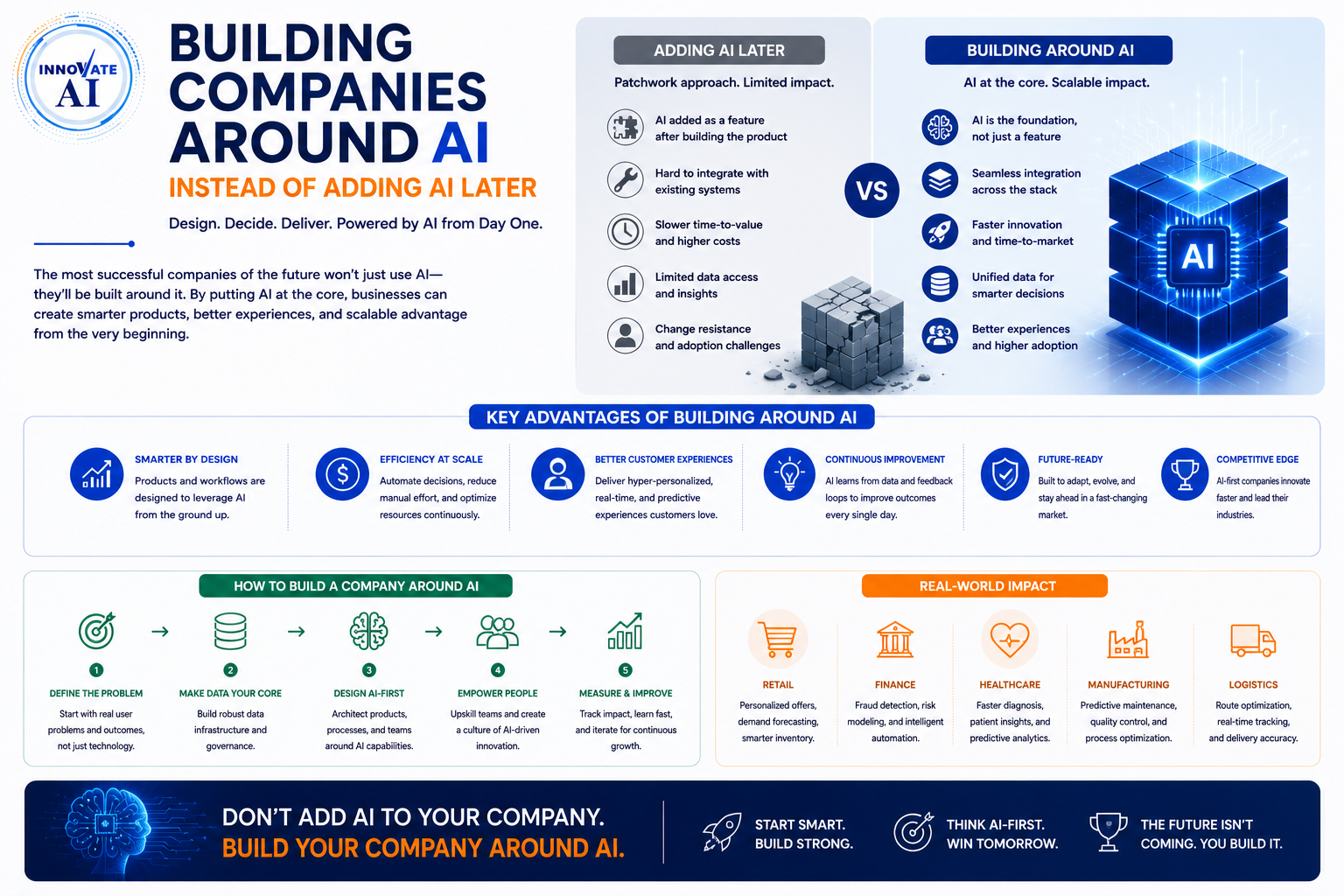
Adding AI to an existing business is like putting a jet engine on a horse carriage. It moves faster, but it was never designed for speed. Building around AI means redesigning the carriage.
Here is the truth:
Eighty-four percent of companies have not redesigned jobs around AI capabilities, while AI high performers are nearly three times as likely as others to fundamentally redesign workflows. The difference is not in the technology—it is in the architecture.
AI-first organizations treat intelligence like capital, identifying the outcomes that matter most and working backwards into the workflows where AI can create the greatest operating leverage. When this works, operations stop being static processes and become learning systems.
Step 3: AI-Enabled vs. AI-Native — The Critical Distinction
The Two Paths
| AI-Enabled Organization | AI-Native Organization |
|---|---|
| Adds AI to existing workflows | Redesigns workflows around AI |
| Uses AI as a tool | Treats AI as a collaborator |
| Incremental efficiency gains | Structural transformation |
| AI in isolated functions | AI across the entire enterprise |
| Periodic updates | Continuous learning and adaptation |
| Technology as an add-on | Technology as the foundation |
What the Data Shows
"AI-first companies reach $100 million in annual recurring revenue in months, compared to the four to eight years it took their predecessors" . The difference is not just speed—it is the fundamental economics of the business.
In commercial insurance, workflows that once took 28 days now complete in under three hours. In healthcare, AI-native platforms transcribe doctor visits into structured medical notes in real time. In biotech, generative AI models simulate biology, design new antibiotics, and map proteins at speed and scale never before possible.
The "Remove the AI" Test
The simplest way to know if a company is truly AI-native is to ask: If you remove the AI, does the business model collapse? If the company can still operate, it is not AI-native. If the company ceases to function, you have built around intelligence.
Step 4: Why "Adding AI Later" Fails
The Efficiency Trap
Most companies use AI to cut costs or improve productivity, but the real winners design AI-native business models where the technology changes how value is created, priced, and captured. The reason is simple: cost savings are finite, but growth is infinite.
In one decade, $27 trillion in enterprise value migrated across the world's 3,000 largest firms, with a third of that shift occurring in the last two years. Companies lost nearly $5 trillion in revenue to disruption. This is not a cost story; it is a story of new value pools forming faster than enterprises can rewire.
The Generic Data Problem
Growth models built on generic data are indistinguishable and replaceable. "One client paused a multi-million-dollar investment in a custom AI model after discovering it was trained on 37 different versions of the same operating procedures, leading to errors, rework and months of lost productivity".
High performers behave differently, using proprietary data to create new products, open new channels, and build commercial models competitors cannot replicate. Organizations that do not make data a differentiator are not AI-native—they are just using generic tools.
Step 5: The Five Building Blocks of an AI-Native Operating Model
Based on research from the World Economic Forum and Kearney, five fundamental building blocks define how leading AI-first organizations design for structural transformation.
1. Intelligence Engine
The starting point is to identify the business's unique learning loops: repeated decisions, feedback, user signals, or operational data that can make an AI system better each time it runs.
AI-first organizations build self-reinforcing, data-driven flywheels that learn from every interaction, grow smarter with use, and connect performance back to business outcomes. They operate across three dimensions:
-
Speed: Rapid hypothesis generation
-
Scale: Platform operationalization
-
Scope: Recomposition of proven capabilities into new ones
Example: Osmo with its olfactory-intelligence platform, trained on more than 3 billion molecules and 5 million fragrance classifications, enabling one platform to support many formulations rather than building per-product models.
2. Adaptive AI Technology Stack
For an intelligence engine to work, it cannot sit alongside the business as just another tool. It must connect into the systems where work already happens, while allowing the organization to adapt as models, vendors, and applications change.
AI-first organizations do this four ways:
-
Turn every interaction into a training signal, capturing overrides, feedback, and edge cases
-
Own the control layers, keeping orchestration and routing inside the enterprise so vendors can change without rebuilding workflows
-
Build model-agnostic portfolios, routing tasks by cost, accuracy, and risk
-
Make context dynamic, pulling live data rather than relying on static prompts
3. Operations Redesign
Eighty-four percent of companies have not redesigned jobs around AI capabilities, while AI high performers are nearly three times as likely as others to fundamentally redesign workflows.
AI-first organizations treat intelligence like capital: identifying the outcomes that matter most, then working backwards into the workflows where AI can create the greatest operating leverage.
Workflows are digitized and connected to the intelligence engine end to end, codifying rules, matching models to tasks, building observability, and defining where human judgment is required. When this works, operations stop being static processes and become learning systems.
"Everyone is chasing the efficiency of AI; the bigger unlock is effectiveness." — Sarah Franklin, CEO of Lattice
4. Human-AI Teaming
The productivity upside is clear: in a controlled field experiment, humans in human-AI teams achieved 73% greater productivity per worker.
AI-first organizations are responding by hiring and developing new talent profiles: design engineers, forward-deployment engineers, evaluation specialists, and AI safety engineers. The most effective AI-first teams are small, flat, and cross-functional—often fewer than 10 people and organized around one product, workflow, or customer problem.
"AI lets us redefine work around human skills rather than tasks. Once the routine work is handled, what's left and what we now build careers and measure success around is curiosity, judgment and the human skills machines don't have." — Sarah Franklin, CEO of Lattice
5. New Value Creation
As intelligence moves from internal operations into products, services, and customer experiences, every AI-first organization has to decide how it will create and capture value in the market. Intelligence can show up as a feature, the product itself, a workflow platform, invisible infrastructure, or a new interface entirely.
That choice matters because it shapes what customers pay for, where value accrues, and how feedback flows back into the intelligence engine. The market signal is clear: newly funded AI companies grew 70% between 2024 and 2025, but AI novelty alone is not enough.
Example: Contextere's voice-first factory-floor troubleshooting system replaced a 47-minute information-gathering process with near-instant context assembly, cutting troubleshooting time by up to 80%. The value was that intelligence was packaged into the way frontline workers already operate.
Step 6: The Four AI Business Models
According to Forbes, four emerging AI business models define how companies are building around intelligence.
Model 1: Product-Only (Winning with Workflow)
Success hinges not on proprietary model performance but on how deeply the product embeds into user workflows. Distribution compounds faster than models decay —AI models degrade over time due to data drift, but a sticky product experience can endure.
Example: Perplexity, MotherDuck. Their defensibility comes from habit formation and trust, not model superiority.
Model 2: Product + Embedded Engineering (Co-Creation)
Companies embed engineers with customers to co-develop systems that reflect real-world workflows and edge cases.
Example: Harvey, which works side-by-side with law firms to build legal AI copilots custom-tuned to legal reasoning and regulatory nuance.
Strategic advantage: Customer entanglement drives long-term defensibility and deep insights into specialized domains.
Model 3: Full-Stack AI Services (Outcome Ownership)
This model shifts the conversation from software delivery to outcome ownership. Customers don't just get tools—they get results.
Example: LILT doesn't sell translation software; it delivers full localization services, combining AI with human linguists.
Strategic advantage: Continuous data loops and full control over execution make the offering nearly impossible to unbundle.
Model 4: Roll-Up + AI (Buy Ops, Layer Intelligence)
This hybrid model marries traditional operational businesses with embedded AI to unlock new efficiencies and capabilities.
Example: AI-infused roll-ups in healthcare, supply chain, and robotics acquire existing businesses and upgrade them with AI-driven labor orchestration, forecasting, and automation.
Strategic advantage: Rapid go-to-market, defensibility via physical assets, and compound efficiency by layering AI atop operational expertise.
Step 7: The AI-Native vs. AI-First Distinction
Some might use "AI-native" and "AI-first" interchangeably. Yet, while similar, they are distinct concepts.
| AI-First | AI-Native |
|---|---|
| Incorporates AI as a core capability that enhances products, services, and operations | Goes further by structuring the entire business model and value proposition around AI |
| A 30-year-old firm systematically incorporating AI tools across its systems | A startup built within the last year with AI embedded in every process from day one |
The difference is structural, not just tactical.
Step 8: The "Bias for Customer Pain" Principle
Most AI ventures are founded by engineers who can get swept up in the novelty of technology and overlook real customer needs. The most successful AI-first companies prioritize solving customer problems over the novelty of technology.
The Cautionary Tale: Humane Inc.
Humane Inc. launched the AI Pin in 2023: a lapel-worn assistant that could take photos, search the web, and send messages. Despite raising over $200 million, the product failed. Critics said few saw the need for a redundant device in a smartphone-saturated world. In early 2025, Humane was sold for a fraction of its peak valuation.
The Success Story: Grammarly
Grammarly, by contrast, focused squarely on solving a widespread pain point: struggles with grammar and clarity. Instead of building the most sophisticated natural language processing model, Grammarly prioritized real-time correction, contextual suggestions, and clear explanations. By May 2025, Grammarly was generating $700 million in annualized revenues and had raised another $1 billion in venture capital.
The lesson: Customer pain > cool technology. Always.
Step 9: Building a Defensible Moat Early
Even if you are the first to solve a compelling need, brutal competition is a given with AI, driving the need to build a defensible moat from the get-go.
A defensible moat can take many forms:
| Moat Type | Example |
|---|---|
| Proprietary data | Data competitors cannot replicate |
| Deep domain expertise | Knowledge of clinical settings, legal reasoning, etc. |
| Better models | Fine-tuned on proprietary data |
| Workflow integration | Embedded into customer workflows |
| Compliance readiness | Built with HIPAA, GDPR, EU AI Act in mind |
Example: Abridge AI uses GenAI to transcribe and summarize doctor-patient conversations. It has built several layers of defensibility: deep knowledge of clinical settings, proprietary NLP models tuned to medical terminology, and integration into EPIC (the dominant EHR platform). Today, Abridge serves over 100 health systems.
"Crucially, scale provides Abridge with a flywheel to continually improve its models through real-world usage" .
Step 10: Implementation Roadmap — 90 Days
Phase 1: Redesign (Weeks 1-4)
| Action | Output |
|---|---|
| Identify your business's unique learning loops | Intelligence engine design |
| Map workflows and decision points | Operations redesign plan |
| Define where AI can create operating leverage | Prioritized use cases |
| Establish data foundation and governance | Data readiness baseline |
Phase 2: Build and Pilot (Weeks 5-8)
| Action | Output |
|---|---|
| Build adaptive technology stack | Modular infrastructure |
| Redesign one workflow around human-AI collaboration | Working prototype |
| Deploy intelligence engine for a bounded use case | Pilot results |
| Measure productivity and quality gains | Early ROI data |
Phase 3: Scale and Transform (Weeks 9-12)
| Action | Output |
|---|---|
| Expand to additional workflows | Scaled deployment |
| Develop new talent profiles | AI-literate workforce |
| Redesign business model around AI-native value creation | New value proposition |
| Establish continuous improvement cycles | Ongoing optimization |
Step 11: Frequently Asked Questions
Q1: What is the difference between AI-first and AI-native?
AI-first companies incorporate AI as a core capability that enhances products, services, and operations. AI-native organizations go further by structuring the entire business model and value proposition around AI.
Q2: Why does adding AI later fail?
Most organizations add AI to the top of existing workflows. That helps the margins but does not fundamentally change how the business operates. Without structural redesign, AI remains an add-on rather than a capability.
Q3: What is the most important building block for an AI-native company?
The intelligence engine. Identifying the business's unique learning loops and building self-reinforcing, data-driven flywheels that learn from every interaction and grow smarter with use.
Q4: How do AI-native companies achieve faster scale?
AI-native companies achieve $100 million in annual recurring revenue in months, compared to the four to eight years it took their predecessors. They scale faster because they are built for intelligence from day one.
Q5: Is building around AI just for startups?
No. Established companies can transition to AI-first by redesigning workflows, decision-making, and business models around intelligence instead of layering AI onto existing processes.
Q6: How can Innovative AI Solutions help?
We help businesses design, build, and deploy AI-native operating models—from intelligence engines and workflow redesign to human-AI collaboration frameworks and new value creation. Based in Delhi, serving clients across India.
Step 12: Final Tagline
"The organizations that win in the AI era are not those adding AI to existing processes. They are those redesigning workflows, decision-making, and business models around intelligence. AI-enabled companies get incremental gains. AI-native companies unlock structural transformation."
Short version:
Building companies around AI instead of adding AI later—the structural shift from AI-enabled to AI-native. Five building blocks, four business models, and implementation roadmap.
Hashtags:
#AINative #AIFirst #AIStrategy #BusinessModel #DigitalTransformation #InnovativeAISolutions
Contact Us
Phone: +91 7464 099 059 / +91 96899 67356
Email: info@innovativeais.com
Address: Netaji Subhash Place, Pitampura, Delhi – 110034
Website: https://innovativeais.com
About the Author
Abhishek Kumar
Founder & CEO, Innovative AI Solutions
5+ years building AI systems for enterprises. Based in Delhi, serving clients across India.
Related services: to apply this in your business, explore our AI development services and API development and integration.