The Economics of Automation
Labor Cost as the Target
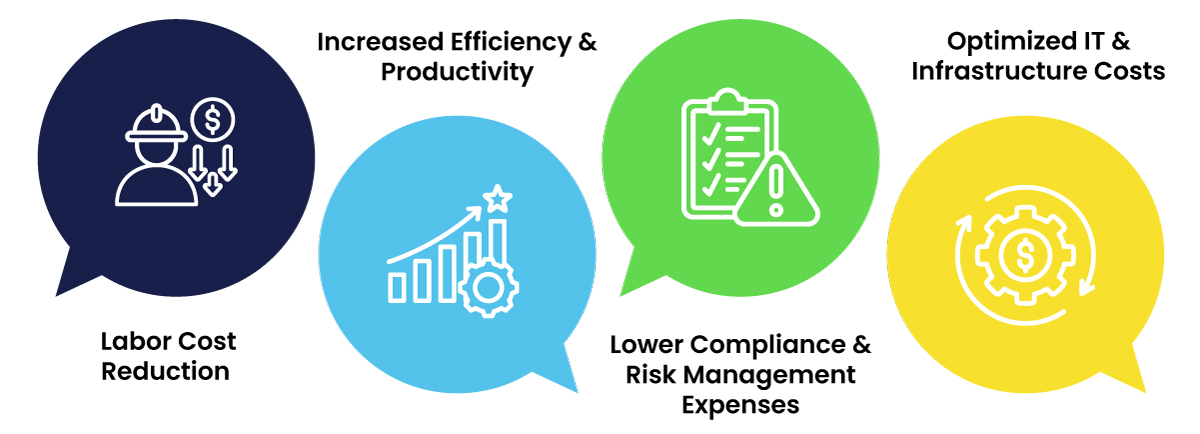
Labor is the largest operating expense for most businesses, typically 30 to 50 percent of revenue. Within labor cost, the most expensive component is not the highest-paid workers. It is the workers doing repetitive, high-volume tasks. A customer support agent earning ₹40,000 per month may handle 1,000 tickets. The cost per ticket is ₹40. An AI chatbot handling the same tickets at ₹10,000 per month for unlimited tickets has a cost per ticket that approaches zero as volume increases.
The math is simple. Any task that is repetitive, rule-based, and high-volume is cheaper to automate than to perform manually.
Fixed versus Variable Cost
Manual processes have variable cost. Each additional unit requires additional human effort. Grow volume by 10 percent, and labor cost grows by 10 percent. Automated processes have mostly fixed cost. The software costs the same whether it processes one hundred transactions or ten thousand. Grow volume by 100 percent, and software cost grows by zero percent.
This is the scalability advantage. Businesses that automate can grow without proportional cost growth. The gap between automated and manual cost structures widens with every transaction.
The Time Value of Money
Automation not only reduces cost. It also accelerates cash flow. Invoicing that takes days takes minutes when automated. Payment collection that takes weeks takes days. The time value of money is real. Faster processing means faster payment, which means more cash on hand, which means less borrowing, which means lower interest costs.
Step 3: Quantifiable Savings by Function
Customer Support Cost Reduction
| Metric | Manual | Automated | Savings |
|---|---|---|---|
| Cost per tier-one ticket | ₹150-300 | ₹15-30 | 80 to 90 percent |
| Agent time on routine tickets | 60-80 percent | 10-20 percent | 50 to 70 percent |
| Overtime hours (peak volume) | 10-20 per agent per week | 0-5 | 50 to 100 percent |
| Training time for new agents | 4-6 weeks | 2-3 weeks (AI assistance) | 50 percent |
A business handling 10,000 tickets per month at ₹200 per ticket spends ₹24 lakhs annually. At ₹20 per ticket automated, the same volume costs ₹2.4 lakhs. The annual savings are ₹21.6 lakhs. The automation investment pays for itself in months, not years.
Lead Management Cost Reduction
| Metric | Manual | Automated | Savings |
|---|---|---|---|
| Cost per lead follow-up | ₹50-100 | ₹5-10 | 80 to 90 percent |
| Sales team time on lead qualification | 40-60 percent | 10-20 percent | 50 to 70 percent |
| Lead response time | 4-24 hours | 0-30 seconds | 90 percent reduction |
| Lead leakage (lost leads) | 60-80 percent | 10-20 percent | 50 to 70 percent |
A business with 5,000 leads per month spending ₹75 per manual follow-up spends ₹45 lakhs annually. At ₹7.50 per automated follow-up, the same volume costs ₹4.5 lakhs. The annual savings are ₹40.5 lakhs.
Data Entry and Document Processing Cost Reduction
| Metric | Manual | Automated | Savings |
|---|---|---|---|
| Cost per invoice processed | ₹25-50 | ₹2-5 | 80 to 90 percent |
| Cost per expense report | ₹20-40 | ₹2-4 | 80 to 90 percent |
| Cost per customer onboarding form | ₹50-100 | ₹5-10 | 80 to 90 percent |
| Error rate | 1 to 5 percent | 0.1 to 0.5 percent | 80 to 90 percent |
A business processing 10,000 invoices per year at ₹40 per invoice spends ₹4 lakhs annually. At ₹4 per invoice automated, the cost drops to ₹40,000. Annual savings of ₹3.6 lakhs.
Supply Chain and Inventory Cost Reduction
| Metric | Manual | Automated | Savings |
|---|---|---|---|
| Inventory carrying cost | 20-30 percent of inventory value | 15-20 percent | 15 to 30 percent |
| Stockout cost (lost sales) | 5-10 percent of revenue | 2-5 percent | 50 percent |
| Safety stock requirement | 20-30 percent higher than optimal | 10-15 percent higher | 50 percent |
| Order processing cost | ₹50-100 per order | ₹10-20 | 80 percent |
For a business with ₹1 crore in inventory, carrying cost at 25 percent is ₹25 lakhs annually. Reducing to 18 percent saves ₹7 lakhs per year.
Accounts Payable and Receivable Cost Reduction
| Metric | Manual | Automated | Savings |
|---|---|---|---|
| Cost per invoice paid | ₹30-60 | ₹3-6 | 80 to 90 percent |
| Cost per customer payment processed | ₹20-40 | ₹2-4 | 80 to 90 percent |
| Days sales outstanding | 45-60 days | 30-40 days | 20 to 40 percent |
| Early payment discount capture | 20-40 percent | 60-80 percent | 2x improvement |
For a business with ₹10 crore in annual revenue, reducing DSO from 50 days to 35 days releases approximately ₹41 lakhs in working capital. The cost of capital at 12 percent saves ₹5 lakhs annually.
Human Resources and Payroll Cost Reduction
| Metric | Manual | Automated | Savings |
|---|---|---|---|
| Cost per new hire (onboarding) | ₹10,000-25,000 | ₹5,000-10,000 | 50 percent |
| Payroll processing cost per employee | ₹200-500 per month | ₹50-100 | 70 to 80 percent |
| Time spent on leave requests (managers) | 2-4 hours per week | 30-60 minutes | 75 percent |
A business with 500 employees spending ₹300 per employee per month on payroll processing spends ₹18 lakhs annually. Automated at ₹75 per employee, the cost drops to ₹4.5 lakhs. Annual savings of ₹13.5 lakhs.
Step 4: Indirect Cost Savings
Error Reduction
Manual data entry errors cost money. A transposed invoice number delays payment. A mis-keyed order ships the wrong product. A wrong address triggers a reshipment. The cost of an error is not just the correction. It is the downstream consequences.
Document extraction errors: 1 to 5 percent manual, 0.1 to 0.5 percent automated. For a business processing 100,000 documents annually, reducing errors from 3,000 to 300 saves 2,700 error corrections. At ₹500 per error correction, annual savings of ₹13.5 lakhs.
Compliance Cost Reduction
Regulatory non-compliance is expensive. Fines, penalties, remediation costs, and legal fees add up. Automated processes enforce compliance rules at the point of execution. Policy violations are prevented, not detected after the fact.
Audit preparation shifts from weeks of manual evidence gathering to minutes of system queries. For a publicly traded company, audit cost reduction of 30 to 50 percent is typical. For a mid-sized private company, savings of ₹5 to 20 lakhs annually.
Fraud Reduction
Manual processes are vulnerable to fraud. Approval routing that can be bypassed. Segregation of duties that is not enforced. Audit trails that are incomplete. Automated processes enforce controls systematically.
Procurement fraud detection improves when three-way matching is automated. Expense report fraud drops when policy rules are enforced before reimbursement. For businesses with significant transaction volume, fraud reduction savings of 50 to 70 percent are typical.
Working Capital Optimization
Automation accelerates cash flow. Invoices go out faster. Payments come in faster. Reconciliation happens faster. The faster the cycle, the less working capital required.
For a business with ₹10 crore in annual revenue, reducing days sales outstanding by 10 days releases approximately ₹27 lakhs in working capital. At a 12 percent cost of capital, the annual savings are ₹3.2 lakhs.
Step 5: Strategic Cost Advantages
Avoided Hiring Cost
When volume grows, manual processes require hiring. Automated processes do not. The cost of hiring is not just salary. It is recruitment, onboarding, training, benefits, management overhead, and turnover. The fully loaded cost of an employee is typically 1.3 to 1.5 times base salary.
A business that automates a process handling 5,000 transactions per month may avoid hiring two data entry clerks at ₹25,000 per month each. The annual salary saving is ₹6 lakhs. The fully loaded saving including benefits, training, and management overhead is ₹8 to 9 lakhs annually.
Scalability Without Cost Drag
Manual processes create a linear relationship between volume and cost. Ten percent volume growth requires ten percent cost growth. Automated processes create a mostly fixed cost structure. Ten percent volume growth requires near-zero cost growth.
For a business growing at 20 percent annually, the cumulative cost advantage of automation compounds over time. After three years, the automated business operates at 30 to 40 percent lower cost than the manual competitor.
Employee Productivity Reallocation
The goal of automation is not to eliminate jobs. It is to reallocate human effort from routine tasks to high-value work. The same employee who spent 80 percent of their time on data entry now spends 20 percent on data entry and 60 percent on analysis, customer relationship, or process improvement.
The value of reallocated time is not just the cost of the employee. It is the incremental revenue or cost reduction enabled by the new focus. For knowledge workers, the value of their time is often 3 to 5 times their salary.
Step 6: Calculating Your Automation ROI
Step 1: Identify the Target Process
Choose a process with high volume, low variation, and measurable current cost. Customer support tickets, invoice processing, lead follow-up, and data entry are common starting points.
Step 2: Measure Current Cost
Calculate the fully loaded labor cost for the process. Include salary, benefits, management overhead, and allocated facilities cost. For each transaction, calculate the average handling time and multiply by the hourly labor rate.
Example: An invoice processor handles 40 invoices per hour at a fully loaded cost of ₹800 per hour. The cost per invoice is ₹20.
Step 3: Estimate Automated Cost
Calculate the software cost for the automated process. Include subscription fees, API usage, and any professional services for setup. Divide by the expected transaction volume to get cost per transaction.
Example: Invoice automation software costs ₹50,000 per month and handles 20,000 invoices per month. The cost per invoice is ₹2.50.
Step 4: Calculate Net Savings
Subtract automated cost per transaction from manual cost per transaction. Multiply by transaction volume. Subtract any one-time setup costs.
Example: Manual cost ₹20 minus automated cost ₹2.50 equals ₹17.50 saving per invoice. For 20,000 invoices per month, monthly saving is ₹3.5 lakhs. Annual saving is ₹42 lakhs. Subtract ₹5 lakhs setup cost. First-year net saving is ₹37 lakhs.
Step 5: Calculate Payback Period
Divide total setup cost by monthly saving.
Example: ₹5 lakhs setup cost divided by ₹3.5 lakhs monthly saving equals 1.4 months payback period.
Step 7: Case Study – Mid-Sized Distribution Company
Before Automation
| Process | Volume | Manual Time per Unit | Labor Cost |
|---|---|---|---|
| Invoice processing | 5,000/month | 6 minutes | ₹15/unit |
| Purchase order processing | 3,000/month | 8 minutes | ₹20/unit |
| Customer support tickets | 4,000/month | 4 minutes | ₹10/unit |
| Sales order entry | 6,000/month | 5 minutes | ₹12.50/unit |
Annual labor cost for these processes: ₹1.8 crores.
After Automation
| Process | Automated Cost per Unit | Annual Cost |
|---|---|---|
| Invoice processing | ₹2 | ₹1.2 lakhs |
| Purchase order processing | ₹3 | ₹1.1 lakhs |
| Customer support tickets | ₹1.5 | ₹72,000 |
| Sales order entry | ₹2 | ₹1.4 lakhs |
Annual software cost: ₹15 lakhs. Total annual automated cost: ₹19.9 lakhs.
Results
| Metric | Before | After | Saving |
|---|---|---|---|
| Annual labor cost | ₹1.8 crores | ₹19.9 lakhs | ₹1.6 crores |
| Setup cost (one-time) | – | ₹8 lakhs | – |
| First-year net saving | – | ₹1.52 crores | – |
| Payback period | – | 1.5 months | – |
The automation investment paid for itself in less than two months. The annual saving is over ₹1.5 crores, which drops directly to the bottom line.
Step 8: Frequently Asked Questions
Q1: How much does AI automation cost?
Costs vary widely. Simple chatbot for a small business: ₹10,000 to ₹20,000 per month. Enterprise invoice automation: ₹50,000 to ₹2 lakhs per month. Custom workflow automation: ₹5 lakhs to ₹50 lakhs. Always calculate ROI before investing. If payback exceeds 12 months, reconsider the approach.
Q2: What is the biggest cost-saving opportunity?
Customer support is typically the largest opportunity. Labor cost is high, volume is high, and AI chatbots have proven effective. Document processing is second. Data entry is third.
Q3: How do I convince leadership to invest?
Start with a pilot. Automate one process. Measure the savings. Show the payback period. Leadership believes results, not promises.
Q4: Will automation eliminate jobs?
The evidence from organizations that have implemented automation shows that employment often increases. Automation enables growth. Growth requires more employees. The nature of jobs changes. Routine tasks decline. Judgment and relationship tasks increase.
Q5: What is the payback period for automation?
For well-chosen processes, payback is typically three to nine months. For customer support and document processing, payback is often three to six months. For more complex processes, payback may be six to twelve months.
Q6: What is the biggest mistake in cost reduction through automation?
Focusing on direct labor cost savings alone. The largest benefits are often indirect: error reduction, compliance cost avoidance, faster cash flow, and reallocated employee time. Measure total impact, not just headcount reduction.
Q7: How can Innovative AI Solutions help?
We help businesses identify automation opportunities, calculate ROI, implement solutions, and measure results.
Step 9: Final Tagline
AI automation changes the relationship between volume and cost. Manual processes have variable cost. Automated processes have mostly fixed cost. Grow volume by 10 percent, and manual labor cost grows by 10 percent. Automated software cost grows by zero percent. This structural advantage is not incremental. It is transformative. Businesses that automate will outrun businesses that do not.
Short version: How AI automation reduces business costs – quantifiable savings in customer support, lead management, data entry, supply chain, AP/AR, HR, and compliance. ROI calculation and case study included.
Hashtags: #AICostReduction #BusinessEfficiency #AutomationROI #ProcessAutomation #LaborCost #CostSavings #InnovativeAISolutions
Contact Us
Phone: +91 7464 099 059 / +91 96899 67356
Email: info@innovativeais.com
Address: Netaji Subhash Place, Pitampura, Delhi – 110034
Website: https://innovativeais.com
About the Author
Abhishek Kumar
Founder & CEO, Innovative AI Solutions
5+ years helping businesses reduce costs through AI automation. Based in Delhi, serving clients across India.
Related services: to apply this in your business, explore our API development and integration and document AI and OCR.