The Big Question
"Abhishek, our teachers write report card comments every term. But they are vague. Parents ask 'what exactly does 'needs improvement' mean?' And teachers don't have real answers. How do we measure student progress objectively?"
The honest answer is:
You need data. Not opinions. Not feelings. Not memory. Real, tracked, analyzed data.
Here is the truth:
Without data, teachers are flying blind. They know something is wrong, but not exactly what. They know a student is struggling, but not where to start.
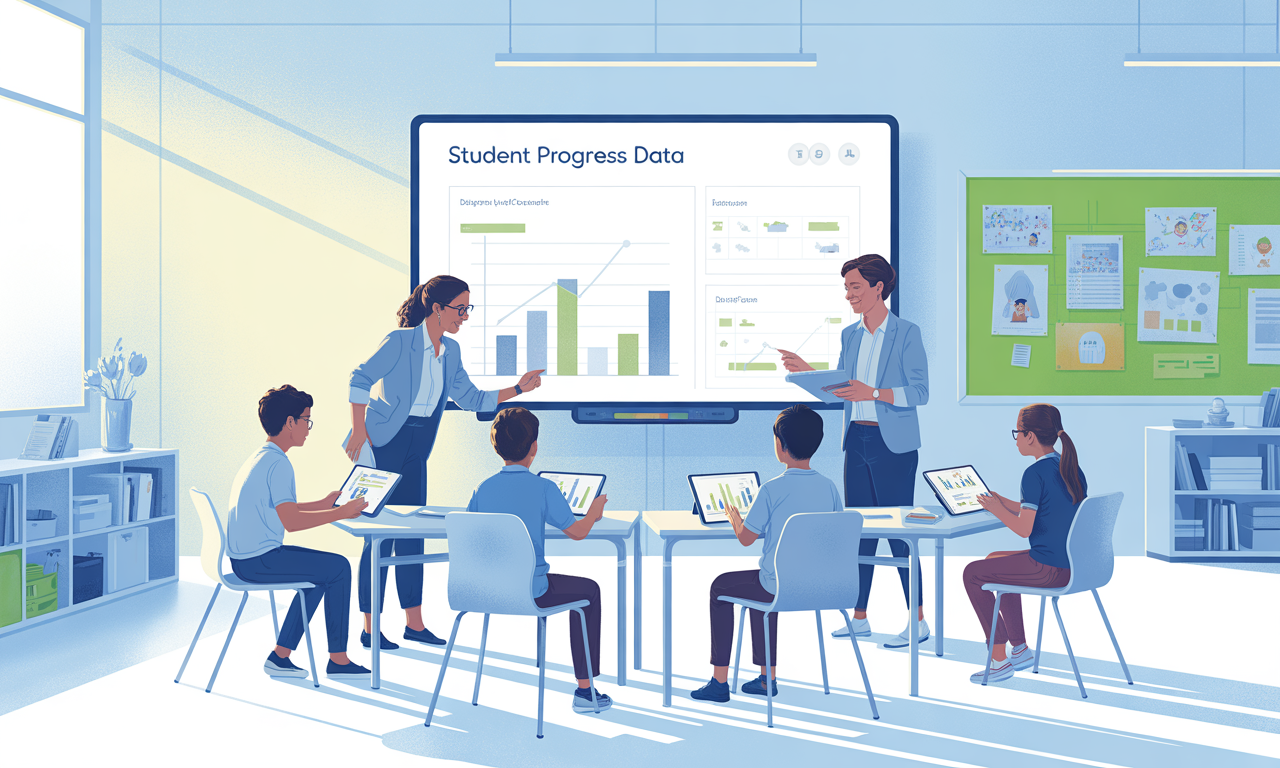
Data gives teachers superpowers – to see what is happening, predict what will happen, and intervene before failure.
Let me show you how.
Step 3: The Problem – Why Traditional Progress Tracking Fails
How Most Schools Track Progress Today
| Method | What It Captures | What It Misses |
|---|---|---|
| Term exams | Performance on one day | Daily progress, learning patterns |
| Homework grades | Completion, some accuracy | Struggle points, help needed |
| Teacher observation | General impression | Specific gaps, trends over time |
| Report card comments | Subjective summary | Actionable next steps |
| Parent-teacher meeting | Verbal updates | Written record, measurable data |
The Result: Vague, Subjective, Unactionable
| Teacher Says | Parent Hears | What Teacher Actually Needs |
|---|---|---|
| "Needs improvement" | "My child is bad" | Specific skill gaps |
| "Struggling with math" | "My child is behind" | Which concepts? Which errors? |
| "Bright but distracted" | "My child is a problem" | Work completion patterns, attention data |
| "Doing well" | "No issues" | Verification of strengths, growth plan |
"Without data, teachers describe. With data, teachers diagnose. Diagnosis leads to prescription. Description leads to confusion."
Step 4: What Data Can Track in Early Education
The 5 Key Data Categories
┌─────────────────────────────────────────────────────────────────────────────┐
│                    STUDENT PROGRESS DATA FRAMEWORK                          │
├─────────────────────────────────────────────────────────────────────────────┤
│                                                                             │
│   ┌─────────────────────────────────────────────────────────────────────┐   │
│   │                    1. ACADEMIC MASTERY                              │   │
│   │  • Concept-specific accuracy (addition, subtraction, etc.)          │   │
│   │  • Error patterns (carry-over mistakes, place value confusion)      │   │
│   │  • Response time (speed with accuracy)                              │   │
│   │  • Grade-level benchmark comparison                                 │   │
│   └─────────────────────────────────────────────────────────────────────┘   │
│                                                                             │
│   ┌─────────────────────────────────────────────────────────────────────┐   │
│   │                    2. LEARNING PROGRESS                             │   │
│   │  • Improvement over time (trend lines)                              │   │
│   │  • Concept mastery sequence (prerequisite gaps)                     │   │
│   │  • Retention over time (does knowledge stick?)                      │   │
│   │  • Speed of learning new concepts                                   │   │
│   └─────────────────────────────────────────────────────────────────────┘   │
│                                                                             │
│   ┌─────────────────────────────────────────────────────────────────────┐   │
│   │                    3. ENGAGEMENT & BEHAVIOR                         │   │
│   │  • Time on task                                                     │   │
│   │  • Number of help requests                                          │   │
│   │  • Distraction patterns                                             │   │
│   │  • Persistence (retry attempts before giving up)                    │   │
│   └─────────────────────────────────────────────────────────────────────┘   │
│                                                                             │
│   ┌─────────────────────────────────────────────────────────────────────┐   │
│   │                    4. SOCIAL & EMOTIONAL INDICATORS                 │   │
│   │  • Participation in group work                                      │   │
│   │  • Peer interactions                                                │   │
│   │  • Confidence indicators (hesitation, volunteering)                 │   │
│   │  • Self-regulation (following routines, transitions)                │   │
│   └─────────────────────────────────────────────────────────────────────┘   │
│                                                                             │
│   ┌─────────────────────────────────────────────────────────────────────┐   │
│   │                    5. COMPARATIVE INSIGHTS                          │   │
│   │  • Individual vs class average                                      │   │
│   │  • Individual vs grade-level benchmark                              │   │
│   │  • Growth vs peers (percentile movement)                            │   │
│   └─────────────────────────────────────────────────────────────────────┘   │
│                                                                             │
└─────────────────────────────────────────────────────────────────────────────┘
Step 5: How Analytics Identifies Weak Areas
Beyond "Struggles in Math"
| Traditional Observation | Data-Driven Discovery |
|---|---|
| "Priya struggles in math" | "Priya solves single-digit addition (90% accuracy). She struggles with 2-digit addition when carry-over is required (40% accuracy). Her subtraction is strong (85%). Specific weakness: carry-over concept." |
| "Rohan is weak in reading" | "Rohan reads at 45 words per minute (grade-level expectation: 60). He struggles with the 'th' and 'wh' sounds. His comprehension remains strong for passages read to him (80%), but drops to 50% when reading independently." |
| "Anjali needs to focus more" | "Anjali completes 60% of classwork within allotted time. She pauses an average of 4 times per 15-minute task. She requires 2-3 redirections per session. However, when tasks are gamified, completion rate rises to 90%." |
Error Pattern Analysis – Example: Addition
| Student | Simple Addition (1+2) | Carry-Over (15+7) | 0-9 (10+10) | Pattern Identified |
|---|---|---|---|---|
| Priya | 95% correct | 40% correct | 85% correct | Carry-over concept gap |
| Rohan | 98% correct | 85% correct | 60% correct | Place value confusion (doesn't understand tens/ones) |
| Anjali | 100% correct | 90% correct | 95% correct | No gaps – ready for multiplication |
Teacher Dashboard Example
| Student | Math – Addition | Specific Gap | Recommended Intervention |
|---|---|---|---|
| Priya | Needs support | Carry-over concept | Use base-10 blocks, practice 15+7 types |
| Rohan | On track | Place value | Daily place value games |
| Anjali | Exceeds | No gaps | Introduce multiplication |
| Vikram | At risk | Counting (fingers) | Number sense, subitizing practice |
"Data tells the teacher exactly which skill to teach next. No guessing. No 'I think.' Just evidence."
Step 6: How Analytics Measures Progress Over Time
Growth Trajectory – Individual Student
| Month | Math Score | Reading Score | Teacher Notes (Data-Informed) |
|---|---|---|---|
| August | 45% | 40% | Baseline: below grade level |
| September | 52% (+7) | 48% (+8) | Intervention working gradually |
| October | 63% (+11) | 55% (+7) | Strong improvement in math |
| November | 70% (+7) | 62% (+7) | Consistent progress |
| December | 75% (+5) | 68% (+6) | Nearing grade level (target: 70%) |
Growth Trajectory – Class Comparison
Class 3A Math Progress (August to December)

100% ─
 90% ─
 80% ─
 70% ─
 60% ─
 50% ─
 40% ─
 30% ─
 20% ─
 10% ─
  0% ─
       Aug    Sep    Oct    Nov    Dec

Class 3A (Teacher A) ──► 45% → 72% (+27)
Class 3B (Teacher B) ──► 48% → 68% (+20)
Class 3C (Teacher C) ──► 42% → 65% (+23)

Insight: Teacher A's strategies are most effective. Share across grade.
"Data doesn't just track individual students. It tracks teacher effectiveness, curriculum effectiveness, and intervention effectiveness."
Step 7: Real-Time Alerts – Catching Problems Early
The Early Warning System
| Trigger | Alert | Intervention |
|---|---|---|
| 3 consecutive math lessons below 50% | Automatic notification to teacher | Schedule 1-on-1 review, adjust lesson plan |
| Reading fluency dropping 2 weeks in a row | Flag for reading specialist | Extra guided reading sessions |
| Homework not submitted 3 times | Parent notification via app | Check-in: is homework too hard? Too much? |
| Student silent in class discussions for 2 weeks | Counselor check-in | Social-emotional assessment |
| Test scores dropped 20% between terms | Principal review | Academic intervention plan |
Example: Early Intervention Saves a Student
| Week | Data Point | Alert | Action | Outcome |
|---|---|---|---|---|
| Week 3 | Math scores 35% | Below threshold | Teacher adds extra practice | Scores improve to 50% |
| Week 5 | Math scores still 45% | No improvement | Specialist observation | Identified language processing issue |
| Week 6 | Language screening | Confirmed gap | Speech therapy referral | Student receives support |
| Week 10 | Math scores 65% | Improvement | Continue support | Student back on track |
Without data: Student would have been labeled "slow," fallen further behind, and potentially referred for special education unnecessarily.
With data: Specific problem identified early. Targeted intervention. Student succeeds.
"Data catches problems when they are small. Fix a small gap today, prevent a large chasm tomorrow."
Step 8: Teacher Dashboard – What Good Analytics Looks Like
For an Individual Student
| Student | Subject | Current Mastery | Weak Areas | Recommended Next Lesson |
|---|---|---|---|---|
| Priya | Math | 68% overall | Carry-over addition, place value | "Addition with regrouping" |
| Priya | Reading | 72% overall | "th" and "wh" sounds, fluency | "Digraph practice – th, wh" |
| Priya | Writing | 75% overall | Capitalization, spacing | "Sentence structure review" |
For the Whole Class
| Class | Subject | Average Mastery | Students Below 50% | Students Above 90% | Teacher Focus |
|---|---|---|---|---|---|
| 3A | Math | 72% | 4 students | 6 students | Remediation group (4 students), enrichment (6 students) |
| 3A | Reading | 68% | 6 students | 5 students | Small groups by level |
| 3A | Science | 81% | 2 students | 12 students | Whole class ready for next unit |
*"A dashboard gives a teacher 30,000-foot view and 2-inch view – instantly. No flipping through notebooks. No trying to remember."*
Step 9: Real Example – School That Transformed with Data
The School
| Detail | Information |
|---|---|
| Location | Hyderabad |
| Students | 500 (Class 1-5) |
| The problem | Teachers relied on intuition. Report cards were vague. Struggling students identified too late. |
The Solution
| Tool | Purpose |
|---|---|
| Digital assessment platform | Weekly 15-minute math and reading checks |
| Teacher dashboard | Real-time view of each student's progress |
| Automatic alerts | Flag students falling behind |
| Parent access | Weekly progress reports via app |
The Results (After 1 Year)
| Metric | Before | After | Change |
|---|---|---|---|
| Students identified as "at risk" before falling 2 grade levels | 20% | 85% | +325% |
| Time to intervention (from struggle to support) | 8-10 weeks | 1-2 weeks | -80% |
| Students who improved from "below grade level" to "at grade level" | 35% | 68% | +94% |
| Teacher confidence in identifying weak areas (survey) | 3.1/5 | 4.6/5 | +48% |
| Parent satisfaction with progress communication | 3.0/5 | 4.5/5 | +50% |
Teacher Feedback
*"Before data, I knew some children were behind, but I couldn't tell you exactly where. Now I pull up a dashboard. 'Ah, Rohan struggles with 2-digit addition.' 'Priya has a place value gap.' I know exactly what to teach next."*
"The early alerts are a lifesaver. I don't have to wait until the term exam to discover a child is struggling. I know in week 3. I intervene in week 4. That child doesn't fall behind for the whole term."
Step 10: Implementing Data Tracking – Practical Roadmap
Phase 1: Start Simple (Month 1)
| Action | Tools | Cost |
|---|---|---|
| Weekly 5-question math check | Google Forms or paper | Free or minimal |
| Track scores in Excel | Excel or Google Sheets | Free |
| Identify students below 50% for 2 consecutive weeks | Manual review | Free |
Phase 2: Add Structure (Month 2-3)
| Action | Tools | Cost |
|---|---|---|
| Digital assessment platform | Simple quiz app (Quizizz, Kahoot) | ₹2,000-5,000/year |
| Teacher dashboard (manual) | Excel with charts | Free |
| Parent reports (weekly) | Email or WhatsApp | Free |
Phase 3: Automate and Scale (Month 4-6)
| Action | Tools | Cost |
|---|---|---|
| Automated assessments | Adaptive learning platform | ₹50,000-1,50,000/year |
| Real-time teacher dashboard | Built-in analytics | Included |
| Automated alerts | Platform features | Included |
| Parent app integration | School management system | ₹10,000-25,000/month |
"Start with paper. Move to spreadsheets. Then invest in digital tools. Don't wait for perfect – start collecting data today."
Step 11: Frequently Asked Questions
Q1: Doesn't data tracking take too much teacher time?
Initially, yes. But digital tools automate data collection and analysis. With the right platform, teachers spend 5-10 minutes per week reviewing data – saving hours of guesswork.
Q2: What data should we track for early education (Kindergarten)?
Focus on foundational skills:
-
Letter recognition (uppercase, lowercase)
-
Letter-sound correspondence
-
Rhyming and phonemic awareness
-
Counting and number recognition
-
Fine motor skills (drawing, writing)
-
Social skills (sharing, listening, following directions)
Q3: How do we ensure data is accurate?
-
Use consistent assessment methods
-
Train teachers on administration
-
Cross-check with multiple data points
-
Regular moderation (teachers review together)
Q4: What about students with learning disabilities?
Data helps identify patterns that may indicate learning disabilities (e.g., consistent reversal of letters, inability to memorize math facts despite practice). But diagnosis requires professional evaluation.
Q5: How do we share data with parents without alarming them?
Focus on growth, not just deficits. "Priya has improved from 30% to 55% in addition. She is making progress. Our next focus is carry-over." Also share strengths.
Q6: What is the minimum data we should track for every student?
-
Weekly concept mastery score (percentage)
-
Homework submission rate
-
Class participation (qualitative)
-
One diagnostic assessment per term
Q7: How often should we assess?
-
Formative (weekly or bi-weekly) – low stakes, guides teaching
-
Summative (termly) – overall progress
Q8: Can data tracking work without computers?
Yes. Paper-based trackers (Excel printed) work. But digital tools save time and provide better visualization.
Q9: What is the biggest mistake schools make?
Tracking data but not acting on it. Data without intervention is just information. Data must lead to action – different instruction, extra support, parent communication.
Q10: How can Innovative AI Solutions help?
We provide data analytics platforms for schools – assessment tools, teacher dashboards, automated alerts, and parent reports. We also offer training and implementation support.
Step 12: Final Tagline (SEO & Social Media Friendly)
"Without data, teachers describe. With data, teachers diagnose. Diagnosis leads to intervention. Description leads to guesswork. Which would you choose?"
Short version:
Data helps teachers track student progress, identify weak areas, and improve outcomes. Stop guessing. Start knowing.
Hashtags:
#StudentProgress #DataAnalytics #EarlyEducation #TeacherTools #EdTech #FormativeAssessment #InnovativeAISolutions
Ready to Bring Data to Your School?
Stop guessing. Start knowing. Let us help you implement data tracking that transforms teaching and learning.
Contact Us
Phone: +91 7464 099 059 / +91 96899 67356
Email: info@innovativeais.com
Address: Netaji Subhash Place, Pitampura, Delhi – 110034
Website: https://innovativeais.com
Related services: to apply this in your business, explore our RAG development and AI development services.