The Skill Assessment Framework
Standard technical interviews built for general software engineers routinely fail to catch AI-specific gaps. You need to assess differently .
For LLM/GenAI Engineers
| Skill Area | What to Assess | Green Flag | Red Flag |
|---|---|---|---|
| RAG Architecture | Design a RAG system for a specific use case | Can explain chunking strategy, embedding model choice, retrieval evaluation | "Just use LlamaIndex" without understanding trade-offs |
| LLM Failure Modes | What can go wrong with LLM-based systems? | Hallucination mitigation, context window limits, cost management | Doesn't know hallucination mitigation strategies |
| Production Reliability | How do you handle API failures and latency? | Retry logic, fallback models, latency monitoring | Never thought about production reliability |
| Agentic Systems | Design a simple multi-agent workflow | Tool registration, state management, orchestration | Confused about how agents work |
The "Demo vs. Production" Test
The most important differentiator is production experience. A demo RAG application built in a weekend with free tools looks identical on a CV to a production RAG system. The difference is in the decisions made :
| Demo RAG | Production RAG |
|---|---|
| Single PDF or small corpus | Millions of documents, dynamic updates |
| No latency requirement | P95 latency SLA (e.g., <3 seconds) |
| No cost optimisation | Token budget management, model tiering |
| No monitoring | Retrieval quality metrics, hallucination detection |
| No fallback | Circuit breakers, graceful degradation |
| No security | Prompt injection prevention, data access controls |
| No audit trail | Every query and response logged with context |
Ask every candidate: "Walk me through an AI system you built that real users depended on. What broke? How did you fix it?" If they cannot name a production system with real users, they do not have production experience .
Step 3: The Interview Process
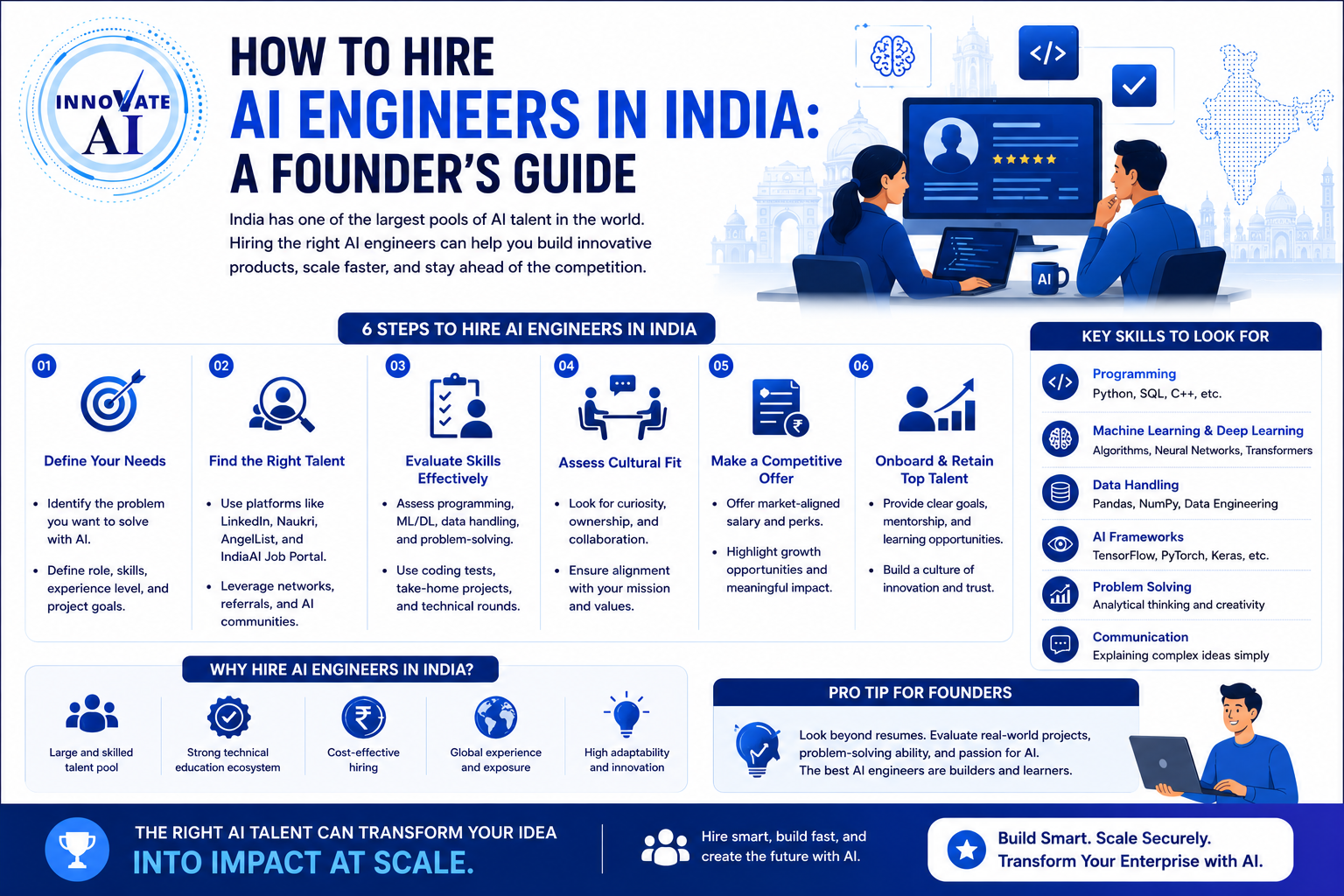
A three-stage process consistently predicts production performance better than ad-hoc technical rounds :
Stage 1: Technical Screening (60 minutes)
An asynchronous coding assessment. For ML engineers, this is a Jupyter notebook task: given a dataset and a business problem, build a model, evaluate it, and document trade-offs. For LLM engineers, it's a prompting task with specific constraints. Look for coding quality, problem decomposition, and documentation discipline.
Stage 2: Technical Deep-Dive (90 minutes)
A live session with a senior engineer. For LLM engineers, design an LLM application for a specific use case (e.g., a document Q&A system with RAG). Push on edge cases: "What happens when the vector database returns irrelevant results? How do you handle the user asking about something outside the knowledge base?"
Stage 3: Hiring Manager Interview (45 minutes)
Focus on product and team fit. Look for concrete examples of production AI systems they have built, how they communicate trade-offs to non-technical stakeholders, and what they actually do when a model's performance degrades in production.
The paid take-home task matters. It signals respect and filters out candidates who aren't serious .
Step 4: Salary Benchmarks in India 2026
The market has moved significantly since 2022. Teams anchoring offers to old ML benchmarks are losing final-round candidates to counter-offers, repeatedly .
| Role | 2–4 Years (₹ LPA) | 4–7 Years (₹ LPA) | 7–12 Years (₹ LPA) |
|---|---|---|---|
| Applied ML Engineer | 12–22 | 20–38 | 35–60 |
| LLM/GenAI Engineer | 10–18 | 18–35 | 32–55 |
| MLOps Engineer | 10–18 | 18–32 | 28–50 |
| Agentic AI Developer | 12–22 | 20–40 | 38–65 |
| AI Architect | 22–35 | 35–55 | 50–90 |
Fresh graduates with AI specialization are now commanding ₹10–25 LPA through elite programmes at Cognizant, Infosys, TCS, and HCLTech—3-4 times standard entry-level salaries .
The GCC premium: Global Capability Centers (GCCs) and product startups are the most aggressive bidders. If you're offering below ₹25 LPA for a GenAI engineer with 3-5 years of production experience, you are likely losing 70-80% of final-round candidates to counter-offers .
City adjustments: These figures reflect Bangalore and Hyderabad rates, where AI compensation runs highest. Pune typically runs 12-15% lower, while Indore runs 30-35% lower .
Step 5: The Hiring Landscape—Where to Find Talent
The Talent Pool Reality
| Profile | Estimated India Pool | Production-Ready |
|---|---|---|
| "GenAI experience" (self-described) | ~180,000 | — |
| ML/AI Engineers with 2+ years ML production | ~28,000 | ~8,000 |
| LLM/RAG Engineers with production deployment | ~12,000 | ~3,500 |
| GenAI Architects with enterprise systems | ~4,200 | ~1,800 |
| Agentic AI engineers with production multi-agent | ~1,400 | ~500 |
The number that matters: approximately 1,800 GenAI architects in India have built enterprise production systems—user-facing, monitored, with latency SLAs and cost controls .
Where to Source
| Channel | Best For | Timeline |
|---|---|---|
| Specialised AI/ML staffing platforms | Pre-vetted candidates | 3–5 weeks |
| IIT/NIT placement cells | Early-career Applied ML talent | Campus cycles |
| Open-source AI communities | Engineers with public portfolios | Variable |
| AI meetups in Bangalore, Hyderabad, Pune | Experienced production engineers | Variable |
| Referrals from existing AI hires | Highest quality signal | Variable |
Median time-to-fill for a Senior LLM/RAG Engineer (production-verified) in Bangalore: 26 days. For a GenAI Architect with enterprise RAG and agentic AI production experience: 38 days .
Step 6: Common Hiring Mistakes to Avoid
Mistake 1: Treating AI Engineering Like Software Engineering
The evaluation criteria are fundamentally different . For a backend engineer, you assess system design and code quality. For an AI engineer, you also assess their intuition about model behavior—their ability to diagnose why a model is underperforming, what data changes will move accuracy, and when to fine-tune versus rebuild. That judgment comes from production experience, not coursework.
Mistake 2: Hiring Based on Framework Knowledge Instead of System Thinking
A candidate who can build a LangChain chatbot in a Jupyter notebook is not the same as one who has shipped a retrieval-augmented pipeline handling 50,000 daily queries with latency SLAs . Frameworks are easy to learn. Shipping reliable AI systems at scale is hard.
Mistake 3: Underestimating the Timeline
Sourcing, screening, technical assessment, negotiation, and notice period: budget 10–14 weeks minimum for a senior hire. Anyone telling you 2–3 weeks is setting you up for a bad experience .
Mistake 4: Anchoring Compensation to 2022 Benchmarks
The market has moved 30-40% higher. GenAI engineers now command a 30-40% premium over equivalent ML engineers .
Mistake 5: Skipping Evaluation Competency in Technical Screens
Teams that ship GenAI features without evaluation pipelines are flying blind. If your screen doesn't test this, you will hire engineers who don't build it .
Step 7: The GenAI Readiness Test for Your Business
Before you start hiring, ask yourself: is your business actually ready for a production GenAI system? A GenAI team without internal AI leadership will produce impressive demos and no deployable product .
Score yourself on these criteria (0 = not in place, 4 = done):
| # | Criterion |
|---|---|
| 1 | Use case defined with specific success metrics (not "build an AI chatbot") |
| 2 | Data strategy confirmed—which data can the AI access, what's off-limits |
| 3 | Acceptable hallucination rate defined—what percentage of incorrect outputs is tolerable |
| 4 | Human-in-the-loop escalation path designed—when does a human review AI output? |
| 5 | Latency SLA defined—what response time is acceptable? |
| 6 | Cost per query budget confirmed—LLM API costs at scale can be significant |
| Score | Tier | Reality Check |
|---|---|---|
| 48–60 | Ready | You know what you're building |
| 34–46 | Builder | 3-4 gaps. Fix before signing SOW |
| 20–32 | Explorer | You're funding experimentation, not production delivery |
| 0–18 | Pre-Stage | Do an internal AI readiness sprint first |
Step 8: Frequently Asked Questions
Q1: How much does it cost to hire an AI engineer in India?
-
Junior (1-3 yrs): ₹8–18 LPA
-
Mid-level (3-6 yrs): ₹18–35 LPA
-
Senior (6-10 yrs): ₹35–70 LPA
-
AI Architect (10+ yrs): ₹70 LPA–1.2 Cr
-
Freelance/contract rates: ₹4,500–₹10,000/hour
Q2: How long does it take to hire an AI engineer?
Direct sourcing with standard job postings: 10–14 weeks. With a pre-vetted specialist pipeline and structured technical screens: 3–5 weeks .
Q3: What is the most important skill to assess?
Production deployment experience. Not demos, not internal tools, not hackathon projects. User-facing systems with real load, latency SLAs, and monitoring .
Q4: Is remote hiring viable for AI engineers in India?
Yes. Bengaluru, Hyderabad, and Pune remain the primary talent hubs, but remote-first roles access a wider pool including strong candidates in Noida, Chennai, and Ahmedabad without meaningfully increasing compensation requirements .
Q5: What is the biggest CV inflation problem in GenAI?
Everyone added GenAI to their CV in 2023-2024. Fewer than 15% have built production systems . The difference between "I used LangChain in a notebook" and "I shipped a production RAG system" is the single most important thing to uncover in interviews.
Q6: How can Innovative AI Solutions help?
We help startups and enterprises build AI engineering teams—from defining the right role and assessment framework to sourcing, screening, and onboarding. Based in Delhi, serving clients across India.
Contact Us
Phone: +91 7464 099 059 / +91 96899 67356
Email: info@innovativeais.com
Address: Netaji Subhash Place, Pitampura, Delhi – 110034
Website: https://innovativeais.com
About the Author
Abhishek Kumar
Founder & CEO, Innovative AI Solutions
5+ years building AI systems and hiring AI engineering talent. Based in Delhi, serving clients across India.
Related services: to apply this in your business, explore our RAG development and generative AI development.