The Big Question
Let me start with a question that every AI product leader must answer.
"Our AI model is 95% accurate. Why don't users trust it? And what do we need to do differently?"
The honest answer:
Accuracy is not trust. Trust is an architectural property.
Here is the truth:
Trust in clinical AI, for example, cannot be reduced to model accuracy, fluency of generation, or overall positive user impression. Trust must be engineered as a measurable system property grounded in evidence, supervision, and operational boundaries of AI autonomy .
A system may demonstrate acceptable average quality while being dangerous if its most critical errors occur in high-risk cases, if it produces an excessive number of false positives, overloads human review, or creates an illusion of autonomy where clinical intervention is actually required .
The HITL Spectrum—Where Does Your System Fit?
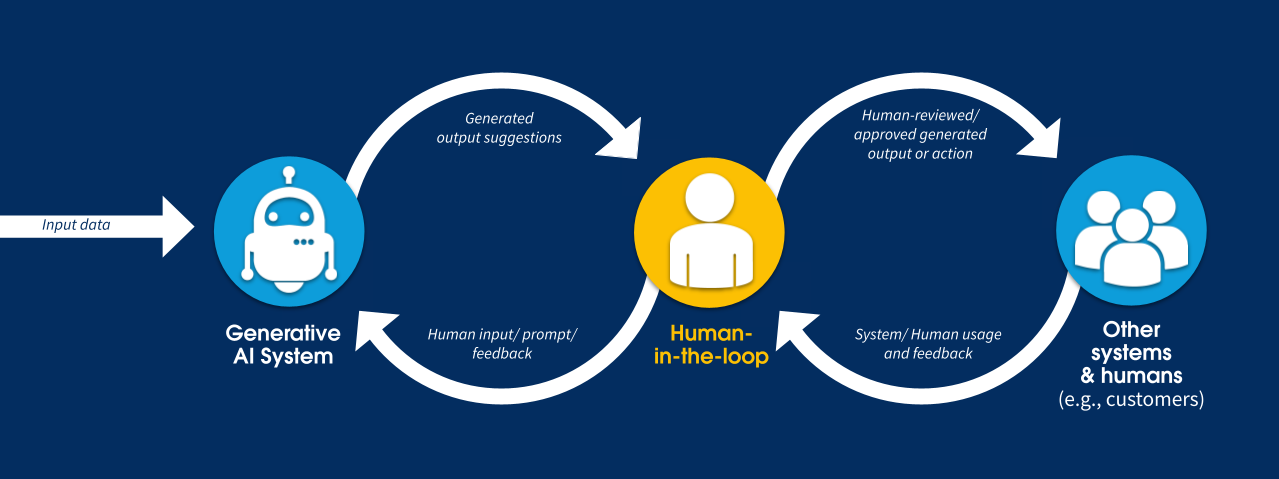
Not all human involvement is the same. The governance model you choose determines how much trust users will place in the system.
The Three Core Models
| Model | Definition | Best For | Example |
|---|---|---|---|
| Human-in-the-Loop (HITL) | Active human intervention required for every output | High-stakes decisions where errors are irreversible | Medical diagnosis, high-value loan approvals |
| Human-on-the-Loop (HOTL) | Human supervises autonomous processes, intervenes on exceptions | Mostly autonomous work with a "safety net" | Fraud detection, autonomous logistics |
| Human-in-Command (HIC) | AI provides recommendations; human retains final authority | Strategic decisions involving long-term governance | Corporate strategy, military operations |
The Emerging Model: Human-Out-of-the-Loop (HOTL)
A newer model positions humans as strategic decision-makers who set boundaries and evaluate outcomes—but do not participate in every action. The key distinction: humans retain oversight, but they delegate execution to AI.
When to Use Which Model
Use HITL when human judgment is a prerequisite for every output—high-stakes outcomes, nuanced interpretation, or active training. Use HOTL for autonomous processes that require a "safety net" or supervisory oversight—exception handling, real-time monitoring, process transparency. Use HIC for strategic, macro-level decision-making where the AI acts as a sophisticated advisor but humans set the intent .
The performance paradox: In high-stakes tasks like detecting fraudulent reviews, AI alone achieved 73% accuracy, whereas the human-AI hybrid dropped to 69% . This gap stems from a lack of sophisticated governance and a fundamental misunderstanding of human-AI collaboration.
The Cognitive Science of Trust
Transparency Reduces Hesitation
A 2026 study from ScienceDirect found that transparency-based interfaces that externalize AI internal states—such as uncertainty visualization and task-goal scaffolding—significantly improve human decision-making. The research revealed a "Cost of Transparency": although transparency slightly increased early information engagement, it reduced decisional hesitation during task execution. Users reported lower mental-demand ratings, meaning transparency actually reduced cognitive burden rather than imposing a net cost .
The takeaway: Transparency does not merely increase cognitive effort—it reshapes evaluative processes in productive ways. The key is designing interfaces that function as cognitive scaffolds, externalizing AI uncertainty and decision-relevant cues to transform user behavior from hesitant guessing into informed decision-making .
Shared Mental Models Enable Better Collaboration
Drawing on Shared Mental Model (SMM) theory, researchers found that effective human-AI collaboration depends on sufficient alignment in task understanding, not identical internal representations. When users understand the AI's intent, capabilities, and uncertainty, they make better decisions .
Practical implication: Design interfaces that reveal what the AI knows, what it is uncertain about, and why it made a particular recommendation. Structured annotation—rather than simple choice or free-form conversation—provides the "sweet spot" that balances user agency with cognitive effort .
Trust Architecture, Not Just Model Quality
Trustworthy AI must be architecturally engineered, not assumed. Trust arises when evidence trails, human oversight, tiered escalation, and policy-based action rights are embedded in the system design from the outset .
Pillar 1: Transparency
Users must understand what the AI is doing, why it is doing it, and what data it is using. This requires:
-
Visualizing AI uncertainty: Show when the model is confident and when it is not
-
Externalizing task goals: Make the AI's intent visible
-
Providing decision-relevant cues: Help users understand why a recommendation was made
Pillar 2: Accountability
Every decision must be traceable to a source, a reasoning path, and a responsible party. This requires:
-
Audit trails: Log every decision and the context that informed it
-
Human oversight: Clear escalation paths for human review
-
Contestability: Mechanisms to challenge and correct AI outputs
Pillar 3: Trustworthiness
Trustworthiness must be measurable, not just perceived. This requires:
-
Calibration: The AI's confidence should match its actual accuracy
-
Evidence traceability: Every answer must be linkable to source documents
-
Reproducibility: The system should behave predictably on similar cases
The Evolution Path: Staged Autonomy
Safe agent autonomy must be achieved through progressive validation, analogous to the staged development of autonomous driving, rather than through immediate full automation . This means starting with high human oversight and gradually increasing autonomy as confidence in the system's performance and alignment grows.
The Triad Architecture—Workflows, Agents, and Human Tasks
The agent architecture that works follows a triad pattern: combining workflows, agents, and human tasks. At the center is a unified orchestration layer—a coordination system that receives a task, breaks it down, and delegates to specialized sub-agents .
How It Works
| Component | Function |
|---|---|
| Workflows | Provide durability and repeatability for deterministic tasks |
| Agents | Offer flexible, probabilistic reasoning for nondeterministic flows |
| Human Checkpoints | Add judgment, policy decisions, and final accountability |
The Dispute Resolution Example
In a dispute resolution workflow, an orchestrator agent receives a complaint and spawns several specialized sub-agents in parallel:
-
An evidence collector agent checks product analytics
-
A Salesforce agent evaluates account signals and returns a risk score
Based on what these agents find, the workflow branches. If the evidence is clear-cut, the system might automatically accept or reject the dispute. But if there is ambiguity, the workflow routes to a human for review and approval before finalizing the decision .
Key insight: Human-in-the-loop checkpoints are designed into the architecture from the start—not added as an afterthought. Humans can see exactly what the AI discovered, review the evidence, and make the final call.
Practical Principles for Designing Trustworthy AI
Contestability Over Explainability
Current approaches to trustworthy AI largely rely on explainability, but explainability alone is insufficient—it enables passive understanding but does not enable users to challenge or correct system outputs .
Contestability is the ability of users to question an AI system's outputs, demand justification, intervene in decision-making, and initiate corrective processes. In multi-agent healthcare systems, for example, contestability enables care partners to challenge decisions, request justification, and override system outputs when they conflict with clinical judgment .
Without contestability, explainability remains limited to passive understanding and does not provide meaningful human control. This weakens clinical responsibility, reduces human agency, and undermines trust .
Design for Contestation
| Requirement | Implementation |
|---|---|
| Challenge mechanisms | Users can ask "why" and "what if" |
| Correction mechanisms | Users can override or correct AI outputs |
| Review mechanisms | Structured processes for human oversight |
| Audit trails | Every decision and override is logged |
The Two Dimensions of HITL
Based on enterprise deployments, HITL operates across two dimensions :
1. Oversight and Accountability: The need for humans to review, interpret, and ultimately accept or reject AI outputs. This is especially relevant in domains where decisions have tangible consequences.
2. Cooperative and Participatory Design: Involving humans not only as validators but as co-creators who define requirements, validate data, shape workflows, test prototypes, and iteratively improve the system to ensure relevance and trust.
The Rolls-Royce Example: In one deployment, the development process included iterations with subject matter experts, engineers, and program managers to ensure the outputs are contextually grounded and trustworthy by design. One colleague remarked: "Well then, I can trust this thing"—expressing confidence in the collaborative design process, not the AI technology itself .
Implementation Roadmap—90 Days
Phase 1: Assessment and Governance (Weeks 1-4)
| Action | Output |
|---|---|
| Identify high-risk decisions requiring human oversight | Risk register |
| Define which HITL model fits each use case | Governance model map |
| Establish contestability requirements | Contestability framework |
| Design audit trails and logging | Traceability baseline |
Phase 2: Interface and Workflow Design (Weeks 5-8)
| Action | Output |
|---|---|
| Design transparency interfaces (uncertainty visualization, decision cues) | UI prototypes |
| Build human checkpoints into workflows | HITL workflow design |
| Implement structured annotation mechanisms | Feedback mechanisms |
| Establish escalation paths for human review | Escalation framework |
Phase 3: Pilot and Iterate (Weeks 9-16)
| Action | Output |
|---|---|
| Deploy HITL system with bounded use case | Working pilot |
| Measure trust metrics (not just accuracy) | Trust baseline |
| Collect user feedback on transparency and contestability | User research |
| Iterate based on feedback | Improved system |
Key Metrics for Trust
Trust metrics must be measurable, not subjective :
| Metric | What It Measures |
|---|---|
| Calibration | Does AI confidence match actual accuracy? |
| Traceability | Can you trace every decision to a source? |
| Contestability | Can users challenge and correct outputs? |
| Reproducibility | Does the system behave predictably? |
| Workflow fit | Does the system reduce cognitive load? |
Frequently Asked Questions
Q1: What is the difference between HITL and contestability?
HITL ensures human involvement. Contestability ensures humans can challenge and correct AI outputs. A system can have HITL without contestability if humans only review but cannot override. Contestability is the ability to question, intervene, and correct—not just observe .
Q2: How do I choose between HITL, HOTL, and HIC?
Use HITL for high-stakes decisions (medical diagnosis, loan approvals). Use HOTL for mostly autonomous work with exception oversight (fraud detection). Use HIC for strategic decisions where humans retain final authority .
Q3: What is the biggest mistake in HITL design?
Treating HITL as an afterthought rather than a foundational design principle. When human oversight is added at the end, users experience friction, and trust erodes .
Q4: How can I measure if users trust my AI system?
Track calibration (does AI confidence match accuracy?), contestability (can users override?), and workflow fit (does the system reduce cognitive load?). Trust metrics must be measurable, not just subjective .
Q5: What is contestability and why does it matter?
Contestability is the ability to challenge and correct AI outputs—not just understand them. Without contestability, explainability is passive. Users can see why a decision was made but cannot change it .
Q6: How can Innovative AI Solutions help?
We help organizations design, build, and deploy human-in-the-loop AI systems—from governance frameworks and interface design to contestability mechanisms and trust metrics.
Final Tagline
"Accuracy is not trust. Trust is an architectural property. It must be engineered—not assumed. The organizations that embed human oversight, transparency, and contestability into their AI systems from the start will build the trust that turns AI from a tool into a partner."
Short version:
Human-in-the-loop AI—designing systems that people actually trust in 2026. HITL spectrum, cognitive science of trust, contestability, and implementation roadmap.
Hashtags:
#HumanInTheLoop #TrustworthyAI #AIGovernance #Contestability #ResponsibleAI #AIDesign #InnovativeAISolutions
Ready to Build Trustworthy AI?
You don't need to sacrifice autonomy for safety. You need to design governance into your AI systems from the start. Let us help you build trust.
Contact Us
Phone: +91 7464 099 059 / +91 96899 67356
Email: info@innovativeais.com
Address: Netaji Subhash Place, Pitampura, Delhi – 110034
Website: https://innovativeais.com
About the Author
Abhishek Kumar
Founder & CEO, Innovative AI Solutions
5+ years building trustworthy AI systems. Based in Delhi, serving clients across India.
Related services: to apply this in your business, explore our AI development services.