The Big Question
Let me start with a question that every AI engineer must answer in 2026.
"If prompt engineering is dead, what skills should I actually be building? And was prompt engineering ever really what we thought it was?"
The honest answer:
Prompt engineering was never about syntax. It was always about clarity of intent—and that skill is not going anywhere.
Here is the truth:
Prompt skills get you a clever one-shot. Context skills get you a system that ships software reliably.
When ChatGPT first took off, people believed that prompt wording could unlock unlimited creativity. Engineers and influencers filled LinkedIn with "magic" templates, each claiming to hack the model's brain. It was exciting at first—but short-lived. As soon as use cases moved from one-off chats to enterprise workflows, the cracks showed.
The end of the prompt craze didn't kill creativity—it redefined it. Writing beautiful prompts gave way to designing resilient environments. The smartest AI engineers today don't ask better questions; they build better conditions for answers to emerge.
Step 3: What Prompt Engineering Actually Was
The Caricature vs. The Craft
A prompt engineer acted as a translator between humans and early AI models, turning natural language queries into structured instructions that produced reliable outputs. For instance, instead of one-off user queries, they could design a template that consistently summarizes legal contracts with the right tone and accuracy.
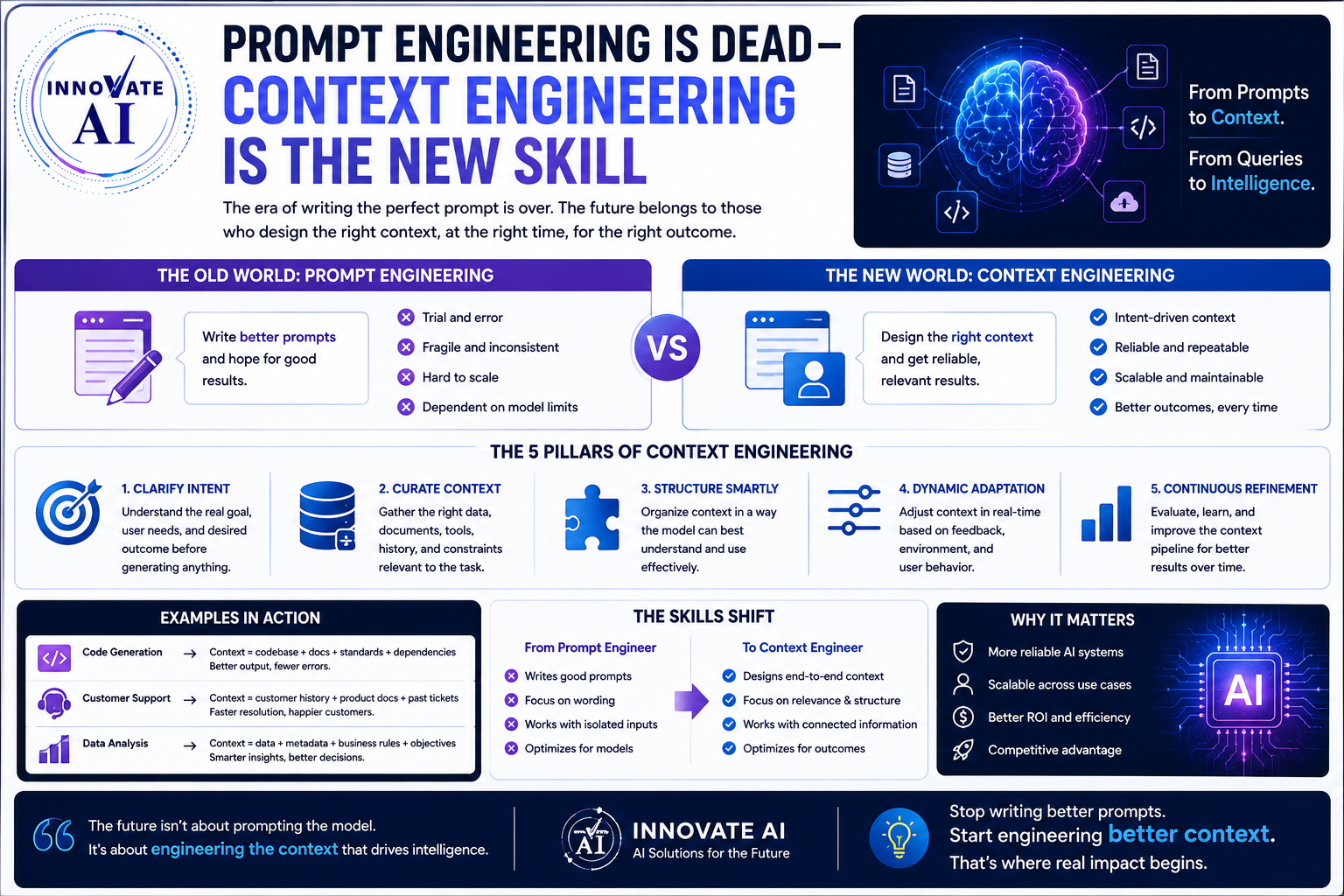
Prompt engineering remains a useful skill for improving a single interaction with a model. But context engineering is fundamentally different—it focuses on controlling the information, structure, governance, and execution boundaries surrounding the model.
The limits of prompt engineering:
| Limit | Why It Happens |
|---|---|
| Prompt fragility | Change one word or token, and the system behaves differently |
| No memory | Models forget and drift unless you spoon-feed them every time |
| No tool reliability | Tool use becomes unreliable because instructions get buried in noise |
| Static context | Prompt engineering treats context as fixed, but agents need dynamic context |
As AI systems mature, organizations seem increasingly concerned with provenance and auditability, retrieval boundaries, orchestration between models and services, deterministic workflows, latency and cost control, and modular offloading to specialized components. Prompt engineering alone cannot address these concerns.
Step 4: What Context Engineering Actually Means
Defining the Discipline
Context engineering is the systematic process of designing and optimizing context collection, storage, management, and usage to enhance machine understanding and their task performance.
Where prompt engineering focuses on the words you say, context engineering focuses on the information architecture surrounding the model.
| Prompt Engineering | Context Engineering |
|---|---|
| Crafts a single instruction | Orchestrates the entire information ecosystem |
| Focuses on wording and phrasing | Focuses on what information lives where, what gets pre-loaded, and what stays out of the window |
| Static, one-time interaction | Dynamic, evolving across multiple steps |
| Treats context as fixed | Treats context as a pipeline that adapts in real time |
| "What do I say?" | "What should the model know, when should it know it, and how should that information be structured?" |
Context engineering is becoming more strategically important than prompt engineering for enterprise systems. As one CTO put it, "Prompt skills get you a clever one-shot. Context skills get you a system that ships software reliably."
The Three Layers of Context
A well-engineered context is layered:
| Layer | Function |
|---|---|
| Persistent identity | Who the user is, what they want, and how the model should behave |
| Knowledge injection | Relevant, time-sensitive knowledge from external databases or APIs |
| Transient adaptation | Updates in real time based on the conversation's direction |
These tiers form the architecture of understanding. The difference between an AI that hallucinates and one that reasons clearly often comes down to a single design choice: how its context is built and maintained.
Step 5: The Architecture Behind Context Engineering
What Context Engineering Manages
Modern AI systems, especially agents that plan, observe, and act across multiple steps, need structured and bespoke context at each step to behave reliably. Context engineering manages:
-
Retrieval
-
Memory
-
Tool definitions
-
Task state
-
Policies
-
Reasoning history
-
Observations
-
Output constraints
The Information Assembly Pipeline
Instead of trying to push prompting beyond its limits, context engineering rebuilds the information assembly pipeline that feeds the model. When a system needs to troubleshoot a production line, its context engineering system dynamically assembles a context window by:
-
Querying knowledge graphs for real-time status of assets and their dependencies
-
Retrieving standard operating procedures from a vector database
-
Accessing memory of similar past events
-
Loading tool definitions the agent can use
-
Potentially delegating sub-tasks to specialized agents
The Context Pyramid
A helpful way to picture the context engineering mindset is the context pyramid:
-
The base is persistent knowledge and policies
-
The middle is dynamic memory and examples
-
The top is the immediate user query and tool output
The goal is to send the smallest, most relevant set of high-signal tokens into the context window.
Step 6: Why Context Engineering Is Replacing Prompt Engineering
The Prompt Craze Was Never Meant to Scale
Prompts rely on linguistic precision, not logic. They're fragile. Change one word or token, and the system behaves differently. In small experiments, that's fine. In production? It's chaos.
Companies learned that models forget, drift, and misinterpret context unless you spoon-feed them every time. So, the industry shifted. Instead of constantly rephrasing prompts, engineers started building frameworks that maintain meaning through memory, metadata, and structure.
The System-Level Shift
Context engineering is a systems-level discipline. It decides:
-
What information lives where
-
What gets pre-loaded per agent invocation
-
What stays out of the window
-
How artifacts stay non-duplicative so agents never see conflicting truth
As AI systems evolve into agents powered by retrieval, memory, policies, APIs, and workflows, prompts are becoming just a cog in a larger machine.
The "Thick Layer" of AI Software
In Andrej Karpathy's words, context engineering is "one small piece of an emerging thick layer of non-trivial software" that powers real LLM apps. A production-grade LLM system typically has to handle many concerns beyond just prompting:
-
Problem decomposition and control flow
-
Model selection and routing
-
Tool integrations and external actions
-
User interaction and UX flows
-
Guardrails and safety
-
Evaluation and monitoring
Designing that loop reliably is a challenge. This is why we are moving from prompt design to system design.
Step 7: The Emerging Standards
Two emerging open standards form the communication layer for agentic systems:
| Protocol | What It Does |
|---|---|
| MCP (Model Context Protocol) | Standardizes agent-to-tool communication—a universal plug-and-play interface for agents to securely access external data and APIs |
| A2A (Agent-to-Agent Protocol) | Standardizes inter-agent communication, allowing different AI agents to collaborate and delegate tasks |
These are not optional. They are becoming the infrastructure for context engineering at scale.
Step 8: What This Means for Your Career
The Shift in Roles
The field is already shifting toward "agent engineering" or "AI systems design." In these roles, prompts remain crucial building blocks but are embedded within larger contexts of retrieval, memory, workflows, and safety layers.
Just as HTML coders gave way to full-stack web developers, context engineering will absorb prompt engineering, leaving little room for prompt-only specialists as enterprises demand end-to-end system expertise.
The Human Skill That Never Changed
Look at what context engineering actually demands of you. You decide what a model needs to know, in what order, under what constraints, and what it must never do. Is that a new skill? It is an old one, scaled up.
The skill of expressing an idea clearly enough that it can be acted upon is as old as teaching, as old as managing people, as old as raising children. It is a human skill before it is a technical one.
Skills for the New Era
| Skill | Why It Matters |
|---|---|
| System architecture | AI generates components; humans design how they connect |
| Context pipeline design | Building the information assembly pipeline |
| Evaluation and monitoring | 90% of AI development time should be on evaluation |
| Tool and API integration | Connecting agents to external systems |
| Guardrail implementation | Preventing unsafe outputs |
| Memory and state management | Ensuring continuity across interactions |
Step 9: Implementation Roadmap—90 Days
Phase 1: Foundation (Weeks 1-4)
| Action | Output |
|---|---|
| Audit current context engineering maturity | Baseline assessment |
| Identify high-impact workflows for context engineering | Use case pipeline |
| Build knowledge base and retrieval infrastructure | Foundation ready |
| Establish governance and memory frameworks | Architecture defined |
Phase 2: Build and Test (Weeks 5-8)
| Action | Output |
|---|---|
| Build context pipelines for one workflow | Working prototype |
| Implement evaluation and monitoring | Quality assurance |
| Measure accuracy and cost improvement | Early ROI data |
Phase 3: Scale (Weeks 9-12)
| Action | Output |
|---|---|
| Expand to multiple workflows | Production deployment |
| Establish continuous improvement cycles | Ongoing optimization |
Step 10: Frequently Asked Questions
Q1: Is prompt engineering really dead?
The label is dying. The skill is not. Prompt engineering was always about clarity of intent—and that skill is as relevant as ever. The difference is that now it is embedded in a larger discipline called context engineering.
Q2: What is the difference between prompt engineering and context engineering?
Prompt engineering focuses on a single instruction to elicit a desired response. Context engineering is the systems-level discipline of designing the entire information ecosystem an AI model sees—system instructions, retrieved knowledge, tools, memory, and policies.
Q3: What happened to the high-paying prompt engineer roles?
The field is shifting toward "agent engineering" or "AI systems design." In these roles, prompts remain crucial building blocks but are embedded within larger contexts of retrieval, memory, workflows, and safety layers. Just as HTML coders gave way to full-stack web developers, context engineering will absorb prompt engineering, leaving little room for prompt-only specialists.
Q4: What are MCP and A2A?
MCP (Model Context Protocol) standardizes agent-to-tool communication. A2A (Agent-to-Agent Protocol) standardizes communication between different AI agents. Together, they form the communication layer for agentic systems.
Q5: Is context engineering also being automated?
Yes. Context engineering is increasingly being automated by AI agents that handle memory, retrieval, tools, and workflows. This shift opens the door for humans to act as AI systems architects who define objectives, devise policies, and ensure ethics and governance, while leaving the cognitive micromanagement to the machines.
Q6: How can Innovative AI Solutions help?
We help teams build context-engineered systems—from architecture and pipeline design to evaluation, monitoring, and production deployment. Based in Delhi, serving clients across India.
Step 11: Final Tagline
Prompt engineering taught us to speak to machines. Context engineering teaches us to build the worlds they think within. The frontier of AI design now lies in memory, continuity, and adaptive structure. Every powerful system of the next decade will be built not on clever wording but on coherent context. The age of prompts is ending. The age of environments has begun. Those who learn to engineer context won't just get better outputs—they'll create models that truly understand. That's not automation. That's co-intelligence.
Short version:
Prompt engineering is dead—context engineering is the new skill. What it means, why it matters, and how to build context pipelines for reliable AI systems.
Hashtags:
#ContextEngineering #PromptEngineering #AgenticAI #AIArchitecture #AISystems #GenerativeAI #InnovativeAISolutions
Contact Us
Phone: +91 7464 099 059 / +91 96899 67356
Email: info@innovativeais.com
Address: Netaji Subhash Place, Pitampura, Delhi – 110034
Website: https://innovativeais.com
About the Author
Abhishek Kumar
Founder & CEO, Innovative AI Solutions
5+ years building AI systems—from prompt engineering to context-engineered architectures. Based in Delhi, serving clients across India.
Related services: to apply this in your business, explore our LLM integration and AI agent development.