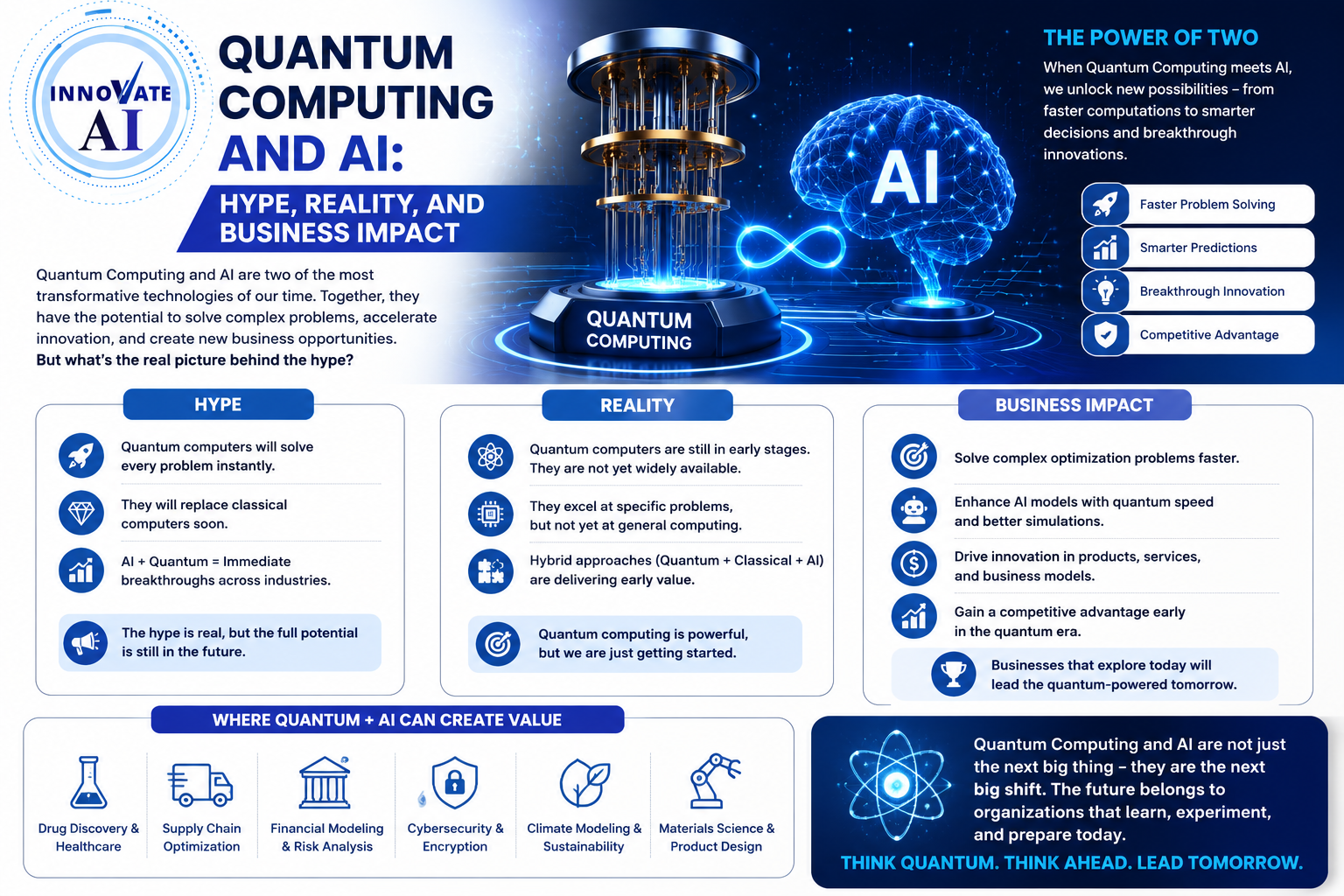
The Big Question
"Is quantum computing the next AI-level revolution, or is it still decades away? Should I be investing now, or waiting?"
The honest answer:
Quantum is real, but it is not imminent. The timeline for practical business impact is 2030 at the earliest—but the time to prepare is now.
IBM's study positions quantum as the fifth and most underappreciated of five forces shaping the enterprise by 2030. The risk is not that companies will miss an early advantage, but that they will fail to adapt when quantum capabilities begin affecting markets indirectly—through supply chains, financial systems, drug discovery pipelines, and national infrastructure .
Step 3: What Is Quantum Computing? (No Jargon)
The Fundamental Difference
Classical computers use bits: 0 or 1. Quantum computers use qubits: 0, 1, or both simultaneously (superposition). This allows quantum computers to explore many possible solutions at once rather than sequentially.
The key capability: Quantum computers can solve certain classes of problems—optimization, simulation, and probabilistic analysis—that strain even the most advanced classical computers .
Quantum AI: The Convergence
Quantum AI is the combination of artificial intelligence and quantum computing. In quantum machine learning, the advantage could be the ability to encode data into higher-dimensional representations that traditional machine learning cannot achieve, and/or the ability to train models with less data .
However, experts caution that the dominant narrative—that quantum will turbocharge AI—is running well ahead of the evidence .
Step 4: The Timeline—When Will Quantum Arrive?
The Predictions
| Source | Timeline |
|---|---|
| UBS | Quantum advantage around 2033 |
| Forrester | Practical utility at 2030 at the earliest |
| IBM, Google, Quantinuum roadmaps | Fault-tolerant systems by 2030 |
| McKinsey | Meaningful commercial value in early-to-mid 2030s |
The "Running Joke" in Quantum
As one expert put it: "It's a running joke in the quantum space—quantum is three to five years away, every year" . The question is not simply when quantum will arrive, but how AI itself will have advanced in that time. As Noah Linden, director of the Bristol Quantum Information Institute, noted: "We're fighting a battle between quantum computing in 10 or 15 years, and what we will have achieved in AI technology in that time" .
The Known Deadline: Q-Day
One deadline is less speculative: Q-Day—the point at which a quantum computer could crack RSA-2048 encryption. It has a roughly 50/50 chance of arriving by 2030, according to Forrester . The U.S. NIST published its post-quantum cryptography standards in 2024 . For most organizations, this is the quantum problem that needs addressing now .
Step 5: The Relationship Between AI and Quantum
AI's Role in Quantum Today
AI is already helping quantum systems become more stable. IBM's Qiskit Runtime is in production use for error mitigation, while Google's AlphaQubit uses a transformer-based decoder that outperforms existing algorithmic approaches on error correction. However, these are operational gains rather than breakthroughs. AI is keeping quantum systems stable and manageable. It is not yet making them transformative .
As Robert Sutor, former VP of IBM Quantum, put it: AI is like noise-cancelling headphones—identifying interference and subtracting it so that a useful, stable signal can get through .
Quantum's Role in AI's Future
Quantum's most immediate role will be as an accelerator for AI-driven workflows. As AI models become larger and more specialized, they generate optimization problems that classical systems struggle to solve efficiently. Quantum computing offers a way to handle those challenges without relying solely on brute-force scaling .
Brian Hopkins, VP of Emerging Technology at Forrester, says: "AI isn't driving quantum breakthroughs yet. Instead, it's helping improve algorithms and hybrid workflows. AI-enhanced hybrid solvers are the most realistic near-term path to early quantum utility" .
Step 6: Real-World Deployments—What's Actually Working Today
Moderna: Drug Discovery
Moderna has been applying quantum algorithms to problems in mRNA design—specifically, predicting how strands of messenger RNA fold, a problem with an astronomically large number of possible configurations. The company used quantum systems involving up to 80 qubits to model mRNA secondary structures, surpassing prior limits in the field .
The significance is not that quantum outperformed classical methods, but that it performed comparably on problems previously considered impractical for quantum systems .
HSBC: Financial Optimization
HSBC tested a quantum tool developed by IBM on European corporate bond market data and found the technology was 34% better than traditional means in predicting how likely an order was to be filled. Philip Intallura, HSBC group head of quantum technologies, called this their "most tangible demonstration of just how close we are from extracting value from quantum computing" .
Google: Error Correction Breakthrough
Google's "Willow" chip successfully demonstrated the first practical application of "surface code" error correction, performing a computation in five minutes that would have taken the world's most powerful classical supercomputer ten septillion years .
A key milestone: This ended the "NISQ" (Noisy Intermediate-Scale Quantum) era and moved quantum into what analysts call the "industrialization phase" .
Step 7: The Business Impact—What's at Stake
The Opportunity
| Industry | Potential Impact |
|---|---|
| Biopharma | Drug discovery timeline: 4-5 years and over $100 million → 12-18 months and $3-5 million |
| Finance | Risk simulation, optimization, and algorithmic trading at unprecedented scale |
| Logistics | Massive supply chain optimization |
| Materials Science | Room-temperature superconductors, carbon capture technologies |
The Risk
Encryption Breaking: Quantum's ability to break RSA-2048 encryption has already been theoretically proven. Data harvested today could be decrypted later. "My advice is to start planning for this transition now" .
The Investment Disconnect
The quantum market shows "striking similarities" to the hype cycles of AI's 50-year journey. Pure-play quantum firms command multi-billion-dollar market caps against minimal revenue:
| Company | Market Cap | Annual Revenue | Revenue Multiple |
|---|---|---|---|
| IonQ (IONQ) | ~$19.9 billion | $52.37 million | ~380x |
| Rigetti (RGTI) | ~$12.0 billion | $7.93 million | ~1,500x |
| D-Wave (QBTS) | ~$10.9 billion | $22.28 million | ~490x |
| Quantum Computing Inc. (QUBT) | ~$3.5 billion | $0.4 million | ~7,800x |
These firms are simultaneously sustaining "massive net losses" while prioritizing heavy R&D investment—indicative of a market driven entirely by speculation on a future paradigm shift .
Step 8: The Geopolitical Dimension
Quantum computing is not merely a corporate race; it is a central pillar of national security. In early 2026, the U.S. government signed the "National Quantum Initiative Reauthorization Act," extending federal funding through 2034 .
The "Quantum-AI Cold War": The U.S. and China are creating two distinct global "technology blocs." The COINS Act effectively freezes U.S. investment in Chinese quantum firms .
The European Union is also set to adopt the "European Quantum Act" by Q2 2026, aiming for "technological sovereignty" by funding six pilot production lines for quantum chips within the Eurozone .
Step 9: What Should Business Leaders Do Today?
IBM's Five Recommendations
IBM's Enterprise in 2030 study calls for organizations to treat quantum the way they once treated cloud computing before mass adoption :
-
Experiment with hybrid workflows: Combine classical computing, AI, and quantum tools, even if those quantum components remain small.
-
Monitor quantum developments: Track them as part of strategic risk management rather than innovation scouting.
-
Build skills and partnerships: Start building governance frameworks now.
-
Plan for Q-Day: Address post-quantum cryptography as a baseline capability.
-
Map quantum value: Identify where advanced computation could unlock value—in drug discovery, financial optimization, or supply chain.
The "AI Strategy Not Enough" Warning
While AI dominates executive agendas—with 79% of respondents saying it will significantly contribute to revenue by 2030—IBM argues that AI's growth will increase demand for new forms of computation rather than reduce it . Quantum readiness is part of AI governance and architecture decisions being made today.
Step 10: Frequently Asked Questions
Q1: Is quantum computing going to replace AI?
No. IBM's study is clear that quantum will not replace classical systems but will instead act as a complementary tool for specific problems like optimization, simulation, and probabilistic analysis. Its most immediate role is expected to be as an accelerator for AI-driven workflows rather than a standalone replacement .
Q2: Why aren't businesses preparing for quantum if they believe it will transform their industry?
59% of executives believe quantum-enabled AI will transform their industry by 2030, yet only 27% expect their organizations to actually be using it. IBM describes this as a strategic miscalculation—unlike previous technology transitions like cloud computing, belief has outpaced preparation .
Q3: When should businesses start preparing for quantum?
IBM recommends companies begin building skills, partnerships, and governance frameworks now—comparing the situation to how forward-thinking organizations adopted cloud computing before mass adoption. Organizations that wait for complete clarity may find quantum's impact arrives embedded in supply chains and markets rather than in obvious product launches .
Q4: What is Q-Day?
Q-Day is the point at which a quantum computer could crack RSA-2048 encryption. It has a roughly 50/50 chance of arriving by 2030. Data harvested today could be decrypted later, making post-quantum cryptography a pressing concern for organizations handling sensitive information .
Q5: How can Innovative AI Solutions help?
We help organizations understand the quantum landscape, develop quantum-ready strategies, and build the hybrid AI-quantum capabilities that will define the next decade of computing.
Step 11: Final Tagline
"Quantum computing is expected to reshape industry by 2030, yet most enterprises are not preparing to use it—a gap that could leave even AI-advanced organizations exposed to the next major computing shift. The risk is not that companies will miss an early advantage, but that they will fail to adapt when quantum capabilities begin affecting markets indirectly—through supply chains, financial systems, drug discovery pipelines, and national infrastructure" .
Short version:
Quantum computing and AI—hype, reality, and business impact. A 2026 guide to the convergence, the timeline, the technology, and what leaders should do today.
Hashtags:
#QuantumComputing #QuantumAI #EmergingTech #AI #BusinessStrategy #InnovativeAISolutions
Contact Us
Phone: +91 7464 099 059 / +91 96899 67356
Email: info@innovativeais.com
Address: Netaji Subhash Place, Pitampura, Delhi – 110034
Website: https://innovativeais.com
About the Author
Abhishek Kumar
Founder & CEO, Innovative AI Solutions
5+ years building AI systems and advising on emerging technology. Based in Delhi, serving clients across India.
Related services: to apply this in your business, explore our AI development services and cloud services.