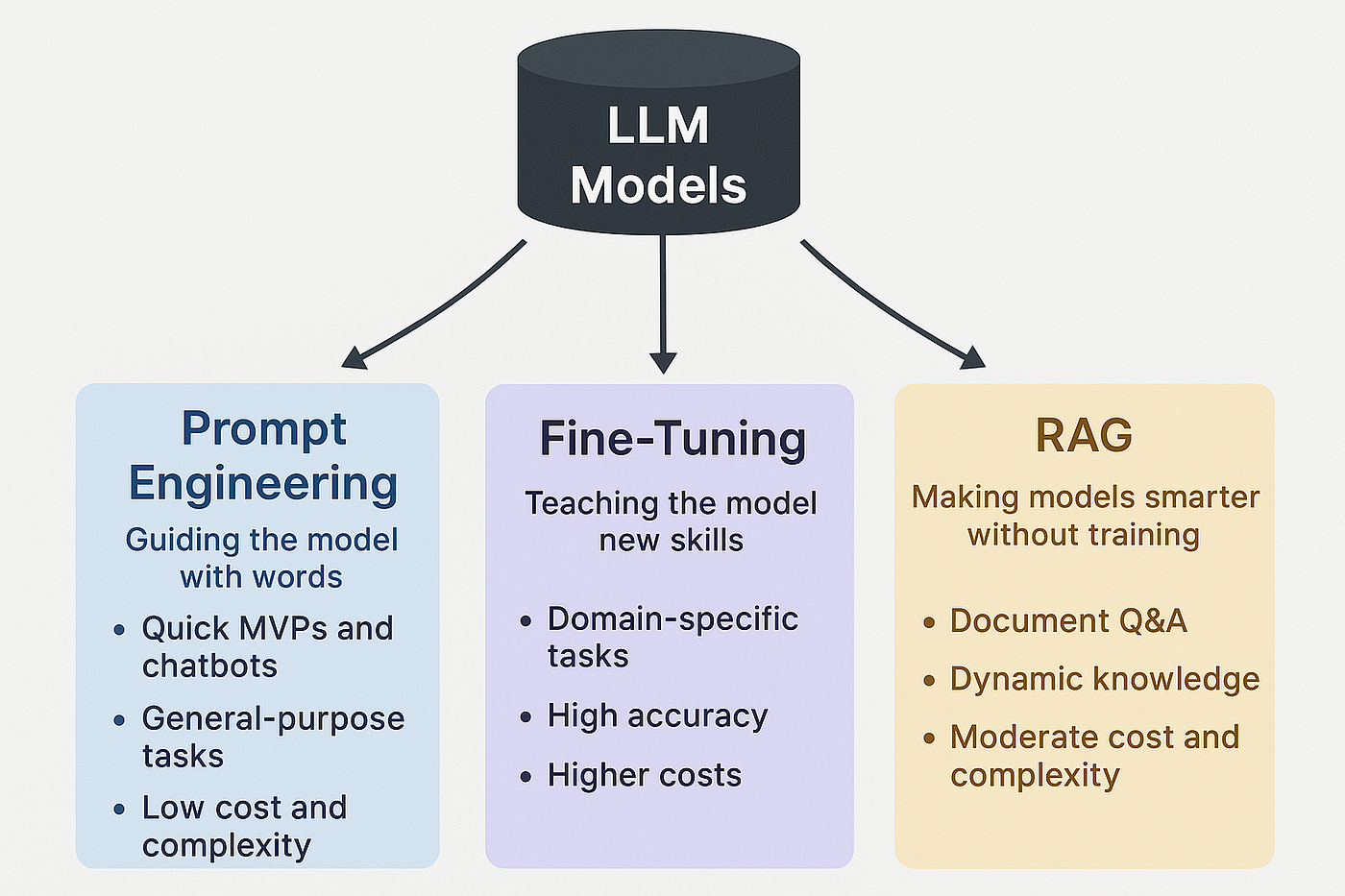
The Big Question
"Should we use RAG or fine-tuning for our customer support assistant? I've read that RAG is better for up-to-date information, but fine-tuning gives more control over tone. And now people talk about combining them. What actually works in production?"
The honest answer:
Most successful enterprise systems use both — but the right starting point depends on your specific constraints.
A 2024 Menlo Ventures survey found that 51% of enterprise AI deployments use RAG in production, while only 9% rely primarily on fine-tuning . Yet a 2026 industrial study on automotive question-answering found that while premium models performed best out of the box, open-source models achieved comparable quality when enhanced with RAG .
Your starting point shapes everything that follows.
Step 3: What Are RAG and Fine-Tuning? (No Jargon)
Retrieval-Augmented Generation (RAG)
RAG connects an LLM to an external knowledge base at inference time. When a query arrives, the system retrieves relevant information from your documents and injects it into the prompt.
Think of RAG as giving your model Google access to your company's private data .
How it works:
| Step | What Happens |
|---|---|
| 1 | User asks a question |
| 2 | System searches your knowledge base (vector database) |
| 3 | Most relevant documents are retrieved |
| 4 | Retrieved documents + question are sent to the LLM |
| 5 | LLM generates answer grounded in those documents |
Fine-Tuning
Fine-tuning continues training a pre-trained model on a specialized dataset, adjusting its internal parameters to reflect domain-specific patterns, tone, and behavior.
Think of fine-tuning as training your model in your company's language .
How it works:
| Step | What Happens |
|---|---|
| 1 | Curate a dataset of prompt-response pairs |
| 2 | Run additional training cycles on that dataset |
| 3 | Model weights adjust to produce desired outputs |
| 4 | Deploy the specialized model |
Step 4: The 2026 Research Reality
Finding 1: RAG's Improved Accuracy Offsets Higher Pipeline Costs
A 2026 study from German research institutions evaluated RAG and fine-tuning on automotive industry QA datasets (vehicle quality tickets and car user manuals) .
The findings were clear:
-
RAG is the most expensive architecture to operate (due to retrieval infrastructure and longer prompts)
-
However, its extended Cost-of-Pass was lowest because it substantially reduces human labor
-
RAG's improved accuracy offsets higher pipeline costs — the primary benefit being significant reduction in human effort
Finding 2: Open-Source Models Can Match Proprietary Giants with RAG
The same study revealed a striking result:
"For domain-specific automotive data, small open-source models match the performance of large proprietary models once RAG is applied" .
Performance comparison:
| Model | Without RAG | With RAG |
|---|---|---|
| GPT-4 (premium) | Best out-of-box performance | Even better |
| LLaMA3.3-70B (open-source) | Lower accuracy | Competes with GPT-4 |
| LLaMA3.2-3B (small open-source) | Poor performance | Achieves respectable accuracy |
This democratizes AI for organizations that cannot afford premium models.
Finding 3: Hybrid Systems Outperform Both
AWS benchmarked RAG, fine-tuning, and hybrid approaches on a customer service dataset :
| Approach | BERTScore | LLM Evaluator Score | Inference Time (sec) | Monthly Cost (USD) |
|---|---|---|---|---|
| RAG | 0.8999 | 0.8200 | 8.336 | ~$548 |
| Fine-Tuning | 0.8660 | 0.5556 | 4.159 | ~$5,107 |
| Hybrid | 0.8908 | 0.8556 | 17.700 | ~$5,457 |
Key observations:
-
RAG achieved the best BERTScore (0.8999) and second-best LLM score
-
Fine-tuning had the lowest latency (4.159 seconds) — good for real-time applications
-
Hybrid achieved the highest LLM evaluator score (0.8556) — best "human-like" quality
"For that dataset, RAG outperformed fine-tuning and achieved comparable results to the hybrid approach with a lower cost, but fine-tuning led to the lowest latency" .
Finding 4: Poorly Planned Deployments Backfire
The automotive study warned:
"An ill-designed setup may cause more cost than having a human complete the task manually, nullifying the benefits of automation" .
Both low-quality retrieval in RAG and overfitting in fine-tuning can produce systems that are worse than no AI at all.
Step 5: The Detailed Comparison
Knowledge Freshness
| Factor | RAG | Fine-Tuning |
|---|---|---|
| How knowledge is stored | External knowledge base (vector DB) | Baked into model weights |
| Update process | Add/update documents — minutes | Retrain model — days to weeks |
| Cost to update | Low (re-index documents) | High (50K−50K−500K per full retraining) |
| Staleness | Near-zero | Knowledge grows stale immediately after training |
"If your knowledge base changes daily, retraining pipelines may introduce operational friction. Evaluation cycles, dataset versioning, and deployment validation all add delay" .
Data Dependency and Governance
| Factor | RAG | Fine-Tuning |
|---|---|---|
| Data needed | Unstructured documents (PDFs, websites, text files) | Labeled, structured training pairs |
| Preparation effort | Low (clean and chunk documents) | High (curation, labeling, validation) |
| Governance maturity | Requires governed data; accuracy drops from 85-92% to 45-60% with ungoverned data | Requires clean training datasets; bad data permanently affects model |
| Explainability | High — retrieved sources are citable | Low — outputs emerge from billions of weights |
Cost Structure
| Factor | RAG | Fine-Tuning |
|---|---|---|
| Upfront cost | Low (no training) | High (training compute, data prep) |
| Per-query cost | Moderate (retrieval + longer prompts) | Low (no retrieval overhead) |
| Economies of scale | Costs scale linearly with queries | Upfront costs amortize over volume |
| Infrastructure | Vector database, embedding pipeline | GPU training cluster, versioning system |
The cost math changes dramatically at scale :
| Monthly Queries | RAG Context Cost (500 tokens/query) | Fine-Tuning Amortized Cost |
|---|---|---|
| 10 million | $8,750 | Lower at this volume? |
| 50 million | $43,750 | Typically lower |
| 100 million | $87,500 | Significantly lower |
"At a sustained scale, what appears flexible and inexpensive becomes a significant recurring expense" .
Latency and Performance
| Factor | RAG | Fine-Tuning |
|---|---|---|
| Latency | Higher (retrieval step adds 50-200ms) | Lower (no retrieval overhead) |
| Consistency | Depends on retrieval quality | Very consistent |
| Best for | Knowledge-intensive QA | Real-time, low-latency applications |
Explainability and Auditability
| Factor | RAG | Fine-Tuning |
|---|---|---|
| Source attribution | Yes — retrieved documents are visible | No — outputs hard to trace |
| Audit trail | Clear — which documents produced which answer | Opaque — black box |
| Regulated industries | Preferred (financial, healthcare, legal) | More difficult to justify |
Step 6: When to Use RAG
RAG is the right choice when:
1. Your Knowledge Changes Frequently
If your domain knowledge updates weekly or daily, fine-tuning becomes operationally expensive. Dataset updates, retraining, evaluation, and deployment introduce delays that can stretch from hours to weeks .
Examples: Customer support policies, product documentation, news, financial data, legal regulations.
2. You Have Extensive Unstructured Data but Limited Labeled Data
Many organizations possess terabytes of internal documents but lack high-quality supervised datasets. Building labeled training corpora requires annotation workflows, domain experts, and quality validation pipelines — often the most expensive part of fine-tuning projects .
Examples: Internal knowledge bases, technical manuals, historical support tickets, legal documents.
3. Governance and Data Residency Are Critical
Once sensitive information is embedded in model weights, deletion and auditing become difficult. RAG architectures avoid this by keeping sensitive information in external storage where standard governance controls already exist .
Examples: Healthcare, financial services, legal, government, any regulated industry.
4. You Need Source Attribution
If your users need to know where an answer came from — or regulators require it — RAG's ability to cite sources is invaluable.
5. You're Starting with Open-Source Models
Recent research shows that small open-source models match proprietary performance when RAG is applied. For budget-conscious organizations, this is transformative .
Examples: Organizations evaluating LLM ROI, startups, non-profits.
6. Query Volume Is Moderate
RAG's per-request cost ($0.001-0.003) is manageable up to tens of millions of monthly queries. Above that threshold, fine-tuning's amortized costs may become more attractive.
Step 7: When to Use Fine-Tuning
Fine-tuning is the right choice when:
1. You Need Consistent Output Format and Tone
Prompt engineering can get you 80% of the way. Fine-tuning locks in the remaining 20% — reliably, consistently, at scale .
Examples: Legal contract generation, structured data extraction (JSON, XML), brand voice compliance, medical coding.
2. Your Domain Has Highly Specialized Terminology
General-purpose models often miss industry-specific jargon. Fine-tuning teaches the model the exact patterns, terminology, and relationships in your domain .
Examples: Medical diagnosis, legal document review, scientific research, regulatory compliance.
3. Query Volume Is Very High (100M+ per month)
At high scale, RAG's per-query retrieval and context costs become significant. A fine-tuned smaller model can be 10-100x cheaper to operate .
Examples: Large-scale customer support, real-time recommendation engines, high-volume API services.
4. Latency Is Critical
Real-time voice interfaces, edge deployments, and applications with sub-100ms SLAs cannot afford retrieval round-trips .
Examples: Voice assistants, real-time translation, high-frequency trading.
5. Knowledge Is Stable and Infrequently Updated
If your underlying knowledge changes quarterly or less, fine-tuning's retraining costs are manageable.
Examples: Fixed taxonomies, static regulations (e.g., ICD-10), internal style guides, company policies that change rarely.
6. You Can Afford the Upfront Investment
Fine-tuning requires: labeled training data, GPU compute, experimentation cycles, versioning infrastructure, and ongoing retraining. This is a full ML lifecycle, not a one-time prompt.
Step 8: The Hybrid Approach — Best of Both Worlds
The enterprise consensus in 2026 is that RAG and fine-tuning are not rivals — they are complements .
Two Common Hybrid Patterns
Pattern 1: Fine-tune then RAG (Most Common)
| Component | Purpose |
|---|---|
| Fine-tuned LLM | Tone, style, formatting, domain language |
| RAG layer | Current facts, up-to-date information, source attribution |
Example: A customer support assistant fine-tuned to speak in your brand voice, using RAG to retrieve the latest product information.
Pattern 2: RAG with Fine-Tuned Retriever
| Component | Purpose |
|---|---|
| Fine-tuned embedding model | Better understanding of domain-specific terminology |
| RAG retrieval | Current knowledge access |
What the Research Says
AWS benchmarked hybrid vs. standalone approaches :
| Metric | RAG | Fine-Tuning | Hybrid |
|---|---|---|---|
| LLM Evaluator Score | 0.8200 | 0.5556 | 0.8556 (best) |
| Latency | 8.3 sec | 4.2 sec (best) | 17.7 sec |
| Monthly Cost (1M queries) | $548 (lowest) | $5,107 | $5,457 |
Key takeaways:
-
Hybrid achieved the highest quality score — best "human-like" responses
-
RAG was most cost-effective for this dataset
-
Fine-tuning had lowest latency — best for real-time applications
-
Hybrid latency is additive — can be optimized with smaller models and efficient retrieval
The RAFT Approach
UC Berkeley's RAFT (Retrieval-Augmented Fine-Tuning) research shows that hybrid systems combining retrieval with fine-tuning outperform either approach alone across benchmarks .
The pattern: fine-tune the model on how to use retrieved information, not just on static answers.
Step 9: Decision Framework — A Practical Flowchart
┌─────────────────────────────────────────────────────────────────────────────┐
│                     RAG vs. FINE-TUNING DECISION FLOW                       │
├─────────────────────────────────────────────────────────────────────────────┤
│                                                                             │
│   START                                                                     │
│     │                                                                       │
│     ▼                                                                       │
│   ┌─────────────────────────────────────────────────────────────────────┐   │
│   │  Does your knowledge change frequently (weekly/monthly)?            │   │
│   └─────────────────────────────────────────────────────────────────────┘   │
│                    │                            │                           │
│                  YES                            NO                          │
│                    │                            │                           │
│                    ▼                            ▼                           │
│            Use RAG FIRST              ┌─────────────────────────┐           │
│                    │                  │ Do you need consistent  │           │
│                    │                  │ output format or tone?  │           │
│                    │                  └─────────────────────────┘           │
│                    │                         │            │                 │
│                    │                        YES           NO                │
│                    │                         │            │                 │
│                    │                         ▼            ▼                 │
│                    │                 Consider          Use RAG              │
│                    │                 Fine-Tuning       (simpler)            │
│                    │                  or Hybrid                             │
│                    │                                                        │
│                    └─────────────────────┬───────────────────────────────── │
│                                          │                                  │
│                                          ▼                                  │
│                    ┌─────────────────────────────────────────────────────┐  │
│                    │  Do you need source attribution (audit trail)?      │  │
│                    └─────────────────────────────────────────────────────┘  │
│                                    │            │                           │
│                                   YES           NO                          │
│                                    │            │                           │
│                                    ▼            ▼                           │
│                              RAG is           Pure fine-tuning              │
│                           strongly            may be acceptable             │
│                           preferred                                         │
│                                                                             │
│                    ┌─────────────────────────────────────────────────────┐  │
│                    │  Is query volume >100M per month?                   │  │
│                    └─────────────────────────────────────────────────────┘  │
│                                    │            │                           │
│                                   YES           NO                          │
│                                    │            │                           │
│                                    ▼            ▼                           │
│                         Consider fine-tuning   RAG is likely                │
│                         for cost efficiency    cost-effective               │
│                                                                             │
└─────────────────────────────────────────────────────────────────────────────┘
The "Start with RAG" Rule
Industry consensus: When in doubt, start with RAG .
Here is why:
| Reason | Explanation |
|---|---|
| Faster to implement | Days to weeks vs weeks to months |
| Lower upfront cost | No training compute or labeled data |
| Easier to iterate | Update knowledge base, not the model |
| Lower risk | No permanent model changes |
| Provides baseline metrics | Before investing in fine-tuning |
| Can evolve to hybrid | Add fine-tuning later for behavior |
"The practitioner heuristic that holds across production implementations: if you need the model to know something, use RAG; if you need it to behave differently, use fine-tuning" .
Step 10: The Fine-Tuning Reality Check
If you are considering fine-tuning, confirm these prerequisites:
Prerequisite 1: Your Knowledge Is Stable
If your domain knowledge changes frequently, fine-tuning will become an operational nightmare. Each update requires dataset preparation, retraining, evaluation, and deployment.
Prerequisite 2: You Have High-Quality Labeled Data
Low-quality training data produces models that are worse than no AI at all. Your dataset must be clean, representative, and free from contradictions.
Prerequisite 3: You Have GPU Compute or Budget
Fine-tuning large models costs 50K–50K–500K per training cycle for full fine-tuning . LoRA reduces this significantly but still requires compute.
Prerequisite 4: You Can Manage the ML Lifecycle
Fine-tuning introduces: data versioning, experiment tracking, model registry, deployment pipelines, monitoring for drift, and retraining schedules.
Prerequisite 5: You Don't Need Source Attribution
Fine-tuned outputs have no traceable source. If your use case requires citable answers, fine-tuning alone is insufficient.
Step 11: Real-World Use Cases
Use Case 1: Enterprise Knowledge Assistant (RAG)
Scenario: Employees need accurate answers from policies, manuals, and internal documentation.
Why RAG works: Knowledge updates frequently, source attribution is required, sensitive data must remain controlled, and there is no labeled training data.
Outcome: Higher accuracy, easier compliance, faster updates .
Use Case 2: Customer Support Automation (Hybrid)
Scenario: A support assistant must follow a consistent brand tone while referencing up-to-date product information.
Approach: Fine-tune for tone and style; RAG for factual grounding .
Outcome: Consistent customer experience, reduced hallucinations, scalable architecture.
Use Case 3: Legal Contract Drafting (Fine-Tuning)
Scenario: Generate contracts in a specific clause format with no retrieval required.
Why fine-tuning works: Low data volatility, style and precision matter more than citations, and fast response is required.
Outcome: Faster responses, lower runtime complexity .
Use Case 4: Automotive Technical Manual QA (RAG)
Scenario: Technicians ask questions about vehicle maintenance.
Research results: RAG on LLaMA3.2-3B matched GPT-4 performance after RAG enhancement .
Use Case 5: Multimodal Manual QA (Hybrid)
Scenario: Question answering with images and text from technical manuals.
Approach: LoRA fine-tuning + multimodal RAG.
Results: BERTScore improved 3.0%, ROUGE-L improved 18.0% compared to baseline RAG. Domain experts rated the system 4.4/5 .
Step 12: Common Mistakes and How to Avoid Them
| Mistake | Why It Fails | The Fix |
|---|---|---|
| Fine-tuning too early | Behavioral fixes without validating retrieval approach | Start with RAG; add fine-tuning only after proving value |
| Ignoring retrieval quality in RAG | "Garbage in, garbage out" — bad chunks produce bad answers | Govern your data; expect retrieval accuracy to drop from 85-92% to 45-60% with ungoverned data |
| Treating RAG as "plug-and-play" | RAG requires careful chunking, embedding, and retrieval optimization | Budget time for retrieval experimentation; chunk size (256-512 tokens) and overlap matter |
| Underestimating governance effort | Unclear data lineage makes audit impossible | Map data sources, version documents, implement access controls |
| Failing to plan for scale | Systems that work at 1,000 queries/month break at 1 million | Understand cost curves early; model RAG context costs at target volume |
Step 13: Frequently Asked Questions
Q1: Is RAG always better than fine-tuning?
No. RAG is better for dynamic knowledge, source attribution, and rapid iteration. Fine-tuning is better for consistent output format, low latency, and stable domains .
Q2: Can I use RAG and fine-tuning together?
Yes. Most successful enterprise systems use hybrid architectures — fine-tuning for tone and behavior, RAG for current knowledge .
Q3: Which is more expensive?
| Volume | Winner |
|---|---|
| Low to moderate (up to 10M queries/month) | RAG (lower upfront, moderate per-query) |
| Very high (100M+ queries/month) | Fine-tuning (if knowledge is stable) |
RAG costs scale with queries. Fine-tuning costs are upfront and amortize .
Q4: Which is faster?
Fine-tuning has lower inference latency (no retrieval step). RAG adds 50-200ms for retrieval .
Q5: Does RAG eliminate hallucinations?
No, but it significantly reduces them when retrieval quality is high . Poor retrieval still produces hallucinations.
Q6: How do I choose between RAG and fine-tuning?
Start with RAG. If you need consistent output format or tone, add fine-tuning. If you need low latency, consider fine-tuning or optimized RAG. If you need source attribution, use RAG.
Q7: What is the RAFT approach?
RAFT (Retrieval-Augmented Fine-Tuning) fine-tunes the model on how to use retrieved information, combining the strengths of both approaches. Hybrid systems outperform either alone .
Q8: Can small open-source models compete with GPT-4?
With RAG, yes. A 2026 study found that LLaMA3.2-3B with RAG matched GPT-4 performance on domain-specific automotive QA .
Q9: What is the biggest RAG failure mode?
Data quality, not retrieval algorithms. Retrieval accuracy runs 85-92% with governed data and drops to 45-60% with ungoverned data .
Q10: How can Innovative AI Solutions help?
We help design and implement RAG pipelines, fine-tuning workflows, and hybrid architectures — with decision frameworks, cost modeling, and production deployment.
Step 14: Final Tagline
"RAG keeps your model current. Fine-tuning makes it yours. The right approach depends on your knowledge, your scale, and your governance. Most enterprises start with RAG — then add fine-tuning for behavior. Start there."
Short version:
RAG vs. Fine-Tuning — complete 2026 guide. Trade-offs, decision framework, cost analysis, and real-world research. Start with RAG. Add fine-tuning when you need behavior.
Hashtags:
#RAG #FineTuning #LLM #EnterpriseAI #GenerativeAI #HybridAI #AIDecisions #InnovativeAISolutions
Ready to Choose Your Approach?
You don't need to commit to one path upfront. Most successful projects start with RAG, prove value, and then add fine-tuning for behavior.
Contact Us
Phone: +91 7464 099 059 / +91 96899 67356
Email: info@innovativeais.com
Address: Netaji Subhash Place, Pitampura, Delhi – 110034
Website: https://innovativeais.com
Related services: to apply this in your business, explore our RAG development and LLM integration.