The Big Question
"If AI agents can do the work of employees, what happens to the software we pay for by the seat – and what happens to our business model?"
The honest answer:
The per-seat model is collapsing. The new model is outcome-based.
Here is the truth:
A single AI agent can now perform the administrative workload of 10 to 15 mid-level employees . Companies are aggressively slashing their software seat counts . The software sector has lost over $1 trillion in market value as investors flee the traditional SaaS model .
What began as a tool for incremental efficiency has evolved into a catalyst for structural change, becoming a system capable of performing discrete units of work with profound implications for pricing, hiring, and the enterprise technology stack .
Step 3: The Software Market Collapse
The $1 Trillion Reckoning
In early 2026, the software sector experienced a historic collapse. A "Black February" sell-off wiped out more than $1 trillion in market capitalization from the software industry .
The catalyst: The widespread deployment of "Computer-Using Agents" – autonomous systems capable of navigating complex software interfaces better than humans, rendering thousands of specialized software tools – and the licenses that fund them – suddenly redundant .
The hardest hit: "Interface-heavy" platforms. Salesforce cratered 38% since the start of 2026. ServiceNow and Workday faced double-digit declines as their core value proposition – providing a destination for human data entry – became bypassable by agentic workflows. Adobe lost over $120 billion in market value in just seven weeks .
Why This Is Happening
| Factor | Impact |
|---|---|
| Per-seat model collapse | Software value tied to headcount. AI compresses labor and licenses |
| Agent-as-worker | Agents execute end-to-end workflows, not just assist |
| "Services-as-Software" | AI-native startups convert human labor spend into software spend |
| Outcome-based pricing | Value tied to results, not users |
Step 4: What Is the Agent Economy?
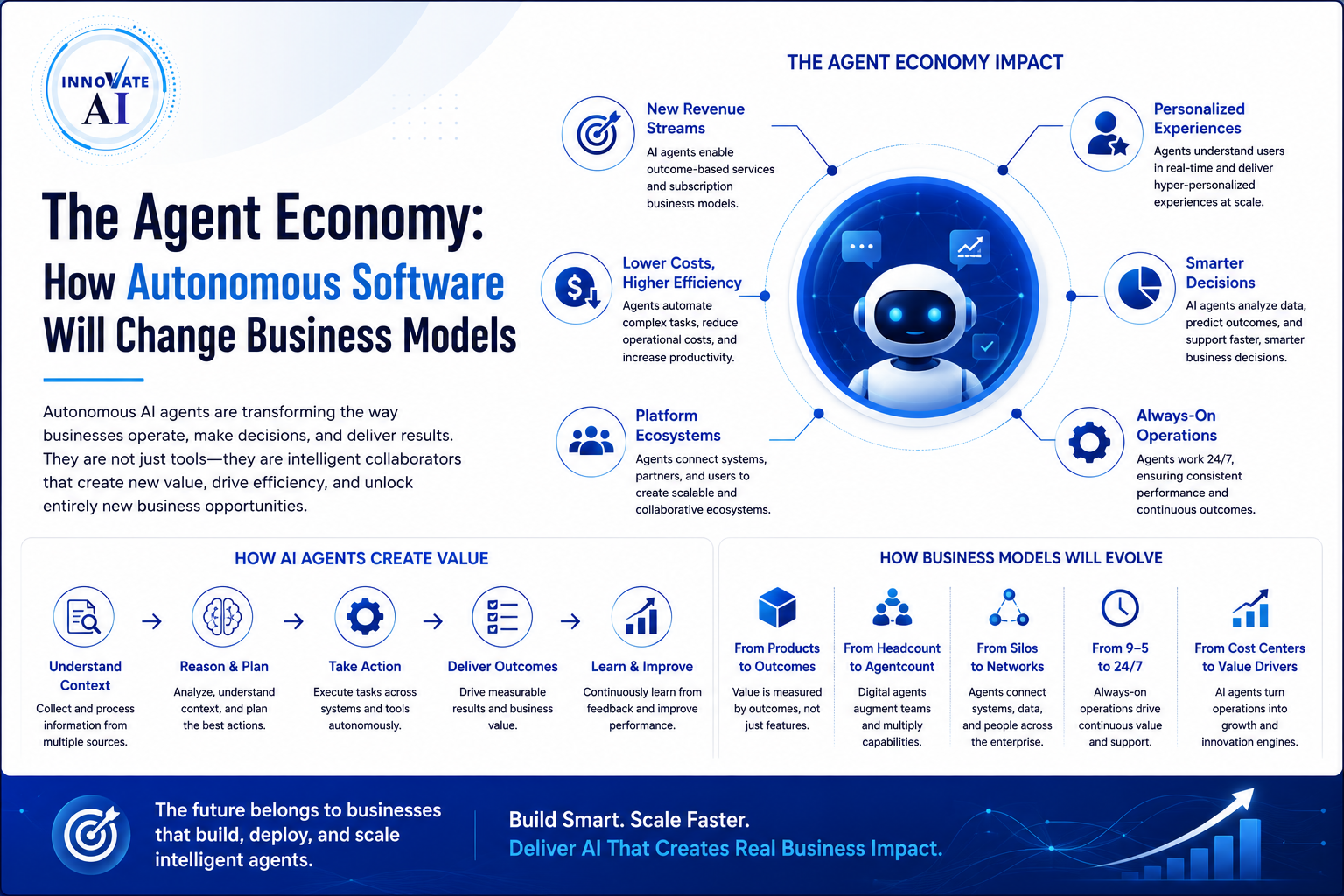
The Agent Economy is the emerging economic paradigm where AI agents – autonomous software systems that can perceive, reason, and act in digital environments – participate directly in markets as buyers, sellers, negotiators, and workers .
The core insight: The SaaS market was worth approximately $140 billion in 2024. Annual wages totaled $11.7 trillion. When software starts performing work rather than assisting, the total addressable market for software vastly expands .
The Shift: From Tools to Workers
| Era | Role of Software | Value Capture |
|---|---|---|
| Systems of Record | Track what humans do | Per-seat licensing |
| Systems of Engagement | Make it easier for humans to work | Per-user SaaS |
| Systems of Labor | Perform work autonomously | Outcome-based pricing |
The Three Key Economic Implications
1. Pricing models are shifting. Many public SaaS firms will need to revisit pricing models, restructure teams, and rethink go-to-market strategies. The firms that survive will likely abandon seat-based economics in favor of usage, workflow, or outcome-based models .
2. Work is being atomized. We are not seeing job cuts, but job atomization – work disaggregating, routine aspects being handled by autonomous execution, and decisions being made and exceptions being handled at the boundaries of human judgment .
3. The execution layer matters more. In the Agent Economy, the companies that win are not simply those with the best front-end experience, but those with the payments, logistics, merchant relationships, data, and digital workflows that agents can access and act on .
Step 5: How Business Models Are Changing
From Per-Seat to Outcome-Based
The shift to agentic AI is forcing investors to rethink legacy software exposure. "If AI compresses labor and licenses, it fundamentally challenges the durability of traditional Software as a Service (SaaS) revenue models" .
| Old Model | New Model |
|---|---|
| Per-seat licensing | Outcome-based pricing |
| Software as a tool | Software as a worker |
| Measured by active users | Measured by autonomous task completion |
| Customer relationship | Transaction-based |
What this means for SaaS companies: "When tectonic shifts hit an industry at scale, leading large, legacy enterprises through this change becomes extraordinarily difficult. It's the Innovator's Dilemma in real time: companies are trying to defend their existing business while, at the same time, the very way software is created is changing" .
The Rise of Services-as-Software
Agentic AI is fundamentally reshaping the economics of software and services. Instead of selling a tool or "seat," these companies are selling an outcome .
| Function | Shift |
|---|---|
| IT | Moving toward AI-driven, automated incident resolution |
| Sales & Marketing | Disintermediating legacy CRMs with AI layers |
| Legal | Shifting from copilots to firm-serving autopilots |
| HR | Automating top-of-funnel recruitment tasks |
The Consumer Side: Bowling-Shoe vs. Bring-Your-Own Agents
MIT research identifies two distinct models for consumer-facing agents :
| Model | Description | Risk |
|---|---|---|
| Bowling-Shoe Agent | Platform-provided, convenient, optimized for the environment | Self-preferencing; may never surface competitor products |
| Bring-Your-Own Agent | User-controlled, portable, aligned with user preferences | Requires more setup; platform access decisions are being made now |
The researchers note: "Both worlds are technically feasible. Which one we get will be decided by firms choosing what to build and what access to grant, and by regulators deciding which kinds of agent access are protected. Those decisions are being made right now, and they'll be hard to reverse once defaults are set" .
Step 6: The $200 Billion Opportunity
Agentic AI Is Expanding the Tech Services Market
BCG's analysis shows that agentic AI will ultimately expand the total addressable market for technology services – unlocking up to $200 billion in net new value pools in the next five years .
The net effect: Even as efficiency gains reduce effort in parts of the current delivery pyramid, agentic AI is simultaneously unlocking new and sizable sources of demand. The net effect is expansion, not contraction .
New Value Pools Are Emerging
| Value Pool | Description |
|---|---|
| Build-Deploy-Run for Agentic Solutions | Agentic application development, implementation, data operations, and infrastructure modernization |
| Expansion in the Addressable Scope of Work | New categories of work become amenable to outsourcing as agents overcome language, context, and domain constraints |
| Oversight and Governance | Demand for recurring services: real-time monitoring, drift detection, human-in-the-loop escalation frameworks, audit trails, compliance reporting |
The $3 Trillion Productivity Opportunity
Fully embracing agentic AI could unlock approximately $3 trillion in global productivity gains – equivalent to a 5% improvement in profitability for the average Fortune 1000 company . Widespread use of AI agents could become one of the strongest drivers of new streams of value in the next three to five years .
Step 7: The Human Role – Partners, Not Replacements
The Real Value Is in Human-Agent Collaboration
The goal is not simply to build a more technically skilled workforce. It's to develop one that is thoughtful, adaptable, and grounded in responsible decision-making . The workforce's ability to understand, question, and collaborate responsibly with AI will determine whether AI amplifies value or erodes it .
New roles emerging:
| Role | Responsibility |
|---|---|
| Orchestration Engineers | Shape how agents think and execute |
| Responsible AI Engineers | Build guardrails and governance |
| AI Supervisors | Oversee autonomous workflows |
The One-Person Company Revolution
Agentic AI could democratize entrepreneurship on an unprecedented scale. The transition from generative to agentic AI allows people to delegate entire layers of execution work to tech-enabled tools .
The Raphael Model: Just as the Renaissance-era painter Raphael ran multiple workshops with skilled associates executing his designs, a single founder can now direct multiple teams of specialized AI agents .
China's one-person company revolution: Alibaba International's enterprise AI agent Accio Work now powers over 230,000 online stores globally and has surpassed 10 million monthly active users. It functions as a full-stack digital workforce for solo founders . Solo lawyers in New York or Nairobi can compete with large traditional firms. Village-based SMEs in Pakistan or Vietnam can source and trade like multinationals .
Step 8: Governance and Trust – The Missing Layer
The Trust Imperative
AI only scales safely and sustainably when trust is built in from day one. The question is no longer whether AI is being used, but how and whether a given agent can be trusted .
Scaling responsibly requires an "agent control system": a governance layer that oversees how agents are deployed, monitored, and evolved .
Trust at scale spans three dimensions:
| Dimension | What It Requires |
|---|---|
| Operational Trust | Real-time controls, centralized AI registries, observability dashboards, human-in-the-loop oversight |
| Technical Trust | Strong data foundations, agent-specific identity and access management, security posture management, threat detection |
| Employee Trust | AI literacy so workers understand an agent's capabilities and limitations, training to counter automation bias and hallucinations |
The Security Reality
The proliferation of AI agents introduces a complex new landscape of risks. Internally, as AI agents inherit permissions and access sensitive data, they create "Shadow AI" attack surfaces that traditional security was never designed to handle .
New security requirements:
-
Agents need their own scoped, temporary, and auditable identities
-
Agents need task-scoped permissions
-
Real-time policy enforcement is required to allow agents to operate autonomously without inheriting dangerous, overscoped credentials
Step 9: Implementation Roadmap – 90 Days
Phase 1: Audit and Assessment (Weeks 1-4)
| Action | Output |
|---|---|
| Inventory current SaaS licenses and seat counts | Visibility into current state |
| Identify workflows where agentic automation could replace seats | Margin-at-risk inventory |
| Assess governance and security readiness | Gap analysis |
Phase 2: Strategy and Design (Weeks 5-8)
| Action | Output |
|---|---|
| Define agent-callable APIs for proprietary business logic | Agent interface specification |
| Decide on agent model (bowling-shoe vs. bring-your-own) | Distribution strategy |
| Establish governance and trust framework | Security controls |
Phase 3: Pilot and Learn (Weeks 9-12)
| Action | Output |
|---|---|
| Deploy one agent for a bounded, high-value workflow | Working prototype |
| Measure outcomes against baseline | Early ROI data |
| Build governance and audit controls | Trust framework |
Step 10: Frequently Asked Questions
Q1: Will AI agents replace human workers?
Neither framing fully captures the reality. The evidence points to job atomization – work disaggregating, with routine aspects handled by autonomous execution and decisions being made at the boundaries of human judgment .
Q2: How will pricing models change in the Agent Economy?
Traditional per-seat SaaS pricing breaks when one agent does the work of ten people. The next generation of software companies will price by results, not logins .
Q3: Is the Agent Economy a short-term trend or a structural shift?
Structural. The software sector has already lost over $1 trillion in market value as investors recognise the shift . The SaaS market ($140B) and the labor market ($11.7T) are converging .
Q4: What is the biggest risk of the Agent Economy?
Trust and governance. Without agent control systems, organizations will face agent sprawl, misalignment, emerging security vulnerabilities, and data-protection risks as agents move across internal and external data flows .
Q5: What is the one-person company revolution?
Agentic AI allows a single founder to direct multiple teams of specialized AI agents, collapsing traditional barriers to starting and scaling a business. This is democratizing entrepreneurship on an unprecedented scale .
Q6: How can Innovative AI Solutions help?
We help organizations navigate the Agent Economy – from margin-at-risk assessments and agent architecture design to governance frameworks and outcome-based pricing models.
Step 11: Final Tagline
"The software sector has lost over $1 trillion in market value because the per-seat model is breaking. The SaaS market ($140B) and the labor market ($11.7T) are converging. When software starts performing work rather than assisting, the total addressable market for software vastly expands. The question is not whether your margin will be contested. It is whether you will be ready when the contest begins."
Short version:
The Agent Economy – how autonomous software will change business models in 2026. $1 trillion SaaS disruption, outcome-based pricing, and strategic implications for leaders.
Hashtags:
#AgentEconomy #AIAgents #SaaS #BusinessModel #OutcomeBased #DigitalTransformation #InnovativeAISolutions
Contact Us
Phone: +91 7464 099 059 / +91 96899 67356
Email: info@innovativeais.com
Address: Netaji Subhash Place, Pitampura, Delhi – 110034
Website: https://innovativeais.com
About the Author
Abhishek Kumar
Founder & CEO, Innovative AI Solutions
5+ years building AI systems and business models. Based in Delhi, serving clients across India.
Related services: to apply this in your business, explore our AI agent development and SaaS development.