The Big Question
Let me start with a question that every education leader must answer in 2026.
"We have seen pilot projects, EdTech apps, and government initiatives. But when does AI actually transform the classroom experience for Indian students—not just in elite institutions, but across the system?"
The honest answer:
The transformation will happen, but it will be uneven. The infrastructure is still being built. The teacher training is still incomplete. The regulatory clarity is still emerging.
This is the current state of AI in Indian education. The vision is clear, but the path is not uniform. Indian education faces three persistent challenges: access, quality, and language. Over 250 million students study in schools where the pupil-teacher ratio is often high, where digital infrastructure is inconsistent, and where the curriculum struggles to keep pace with economic change. AI's promise is to address these challenges at scale—if deployed with intention and equity .
Step 3: The AI Opportunity—Three Directions
Based on where Indian education institutions are currently heading, AI adoption is taking shape across three broad fronts. These are not separate tracks—they overlap and inform each other.
Front 1: Classroom and Pedagogy
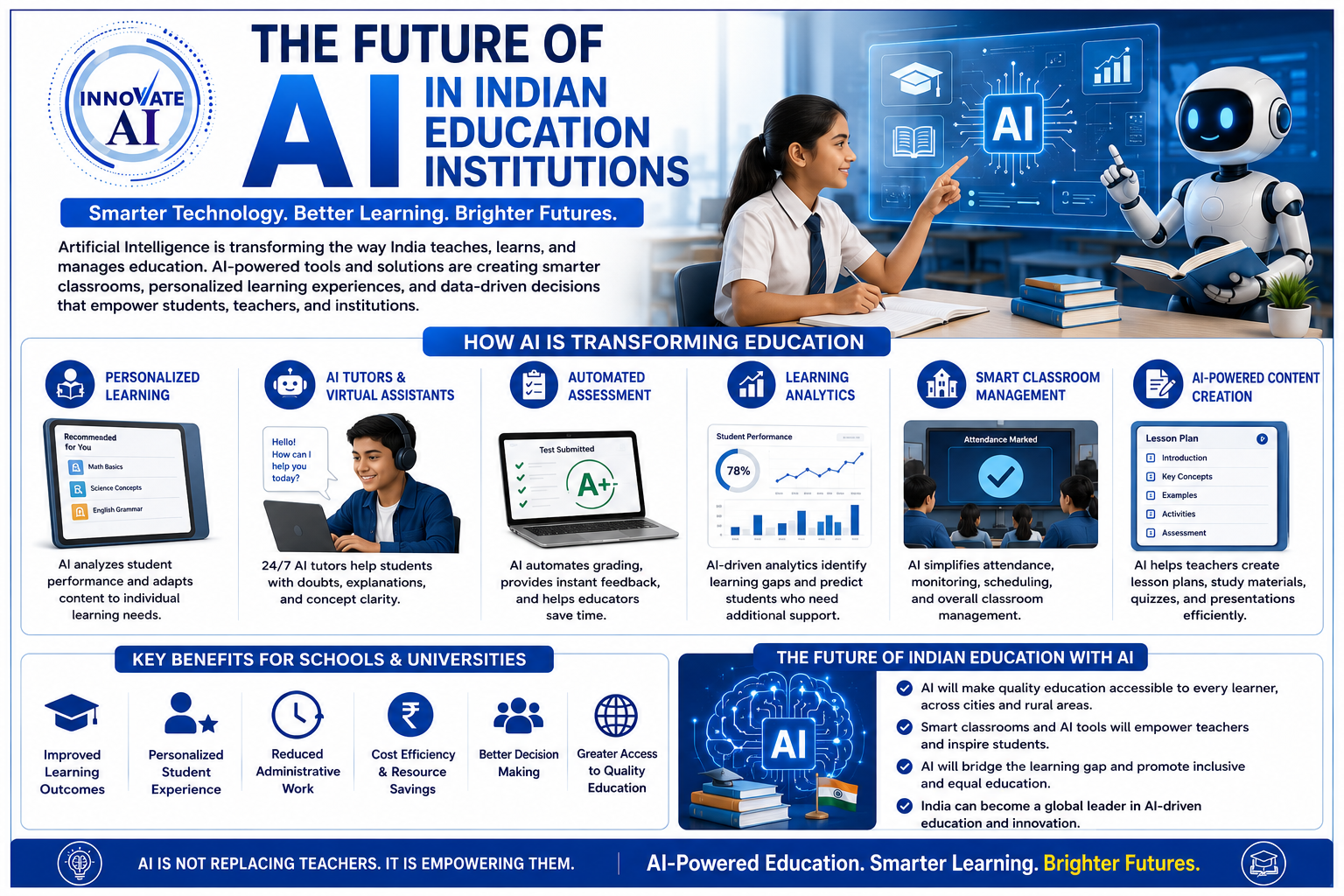
This is where AI directly touches the student and teacher experience. The National Education Policy 2020 has already laid the groundwork: it describes the use of technology in assessment, teaching, and learning as a means to improve outcomes. AI-enabled adaptive learning platforms can now create personalized pathways for students, adjusting difficulty based on performance and engagement. They are particularly valuable in large, mixed-ability classrooms—common in India—where one teacher cannot meet every student's pace.
For teachers, AI is an assistant, not a replacement. Natural language processing tools can help grade written answers with consistency, reducing workload. Generative AI can generate lesson plans, question banks, and teaching materials in multiple languages. This is not automation that replaces judgment—it is automation that frees teachers to teach.
Front 2: Administration and Operations
The second front is behind the scenes. Indian schools are decentralized and administratively heavy. The state board system alone encompasses thousands of schools across 28 states, each with its own schedule, curriculum interpretation, and examination cycle. AI has already begun automating:
-
Admission management
-
Fee collection and tracking
-
Attendance monitoring
-
Report card generation
-
Timetable scheduling
-
Parent communication
These are not glamorous applications, but they are high-impact. A school that automates administrative tasks can redirect its energy toward instruction.
Front 3: Skilling and Employability
The third front is the largest opportunity—and the least discussed in mainstream EdTech narratives. Indian higher education and vocational training systems produce millions of graduates every year, but the link between academic credential and economic opportunity remains weak. AI is being used to:
-
Map curriculum to industry skill requirements
-
Predict dropout risk and recommend interventions
-
Generate career pathways based on student profiles
-
Translate learning resources across Indian languages
-
Provide individualized feedback to students through AI chatbots and writing assistants
This is where AI moves from improving education to reshaping it. When a student's learning path is guided by real-time data on what skills are needed in the labor market, education becomes a continuous interface with the economy.
Step 4: What Makes This Different for India
The global discourse on AI in education tends to focus on performance and optimization. In India, the conversation also includes scale, inclusion, and diversity:
Scale – The Indian system serves nearly 300 million students in school and college, with over 10 million teachers. The number of students enrolled in higher education institutions exceeds 40 million. Any AI solution must work at a scale that most global EdTech systems have not yet faced.
Language – India has 22 scheduled languages, and students learn in dozens more at the primary level. AI's ability to translate, summarize, and generate text in multiple Indian languages—including low-resource languages—is not a feature. It is a necessity.
Equity – Not every student has consistent internet access. Many teachers lack formal training in technology. AI systems must be designed for low-bandwidth environments, offline use, and varying levels of digital literacy among both students and educators. AI tools that rely on high-speed connectivity and 5G devices will remain inaccessible to a large portion of Indian institutions.
Step 5: The Challenges Ahead
No one working on AI in Indian education is unaware of the obstacles. These challenges are structural, not just technical. They require investment, policy alignment, and institutional commitment:
Teacher Readiness
Teachers are the mediators of any educational change. According to some estimates, fewer than 10% of teachers in India have received formal training in AI or data literacy. AI cannot be imposed on teachers. It must be integrated with their workflows, not added as a parallel system.
Data Privacy and Security
India's Digital Personal Data Protection Act (DPDP) 2023 establishes clear parameters for collecting and processing personal data. Schools collect large amounts of sensitive data on students, including health, behavior, and academic performance. The question is not whether data will be collected, but whether it will be collected transparently, used responsibly, and protected from misuse.
Infrastructure
Many schools—particularly in rural areas—still lack reliable electricity, internet access, and functional devices. AI systems that require cloud connectivity, continuous power, or student devices are not yet feasible in these contexts.
Systemic Inertia
The Indian education system is not monolithic, but it is deeply institutionalized. Curricula, examination boards, and assessment frameworks are centralized. Introducing AI-driven assessments or adaptive learning pathways requires not just technical capability, but regulatory coordination across states and boards.
Step 6: What Success Looks Like
Success is not measured by the number of AI tools deployed. It is measured by:
-
Whether teachers feel supported, not replaced
-
Whether students who are behind grade level receive targeted support
-
Whether administrative burden on schools decreases
-
Whether curricula adapt to changing economic needs
-
Whether access to quality education extends beyond cities and private institutions
This is not a technology-first vision. It is a people-first vision enabled by technology.
Step 7: Key Statistics Shaping AI in Indian Education
| Statistic | Implication |
|---|---|
| Over 250 million students in 1.5 million schools | AI must operate at scale never before attempted in education |
| 22 scheduled languages plus regional variations | AI must be multilingual and adaptable |
| Pupil-teacher ratio often exceeds 30:1 in many states | AI is most valuable where individual attention is rarest |
| Digital infrastructure is uneven across states | Offline-first and low-bandwidth solutions are essential |
| DPDP Act 2023 establishes data protection standards | Privacy is no longer optional—it is regulated |
Step 8: Frequently Asked Questions
Q1: Will AI replace teachers in Indian schools?
No. The evidence from education deployments globally suggests that AI is more effective when it augments teachers, not replaces them. In India, the teacher shortage is acute—AI can help by automating administrative tasks and providing personalized practice, but the teacher remains central to instruction and mentorship.
Q2: What is the biggest barrier to AI adoption in Indian education?
Teacher readiness and infrastructure. Fewer than 10% of teachers have received formal AI training, and many schools still lack reliable power and internet . Until these gaps are addressed, AI will remain confined to well-resourced institutions.
Q3: Can AI be used in Indian languages effectively?
Yes. AI translation and summarization models are improving rapidly for Indian languages, though they still lag behind English. The long-term opportunity is to make high-quality educational content available in every language, including underserved ones.
Q4: How does the DPDP Act affect AI in education?
The Digital Personal Data Protection Act, 2023, governs how schools collect, store, and process student data. AI systems must comply with consent, purpose limitation, and data localization requirements. Schools and EdTech providers must ensure that AI tools are used transparently and in compliance with the law.
Q5: What is the role of the National Education Policy 2020?
The NEP 2020 explicitly supports the use of technology in education, describing it as a means to improve access, quality, and equity. It also emphasizes teacher training, multilingual instruction, and flexible learning pathways. AI adoption in education is aligned with the policy's vision .
Q6: How can Innovative AI Solutions help?
We work with schools, universities, and EdTech organizations to design AI systems that align with Indian educational realities—scale, language, infrastructure, and regulation. We build AI for impact, not just innovation.
Step 9: Final Tagline
India's education system is vast, diverse, and uneven. AI is not a replacement for infrastructure, teacher training, or policy coordination—but it is an accelerant. The question is whether we will use it to reinforce existing hierarchies or to extend opportunity to students who have historically been left behind. The technology is ready. The vision is clear. The rest is execution.
Short version:
The future of AI in Indian education institutions—personalized learning, teacher empowerment, administrative automation, and the infrastructure, language, and equity challenges that remain. A practical overview.
Hashtags:
#AIinEducation #IndianEducation #EdTech #NEP2020 #DigitalIndia #AIforGood #InnovativeAISolutions
Contact Us
Phone: +91 7464 099 059 / +91 96899 67356
Email: info@innovativeais.com
Address: Netaji Subhash Place, Pitampura, Delhi – 110034
Website: https://innovativeais.com
About the Author
Abhishek Kumar
Founder & CEO, Innovative AI Solutions
5+ years building AI solutions for education and enterprise. Based in Delhi, serving clients across India.
Related services: to apply this in your business, explore our AI development services and API development and integration.