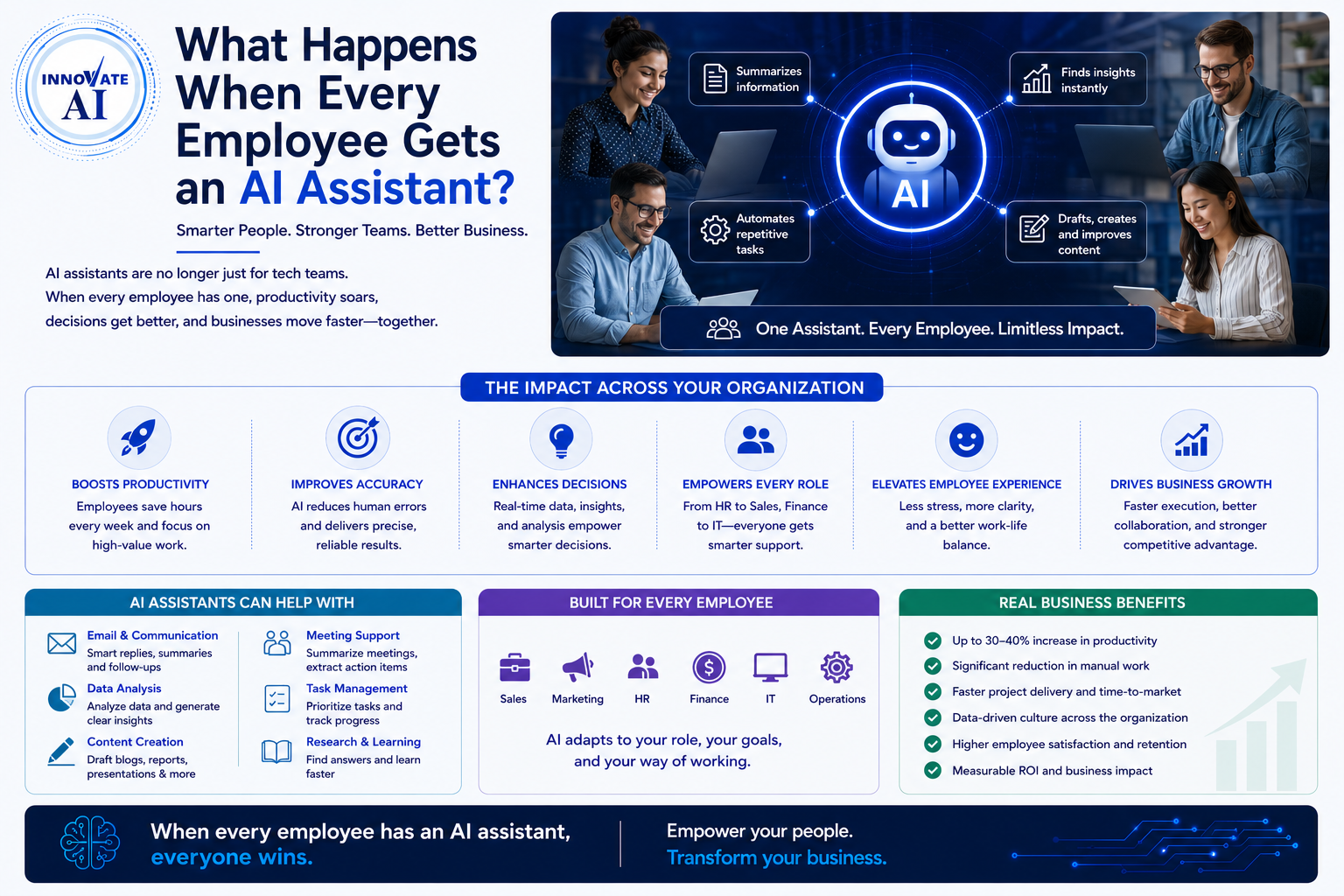
The Big Question
"We have heard about AI assistants improving productivity. But what actually changes when every employee—from the CEO to the newest hire—has a capable AI agent working alongside them? Is this just a productivity bump, or is it something more fundamental?"
The honest answer:
It is a structural shift in how work gets done. Productivity is just the beginning.
Here is the truth:
When AI assistants become ubiquitous, they do not just make workers faster. They change the nature of work itself. They democratize expertise, flatten organizations, and create new expectations for what a single employee can accomplish. The organizations that manage this shift well will see compounding advantages. Those that do not will struggle with misaligned adoption and widening internal gaps.
Step 3: The Scale Is Unprecedented
The numbers are staggering. Cisco is rolling out AI agents to 90,000 employees . Infosys, TCS, and Wipro have each deployed Microsoft Copilot to more than 100,000 employees . Combined, these three Indian IT firms have surpassed 300,000 seats . Elastic has achieved a 98% satisfaction rate with ElasticGPT, saving 63 hours per employee annually with a two-month payback period . Snowflake scaled its GTM AI Assistant to 6,000 users, answering over 330,000 questions and delivering a return on investment exceeding 5x .
The Scale of AI Assistant Adoption
| Organization | Deployment | Key Metric | Source |
|---|---|---|---|
| Cisco | 90,000 employees | Personal AI agent for every worker, dynamic model routing for cost efficiency | |
| Wipro | 100,000+ employees | 7.5M prompts/month; 250,000 FTE workdays saved per quarter | |
| Infosys | 100,000+ employees | 91% monthly active usage | |
| TCS | 100,000+ employees | 86% active users; 20-25% productivity gains in research and content tasks | |
| Elastic | 3,000+ employees | 98% satisfaction; 63 hours saved/employee/year; two-month payback | |
| Snowflake | 6,000 sales/marketing users | 5x ROI; 65+ FTE equivalent productivity gain |
The scale of these deployments signals a clear trend: AI assistants are moving from pilot programs to core infrastructure. The infrastructure investment is significant, with each of the top three IT firms committing approximately $36 million annually at the $30-per-user monthly Copilot rate .
Step 4: What Actually Happens When Every Employee Gets an AI Assistant
Productivity Gains Are Real
The productivity gains from AI assistants are substantial and well-documented. Snowflake's GTM AI Assistant reduced time per question to 5-14 minutes for simple knowledge retrieval and saved hours for complex data analysis . At scale, this translated to 65+ full-time employees' worth of annual productivity across a 6,000-person organization .
| Organization | Measured Impact | Source |
|---|---|---|
| Snowflake | 5x ROI; 65+ FTE-equivalent productivity gain | |
| Elastic | 63 hours saved per employee per year; two-month payback | |
| Cisco | 80-90% of first draft of financial MD&A generated by AI | |
| Wipro | 250,000 FTE workdays saved per quarter |
Work Transforms, Not Just Gets Faster
The most consequential change is not just speed—it is capability. Knowledge workers are emerging as the heaviest users of agentic AI, using it to boost productivity and support learning . Queries cluster into several top categories: productivity and workflow at 36%, learning at 21%, media and entertainment at 16%, and shopping and commerce at 10% .
Harvard Business School researcher Jeremy Yang notes that much of the work is cognitively loaded, such as researching and summarizing key findings—less like an executive assistant and more like a research assistant . "It's like having a second brain and pair of hands," Yang says .
The CFO's Assistant Is Already Writing Financial Reports
Cisco is a prime example of how deeply AI is embedding into core business functions. CFO Mark Patterson reported that AI now produces 80% to 90% of the first draft of the company's Management Discussion and Analysis (MD&A) narrative . The finance team has also developed an AI-powered investor relations tool that analyzes Cisco's historical financial performance alongside competitors' earnings calls to anticipate questions from analysts .
Patterson is also refining a "CFO cockpit," an AI-powered dashboard that synthesizes data across products, geographies, and customer segments to generate forward-looking business insights and recommendations . This represents a shift from AI as a productivity tool to AI as a strategic partner in financial decision-making.
Trust and Judgment Become the Deciding Skill
As AI accelerates content generation, the ability to verify, judge, and take responsibility becomes more valuable. A study of over 5,000 customer service employees found that AI tools helped increase productivity by an average of about 15%. However, the improvement was greater in the group of less experienced employees, while the highly skilled and experienced group received less benefit .
This suggests that AI may help level the playing field for junior employees, but experienced workers need to develop new skills to stay ahead. The new divide in the workplace is not simply between AI users and non-users, but between methodical users and machine-dependent users; between businesses with established management processes and those that simply purchase tools and leave employees to fend for themselves .
Democratized Expertise
AI assistants act as a force multiplier for junior employees, giving them access to capabilities that once required years of experience. One team lead noted that "AI is the leveler of expertise"—junior employees with AI assistants can operate at the level of mid-level professionals. This has profound implications for hiring, training, and organizational structure.
Flatter Organizations
When AI assistants can do the work of middle managers and analysts, the shape of organizations begins to change. Some organizations are already seeing this: small teams with strong AI support are out-performing larger teams without it. The trend suggests a move toward AI-augmented "expert teams" rather than large, hierarchical structures.
Step 5: The Real Challenge—Efficiency Alone Is Not Enough
The most successful enterprise AI deployments treat efficiency as a starting point, not a destination. Cisco's CFO, Mark Patterson, emphasized that the company is focused on using the most efficient AI models, not the most powerful ones . The platform dynamically selects the right model for each task, optimizing both performance and cost .
The "Right Model" Strategy
| Task | Model Type | Cost | Performance |
|---|---|---|---|
| Simple Q&A | Lightweight local model | Low | Adequate |
| Document analysis | Medium model (fine-tuned) | Moderate | High |
| Complex reasoning | Frontier model (external) | High | Very High |
Cisco has built much of its infrastructure on-premises to gain greater control over both operating costs and enterprise data . The company is also pairing the deployment with company-wide upskilling and knowledge-sharing programs to encourage employees to experiment with AI in their daily work .
The 90% Evaluation Rule
Slack's approach to scaling AI—spending approximately 10% of time on prompting and 90% on evaluation, iteration, and observability—is echoed across successful deployments. Snowflake's phased rollout strategy prioritized validation of quality and trust before full deployment . "Quality is P(-1)," the team noted, meaning it is the highest priority before launch . They achieved over 92% NPS among beta users and 70% weekly active user retention before scaling .
Step 6: The Human Role—Why Judgment Still Matters
When Judgment Matters More
| Task Type | AI Role | Human Role |
|---|---|---|
| Data aggregation | Full | Review and verify |
| Drafting and summarization | Full | Edit and approve |
| Anomaly detection | Full | Investigate and decide |
| Strategic analysis | Support | Lead and decide |
| Final decisions | None | Full |
| Critical thinking | Support | Full |
| Negotiation and relationship | None | Full |
The Productivity Gap
The potential for AI to exacerbate inequality is real. Employees who know how to use AI effectively can process larger amounts of information, prepare documents faster, and dedicate more time to tasks requiring critical thinking. Those who stick to old processes risk being at a disadvantage in terms of speed and efficiency .
However, the ability to write code or use AI tools is not the only skill that determines an advantage. Workers must also know how to define objectives, provide sufficient context, identify misinformation, verify sources, protect data, and assess which tasks should be delegated to AI .
The Accountability Imperative
According to Microsoft's Work Trend Index 2026 survey, 66% of AI users surveyed said the technology helps them dedicate more time to high-value tasks. Meanwhile, 86% believe that AI output is only a starting point and that humans still need to be responsible for evaluation and editing .
Step 7: The Cisco Lesson—AI Alone Does Not Fix Broken Processes
Cisco's experience offers an important cautionary tale. While the company is a leader in AI deployment, Cisco executive Liz Centoni has acknowledged that adopting AI across a large enterprise can be a difficult process, describing it as "surgery without the drugs" .
One key lesson came from Cisco's customer support operations. The company initially deployed generative AI to create summaries when support cases were transferred between engineers during shift changes. While the technology sped up handoffs, it failed to improve the customer experience .
"The outcome was never the handoff," Centoni said. It was "how do I get to the right engineer the first time around?" .
This insight is critical. AI is not a substitute for good process design. It amplifies whatever processes already exist.
Step 8: Implementation Roadmap
Phase 1: Pilot and Validate (Months 1-3)
| Action | Output |
|---|---|
| Launch AI assistant to a small, motivated team (e.g., 100-200 users) | Validated quality and trust |
| Focus on user quality (P-1) and test phase | >90% NPS; >70% weekly active retention |
| Identify use cases where AI delivers the highest value (research, drafting, data analysis) | Use case catalog |
| Establish cost controls and model routing | Efficient model selection |
Phase 2: Scale and Activate (Months 4-6)
| Action | Output |
|---|---|
| Expand to the broader organization (thousands of users) | Broader deployment |
| Deploy company-wide upskilling and knowledge-sharing programs | AI-literate workforce |
| Create momentum with leadership support and enablement | High adoption |
| Measure productivity gains and ROI | ROI data |
Phase 3: Optimize and Transform (Months 7-12)
| Action | Output |
|---|---|
| Redesign workflows around AI capabilities | Structural change |
| Enable employees to create their own AI agents | Employee-developed agents |
| Shift accountability and judgment requirements | Clear governance |
| Scale what works and stop what doesn't | Continuous improvement |
Step 9: Frequently Asked Questions
Q1: Will AI assistants replace human workers?
No. The evidence suggests augmentation, not replacement. Employees with AI assistants do more, not less. However, roles and responsibilities shift significantly.
Q2: What is the biggest mistake companies make with AI assistants?
Treating AI as a plug-in without redesigning processes. Cisco's experience shows that adding AI to existing workflows doesn't necessarily solve underlying problems. The outcome was never the handoff—it was getting to the right engineer the first time .
Q3: How do I measure ROI from AI assistants?
Track both direct productivity gains (time saved, workdays saved) and indirect benefits (reduced analyst load, faster deal cycles, improved decision quality). Snowflake measured a 5x ROI including only direct productivity savings .
Q4: Will AI assistants create inequality in the workplace?
Potentially. Employees who adopt AI effectively will be significantly more productive than those who do not. The gap is not between users and non-users, but between methodical users and machine-dependent users .
Q5: Do we need to rebuild our enterprise to accommodate AI assistants?
Not entirely, but some redesign is necessary. AI amplifies whatever processes you already have. If your processes are broken, AI will break them faster. If they are well-designed, AI will make them more efficient.
Q6: How can Innovative AI Solutions help?
We help organizations design, deploy, and optimize AI assistants at scale—from pilot architecture and cost controls to change management and workflow redesign. Based in Delhi, serving clients across India.
Step 10: Final Tagline
"The question is no longer whether AI assistants will reach every desk. It is what happens when they do. The organizations that manage this shift well will see compounding advantages. Those that do not will struggle with misaligned adoption and widening internal gaps. The AI revolution is not coming. It is already in your inbox. The only question is how quickly you will learn to work alongside it."
Short version:
What happens when every employee gets an AI assistant? The quietest revolution in business history—with real productivity gains, structural shifts, and new demands for judgment and accountability.
Hashtags:
#AIAssistant #EnterpriseAI #FutureOfWork #AIAgents #AIDeployment #DigitalWorkforce #InnovativeAISolutions
Contact Us
Phone: +91 7464 099 059 / +91 96899 67356
Email: info@innovativeais.com
Address: Netaji Subhash Place, Pitampura, Delhi – 110034
Website: https://innovativeais.com
About the Author
Abhishek Kumar
Founder & CEO, Innovative AI Solutions
5+ years building AI systems for enterprises. Based in Delhi, serving clients across India.
Related services: to apply this in your business, explore our AI agent development and AI development services.