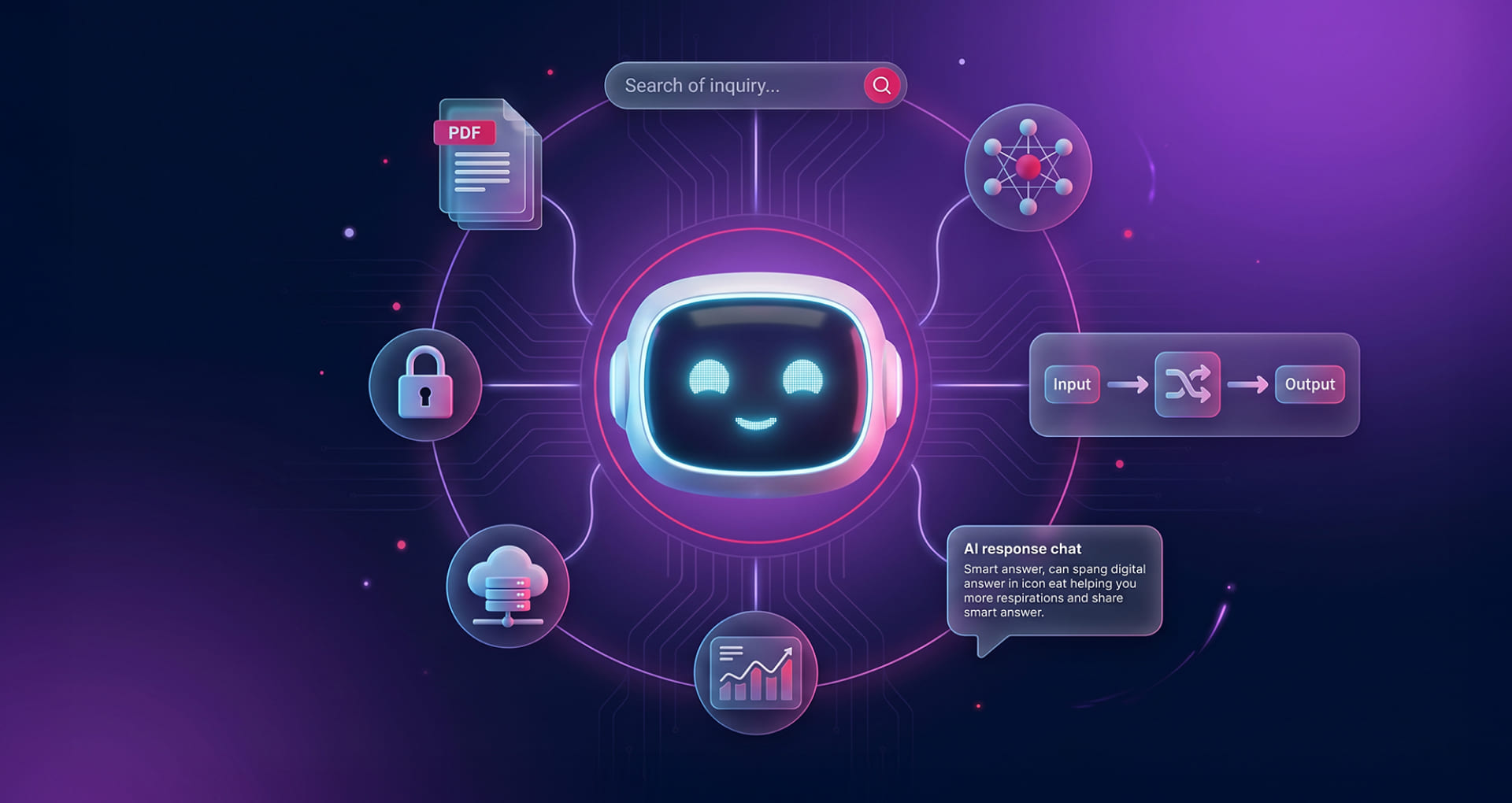
The Big Question
"Abhishek, we built a chatbot. It answers FAQs. But customers still call for anything beyond basic questions. It doesn't know their order status. It can't check their account balance. It feels like talking to a wall. Is that just how chatbots are?"
The honest answer: No. That is how basic chatbots are. RAG-powered chatbots are different.
Your current chatbot knows what you told it – a fixed set of FAQs. A RAG chatbot knows your data – your customer records, your inventory, your policies, your entire business knowledge.
The difference is between talking to a receptionist who can only read a script and talking to an expert who can access your file before you walk in.
Step 3: What Is RAG (Retrieval-Augmented Generation)?
Simple Explanation: RAG gives your chatbot the ability to look up information from your business data before answering.
| Without RAG | With RAG |
|---|---|
| Chatbot knows only what it was trained on (general knowledge + your FAQs) | Chatbot can query your order database, knowledge base, product catalog, policy documents |
| Same answer for every customer | Personalized answer based on customer history |
| "I don't know" when question isn't in FAQs | "Let me check" – and actually finds the answer |
| Answers are generic | Answers are specific, accurate, and up-to-date |
How RAG Works – A Simple Visual
┌─────────────────────────────────────────────────────────────────────────────┐
│                    HOW RAG WORKS                                            │
├─────────────────────────────────────────────────────────────────────────────┤
│                                                                             │
│   USER: "Where is my order?"                                                │
│         │                                                                   │
│         ▼                                                                   │
│   STEP 1: Chatbot understands the request                                   │
│         │                                                                   │
│         ▼                                                                   │
│   STEP 2: Chatbot retrieves relevant information from your data             │
│         │   ┌─────────────────────────────────────────────┐                 │
│         ├──►│ Order database (looks up order #12345)      │                 │
│         ├──►│ Knowledge base (shipping policy)            │                 │
│         ├──►│ Customer history (past orders, preferences) │                 │
│         │   └─────────────────────────────────────────────┘                 │
│         │                                                                   │
│         ▼                                                                   │
│   STEP 3: Chatbot generates personalized answer                             │
│         │                                                                   │
│         ▼                                                                   │
│   RESPONSE: "Your order #12345 shipped yesterday and is out for delivery    │
│             today. Tracking link: [link]. Would you like me to notify you   │
│             when it's delivered?"                                           │
│                                                                             │
└─────────────────────────────────────────────────────────────────────────────┘
"RAG turns your chatbot from a script-reader into a knowledgeable assistant who can access your entire business data in real-time."
Step 4: Why Basic Chatbots Are No Longer Enough
The Problem with Traditional Chatbots
| Limitation | Impact |
|---|---|
| Fixed training data | Cannot answer anything outside pre-loaded FAQs |
| No personalization | Every customer gets the same answer |
| No real-time information | Cannot check order status, inventory, account balance |
| No learning | Answers don't improve from new information |
| High maintenance | Every change requires retraining or manual updates |
The Customer Expectation Gap
| Customer Expects | Basic Chatbot Delivers |
|---|---|
| "Does this product fit me?" | "Check our size guide" |
| "Where is my order?" | "Please call customer service" |
| "Can I change my delivery address?" | "I don't understand that question" |
| "Why was my return rejected?" | "Please refer to our return policy" |
"Your customers don't want to talk to a FAQ bot. They want to talk to an assistant who knows them and can actually help."
Step 5: What a RAG-Powered Chatbot Can Do That Basic Chatbots Cannot
Capability 1: Personalized Customer Support
| Basic Chatbot | RAG-Powered Chatbot |
|---|---|
| "What is your return policy?" (generic link) | "I see you ordered a size M blue shirt on May 15. According to our policy, you can return it until June 15. Would you like me to initiate the return?" |
| No context of past interactions | Remembers past conversations, preferences, purchase history |
Capability 2: Real-Time Business Information
| Basic Chatbot | RAG-Powered Chatbot |
|---|---|
| "I cannot check order status. Please call." | "Your order #12345 is out for delivery. Tracking number: XYZ. Expected delivery: today by 5 PM." |
| "Please check our website for inventory" | "The blue shirt in size M is in stock at your local store. Would you like me to reserve it?" |
Capability 3: Dynamic Policy & Knowledge Access
| Basic Chatbot | RAG-Powered Chatbot |
|---|---|
| Only knows policies loaded during training | Queries latest policy documents in real-time |
| Requires retraining when policies change | Automatically reflects updated documents |
Capability 4: Proactive Engagement
| Basic Chatbot | RAG-Powered Chatbot |
|---|---|
| Responds only when asked | "I see you've viewed this product three times. It's now back in stock. Would you like me to notify you when price drops?" |
"A RAG chatbot knows your customer before they ask. That is the difference between transactional and relationship-building."
Step 6: Business Use Cases Across Industries
E-commerce / Retail
| Use Case | How RAG Helps |
|---|---|
| Order status | Queries order management system in real-time |
| Product recommendations | Analyzes browsing history, past purchases, inventory |
| Returns processing | Checks order date against return policy, initiates return |
| Size & fit advice | Queries size guide, customer reviews, return rates by size |
Healthcare
| Use Case | How RAG Helps |
|---|---|
| Appointment scheduling | Checks provider availability, patient history, insurance eligibility |
| Prescription refills | Queries patient medication list, last refill date, provider approval |
| Symptom triage | Queries medical knowledge base, patient history, flags emergencies |
| Billing questions | Queries insurance coverage, outstanding balance, payment plans |
Finance & Banking
| Use Case | How RAG Helps |
|---|---|
| Account balance | Real-time query to banking systems |
| Transaction disputes | Retrieves transaction details, applies dispute policy, initiates process |
| Loan applications | Checks credit score, income documents, application status |
| Fraud alerts | Analyzes transaction patterns, flags anomalies, guides reporting |
Professional Services (Legal, Accounting, Consulting)
| Use Case | How RAG Helps |
|---|---|
| Document Q&A | Queries client contracts, legal documents, case files |
| Status updates | Checks project milestones, deliverable status, billing progress |
| Knowledge retrieval | Queries internal knowledge base, past precedents, best practices |
Manufacturing & Logistics
| Use Case | How RAG Helps |
|---|---|
| Shipment tracking | Real-time query to logistics systems, carrier APIs |
| Inventory check | Queries warehouse management system, predicts availability |
| Maintenance requests | Checks equipment history, schedules technician, orders parts |
Education & Training
| Use Case | How RAG Helps |
|---|---|
| Course recommendations | Analyzes student history, career goals, job market data |
| Assignment help | Queries course materials, past student submissions, grading rubrics |
| Enrollment questions | Checks program requirements, transfer credits, financial aid |
Step 7: Technical Deep Dive – How RAG Works
The RAG Architecture
| Component | Purpose | Example |
|---|---|---|
| User query | What the customer asks | "Where is my order?" |
| Retriever | Finds relevant information from your data sources | Vector search over order database |
| Context | Retrieved information added to prompt | Order status, tracking number, delivery estimate |
| LLM | Generates response using retrieved context | Personalized answer with order details |
| Response | What the customer sees | "Your order #12345 shipped yesterday..." |
Data Sources for RAG
| Data Source | What It Enables | Implementation |
|---|---|---|
| Order database | Order status, history, tracking | API connection |
| Customer database | Customer profile, preferences, past interactions | API connection |
| Knowledge base | Policies, FAQs, product info | Vector database (Pinecone, Chroma, Milvus) |
| Product catalog | Inventory, pricing, availability | API connection |
| Document store | Contracts, manuals, guidelines | Vector database |
| CRM | Support history, sales notes, tickets | API connection |
Query Enrichment – What Advanced RAG Does
Before retrieving, advanced RAG systems enrich the user's query with additional context:
| Enrichment Type | Example |
|---|---|
| Customer identity | Look up customer ID from email, phone, or session |
| Conversation history | Include previous exchanges for multi-turn context |
| Entity extraction | Extract order number, product name, date from query |
| Intent classification | Determine if user is asking about order, return, or refund |
| Sentiment analysis | Adjust response tone based on customer frustration |
"Query enrichment is what separates basic RAG from production-grade RAG. It tells the system what to retrieve and how to respond."
The Retrieval Challenge – Why It Matters
Traditional keyword search fails when queries use natural language:
| Customer Query | Keyword Search | Semantic (Vector) Search |
|---|---|---|
| "How do I get my money back?" | "money back" – may fail | Recognizes intent: return/refund policy |
| "My package hasn't arrived" | "package arrived" – irrelevant | Recognizes intent: delivery status |
| "Can I exchange this?" | "exchange" – may miss | Recognizes intent: return policy, replacement |
Solution: Vector databases (Pinecone, Chroma, Milvus) with embedding models (text-embedding-3-small, etc.) convert text to vectors, enabling semantic understanding.
Step 8: RAG vs Basic Chatbot – Side-by-Side
| Dimension | Basic Chatbot | RAG-Powered Chatbot |
|---|---|---|
| Knowledge source | Static training data | Live business systems + knowledge base |
| Personalization | None – same answer for all | Full – uses customer context |
| Real-time information | No | Yes – queries systems live |
| Answer accuracy | Only on pre-loaded FAQs | High – retrieves from source documents |
| Maintenance | Retrain with every policy change | Update documents; no retraining |
| Customer experience | Generic, frustrating | Personalized, helpful |
| Cost to build | Low | Medium |
| Cost to maintain | High (retraining) | Low (document updates) |
Step 9: Real-World Example – Before and After RAG
The Business – Online Electronics Retailer
| Metric | Before RAG (Basic Chatbot) | After RAG (RAG-Powered) | Change |
|---|---|---|---|
| Query resolution rate | 35% (only FAQs) | 78% (full support) | +123% |
| Human escalations per day | 450 | 120 | -73% |
| CSAT for chatbot interactions | 3.2/5 | 4.7/5 | +47% |
| Average response time | Instant (but often wrong) | Instant (and correct) | N/A |
| Customer repeat call rate | 40% | 12% | -70% |
Specific Interaction Comparison
Customer: "Where is my order #98765? It was supposed to arrive yesterday."
| Basic Chatbot | RAG-Powered Chatbot |
|---|---|
| "I'm sorry, I cannot check order status. Please call customer service at 1-800-XXX." | "I see your order #98765 (iPhone 15, Blue) was shipped on May 18 via FedEx. Tracking shows it is delayed due to weather. Expected delivery: tomorrow. Here is the tracking link: [link]. Would you like me to notify you when it's out for delivery?" |
"One chatbot escalates. The other resolves. The difference is RAG."
Step 10: How to Build a RAG-Powered Chatbot – Getting Started
Phase 1: Start with a Simple Implementation (1-2 weeks)
| Step | Action | Tools |
|---|---|---|
| 1 | Identify one data source (e.g., FAQ documents) | Knowledge base, policy docs |
| 2 | Set up vector database | Pinecone (free tier), Chroma (open source) |
| 3 | Embed your documents | OpenAI embeddings, Cohere, Voyage |
| 4 | Build retrieval pipeline | LangChain, LlamaIndex, custom |
| 5 | Connect to LLM for generation | OpenAI, Anthropic, open-source |
Phase 2: Add Customer Context (2-3 weeks)
| Step | Action | Tools |
|---|---|---|
| 1 | Authenticate customer (email, phone, login) | Auth0, Supabase, custom |
| 2 | Fetch customer data from CRM/order system | API connection |
| 3 | Enrich query with customer context | Add to retrieval step |
| 4 | Customize responses based on customer | Dynamic prompt engineering |
Phase 3: Connect to Live Business Systems (3-6 weeks)
| Step | Action | Tools |
|---|---|---|
| 1 | Connect to order management system | Order API |
| 2 | Connect to inventory system | Inventory API |
| 3 | Connect to CRM | Salesforce, HubSpot APIs |
| 4 | Add write capabilities (returns, address changes) | API with approvals |
"You do not need to connect every system at once. Start with one data source (FAQs). Add customer context. Add order lookup. Add write capabilities. Add more systems over time."
Step 11: Common Mistakes and How to Avoid Them
| Mistake | Why It Fails | The Fix |
|---|---|---|
| No query enrichment | Retrieval fails because customer query lacks entity (order ID, customer name) | Add step to extract entities before retrieval |
| Poor chunking | Retrieval returns irrelevant document sections | Experiment with chunk size (512, 1024); overlap chunks |
| No fallback for low confidence | Agent answers incorrectly when retrieval confidence low | Set confidence threshold; escalate to human below threshold |
| Stale data | Documents become outdated but never refreshed | Implement weekly or daily document refresh |
| Ignoring customer context | Responses are generic despite having customer data | Always pass customer ID, order history, past interactions |
| Symptom | Likely Cause | Remedy |
|---|---|---|
| Chatbot gives different answers to same question | Retrieval returning different chunks | Fix chunking; increase overlap |
| Chatbot refuses to answer questions it should know | Retrieval not finding relevant content | Expand document coverage; improve embedding quality |
| Answers are correct but robotic | No tone guidance in prompt | Add tone instructions to system prompt |
| Slow responses (>3 seconds) | Retrieval latency or LLM latency | Optimize vector DB index; use smaller, faster model for generation |
Step 12: Frequently Asked Questions
Q1: Do I need to be a data scientist to build a RAG chatbot?
No. Low-code platforms (LangChain, LlamaIndex) and managed services (OpenAI Assistants API, Pinecone) have lowered the barrier significantly. You can build a working RAG prototype in days, not months.
Q2: How much does a RAG chatbot cost to run?
Cost components:
-
LLM API calls: $0.001-0.01 per query (depending on prompt size, model)
-
Vector database storage: $0.05-0.50 per GB per month
-
Compute (if self-hosted): variable
For a business with 10,000 monthly queries, expect $50-200 per month.
Q3: Which LLM should I use for RAG?
-
Best performance: GPT-4, Claude 3.5 Sonnet, Gemini 1.5 Pro
-
Best cost-performance: GPT-4 mini, Claude Haiku, Gemini Flash
-
Best open source: Llama 3 (70B or fine-tuned), Mistral
Q4: What is the best vector database for RAG?
| Database | Best For | Cost |
|---|---|---|
| Pinecone | Managed, easy setup | Free tier available |
| Chroma | Open source, lightweight | Free |
| Milvus | Large scale, enterprise | Open source; cloud paid |
| Weaviate | Hybrid search | Free tier available |
Q5: How do I handle customer identity and authentication?
-
Logged-in users: Pass customer ID from session to API; fetch customer data from CRM
-
Anonymous users: Use session ID to maintain conversation context; ask identifying info when needed (order number, email)
Q6: What if retrieval returns wrong information?
Implement a confidence threshold. If retrieval confidence < threshold:
-
Ask clarifying question
-
Fall back to "I'm not sure; let me connect you to a human"
Q7: How do I keep the knowledge base updated?
-
Static documents (policies, FAQs): Update vector database when documents change
-
Live systems (orders, inventory): Query APIs in real-time; do NOT pre-index frequently changing data
Q8: Can RAG work for internal business use (employee support)?
Absolutely. Employee FAQs, IT support, HR policy lookup, document search – RAG excels at internal knowledge retrieval.
Q9: What is the difference between RAG and fine-tuning?
| RAG | Fine-Tuning |
|---|---|
| Adds knowledge at query time via retrieval | Bakes knowledge into model weights via training |
| Knowledge updates instantly | Requires retraining to update knowledge |
| Works for rapidly changing information | Better for style, tone, behavior changes |
| Lower training cost (no training) | Higher training cost |
Best practice: Use RAG for facts and knowledge; fine-tune for tone and behavior.
Q10: How can Innovative AI Solutions help?
We build RAG-powered chatbots connected to your business systems – order databases, CRMs, knowledge bases, inventory systems. We also provide consulting on RAG architecture, data preparation, and ongoing optimization.
Step 13: Final Tagline
"Your basic chatbot answers 'What are your hours?' Your competitor's RAG chatbot knows your order status, remembers your preferences, and offers proactive help. That is the difference between table stakes and competitive advantage."
Short version:
Why every business needs a RAG-powered chatbot in 2026 – personalized answers, real-time data access, and proactive engagement. Build one without a PhD.
Hashtags:
#RAGChatbot #ConversationalAI #GenerativeAI #CustomerService #AIAgents #RetrievalAugmentedGeneration #InnovativeAISolutions
Ready to Build Your RAG-Powered Chatbot?
Your customers expect more than a FAQ bot. Give them a chatbot that actually knows them.
Contact Us
Phone: +91 7464 099 059 / +91 96899 67356
Email: info@innovativeais.com
Address: Netaji Subhash Place, Pitampura, Delhi – 110034
Website: https://innovativeais.com
Related services: to apply this in your business, explore our RAG development and AI chatbot development.