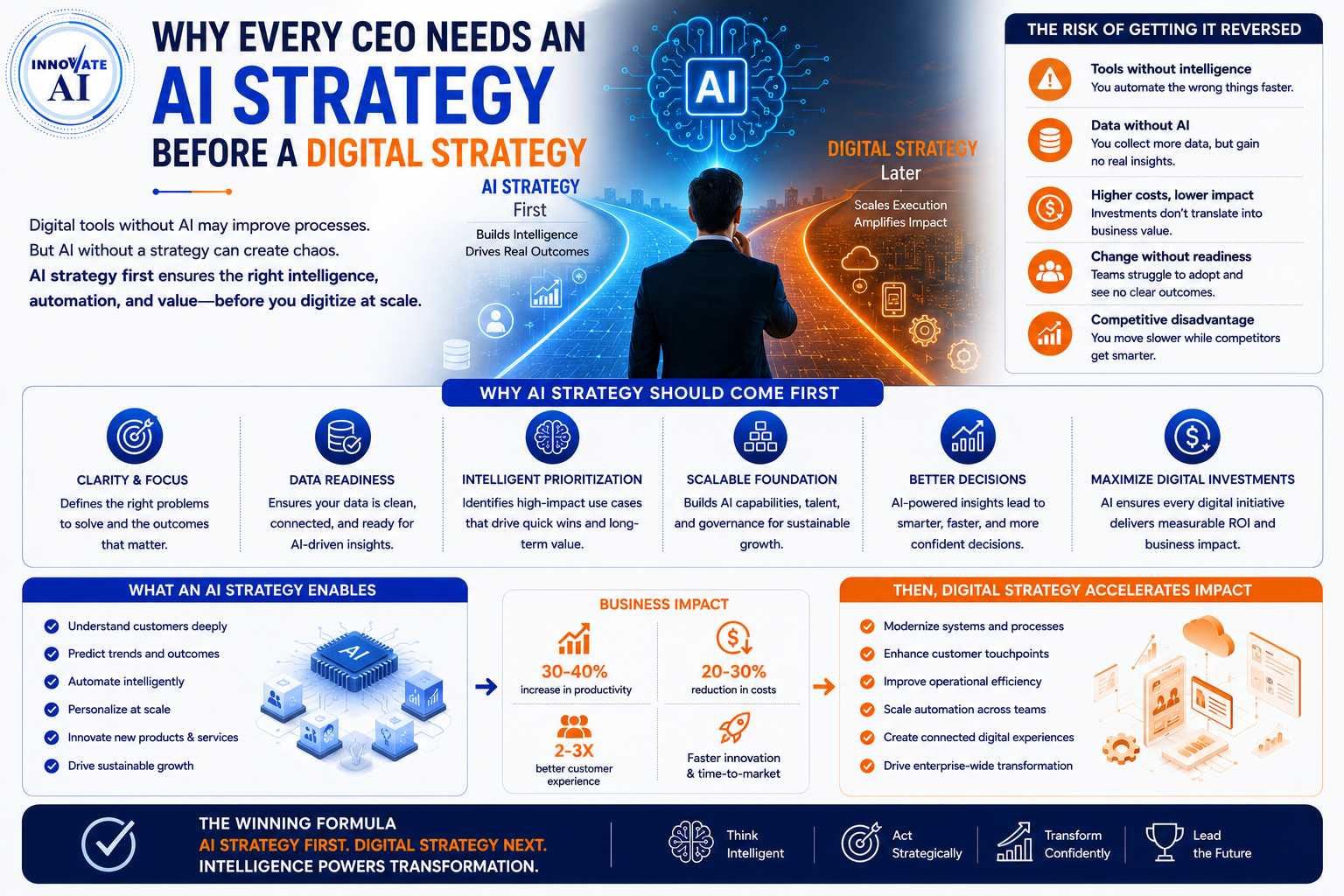
The Big Question
What happens when the CEO's strategic priority shifts from digital to AI? And why does this shift demand a separate, focused AI strategy rather than just adding AI to the digital roadmap?
These questions are no longer theoretical. Gartner's 2024 CEO Survey reveals a seismic shift: CEOs' use of the term "digital" increased for a decade but has declined over the last two years—just as their use of "AI" has started to rise. AI is now mentioned in 24% of CEOs' top two strategic priorities for 2024, compared to just 4% in 2023. Mentions of "digitalization" have declined significantly, from 20% to 13% .
"I think the names are shifting," says Gabriela Vogel, senior director analyst at Gartner. "We see in the report that CEOs are displacing the word digital with AI" .
But here's the critical insight: CEOs who treat AI as just another digital initiative are missing the point—and the opportunity. As one CEO put it: "Digital transformation is so last year" . The rise of generative AI has created a new era: the autonomous business era. And it demands a different kind of strategy.
The Shift: From Digital to AI Transformation
What the Data Shows
Gartner's research shows that more than half of CEOs (59%) believe AI is the technology that will most significantly impact their industry over the next three years. Digitalization is second—with just 5% .
This isn't just hype. Gartner says it has never seen such a strong technology trend in the 15-year history of its CEO report . The belief in AI's transformative power is unprecedented.
But there's a catch. Gartner's research also reveals that 87% of CEOs believe the benefits of AI outweigh the risks. That's a staggering figure—and one that rings alarm bells for CIOs who are acutely aware of the ethical concerns, security issues, and hallucination risks that come with generative AI .
The CIO's New Opportunity
This fascination with AI creates a big opportunity for CIOs. The CEO's usual go-to person for business transformation is the CFO or COO. But not this time. "With the entry of Gen AI and AI as a whole, it's a more technical topic, and CEOs are moving more towards the CIO, the CTO, or the CDO to try and unlock value," says Vogel .
Gartner's research suggests half of CEOs say the executive they rely on to make the most of Gen AI is the CIO or their digital leadership equivalent .
But there's a tension. CIOs are rightfully cautious. They know that Gen AI production stories are the rarity, not the rule. They're focused on data foundations, strategies, and frameworks. Meanwhile, CEOs are demanding AI transformation .
"The challenge is real," says one observer. "It's a frustrating position for CIOs, and it's become a very, very political position for digital leaders" .
Why AI Strategy Is Not Digital Strategy
The Fundamental Difference
Digital transformation modernizes your foundation—cloud platforms, data architecture, security, and core processes. It's broad by design, often multi-year. AI strategy is narrower and outcome-specific: apply models to high-value problems, reshape workflows, and build an AI operating model .
But the two are not sequential. They must be integrated. "AI transformation is true, but it's not replacing digital transformation. It's an enhancement of digital transformation," says Rahul Todkar, head of data and AI at Tripadvisor .
You need both, but not in sequence. When AI strategy runs within digital transformation, value compounds: AI informs which processes to reengineer first; modernization removes friction that blocks AI scale .
The "Digital Foundation" Precedes AI Value
Zoho's Director of AI Research, Ram Ramamoorthy, is explicit: organizations must first fix their digital foundation. AI maturity is an outcome of a coherent digital strategy .
He gives examples. When an organization deployed AI for ticket assignment within Zoho Desk, they encountered an orchestration problem: if a support staff member is on leave or over capacity, that AI capability must be connected across HRMS, workload management, reporting hierarchies, escalation structures, and SLA data. AI systems require a unified enterprise architecture layer that integrates data, processes, roles, and constraints .
Zoho's position is that loosely coupled integrations create clutter. AI demands natively connected systems with consistent identity management and privacy controls. For CIOs and CTOs, the recommendation is clear: de-siloing, rationalizing the application portfolio, reducing spreadsheet dependency, formalizing integration patterns, and embedding privacy controls. AI initiatives launched into fragmented environments will underperform or generate complexity rather than value .
The ADROIT Framework: How AI Creates Competitive Advantage
An academic framework published in IEEE provides a structured way to understand AI's strategic impact. The ADROIT framework parses the value created by AI into six components :
-
Adding revenue or volume - AI can help add revenue through inorganic means, such as acquiring other companies, or through organic means involving increasing sales to existing or new customers .
-
Differentiating or increasing willingness-to-pay - AI can help increase willingness-to-pay by anticipating latent needs of customers and serving them, like Amazon delivering goods to your doorstep before you order them .
-
Reducing costs - AI can reduce overall costs through better analytics. Elevator companies like Kone, Schindler, and Thyssenkrupp use AI and IoT to proactively predict maintenance requirements, significantly reducing costs .
-
Optimizing risks - AI can reduce risks through predictive analytics and proactive maintenance. Managers must also consider the risks of not investing in AI through counterfactual reasoning .
-
Innovating by generating and deploying knowledge - AI can make R&D more effective and scalable. Aravind Eye Hospital in India collaborates with Google on an AI-based algorithm to screen diabetic retinopathy .
-
Transforming business models - AI can transform business models, business priorities, and business processes. Some heavy commercial vehicle manufacturers in India are seeking to provide "bus-as-a-service" using IoT and AI-based applications .
Viewing strategy as the creation or capture of economic value, firms can add value by increasing price or willingness-to-pay without affecting costs, decreasing costs without affecting price, or changing both in ways that increase the difference between price and cost. AI can help in all these choices .
Why the CEO Must Lead
The Imagination Gap
BCG's research reveals a critical gap: many CEOs aren't thinking big enough with AI. They're focusing on incremental automation—which is useful but leaves so much potential untapped .
"CEOs have to decide if they're chasing small wins, or if they are going to reimagine how the business transforms for the 100x payoff," says Jessica Apotheker, BCG managing director and senior partner .
The barriers are real: economic uncertainty, heightened scrutiny, risk aversion, and the pressure to deliver next quarter's numbers. "There's a lack of willingness among leaders to look beyond the quarter or the year and say, 'What are my next frontiers, and how am I going to invest?'" says Lee Robertson, a BCG managing director and partner .
But the technology is ready. "With current technology, there's nothing that cannot be reimagined," says Nacho Hafner, a BCG managing director and partner .
The CEO's Direct Involvement Is Critical
Data from Heidrick & Struggles shows that the proportion of AI leaders reporting to the CEO has nearly doubled since 2023, growing from 17% to 31% . This signals AI's growing strategic importance and sends a strong message to employees and shareholders .
But many CEOs are not directly involved enough. Research from L.E.K. Consulting reveals a concerning pattern: successful AI adopters have significantly higher CEO involvement than others. CEOs in successful AI adopters are fully or highly involved at 67%, compared to just 26% in other organizations .
The peripheral engagement that many CEOs have with AI transformation suggests a siloed perspective in the C-suite that's at odds with how the role of technology executives is trending .
The C-Suite Collaboration Imperative
One business norm that's really changing is the amount of collaboration needed across the C-suite—especially for earlier AI transformations. Being part of the executive leadership team creates the opportunity to "drive and own AI transformation as thought partners instead of order takers," says a chief data officer of a consumer company .
59% of information technology and digital chiefs say their scope of responsibilities has expanded over the past year due to AI efforts. Common new tasks include AI strategy development, AI project oversight, and digital transformation leadership .
Two Paths to Value: Reshape and Invent
BCG identifies two distinct paths for AI strategy :
Path 1: Reshape
This approach redesigns workflows around AI. It's about rethinking the way work gets done, how decisions happen, and where value comes from. For example, in consumer goods R&D, teams can use AI to speed up development cycles in a leaner operating model. A multi-year stability study that usually takes months—including four weeks of drafting and two weeks of approval—can be cut to less than two weeks with AI .
Path 2: Invent
This approach imagines entirely new products and revenue streams. L'Oréal built Beauty Genius, an AI-powered virtual advisor that reached over 10 million consumers and drove 30% to 70% higher engagement rates than static product content .
Penske built Catalyst AI, a platform that lets fleet managers compare real-time vehicle data against top-performing vehicles—transforming an internal asset into a commercial-grade AI product .
The Tech-Driven CEO: Five Key Traits
MIT Sloan Management Review identifies five traits that set technology-driven CEOs apart :
-
See technology as a growth engine, not a cost center
-
Reimagine what their companies can become by applying technology across customers, products, channels, and data
-
Study how advanced systems can redefine industries, not just dabble with chatbots
-
Develop the expertise to steer technology-driven transformations themselves, rather than leaving those decisions to a CIO or CTO
-
Build stakeholder conviction to make bold bets
Today, only 5.9% of CEOs at the world's 2,660 largest companies have ever worked in tech, and just 3.2% have held technical roles. But experience isn't destiny—more leaders are now cultivating the knowledge to push their organizations into new arenas of growth .
Structuring the AI Function: Questions Every CEO Must Ask
Heidrick & Struggles provides a framework of questions leaders should answer when structuring the AI function, in this order :
-
Business strategy: What strategic goals will AI enable?
-
Data: Who owns and ensures the quality and accessibility of data?
-
AI strategy: What are the initiatives or use cases for implementing AI in support of strategic goals? Which ones are priorities?
-
AI implementation: Which units will implement AI, and who owns each plan—business or AI leaders?
-
Tech stack: Who manages the tech stack and vendor relationships?
With data as the foundation, assessing AI's ownership and quality is crucial before addressing any part of implementation .
The E-D-U-C-A-T-E Framework
Broadridge's RP Sandilya introduced a framework to help firms adopt and implement AI strategies that will continue to grow and evolve :
-
Ethics are paramount—guardrails must ensure responsible deployment
-
Data governance is critical—strict controls on sourcing and usage
-
Understanding across the organization is important—all users must be brought along
-
Client-driven use cases deliver the biggest impact
-
Architecture drives the technologies used—flexible, not tool-based
-
Talent upskilling and retention is critical
-
Experimentation must be part of the culture
Implementation Roadmap: The CEO's 90-Day Plan
Phase 1: Foundations (Weeks 1-4)
-
Define business outcomes: What are you trying to achieve? Growth, efficiency, risk reduction, talent enablement?
-
Assess current state: Data readiness, technology architecture, talent capabilities
-
Build the AI strategy team: CEO-led with cross-functional representation
-
Set governance framework: Risk controls, ethics, compliance
Phase 2: Prioritization (Weeks 5-8)
-
Identify use cases: Score by value vs. friction
-
Select pilots: Choose high-impact, achievable first use cases
-
Define success metrics: Time-to-value, ROI, quality improvements
-
Allocate budget: Investment needed for infrastructure and talent
Phase 3: Execution (Weeks 9-12+)
-
Launch pilots: Shadow mode initially, then limited autonomy
-
Measure and learn: Track against metrics, capture learnings
-
Scale winners: Expand what works, kill what doesn't
-
Communicate: Share results with stakeholders and the organization
Frequently Asked Questions
Q1: Why does AI need a separate strategy from digital transformation?
Digital transformation modernizes infrastructure and processes. AI strategy focuses on specific use cases, governance, and value creation. The two are complementary—AI strategy accelerates digital transformation, and digital transformation enables AI at scale. But treating them as one blurs priorities and slows results .
Q2: Should the CEO be directly involved in AI strategy?
Yes. Research shows CEOs in successful AI adopters are fully or highly involved at 67%, compared to just 26% in other organizations. The proportion of AI leaders reporting to the CEO has nearly doubled since 2023 .
Q3: What's the "imagination gap" in AI?
The distance between what most companies are attempting with AI and what the technology makes possible. Many CEOs focus on incremental automation rather than reimagining workflows, products, and business models for transformative impact .
Q4: What are the two paths to AI value?
Reshape: redesigning workflows around AI for efficiency. Invent: creating entirely new AI-powered products and revenue streams. Most successful CEOs pursue both in a portfolio approach .
Q5: What are the risks of not having an AI strategy?
Falling behind competitors who are using AI to reduce costs, improve quality, and create new revenue streams. 87% of CEOs believe the benefits of AI outweigh the risks, but the risks of not investing include loss of market share and inability to attract new customer segments .
Q6: How can Innovative AI Solutions help?
We help CEOs and leadership teams develop comprehensive AI strategies—from governance design and use case identification to implementation and scaling. Based in Delhi, serving clients across India.
Why Delhi is a Great Hub for AI Development
Delhi is emerging as a significant hub for AI development, backed by concrete government support and infrastructure. The recent Delhi Budget 2026-27 allocated ₹8.20 crore for two Artificial Intelligence centres of excellence (AI-CoEs), functioning as hubs for research, innovation, and startup incubation.
The city's AI infrastructure is expanding rapidly. Under the IndiaAI Mission, more than 38,000 high-end GPUs have been onboarded and are available at approximately ₹65 per hour—roughly one-third of the global average cost. This makes AI development remarkably cost-effective compared to other tech hubs.
The government has also announced a ₹350 crore startup policy over five years, aiming to support the emergence of at least 5,000 startups by 2035, with key focus areas including artificial intelligence, machine learning, and automation.
The AI ecosystem in Delhi combines: cost-effective infrastructure, government support, a growing talent pool, and proximity to the country's business decision-makers. For businesses looking to develop practical AI solutions, it's becoming an increasingly attractive location.
What We Offer at Innovative AI Solutions
After five years of building AI solutions for businesses, we've developed a practical approach that focuses on what actually works:
-
AI Strategy Development: We help CEOs and leadership teams develop comprehensive AI strategies aligned with business outcomes
-
Governance and Risk Frameworks: We help you establish responsible AI governance, ethics, and compliance structures
-
Use Case Identification: We help you identify, prioritize, and sequence high-value AI initiatives
-
Implementation and Scaling: We help you move from pilots to production with measurable ROI
-
Change Management: We help you build AI literacy, redesign roles, and drive adoption across the organization
Our approach is built on the reality that AI strategy is a business imperative, not just a technology initiative.
Final Thought
The era of cautious incrementalism is over. As AI commoditizes raw computation, the market premium on distinctly human outputs—context, empathy, and non-linear creativity—skyrockets. Leaders should avoid the seduction of mere efficiency. Using AI solely to execute the old playbook "faster" is a trap that eventually competes margin down to zero. True strategic advantage is achieved when the algorithm's speed is paired with the irreplaceable capacity for context and empathy .
The mandate is unequivocal: abandon the illusion of perfect predictability, unleash the irreplaceable human premium, and command the future .
Contact Us:
Phone: +91 7464 099 059 / +91 9689967356
Email: info@innovativeais.com
Address: Netaji Subhash Place, Pitampura, Delhi – 110034
Website: https://innovativeais.com
About the Author
Abhishek Kumar
Founder & CEO, Innovative AI Solutions
5+ years building AI systems for enterprises. Based in Delhi, serving clients across India.
Hashtags: #AIStrategy #CEOLeadership #DigitalTransformation #AIStrategy #BusinessReinvention #AITransformation #InnovativeAISolutions
Related services: to apply this in your business, explore our AI development services and generative AI development.