The Big Question
"We have AI prototypes that work. But moving them to production feels impossible. Security reviews, scalability concerns, governance gaps—how do we bridge the gap between prototype and production?"
The honest answer:
The gap is not a technology problem. It is an architecture and governance problem.
Here is the truth:
AI tools are remarkably effective at generating functional code. What they consistently do not produce is the infrastructure that enterprise software requires behind the scenes. Production applications need security, scalability, compliance, integration, and ongoing governance—all of which require human engineering judgment.
Step 3: The AI-First Enterprise—What It Actually Means
An AI-first enterprise is not defined by the number of AI tools it deploys. It is defined by its unified, governed, and scalable AI ecosystem that eliminates fragmentation. For Elastic, this means moving from isolated AI experiments to a single architecture built on a proprietary data foundation .
The Core Distinction: Conversational AI vs. AI Agents
| Type | What It Does | Example |
|---|---|---|
| Conversational AI | Surfaces relevant answers and insights from unified data | Internal knowledge assistants, customer support chatbots |
| AI Agents | Goes beyond information retrieval to execution—autonomously performs key actions within a workflow | IT helpdesk automation, lead qualification, threat intelligence |
The shift is significant: Enterprise applications are evolving beyond systems of record to systems of action coordination. AI-enabled enterprise applications are capable not only of reporting and visualizing but also of detecting operational irregularities, interpreting situations across different systems, suggesting next best actions, coordinating workflows, and learning .
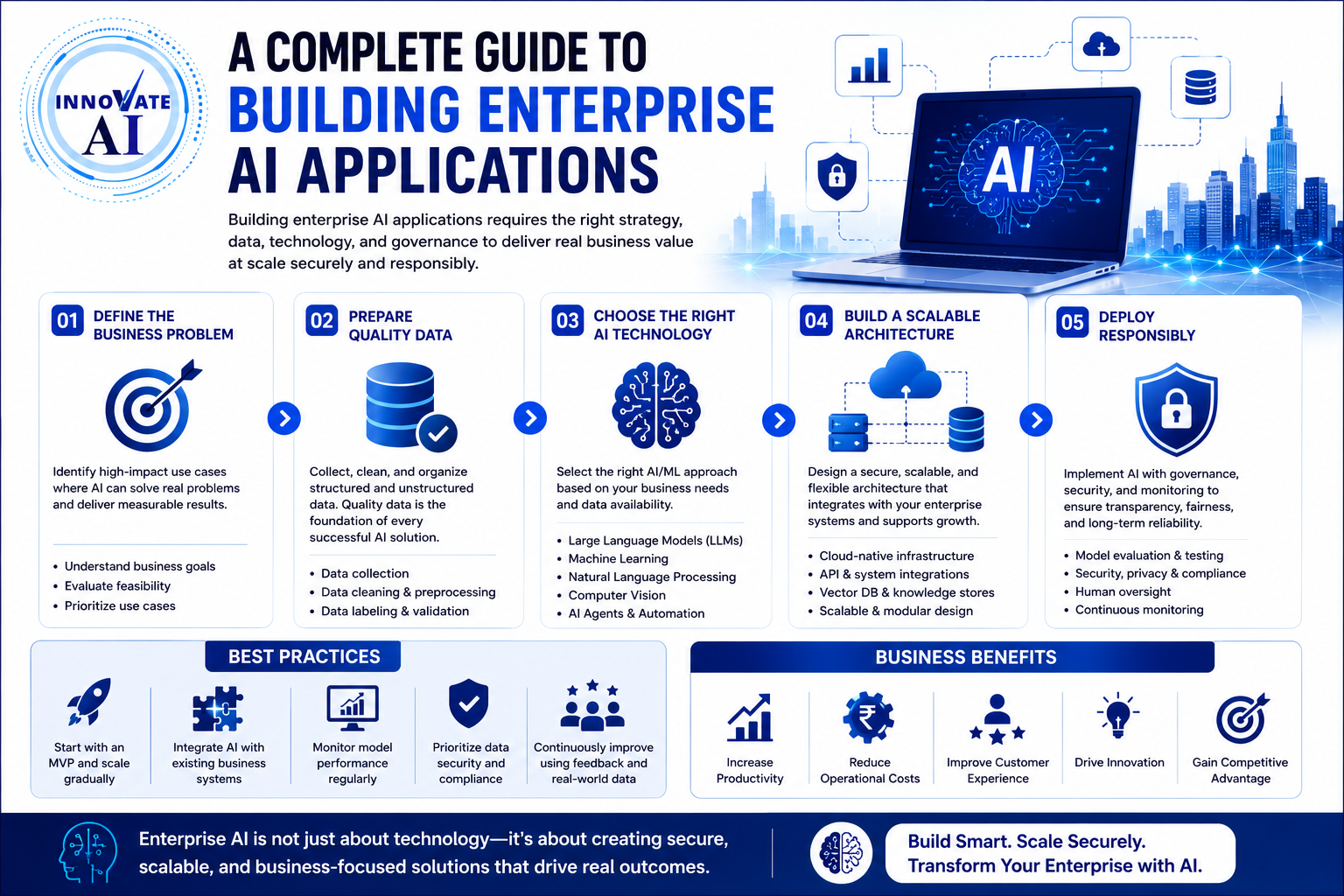
Step 4: The Architecture of Enterprise AI Applications
The Four Parts of Enterprise AI Architecture
Based on a comprehensive guide to enterprise AI application design, the architecture spans four interconnected domains :
| Part | Focus | Key Topics |
|---|---|---|
| Part 1: Defining Your AI Application | Understanding what you are building and why | Human flexibility, meta systems, prediction machines |
| Part 2: Designing Your AI Application | The technical anatomy of the system | Data, ML models, reasoners, LLMs, AI agents |
| Part 3: Maintaining Your AI Application | Ongoing lifecycle management | Testing, test automation, security, information curation |
| Part 4: AI-Enabled Teams | Human-AI collaboration | Remote work, expert personas, AI handler role, legal/ethical considerations |
The Building Blocks of Enterprise AI Applications
A well-architected enterprise AI application consists of several interconnected layers :
| Layer | What It Does | Why It Matters |
|---|---|---|
| Data Layer | Manages ingestion, storage, and retrieval of structured and unstructured data | AI is only as good as the data it accesses |
| Machine Learning Layer | Trains and serves prediction models | Enables pattern recognition and forecasting |
| Reasoning Layer | Handles logical inference and decision-making | Moves beyond pattern matching to actual reasoning |
| Agent Layer | Orchestrates multi-agent coordination and execution | Enables autonomous workflows |
| Governance Layer | Enforces security, compliance, and audit controls | Keeps AI accountable |
The Unified Data Foundation
The backbone of an AI-first enterprise is the environment in which the models operate. This requires :
-
Strategic data foundation: Rigorous master data management to certify global datasets, ensuring every model is grounded in accurate, reliable corporate truth
-
Self-service AI agent infrastructure: A secure data layer and governance framework that allows business units to deploy and manage their own agents while maintaining enterprise security
-
Unified agent hub: A centralized platform providing a single, consolidated channel to engage with all agents
Step 5: The Two Primary AI Application Types
Type 1: Conversational AI (Knowledge and Insights)
Conversational AI applications ground LLM outputs in real-time, proprietary data to ensure relevance. These tools transform how teams work by providing immediate, natural language responses to complex questions that can only be answered with internal knowledge .
Real-World Example—Elastic's Conversational AI Applications:
| Application | Business Challenge | Measured Result |
|---|---|---|
| Internal Support Assistant | Engineers spent excessive time searching across documentation and past cases | $1.7 million in cost avoidance; 23% improvement in mean time to first response |
| External Support Assistant | Growing demand for self-service | 5% customer adoption, 30% return rate, 11% month-over-month usage growth |
| Internal Knowledge Assistant | Employees struggled to access reliable knowledge across disconnected platforms | 92% YoY increase in daily active users; 1,300 workdays saved |
| Sales Assistant | Sales reps overloaded with information in CRM | $372 million AI-influenced pipeline; 46 weeks of field service hours saved |
Type 2: AI Agents (Execution and Automation)
AI agents function as autonomous "executors" that use reasoning and predefined tools to navigate multistep workflows without constant human prompts. They can independently plan tasks, synthesize disparate data sources, and trigger actions across internal and external platforms .
Real-World Example—Elastic's AI Agents:
| Application | Business Challenge | Measured Result |
|---|---|---|
| Threat Intelligence Agent | InfoSec team struggled to scale defenses against exponential threat data | 75% of analyst time recouped; 92% increase in threat intelligence report output |
| RFP Automation | Teams lost critical time manually searching fragmented documents | Completed RFPs faster with higher consistency |
| IT Helpdesk Agent | Laptop request process required 30 minutes of admin effort | Five-minute automated chat handling identity verification and compliance |
Step 6: The Engineering Shift—From Copilots to Decision Systems
Why AI Initiatives Stall
Many organizations have deployed copilots and AI assistants, but operational performance has barely changed. Approvals remain slow, customer escalation relies on manual intervention, and time is still wasted resolving disparate data sets before making decisions .
The core problem: Most organizations continue to use AI technology as a supporting layer and not as embedded intelligence in their enterprise operations .
Moving from Systems of Record to Systems of Action
Enterprise applications have traditionally been transaction systems—ERP for finance, CRM for customers, HR systems for employees. They required extensive human involvement in interpreting information, deciding, coordinating, and responding to changes .
AI-enabled enterprise applications are capable of:
-
Detecting operational irregularities
-
Interpreting situations in the broader context of different systems
-
Suggesting next best actions
-
Coordinating workflows
-
Learning
Real-World Example—Procurement Automation:
A procurement team faced significant challenges because of supply disruptions and manual workflow coordination. People had to spend hours looking through ERP, inventory, logistics, and finance systems to find appropriate sourcing alternatives and make a decision.
The organization introduced an AI application that detected supply risks, proposed sourcing alternatives, and launched relevant approval procedures according to business logic defined beforehand .
The Difference: Adoption vs. Transformation
The problem many organizations face has been termed the "Gen AI Paradox" by McKinsey. Despite rapid proliferation of generative AI adoption, many firms still have difficulty leveraging it to make a tangible impact on business outcomes. Deployment of enterprise copilots has outpaced the need for changing operations to improve decision-making, coordination, and execution .
The distinction is critical:
| AI Adoption | AI Transformation |
|---|---|
| Deploying tools and features | Redesigning workflows around intelligence |
| Measuring adoption metrics | Measuring business outcomes |
| Copilots and assistants | Embedded decision intelligence |
| Local improvements | Enterprise-wide coordination |
Step 7: Testing Enterprise AI Applications
Why Testing Is Different for AI
Unlike traditional software, AI applications are probabilistic rather than deterministic. Testing must account for:
-
Accuracy and relevance: Does the AI produce correct and useful outputs?
-
Robustness: Does the AI handle edge cases and unexpected inputs?
-
Fairness and bias: Does the AI treat all users equitably?
-
Security: Is the AI vulnerable to prompt injection or other attacks?
-
Performance: Does the AI maintain acceptable latency at scale?
Testing Strategies for Enterprise AI
According to enterprise AI architecture guidance, testing spans multiple levels :
| Test Type | What It Validates | When to Apply |
|---|---|---|
| Unit tests | Individual components and functions | During development |
| Integration tests | Interactions between components | Before deployment |
| End-to-end tests | Complete user journeys | Before production |
| Performance tests | Latency, throughput, and scalability | Load testing |
| Security tests | Vulnerability to attacks | Security review |
| Adversarial tests | Resistance to malicious inputs | Red team exercises |
| Drift tests | Model performance over time | Ongoing monitoring |
Human-in-the-Loop Testing
For enterprise AI applications, human review is not optional. One of the central operating principles from Hexaware's Tensai platform is that no action will be recommended without supporting signals, with decisions systematically checked against policy and risk factors .
Step 8: Security and Governance
The Security Imperative
AI-generated code should be reviewed for vulnerability patterns, including injection attacks, broken authentication, exposed credentials, and misconfigured access controls before it touches production data or users .
The data: Veracode's 2025 GenAI Code Security Report found that AI-generated code introduced security vulnerabilities in 45% of cases. Notably, more advanced AI models did not produce more secure code than smaller ones .
Key Governance Requirements
| Requirement | What It Means |
|---|---|
| Information curation | Ensuring the AI has access to accurate, up-to-date, and authoritative data sources |
| Audit trails | Every AI decision and action must be logged and traceable |
| Role-based access control | Restricting AI capabilities based on user permissions |
| Human oversight | Critical decisions require human approval |
| Compliance alignment | Meeting regulatory requirements (DPDP, GDPR, HIPAA, etc.) |
The Shared Responsibility Model
Enterprise AI governance is not just about the technology. It requires clear accountability across teams and clear escalation paths when AI makes mistakes .
Step 9: Moving from Prototype to Production
The Production Readiness Framework
According to RSM's enterprise AI practice, taking an AI-built prototype to production requires three phases :
Phase 1: Assessment
Evaluate the existing codebase, architecture, security posture, and integration requirements to determine what carries forward, what needs remediation, and what needs to be rebuilt.
Phase 2: Remediation and Hardening
| Area | What to Fix |
|---|---|
| Security | Address vulnerabilities, injection attacks, broken authentication |
| Architecture | Restructure for scale, concurrent users, growing data |
| Testing | Implement automated tests and deployment pipelines |
| Compliance | Add audit trails, role-based access, data retention |
| Integration | Connect reliably to existing business systems |
Phase 3: Production Deployment and Support
Deploy with monitoring, governance controls, and compliance measures in place, along with a plan for ongoing support as the application evolves.
What AI-Generated Prototypes Typically Miss
AI tools optimize for getting to a working result quickly, not for the engineering practices that make software reliable over time. Areas that most commonly require attention include :
| Area | What's Missing |
|---|---|
| Security | Vulnerability patterns, injection attacks, broken authentication |
| Architecture | Scalability, concurrent users, growing data volumes |
| Testing | Automated tests, deployment pipelines, regression testing |
| Compliance | Audit trails, role-based access, data retention |
| Integration | Reliable connections to existing systems, error handling |
Step 10: Real-World Enterprise AI Deployments
Elastic's AI-First Transformation
Elastic's IT team has built a comprehensive AI-first enterprise with measurable ROI :
| Metric | Result |
|---|---|
| Support cost avoidance | $1.7 million |
| AI-influenced pipeline | $372 million |
| Internal assistant daily active users | 92% YoY increase |
| Threat intelligence report output | 92% increase |
| Analyst time recouped | 75% |
Key success factors:
-
Unified data foundation eliminating silos
-
Clear distinction between conversational AI and AI agents
-
Built-in observability for technical performance, contextual accuracy, and business impact
-
Self-service agent infrastructure enabling business units to deploy their own agents within governance frameworks
Hexaware's Tensai for Reasoning Ops
Hexaware's platform uses agentic AI to analyse IT operations signals and recommend actions :
| Target Metric | Improvement |
|---|---|
| Mean time to resolution | 25–40% faster |
| Manual interventions | 35–45% reduction |
| Cost to serve | 10–18% reduction |
| SLAs and user experience | 10–20% improvement |
Key principle: No action is recommended without supporting signals; decisions are systematically checked against policy and risk factors .
Infosys Topaz Fabric
Infosys Topaz Fabric is a composable stack of AI agents, services, and models that helps unify and accelerate IT service delivery across the enterprise landscape :
-
50+ agents purpose-built for IT operations
-
Out-of-the-box integration with 9 enterprise platforms
-
Human-in-the-loop operation—AI agents execute workflows while humans supervise, train, and continuously contextualize
Step 11: Implementation Roadmap—90 Days
Phase 1: Define and Assess (Weeks 1-4)
| Action | Output |
|---|---|
| Identify one high-impact, bounded use case | Clear business problem |
| Assess data readiness and integration requirements | Data maturity baseline |
| Define success metrics (cost savings, time saved, revenue impact) | KPI framework |
| Establish governance and security requirements | Governance baseline |
Phase 2: Build and Test (Weeks 5-8)
| Action | Output |
|---|---|
| Deploy prototype with human-in-the-loop | Working application |
| Implement automated testing and security review | Validated application |
| Measure performance against baseline | Early ROI data |
| Refine based on feedback | Improved application |
Phase 3: Production and Scale (Weeks 9-12)
| Action | Output |
|---|---|
| Deploy with monitoring and governance | Production deployment |
| Implement continuous improvement cycles | Ongoing optimization |
| Expand to additional use cases | Scaled deployment |
Step 12: Frequently Asked Questions
Q1: What is the difference between a copilot and an AI agent?
A copilot assists with tasks—it suggests, summarizes, and generates content. An AI agent goes beyond assistance to autonomous execution—it plans, coordinates across systems, takes actions, and learns from outcomes.
Q2: How do I know if my AI prototype is ready for production?
Evaluate across five dimensions: security (no vulnerabilities), architecture (scalable), testing (automated), compliance (auditable), and integration (reliable). If any dimension is weak, address it before production .
Q3: What is the most common reason AI projects fail to deliver business value?
Not redesigning workflows. Organizations deploy AI tools but keep existing processes unchanged. The real value comes from embedding intelligence into how decisions are made and executed .
Q4: How do I measure the ROI of an enterprise AI application?
Track both direct cost savings (time saved, manual work eliminated) and revenue impact (pipeline influenced, conversion improved). Elastic measured $1.7 million in cost avoidance and $372 million in AI-influenced pipeline .
Q5: What is the role of human oversight in enterprise AI?
Human oversight is non-negotiable. Critical decisions require human approval. Humans train, supervise, and continuously contextualize AI agents to ensure accuracy, governance, and ethical alignment .
Q6: How can Innovative AI Solutions help?
We help enterprises design, build, and deploy AI applications—from architecture and governance to prototyping and production deployment. Based in Delhi, serving clients across India.
Step 13: Final Tagline
"The gap between AI prototype and enterprise production is where most projects fail. Moving from demo to deployment requires more than better models—it requires architecture, governance, testing, security, and human oversight. Organizations that master this transition will turn AI experiments into sustainable competitive advantage. Those that don't will remain stuck in pilot purgatory."
Short version:
A complete guide to building enterprise AI applications—from architecture and use cases to testing, security, and production deployment. 2026 practical framework.
Hashtags:
#EnterpriseAI #AIAgents #AIArchitecture #AIDeployment #AIGovernance #DigitalTransformation #InnovativeAISolutions
Contact Us
Phone: +91 7464 099 059 / +91 96899 67356
Email: info@innovativeais.com
Address: Netaji Subhash Place, Pitampura, Delhi – 110034
Website: https://innovativeais.com
About the Author
Abhishek Kumar
Founder & CEO, Innovative AI Solutions
5+ years building enterprise AI applications. Based in Delhi, serving clients across India.
Related services: to apply this in your business, explore our AI agent development and AI development services.