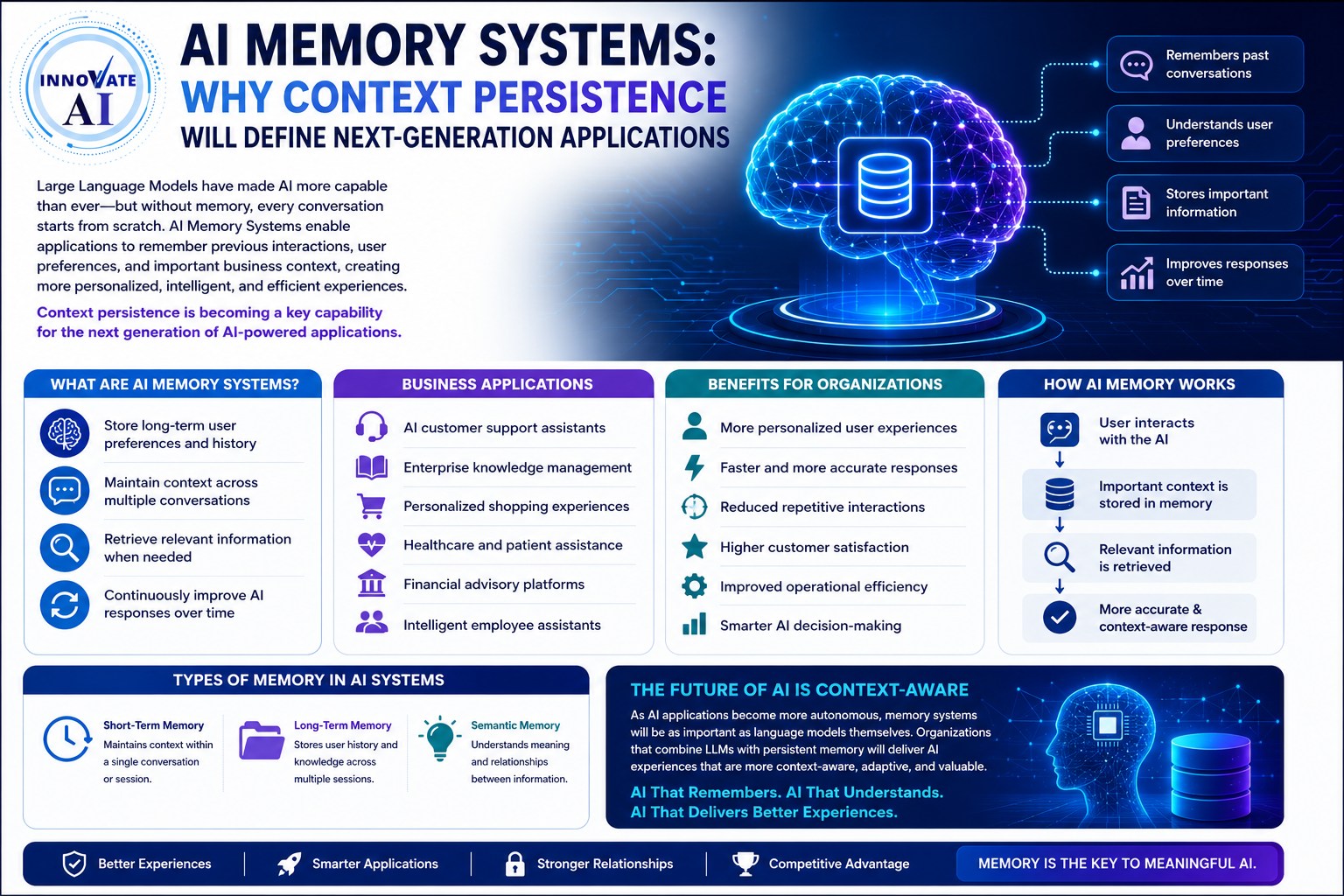
The Big Question
Let me start with a question that every AI leader must answer in 2026.
"We have deployed AI agents. They work for single interactions. But they forget everything between sessions. Our users are frustrated. How do we build AI that actually remembers?"
The honest answer:
You need memory as an architectural layer, not a feature.
Here is the truth:
Memory transforms a stateless LLM into a self-evolving agent that can accumulate factual knowledge and user preferences, develop behavioral patterns grounded in prior experience, avoid repeating costly mistakes, and continuously improve through interaction .
The difference is qualitative. A coding assistant without memory rediscovers the directory layout every Monday, re-reads the same README, and retries the exact fix that crashed the build on Friday. Equip the same agent with even a modest memory module, and it arrives already knowing the hotspots, skips the dead ends, and gradually distills project-specific heuristics .
Step 3: The Context Window Problem
Why Context Windows Alone Are Not Enough
The dominant paradigm for AI memory has been fixed-size context windows. Models with 128K to 10M token context windows can process substantial information—but only within a single session. When the conversation ends, the memory vanishes . Agentic AI systems that must operate over days, weeks, or months cannot afford this amnesia.
The mathematics are unforgiving: Self-attention scales quadratically with sequence length. A 1M-token context requires 1,000x more computation than a 32K-token context for the same operations. This creates a hard economic ceiling on useful context size .
The cost reality: Maintaining a 1M-token context window costs approximately 15x more per interaction turn than equivalent persistent memory retrieval . The cost curve is exponential—every doubling of context length roughly quadruples the inference cost. Retrieval-augmented approaches maintain near-constant retrieval latency regardless of accumulated history .
The Economics of Scaling Context
| Approach | Cost Model | Scalability |
|---|---|---|
| Context window scaling | O(n²) attention | Breaks at scale |
| Persistent memory retrieval | Near-constant O(1) | Scales indefinitely |
| Hybrid hierarchical memory | O(1) + selective attention | Optimal for real workloads |
The economic case for persistent memory becomes overwhelming as enterprises deploy AI agents for sustained workflows .
Step 4: What Is an AI Memory System?
The Memory Loop
A well-designed AI memory system operates as a write–manage–read loop tightly coupled with perception and action :
| Operation | What It Does |
|---|---|
| Write | Summarizes, deduplicates, scores priority, resolves contradictions, and deletes when appropriate |
| Manage | Organizes memory for efficient retrieval—compression, indexing, and consolidation |
| Read | Retrieves relevant information at the right time to inform decision-making |
Why Memory Matters
Memory isn't simply about storing everything indefinitely. It is about preserving what is important, letting low-value details fade, and strengthening connections that recur across workflows .
| Without Memory | With Memory |
|---|---|
| Re-ingests background information every interaction | Builds on prior knowledge |
| Re-validates decisions repeatedly | Maintains decision continuity |
| Reconstructs context across handoffs | Preserves context across sessions |
| Treats every task as fresh | Learns and improves over time |
| Inconsistent behavior | Consistent, adaptive behavior |
When agents draw from accumulated knowledge rather than reconstructing context at every step, operational overhead stabilizes and performance becomes more predictable .
Step 5: The Three Memory Types
Purpose-built memory approaches distinguish between different types of memory :
| Memory Type | What It Stores | Access Speed | Example |
|---|---|---|---|
| Working Memory | Current context window | Immediate | This conversation |
| Short-Term / Episodic | Recent interactions | Fast retrieval | Last few sessions |
| Long-Term Memory | Persistent knowledge | Selective retrieval | Facts, patterns, user preferences |
This hierarchy mirrors biological memory systems. The most promising architectures combine multiple memory types in hierarchical configurations :
| Layer | Function | Implementation |
|---|---|---|
| Working Memory | Immediate coherence | Attention window |
| Episodic Memory | Recent interactions | KV-cache persistence |
| Long-Term Memory | Persistent knowledge | External vector stores |
Step 6: Real-World Memory Systems
Memori: Structured Memory at 5% of Full Context
Memori is a persistent memory layer that treats memory as a structuring problem rather than a storage problem. Its Advanced Augmentation pipeline converts unstructured dialogue into semantic triples (subject–predicate–object) and conversation summaries .
Key results on the LoCoMo benchmark:
| Method | Overall Accuracy | Tokens per Query | Cost vs. Full Context |
|---|---|---|---|
| Memori | 81.95% | 1,294 | 5% of full context |
| Full Context | ~80% | ~25,000 | Baseline |
| Zep | 79.09% | — | — |
| LangMem | 74.47% | — | — |
Memori achieved 81.95% accuracy while using only 1,294 tokens per query—5% of full context. This represents a 20x cost reduction compared to full-context methods .
The architectural insight: Effective memory in LLM agents depends on structured representations instead of larger context windows, enabling scalable and cost-efficient deployment .
Mem0: Persistent Memory Across Models
Mem0 provides memory infrastructure that works across models. Its core premise: AI agents forget, but purpose-built memory infrastructure remembers, enabling personalized experiences that get sharper over time . As AI coworkers operate, they build memories, turning past interactions into useful context that improves performance over time.
NVIDIA Inference Context Memory Storage Platform
At CES 2026, NVIDIA introduced a purpose-built context-memory tier designed to extend effective GPU KV cache capacity while enabling high-bandwidth sharing across AI pods . The platform targets the metrics that now define inference success: improved time-to-first-token, higher throughput per GPU, and better power efficiency at scale .
The significance: NVIDIA's announcement signals that context has become infrastructure . Inference context is no longer an optimization—it is a platform requirement.
Step 7: Why This Matters for Enterprise Applications
The Business Case for Persistent Memory
| Benefit | Impact |
|---|---|
| Cost efficiency | 20x reduction in inference cost vs. full-context methods |
| Consistency | Agents behave consistently across interactions |
| Continuity | Workflows persist across days, weeks, and multiple stakeholders |
| Trust | Users can rely on AI that remembers context |
| Governance | Memory can be governed as part of core architecture |
The Productivity Compound Effect
When AI systems retain context across sessions, productivity compounds . Instead of re-explaining goals, tone, or priorities at the start of every interaction, AI systems learn and retain that context and act on it.
Examples:
-
Meeting continuity: AI connects today's discussion to decisions made three weeks ago
-
Proactive briefings: AI assembles relevant materials before meetings
-
Institutional continuity: AI becomes a living record of how and why decisions were made
-
Trusted advisor: AI learns your communication style, decision preferences, and priorities
The Governance Imperative
As AI systems accumulate more knowledge about users and workflows, governance becomes critical . Organizations must establish clear frameworks for:
-
What context AI should and shouldn't retain
-
How long it holds information
-
How individuals maintain meaningful control
-
Who owns the memory layer
-
What happens to it when an employee leaves
These are not optional. The systems that provide the most value are the ones that see the most, creating a genuine tension between utility and privacy.
Step 8: Implementation Roadmap — 90 Days
Phase 1: Assess and Design (Weeks 1-4)
| Action | Output |
|---|---|
| Identify workflows that require cross-session continuity | Use case pipeline |
| Assess current stateless vs. stateful AI capabilities | Baseline assessment |
| Define memory requirements (retention period, recall accuracy, cost targets) | Requirements document |
Phase 2: Pilot (Weeks 5-8)
| Action | Output |
|---|---|
| Deploy a persistent memory layer for one bounded use case | Working prototype |
| Implement structured memory extraction (triples, summaries) | Memory pipeline |
| Measure accuracy and cost improvement | Early ROI data |
Phase 3: Scale (Weeks 9-12)
| Action | Output |
|---|---|
| Expand to additional workflows | Broader deployment |
| Establish governance and privacy controls | Governance framework |
| Measure organizational context accumulation | Long-term value assessment |
Step 9: Frequently Asked Questions
Q1: What is the difference between context windows and persistent memory?
Context windows are limited to the current session. Persistent memory retains information across sessions. When the conversation ends, the context window vanishes. Persistent memory preserves what matters.
Q2: How much can persistent memory save?
Recent research shows that persistent memory can achieve 95% recall accuracy at 10x lower cost than equivalent context scaling. Memori achieved 81.95% accuracy while using only 5% of full context tokens.
Q3: What is the biggest risk of AI memory?
Governance and privacy. An AI that knows your priorities, communication patterns, and organizational decision history is extraordinarily useful—and an extraordinarily sensitive data store. Organizations need clear policies on what AI should retain, for how long, and under what conditions.
Q4: Is memory just another vector database?
No. Vector databases are storage. Memory systems include write filtering, contradiction resolution, consolidation, and selective retrieval—the intelligence layer on top of storage.
Q5: When will this matter for my business?
It already does. If your AI agents forget context between sessions, you are paying for repeated reprocessing and losing the compounding value of accumulated knowledge. The organizations that build memory infrastructure now will have a structural advantage.
Q6: How can Innovative AI Solutions help?
We help organizations design and deploy AI memory systems—from persistent memory layers and structured extraction to governance frameworks and cost optimization.
Step 10: Final Tagline
"The frustration with early AI tools was real: you'd have a useful conversation, close the window, and come back the next day to explain everything from scratch. Today's AI systems are developing persistent understanding—the ability to maintain continuity across conversations, remember preferences and context, and accumulate knowledge about your work, your team, and your goals over time. The organizations that build memory infrastructure now will create AI that never forgets, learns continuously, and accumulates wisdom across its operational lifetime" .
Short version:
AI memory systems—why context persistence will define next-generation applications. From stateless responders to persistent intelligence, a 2026 guide.
Hashtags:
#AIMemory #PersistentContext #AgenticAI #MemorySystems #EnterpriseAI #ContextPersistence #InnovativeAISolutions
Contact Us
Phone: +91 7464 099 059 / +91 96899 67356
Email: info@innovativeais.com
Address: Netaji Subhash Place, Pitampura, Delhi – 110034
Website: https://innovativeais.com
About the Author
Abhishek Kumar
Founder & CEO, Innovative AI Solutions
5+ years building AI systems for enterprise. Based in Delhi, serving clients across India.
Related services: to apply this in your business, explore our AI agent development and RAG development.