The Big Question
"We have a working prototype. But every time we try to scale, we hit new problems—costs spike, latency increases, agents forget context. What are we missing?"
The honest answer:
You are treating production AI like a prototype with more users. It is not. It is a fundamentally different system.
Here is the truth:
A prototype is a single agent running locally on a laptop. A production system is dozens of specialized agents orchestrated by a planner, each with its own context window and toolset, serving real users with real SLAs. The transition from stage four to stage five is where most systems break.
Step 3: The Five Stages of Agent Scale
Every AI product progresses through five stages. Each stage unlocks new patterns—and exposes new bottlenecks. The transition from beta to production is where most systems fail.
| Stage | Description | Key Characteristics |
|---|---|---|
| Prototype | Single agent running locally on a laptop or cloud notebook powered by a general-purpose LLM | No concurrency; minimal latency concern |
| Demo | Agent wrapped in a UI using LangChain or CrewAI. A handful of people try it. | Performance still acceptable |
| Internal Tool | Agent solves a real workflow for a small group. Concurrent calls start. | First scaling issues appear (cold starts, context spills) |
| Beta | External stakeholders try the agent. RAG, tool calls, and scraping integrated. | Concurrency and security become concerns |
| Production | Agent becomes part of a critical workflow. Must meet SLAs for latency, reliability, and cost. | You likely have dozens of specialized agents orchestrated by a planner |
Step 4: What Breaks at Scale
1. Cold-Start Latency
Cold-start latency is often the first complaint when prototypes enter real-world use. There are two cold-start problems:
-
Session cold start: The agent forgets prior interactions upon a user's return. Session memory frameworks like Mem0 and LangMem provide continuity of conversation.
-
Organizational cold start: The agent lacks foundational knowledge of the business—how "revenue" is defined, where canonical data sources live, or what policies apply.
Most teams invest in session memory solutions but overlook organizational context. This leads to agents hallucinating answers when it lacks definitions, applying deprecated policies, or returning conflicting results when different teams define the same term differently.
Increasing context window size is not the solution. Stuffing unfiltered documents into a vector store clutters your model with noise, degrading attention while increasing latency.
2. Context Economics and Token Costs
For each token added to the prompt—system instructions, conversation history, retrieved documents, tool outputs—the model must perform computation before it generates a response. With multiple agents collaborating, this cost is multiplied.
Key insight: A single agentic task might initiate hundreds of model calls and use over one million tokens. Agents can quickly trigger models as they retrieve context, call tools, critique reasoning, and retry failed steps.
Production systems should implement:
-
Prompt caching: Reuse repeated instructions and static context
-
Dynamic turn limits: Stop agents from iterating when additional reasoning won't improve the final answer
-
Cost budgets: Enforce spending caps per workflow
-
Model routing: Use smaller, cheaper models for simple tasks
3. CPU Load in Agentic Systems
GPUs are critical for serving models, but building agentic systems also requires massive amounts of CPU work. CPUs handle orchestration, routing, retrieval, queueing, JSON parsing, tool calling, policy evaluation, and workflow coordination.
DigitalOcean reports that CPUs can account for 50% to 90% of a typical agentic workload. A multi-agent workflow involves:
-
A planner agent determining the order of operations
-
A research agent retrieving knowledge
-
A tool agent calling APIs
-
A validator agent checking the result
-
A supervisor agent deciding whether to continue
-
A memory layer updating user or workflow state
Warning: Many agentic systems become inefficient when agents lack clear stop conditions. Agent A calls Agent B, Agent B calls Agent C, Agent C requests more context, and Agent A re-plans the workflow. The system may look intelligent, but it is often just cycling through unnecessary steps, wasting tokens, increasing latency, and consuming compute without meaningful progress.
4. Agent Governance and Versioning
The most powerful agents in production are not the most autonomous agents. They are the most governable agents.
Each agent must have:
-
A well-defined role
-
A typed input schema
-
A typed output schema
-
A maximum number of turns
-
A timeout
-
A tool permission boundary
-
A retry policy
-
A stop condition
-
A failure mode
Agent versioning is harder than rolling back code. An agent isn't just code—it's a combination of prompts, model configuration, tool schemas, retrieval settings, memory behavior, guardrails, routing rules, and knowledge base versions. Adjusting a few words in a prompt can alter tool selection. Upgrading the model might fix reasoning but break formatting. Changing one specialist can affect an entire multi-agent workflow.
Step 5: Scaling Infrastructure—Real-World Deployments
OpenAI: Platform-First Orchestration
OpenAI faced a critical scaling challenge when their image generation service went viral. Synchronous request-response flows couldn't handle the massive demand, forcing the system to reject requests.
The solution: Adopting Temporal Cloud for durable workflow orchestration and building a comprehensive platform layer that abstracted infrastructure complexity from product teams.
Key outcomes:
-
Processing approximately 1 billion images per week entirely through Temporal workflows
-
60x growth in one year
-
Developer onboarding reduced from 1-2 weeks to under one day
-
Managed by a platform team of just four engineers supporting 700+ namespaces and 1000+ different workflow types
The platform journey evolved through three phases:
| Phase | Focus |
|---|---|
| Safe Starting Point | Narrow scope, explicit risk before self-serve path |
| Developer Friction | Removing infrastructure code burden from product teams |
| Paved Road | Managed workers and workflows—product teams only write business logic |
Slack: Cost-Efficient Scale
Slack serves over a dozen generative AI features to millions of daily active users while processing 1-5 billion messages weekly.
The migration journey:
-
Initial: SageMaker provisioned throughput—inflexible, expensive over-provisioning
-
Migration: Amazon Bedrock with FedRAMP Moderate compliance
-
Optimization: On-demand infrastructure with cross-region inference profiles
Key outcomes:
-
>90% reduction in infrastructure costs (exceeding $20 million in savings)
-
5x increase in scale
-
15-30% improvements in user satisfaction
-
Experimentation with over 15 different LLMs in production
Quality evaluation framework:
| Metric Type | What It Measures |
|---|---|
| Objective | Proper rendering, JSON parsing, ID formatting |
| Subjective | Factual accuracy, answer relevancy, attribution accuracy |
| Safety | Toxicity, bias, prompt injection protection |
Critical principle: "You can only improve what you have the ability to measure." Slack's team spends approximately 10% of their time on prompting and 90% on evaluation, iteration, and observability.
Step 6: The 90% Evaluation Rule
A critical lesson emerges across successful AI deployments. Notion AI, serving over 100 million users, follows the 10% rule: spend approximately 10% of time on prompting and 90% on evaluation, iteration, and observability.
What this means:
-
The real challenge isn't getting something to work once—it's ensuring it works consistently for diverse user scenarios
-
Evaluation criteria must be regularly updated based on real usage patterns
-
Human expertise is critical for creating meaningful evaluation datasets
-
Non-technical stakeholders actively participating in evaluation leads to better alignment with user needs
Notion's approach includes:
-
Custom LLM-as-a-judge systems: Specific evaluation prompts for individual elements in datasets
-
Specialized data specialists: A hybrid role between product managers, data analysts, and data annotators
-
Multilingual evaluation: Testing scenarios where users might ask questions in Japanese but expect responses in English
-
Thumbs down feedback: Used to create targeted evaluation datasets for functionality improvements
Step 7: Key Takeaways for Building AI That Scales
| Principle | Why It Matters |
|---|---|
| Treat agents as production infrastructure | Not just prompts wrapped around LLMs |
| Context is a limited resource | Larger context windows increase latency, cost, and debugging complexity |
| Governability beats autonomy | The most powerful agents are the most governable agents |
| Platform-first approach scales | Abstract infrastructure complexity from product teams |
| Invest in evaluation infrastructure | 90% of AI development time should be on evaluation |
| Vertical optimization delivers returns | Co-optimize across model, framework, hardware, and infrastructure |
| Cost monitoring is non-negotiable | Token costs can grow rapidly without visibility |
Step 8: Implementation Roadmap—90 Days
Phase 1: Foundation (Weeks 1-4)
| Action | Output |
|---|---|
| Define clear success metrics for your AI product | Measurable KPIs |
| Implement basic observability (latency, cost, error rates) | Visibility baseline |
| Build golden dataset for evaluation | Quality baseline |
| Establish governance and versioning framework | Agent management |
Phase 2: Scale (Weeks 5-8)
| Action | Output |
|---|---|
| Implement prompt caching and cost budgets | Cost control |
| Deploy model routing for task-appropriate models | Optimized performance |
| Set up agent versioning and rollback | Governed deployment |
| Measure against baseline | Early ROI data |
Phase 3: Optimize (Weeks 9-12)
| Action | Output |
|---|---|
| Expand evaluation framework to 90% coverage | Quality assurance |
| Optimize CPU/GPU orchestration | Performance improvement |
| Establish continuous improvement cycles | Ongoing optimization |
Step 9: Frequently Asked Questions
Q1: Why do most AI projects fail at scale?
Most fail because teams treat production AI like a prototype with more users. They don't anticipate cold-start latency, token costs, agent governance, and the need for 90% evaluation infrastructure.
Q2: What is the most important metric to track in production AI?
Cost per successful task. Not just token usage—but whether the AI actually delivers business value. Track together: cost, latency, accuracy, and user satisfaction.
Q3: How do I prevent agent versioning problems?
Implement versioning across the entire agent stack: prompts, model configuration, tool schemas, retrieval settings, memory behavior, guardrails, routing rules, and knowledge base versions. Treat agent changes like infrastructure changes—with rollback plans and impact assessment.
Q4: Should I use one large model or many small models?
Use model routing. Send simple tasks to small, cheap models and complex tasks to large, capable models. This can reduce costs by 5-10x while maintaining quality.
Q5: What is the biggest hidden cost in production AI?
Agent loops without stop conditions. Agents that cycle through unnecessary steps without clear termination waste tokens, increase latency, and consume compute without meaningful progress.
Q6: How can Innovative AI Solutions help?
We help enterprises build AI products that scale—from architecture and evaluation frameworks to production deployment and cost optimization. Based in Delhi, serving clients across India.
Step 10: Final Tagline
"A prototype is a single agent running locally. A production system is dozens of specialized agents orchestrated by a planner, each with its own context window and toolset, serving real users with real SLAs. The transition from beta to production is where most systems break. The organizations that invest in evaluation infrastructure, agent governance, and cost monitoring will build AI that scales. Those that don't will remain stuck in pilot purgatory."
Short version:
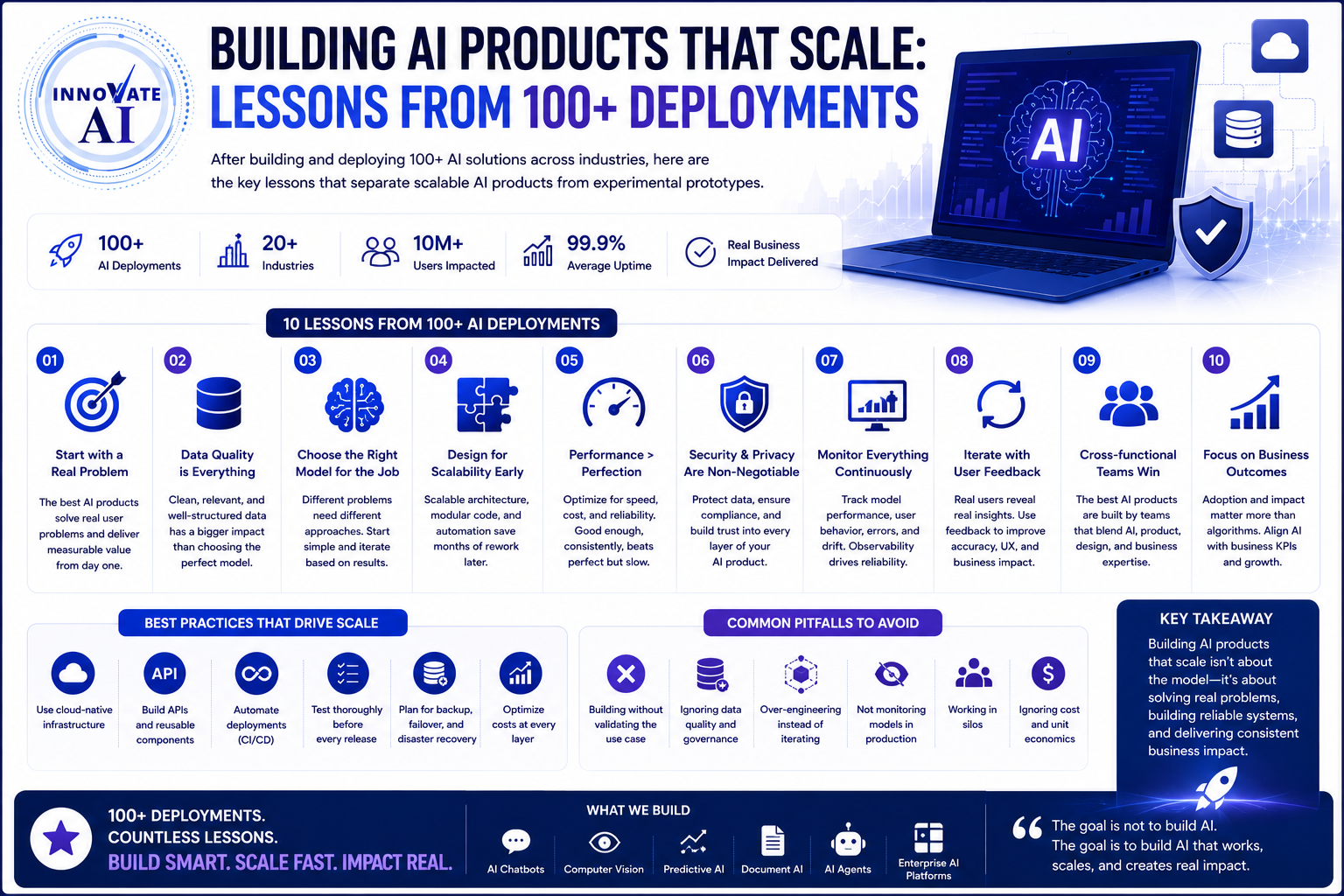
Building AI products that scale—lessons from 100+ deployments. What breaks at scale, production infrastructure patterns, the 90% evaluation rule, and implementation roadmap.
Hashtags:
#AIProduction #ScalingAI #AgenticAI #AIInfrastructure #MLOps #AIObservability #InnovativeAISolutions
Contact Us
Phone: +91 7464 099 059 / +91 96899 67356
Email: info@innovativeais.com
Address: Netaji Subhash Place, Pitampura, Delhi – 110034
Website: https://innovativeais.com
About the Author
Abhishek Kumar
Founder & CEO, Innovative AI Solutions
5+ years building AI systems that scale. Based in Delhi, serving clients across India.
Related services: to apply this in your business, explore our AI agent development and RAG development.