The Big Question
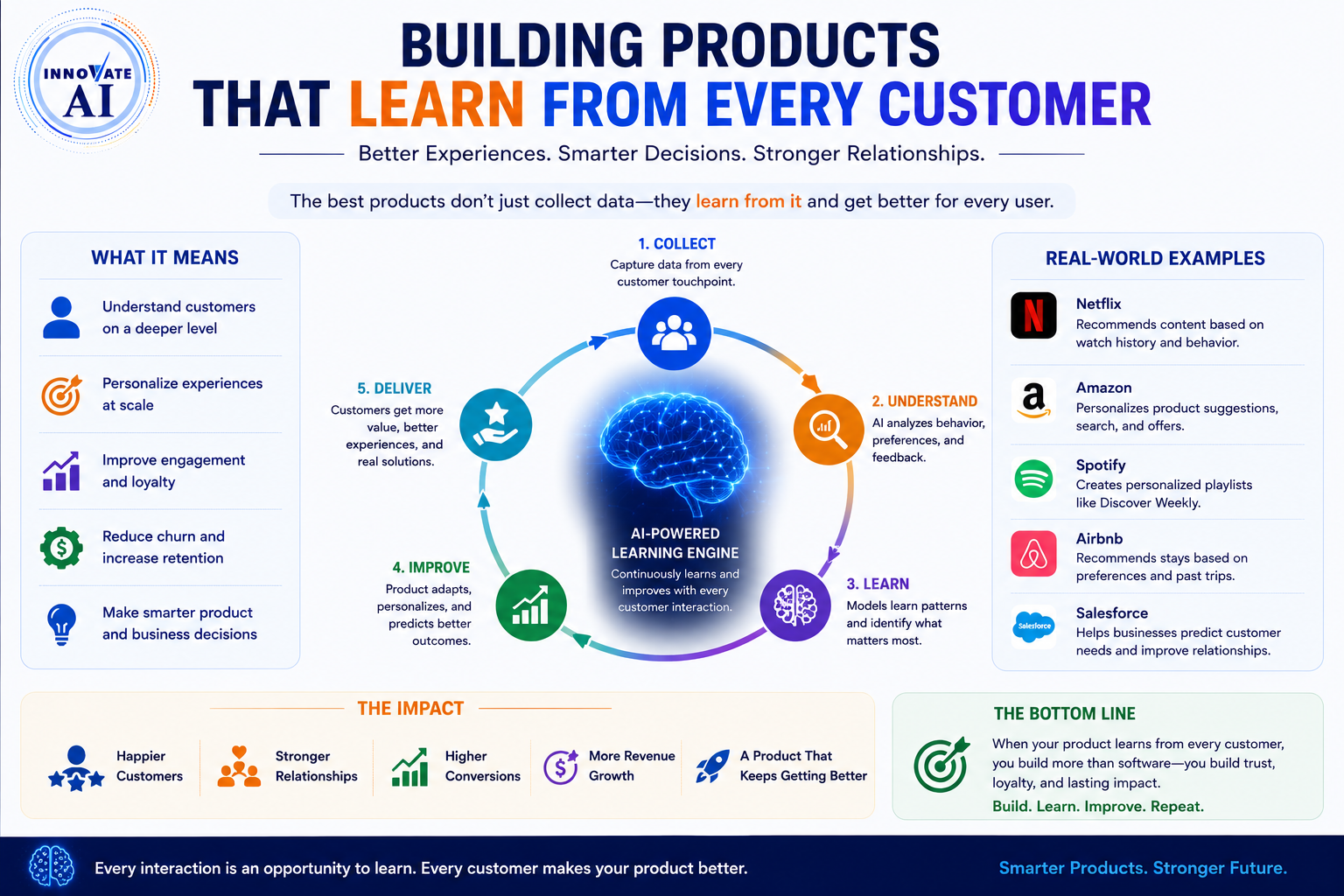
What if every customer interaction made your product smarter? What if complaints, confusion, and even the "small paper cuts" users have normalized became fuel for continuous improvement? And what if building a product that learns from every customer wasn't a feature—it was your operating model?
The most successful product teams have figured this out. They don't just listen to customers—they build systems that turn every interaction into learning.
The "Partner-Mentor" Model
Traditional product development treats customers as passive consumers. The most innovative teams treat them as mentors.
McKinsey research shows that companies integrating customer insights into development see satisfaction improve by 30% and time-to-market accelerate by up to 50% . Bain & Company found these companies are 28% more innovative and enjoy 35% higher retention rates .
This is the "Partner-Mentor" model—where every user acts not just as a consumer but as a mentor, providing crucial insights that drive innovation . Customers who see their suggestions lead to real changes become advocates, not just users.
The Empathy Flywheel
Kit's Nathan Barry built a $40M+ product-led business on a simple flywheel: build the best product possible, remove friction at every point, repeat . The key? Proximity to the customer.
"Analytics can tell you what happened, but it rarely explains why a customer feels stuck," Barry explains . The highest leverage insights come from informal, human contexts: listening to how creators describe workflows, noticing the tiny annoyances they've normalized, and catching details that never make it into formal feature requests.
The critical insight: "Many of the product improvements that drive word of mouth are too small to rise through a standard 'top requested features' process. They are the paper cuts that make someone say, 'This tool just gets me'" .
The Problem with Build-Measure-Learn
Steve Blank, the father of Customer Development, acknowledges that even the Lean Startup's Build-Measure-Learn framework has a fundamental flaw. It starts with "Build," which can imply throwing things at the wall to see what sticks .
Instead, Blank argues that startups begin with hypotheses—educated guesses about customers, value propositions, pricing, and channels. The MVP isn't the product with fewer features; it's the simplest thing that maximizes learning at that point in time .
The updated framework:
-
Hypotheses → Experiments → Tests → Insights
"The entire point of getting out of the building is to inform the founder's vision. The insight may come from analyzing customer responses, but it also may come from ignoring the data or realizing that what you are describing is a new, disruptive market that doesn't exist" .
Scaling Empathy Across the Team
Customer obsession can't live only in the founder's head. Kit uses practical mechanisms to spread empathy across the organization .
The Landing Page Exercise: Small groups built landing pages as if they were real customers within a short time window. Almost everyone got stuck writing the headline. That insight led to a product improvement: contextual help that appears right when someone clicks into the title field—connecting existing knowledge base content to the moment of need .
Side Hustles That Use the Product: Kit encourages employees to build newsletters, sell products, or experiment with audience projects. This turns teammates into real users who encounter the same friction customers face. "That empathy comes back into the product as grounded feedback" .
Continuous Discovery Habits: Teresa Torres's framework recommends making customer learning a regular part of the product team's weekly routine—not a one-off phase . Regular customer interviews, rapid experiments, and assumption testing become habits, not projects .
Learning from Mistakes: The Glove Story
Thibault Duchemin grew up the only hearing person in a Deaf family. His initial idea? Smart gloves to translate sign language. The team built a prototype, won a prize, and got started .
But Steve Blank challenged them: "We're not married to the glove." The team had to enter the Lean LaunchPad, they had to be willing to let go of their first idea .
The lesson: "Nobody wants your product until you prove it." First ideas rarely hit home for users. The goal isn't to build a prototype—it's to learn the most you can .
Removing Friction Through Observation
Kit's operational habits for reducing friction include :
-
Watch real user sessions using tools like FullStory to see where people hesitate, hunt, or abandon
-
Sit with customers in live settings and ask them to think out loud while completing a task
-
Use feature flags to release changes gradually—ship to a small percentage, observe the first-time experience, fix what breaks, and expand
This flips the usual dynamic. Instead of shipping to 100% and learning through support tickets, teams get early signal while the blast radius stays small .
Implementation Roadmap: The First 90 Days
Phase 1: Foundation (Weeks 1-4)
-
Audit your feedback channels: How do you currently learn from customers? Are you treating feedback as data or as fuel for improvement?
-
Start customer conversations: Begin with at least 5-10 customer interviews focused on understanding how they feel about your product
-
Identify "paper cuts": What small annoyances have customers normalized? These are often more valuable than major feature requests
-
Map hypotheses: Use a Business Model Canvas to frame your untested assumptions
Phase 2: Build Learning Systems (Weeks 5-8)
-
Implement session recording to observe real user behavior
-
Create a "partner-mentor" loop: Establish a mechanism for customers to see how their feedback influences product decisions
-
Run a discovery exercise: Have team members build something as if they were real customers to feel product friction
-
Design rapid experiments: Start testing one key hypothesis weekly
Phase 3: Scale Empathy (Weeks 9-12+)
-
Spread customer exposure across engineering, design, and leadership teams
-
Implement feature flag rollouts for gradual, observed releases
-
Develop a continuous discovery cadence—regular customer conversations become a team habit, not a project
-
Measure outcomes: Track how customer-driven improvements affect retention and word-of-mouth
Frequently Asked Questions
Q1: What is the "Partner-Mentor" model?
An approach where every user acts not just as a consumer but as a mentor, providing crucial insights that drive innovation . Companies implementing this see 30% higher satisfaction and 50% faster time-to-market.
Q2: How is this different from traditional customer feedback?
Traditional feedback is reactive—waiting for complaints or feature requests. Products that learn proactively observe behavior, uncover "paper cuts," and build systems that turn every interaction into learning .
Q3: What are "paper cuts" in product experience?
Small annoyances that customers have normalized but that reduce satisfaction. These often drive word-of-mouth more than major features—"this tool just gets me" comes from eliminating friction, not adding features .
Q4: What's wrong with Build-Measure-Learn?
Starting with "Build" implies building before knowing what to test. The updated framework starts with hypotheses, then designs experiments to test them, generating insights that inform the next cycle .
Q5: How can Innovative AI Solutions help?
We help organizations design customer-learning systems, implement observation tools, and build continuous discovery habits. Based in Delhi, serving clients across India.
Why Delhi is a Great Hub for AI Development
Delhi is emerging as a significant hub for AI development, backed by concrete government support and infrastructure. The recent Delhi Budget 2026-27 allocated ₹8.20 crore for two Artificial Intelligence centres of excellence (AI-CoEs), functioning as hubs for research, innovation, and startup incubation.
The city's AI infrastructure is expanding rapidly. Under the IndiaAI Mission, more than 38,000 high-end GPUs have been onboarded and are available at approximately ₹65 per hour—roughly one-third of the global average cost.
The government has also announced a ₹350 crore startup policy over five years, aiming to support the emergence of at least 5,000 startups by 2035, with key focus areas including artificial intelligence, machine learning, and automation.
The AI ecosystem in Delhi combines: cost-effective infrastructure, government support, a growing talent pool, and proximity to the country's business decision-makers.
What We Offer at Innovative AI Solutions
-
Customer-Learning Strategy: We help you design systems that turn every interaction into product improvement
-
Discovery Habits Implementation: We help you embed continuous customer conversations into team routines
-
Observation Tools: We help you implement session recording and behavior analysis
-
Hypothesis Testing Frameworks: We help you design rapid experiments that maximize learning
-
Change Management: We help your organization shift from building features to building learning systems
Final Thought
The unglamorous truth is that many companies cannot rely on product-led growth early. Product-led advantages show up at scale, once the product experience is mature and distribution loops are working. Before that, teams still face the cold start problem .
One practical solution: "manual first." High-touch tactics like concierge onboarding and founder-led support buy time while you learn what the product must become. These tactics may feel sales-led, but they are the bridge that gets enough momentum to build the product-led flywheel later .
Sustainable product-led growth rewards teams that preserve runway, iterate quickly from real feedback, and keep shipping improvements that users can feel .
Contact Us:
Phone: +91 7464 099 059 / +91 9689967356
Email: info@innovativeais.com
Address: Netaji Subhash Place, Pitampura, Delhi – 110034
Website: https://innovativeais.com
About the Author
Abhishek Kumar
Founder & CEO, Innovative AI Solutions
5+ years building AI systems for enterprises. Based in Delhi, serving clients across India.
Hashtags: #ProductLedGrowth #CustomerObsession #ContinuousDiscovery #ProductDevelopment #CustomerCentric #InnovativeAISolutions
Related services: to apply this in your business, explore our AI development services and API development and integration.