The Big Question
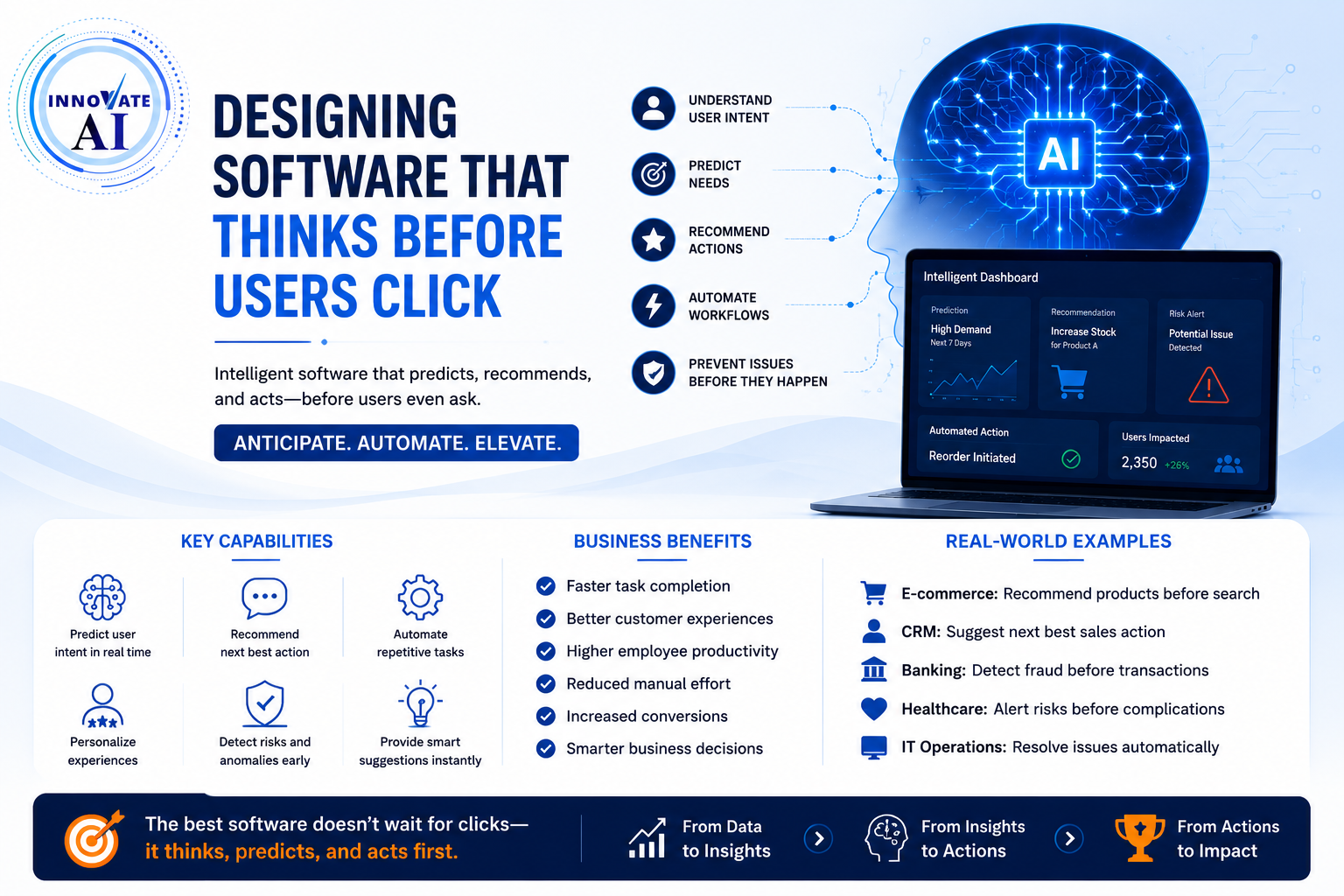
What if your software knew what you wanted to do before you clicked a single button? What if the interface assembled itself in real-time based on your context, preferences, and task? And what if you could simply express your intent—and the system executed outcomes without forcing you through rigid menus?
This is the promise of intent-based, anticipatory design. And it's reshaping how we think about software interaction.
The Shift: From Clicks to Conversations
For decades, the story of software design has been one of humans conforming their behavior to work with computers. Interfaces evolved from form-heavy command-based UI to graphical dashboards of clicks, taps, and swipes. Each step lowered friction but still required people to undergo steep learning curves, memorize workflows, and navigate dozens of menus and buttons .
With AI, the design philosophy flips. For the first time in history, software systems will now learn from humans, not the other way around. Instead of navigating menus, users can express intent in plain language and see the system execute. This is more than efficiency—it's a fundamental paradigm shift in how we interact with technology .
Jacob Nielsen, one of the pioneers of usability, captured this transformation: "With the new AI systems, the user no longer tells the computer what to do. Rather, he or she tells the computer what outcome they want" .
The shift is evident in industry adoption. According to McKinsey, 88% of organizations already use AI in at least one business function, with conversational interfaces increasingly embedded in workflows .
The "Interface-of-Intent" Philosophy
A concept called the "Interface-of-Intent" is emerging across leading software platforms. The premise is simple: software should revolve around intent, not clicks. Instead of navigating menus to find the right function, users can simply state what they want to achieve .
Four Design Principles
Leading product teams are applying four First Principles to intent-based design :
1. Focus on Use Case and Intent
The interface should strip away complexity so users can concentrate on the outcome they want, not the mechanics of how to get there. AI becomes the bridge between intent and outcome.
2. Transparency as the Default
Trust is built when users see why AI makes certain recommendations. By embedding explainability, AI becomes a transparent collaborator rather than a hidden layer.
3. Manual Editability Everywhere
AI accelerates workflows, but human creativity and judgment remain central. Every AI-generated output should be fully editable.
4. Modular, System-Wide AI
AI is not a bolt-on feature—it's a design layer that can be plugged into any workflow across the product.
Proactive vs. Reactive: The Core Distinction
Current AI assistants primarily operate reactively, responding only when prompted by users. Research from Carnegie Mellon and Microsoft has demonstrated significant potential for these systems to proactively assist without explicit invocation .
What Makes Interaction Proactive?
In a randomized experimental study, proactive assistants increased the number of tasks completed by an average of 12-18% . However, the study also revealed important nuances:
-
80-90% of participants preferred the proactive assistant over the baseline chat assistant
-
Only half preferred assistants that provided more frequent suggestions, despite productivity gains
-
Too many suggestions can saturate utility, leading users to copy suggested code less often
The key insight: proactivity must be designed carefully. The study found that people tend to rely on proactive assistant capabilities when available—including the ability to incorporate suggestions—rather than manual efforts .
The Three-Panel Architecture
A practical implementation of intent-based design uses a three-panel architecture :
-
Ask AI: The space where intent becomes input—users type in plain language, and the system understands and provides output
-
Explain AI: The panel that makes reasoning visible—every recommendation comes with an explanation users can follow and rectify
-
Insights Panel: The hub for context, adjustments, and decisions
Together, these panels create flow: intent leads to action, action comes with reasoning, and reasoning drives insight.
Anticipatory Design: Before You Even Ask
Anticipatory interfaces take this further—they surface what users need before they think to ask. Imagine a wealth management platform where, when a user logs in, the system has already surfaced what matters: an urgent compliance flag, a time-sensitive opportunity, and a trade approval staged for sign-off .
What Users Want
TELUS Digital research revealed what users expect from AI interfaces :
-
83% want a presence that moves with them across devices
-
89% want a system that knows their routines, preferences, and context
-
Users shift fluidly between mindsets—the same person who delegates routine tasks becomes a deliberator when stakes rise
The Five Foundational Layers
Building anticipatory interfaces requires five technical layers :
1. Signals and Context
Ambient data drives anticipation—time of day, location, calendar events, even weather. Each signal on its own is useful; together, they enable prediction.
2. User Data
This layer separates one-time interactions from those that improve with every session, retaining preferences and behavioral patterns.
3. Third-Party Integrations
Standards like MCP (Model Context Protocol) enable AI systems to cross boundaries and pull in context from calendars, tasks, and customer data.
4. Design Systems
Well-structured components and tokens give AI guardrails to generate on-brand, contextually appropriate UI.
5. Agentic Execution
The system stops reading, starts deciding, and starts doing—executing tasks on the user's behalf with defined permissions.
The Architecture of Thinking Software
How It Actually Works
In a proactive chat assistant for programming, the system operates as follows :
-
Timing: Proactive suggestions depend on the user's recent activities and interactions
-
Presentation: Proactive messages display a high-level description unless the user expands to see implementation details
-
Integration: Each message includes a "preview" button highlighting changes that will be made
-
Context Awareness: The assistant monitors what's happening in the workspace to infer intent
Real-World Examples
CleverTap's Interface-of-Intent: Marketers can ask questions like "Show me users who are likely to churn in the next 7 days" instead of navigating dashboards. The system generates outcomes, explains reasoning, and keeps outputs editable .
PredictHQ's Bolt: An AI-native notebook combining conversational AI with a persistent notebook of interactive cards. Users describe what they need in natural language, and Bolt queries APIs, returns real data, and provides production-ready code snippets alongside visualizations .
Anthropic's "Imagine with Claude": An intelligent canvas that creates any application on demand and generates the interface as users click through it—laying the track in front of the user's proverbial locomotive .
Trust and Transparency: The Critical Challenge
Research shows that 88% of consumers have seen AI make a mistake. Asking "Are you sure?" rarely leads to more accurate responses . Building trust requires three principles:
1. Build Transparency In, Don't Bolt It On
Users need to see what the system is doing, why it's making recommendations, and how to reverse actions.
2. Give Users Control
Every AI-generated output should be editable. Approvals should be clear and reversible.
3. Make Errors Easy to Recover From
Rollback controls, version history, and clear audit trails build confidence.
Control and Trust by Design
Intent-based interfaces address trust with :
-
Every prompt has an ID and version history
-
Policy checks flag ambiguity
-
Transparency receipts show inputs, parameters, and reasoning
-
Rollback controls make every AI action reversible
The UX to AX Evolution
Some designers are calling this the shift from UX (User Experience) to AX (Agentic Experience) . Traditional software treats every interaction like meeting a stranger: open app → click through → get result → forgets everything. Repeat. This made sense when computers had no intelligence and memory was expensive.
Agentic Experience is built on three principles :
Dialogue Over Commands: No clicking through menus when you can say what you want. The software responds like a real partner—asking clarifying questions, pushing back on weak ideas, suggesting better approaches.
Memory That Compounds: Every interaction adds to a permanent understanding of you—your style, patterns, insights. The software becomes more valuable with every use.
Invisible Intelligence: Every click eliminated, every friction point removed builds trust not through features you can see, but through friction that disappears.
The Debates: Where Practitioners Disagree
Is Conversation Always Better?
Not everyone agrees that conversation-driven interfaces are universally superior. Some designers caution against the "blank slate/black box problem"—a conversational interface has less visibility into what's possible, and the interaction cost of asking for things in natural language can sometimes exceed clicks .
The Predictability Question
When a system anticipates incorrectly, trust erodes faster than it built up. A phantom notification, delayed update, or inaccurate prediction isn't just a technical hiccup—it's a credibility problem .
The Cognitive Overhead Concern
Even with excitement about adaptive interfaces, some question whether users actually want constant adaptation: "We went through a whole hyperpersonalization phase only to discover that most people want roughly the same thing. Choice fatigue is real. Sometimes a well-designed, predictable interface beats one that's constantly reshaping itself" .
Implementation Roadmap: The First 90 Days
Phase 1: Foundation (Weeks 1-4)
-
Audit your UX friction: Identify where users struggle to navigate, what workflows cause confusion, and where prompt abandonment occurs
-
Define intent patterns: What outcomes do users most frequently seek? Map these to intent templates
-
Establish guardrails: Define what the system can access, what it can execute autonomously, and where it must pause
Phase 2: Pilot (Weeks 5-8)
-
Select one high-friction workflow for the intent-based pilot
-
Build the intent layer: Design natural language prompts, explanations, and editability
-
Implement transparency: Ensure reasoning is visible, actions are reversible
-
Measure adoption: Track time saved, user satisfaction, and accuracy
Phase 3: Scale (Weeks 9-12+)
-
Add anticipatory signals: Layer in context, location, and behavioral patterns
-
Enable agentic execution: Let the system execute tasks within permission boundaries
-
Expand to additional workflows
-
Continuous refinement: Monitor trust signals and refine based on feedback
Frequently Asked Questions
Q1: What is "thinking before users click" software design?
It's an approach where software anticipates user intent, surfaces relevant options proactively, and adapts interfaces in real-time rather than waiting for explicit clicks. Users express outcomes; the system handles mechanics.
Q2: How is this different from traditional UX?
Traditional UX forces users to learn menus and navigate pre-defined paths. Intent-based design flips this—the system interprets what users want to achieve and adapts the interface accordingly.
Q3: What does the research say about proactive assistants?
A randomized study found proactive assistants increased task completion by 12-18%. However, design details matter—too many suggestions can saturate utility even if they boost productivity.
Q4: What are anticipatory interfaces?
Interfaces that surface what users need before they think to ask. They use signals (location, time, past behavior) to predict needs and present options proactively rather than reactively.
Q5: What are the trust challenges?
Eighty-eight percent of consumers have seen AI make mistakes. Building trust requires transparency (showing reasoning), control (making actions reversible), and clear explanations.
Q6: How can Innovative AI Solutions help?
We help organizations design, build, and deploy intent-based, anticipatory interfaces—from UX audits and intent mapping to platform selection and trust-building implementation. Based in Delhi, serving clients across India.
Why Delhi is a Great Hub for AI Development
Delhi is emerging as a significant hub for AI development, backed by concrete government support and infrastructure. The recent Delhi Budget 2026-27 allocated ₹8.20 crore for two Artificial Intelligence centres of excellence (AI-CoEs), functioning as hubs for research, innovation, and startup incubation.
The city's AI infrastructure is expanding rapidly. Under the IndiaAI Mission, more than 38,000 high-end GPUs have been onboarded and are available at approximately ₹65 per hour—roughly one-third of the global average cost. This makes AI development remarkably cost-effective compared to other tech hubs.
The government has also announced a ₹350 crore startup policy over five years, aiming to support the emergence of at least 5,000 startups by 2035, with key focus areas including artificial intelligence, machine learning, and automation.
The AI ecosystem in Delhi combines: cost-effective infrastructure, government support, a growing talent pool, and proximity to the country's business decision-makers.
What We Offer at Innovative AI Solutions
After five years of building AI solutions for businesses, we've developed a practical approach that focuses on what actually works:
-
UX-to-AX Strategy: We help you audit existing UX friction and design intent-based experiences
-
Intent Layer Design: We help you map user outcomes to natural language prompts and responses
-
Anticipatory Architecture: We help you build the five-layer foundation—signals, user data, integrations, design systems, agentic execution
-
Trust and Transparency: We help you implement explainability, editability, and reversibility
-
Platform Selection: We help you choose CleverTap, PredictHQ, or custom solutions
-
Change Management: We help your organization shift from click-based to intent-based culture
Our approach is built on the reality that software that thinks before users click isn't just better design—it's the new competitive advantage.
Final Thought
The question isn't whether AI will redefine interfaces—it already is. The question is how we design for it to optimize for the jobs to be done .
The future of interfaces isn't about teaching humans how to use software. It's about designing software that understands humans. It's about moving from clicks to conversations, from reactive to anticipatory, from tool usage to collaboration .
The organizations that navigate this transition successfully won't just have better UX. They'll fundamentally rewire how humans and machines work together.
Contact Us:
Phone: +91 7464 099 059 / +91 9689967356
Email: info@innovativeais.com
Address: Netaji Subhash Place, Pitampura, Delhi – 110034
Website: https://innovativeais.com
About the Author
Abhishek Kumar
Founder & CEO, Innovative AI Solutions
5+ years building AI systems for enterprises. Based in Delhi, serving clients across India.
Hashtags: #IntentBasedDesign #AnticipatoryUX #AIUX #HumanAIInteraction #AgenticExperience #SoftwareDesign #InnovativeAISolutions
Related services: to apply this in your business, explore our AI development services and AI agent development.