The Big Question
"We deploy new software features quarterly. But our competitors seem to ship faster and improve their products continuously. How do we move from scheduled releases to continuous self-improvement?"
The honest answer:
The future of enterprise software is not about shipping updates faster. It is about building systems that improve themselves.
Here is the truth:
Self-improving software is not a feature you add. It is a fundamental architectural shift. Instead of software that is "done" at deployment, we are building software that gets smarter with every interaction.
This shift is driven by two converging trends: the maturation of machine learning models that can learn from usage data, and the emergence of agentic systems that can act on those learnings autonomously.
Step 3: What Is Self-Improving Software?
The Core Concept
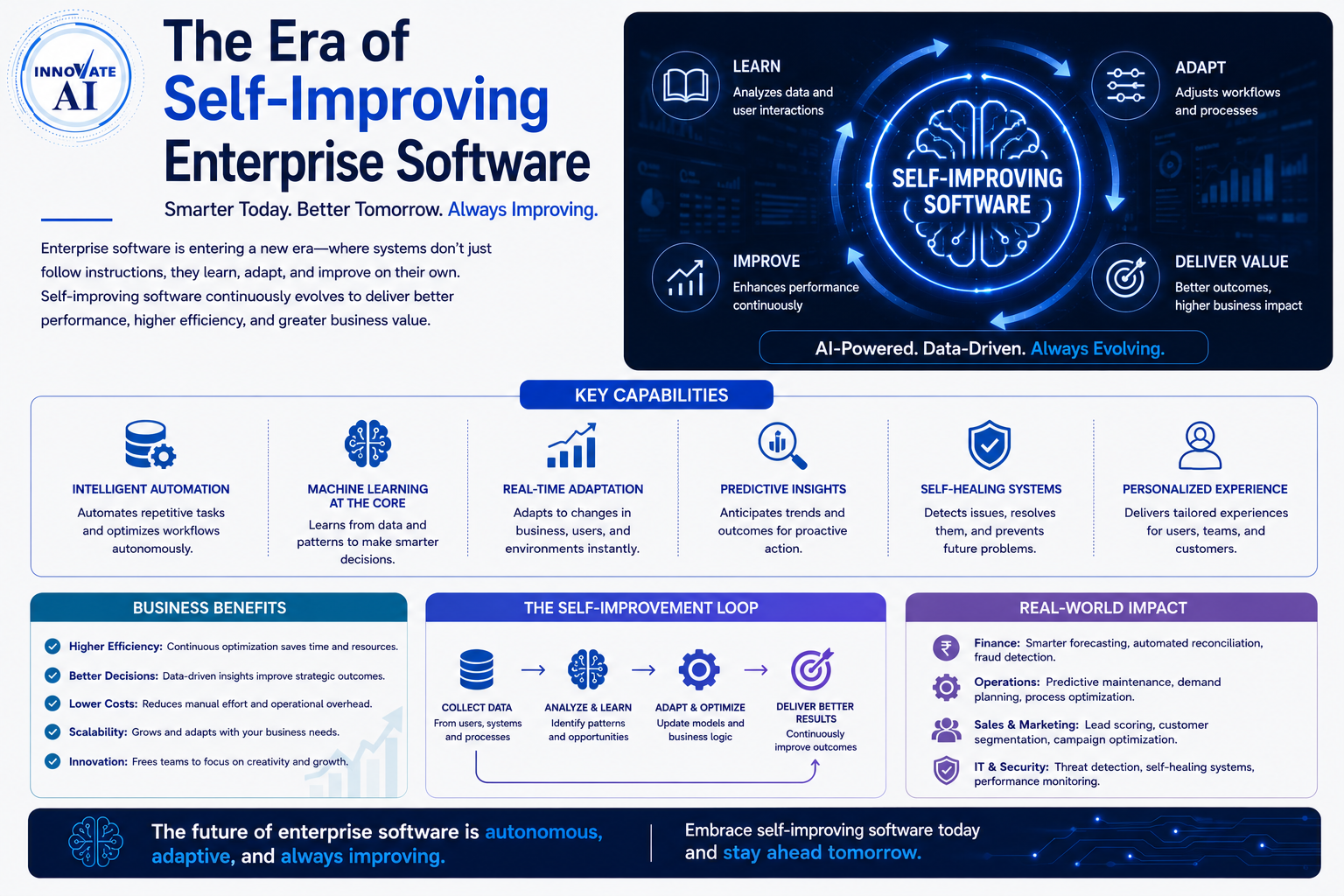
Self-improving software is an application that continuously learns from its usage patterns, adapts to changing conditions, and improves its own performance without requiring manual intervention. The software does not remain static—it evolves.
The Key Distinction
| Traditional Software | Self-Improving Software |
|---|---|
| Fixed capabilities at deployment | Continuously learns and adapts |
| Updates require human effort | Improves autonomously |
| Responds to user actions | Anticipates user needs |
| Static models and rules | Dynamic, evolving intelligence |
| Consistent performance | Improving performance over time |
The Architecture
Self-improving software typically combines:
-
Feedback loops that capture user interactions and outcomes
-
Learning systems that identify patterns and optimize
-
Adaptation mechanisms that apply learnings without human intervention
-
Observation layers that monitor performance and detect improvement opportunities
Step 4: How Self-Improving Software Works
The Core Components
| Component | Function | Key Technologies |
|---|---|---|
| Data collection | Captures user interactions, outcomes, and context | Telemetry, event logging, observability |
| Learning layer | Identifies patterns and optimization opportunities | Machine learning, reinforcement learning, analytics |
| Adaptation engine | Applies learnings to improve performance | AI agents, autonomous systems, automated configuration |
| Feedback loop | Measures impact and iterates | A/B testing, continuous evaluation, experimentation |
The Learning Cycle
-
Data collection: The software observes how users interact with it
-
Pattern recognition: ML models identify patterns and improvement opportunities
-
Decision making: The system decides what to change or optimize
-
Adaptation: The system applies the change autonomously
-
Evaluation: The system measures the impact of the change
-
Iteration: The cycle repeats with new data
Types of Self-Improvement
| Type | Description | Example |
|---|---|---|
| Performance optimization | Software becomes faster, more efficient | Query optimization, caching |
| Predictive improvement | Recommendations and predictions get more accurate | Recommendation engines |
| Autonomous adaptation | Software adjusts to changing conditions | Auto-scaling, self-healing |
| User experience evolution | UI and UX improve based on usage patterns | Adaptive interfaces |
| Feature evolution | Features are refined based on usage data | Usage-driven feature development |
Step 5: Why Self-Improving Software Matters
Reason 1: Speed of Evolution
Traditional software evolves at the speed of engineering teams. Self-improving software evolves at the speed of usage. The more people use it, the faster it improves.
Reason 2: Competitive Advantage
Software that improves itself continuously will outpace software that requires human intervention for every update. The advantage compounds over time.
Reason 3: Reduced Technical Debt
Self-improving software continuously optimizes itself, reducing the accumulation of technical debt. Instead of waiting for a major rewrite, improvements happen incrementally.
Reason 4: Better User Experience
Software that learns from usage patterns naturally becomes more aligned with user needs. It adapts to how people actually work, rather than forcing them to adapt to the software.
Reason 5: Lower Maintenance Cost
Self-improving software reduces the cost of maintenance because the system handles many optimization tasks autonomously.
Step 6: Real-World Use Cases
E-commerce and Retail
AI-powered recommendation engines improve over time as they learn from customer behavior. Product search becomes more accurate. Inventory predictions become more precise. Dynamic pricing adapts to market conditions.
Key applications: Product recommendations, pricing optimization, inventory management, personalization
Measured impact: 15-30% increase in conversion rates, 10-20% reduction in inventory costs
Manufacturing and Supply Chain
Manufacturing software learns from sensor data and adjusts production schedules, optimizes maintenance schedules, and reduces waste. Supply chain systems learn from disruptions and adapt proactively.
Key applications: Predictive maintenance, production optimization, supply chain resilience
Measured impact: 30-50% reduction in downtime, 15-25% reduction in maintenance costs
Financial Services
Fraud detection systems learn from new fraud patterns and adapt in real time. Risk models improve with more data. Trading algorithms learn from market conditions.
Key applications: Fraud detection, risk modeling, algorithmic trading
Measured impact: 40-60% reduction in fraud losses, improved risk-adjusted returns
Customer Support
AI agents learn from resolved tickets and improve their resolution rates. They become more accurate, faster, and better at handling edge cases.
Key applications: AI customer support, ticket triage, knowledge management
Measured impact: 20-40% improvement in resolution rates, 50% reduction in escalation rates
Software Development
Code assistants learn from codebases and improve their suggestions. Code review tools learn from approved patterns. Testing tools learn from past failures.
Key applications: AI coding assistants, automated code review, testing automation
Measured impact: 30-50% improvement in developer productivity
Step 7: The Technologies Enabling Self-Improving Software
Reinforcement Learning
Reinforcement learning enables software to learn optimal behaviors through trial and error. The system receives feedback on outcomes and adjusts its actions accordingly.
Continual Learning
Continual learning allows software to learn from new data without forgetting previously learned knowledge. This is critical for systems that operate in changing environments.
Agentic AI
Agentic AI systems can reason about goals, plan actions, and adapt based on outcomes. They are the engine of autonomous self-improvement.
Observability
Observability is the foundation of self-improvement. If you cannot measure performance, you cannot improve it. Rich telemetry, logging, and tracing provide the data that drives improvement.
MLOps
MLOps pipelines enable continuous training, validation, and deployment of machine learning models—the core of self-improving systems.
Step 8: Implementation Roadmap — 90 Days
Phase 1: Observability and Measurement (Weeks 1-4)
| Action | Output |
|---|---|
| Instrument applications with rich telemetry | Performance baseline |
| Define metrics that matter for your software | KPIs |
| Establish baseline performance benchmarks | Current state documented |
Phase 2: Learning Layer (Weeks 5-8)
| Action | Output |
|---|---|
| Build feedback loops into applications | Data capture in place |
| Implement ML models that learn from usage | Learning capability |
| Evaluate model performance and improvement | Validation results |
Phase 3: Autonomy (Weeks 9-12)
| Action | Output |
|---|---|
| Deploy autonomous adaptation mechanisms | Self-improvement enabled |
| Establish evaluation and iteration cycles | Continuous improvement |
| Measure impact and refine | ROI data |
Step 9: Frequently Asked Questions
Q1: What is self-improving software?
Software that continuously learns from usage patterns, adapts to changing conditions, and improves its own performance over time without requiring manual intervention.
Q2: How does self-improving software differ from traditional software?
Traditional software is fixed at deployment and requires human effort for every update. Self-improving software evolves continuously through autonomous learning and adaptation.
Q3: What technologies enable self-improving software?
Reinforcement learning, continual learning, agentic AI, observability, and MLOps pipelines are the core technologies.
Q4: What is the biggest barrier to self-improving software?
Observability. If you cannot measure performance, you cannot improve it. Rich telemetry and monitoring are prerequisites.
Q5: Can any software be self-improving?
Not all software. Self-improvement requires data collection, learning mechanisms, and adaptation capabilities. Simple CRUD applications are unlikely to benefit.
Q6: How can Innovative AI Solutions help?
We help organizations design and build self-improving software architectures—from observability and feedback loops to learning layers and autonomous adaptation. Based in Delhi, serving clients across India.
Step 10: Final Tagline
"The enterprise software of the future will not be static. It will learn, adapt, and improve continuously—without waiting for the next release cycle. Self-improving software is not a feature you add. It is a fundamental architectural shift. The organizations that embrace it will outpace competitors still waiting for the next version."
Short version:
The era of self-improving enterprise software—how AI is transforming applications from static tools to autonomous learning systems. A 2026 guide.
Hashtags:
#SelfImprovingSoftware #EnterpriseAI #AgenticAI #ContinuousLearning #AIArchitecture #InnovativeAISolutions
Contact Us
Phone: +91 7464 099 059 / +91 96899 67356
Email: info@innovativeais.com
Address: Netaji Subhash Place, Pitampura, Delhi – 110034
Website: https://innovativeais.com
About the Author
Abhishek Kumar
Founder & CEO, Innovative AI Solutions
5+ years building AI systems for enterprises. Based in Delhi, serving clients across India.
Related services: to apply this in your business, explore our AI agent development and AI development services.