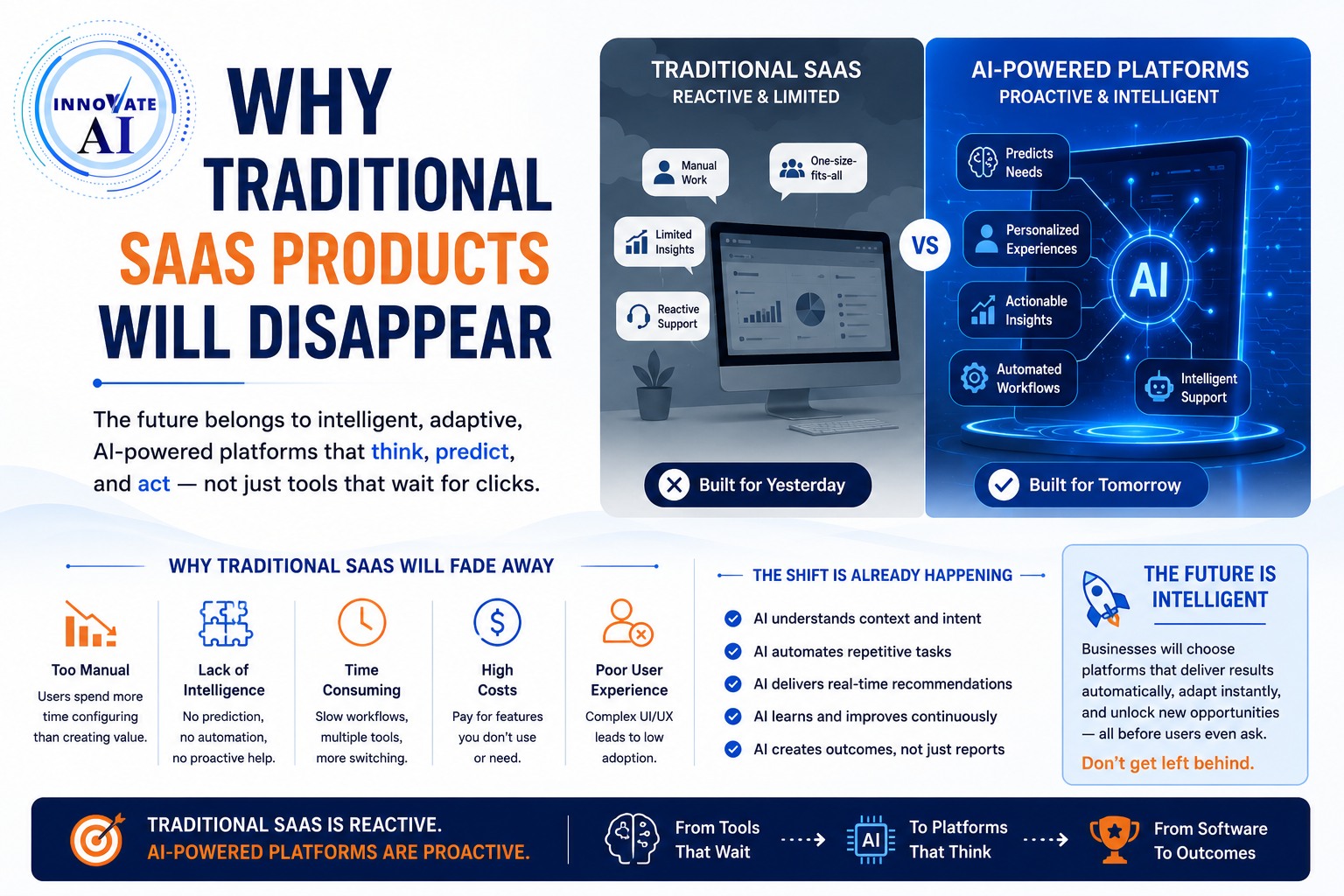
The Big Question
What happens when a software company's CEO tells a customer they have to pay $20,000 a year just to add a logo to the app—"Because we need the revenue"? What happens when the federal government negotiates a 90% discount on the same software you're paying full price for? And what happens when AI agents can now build, deploy, and maintain software that used to require multi-million dollar licenses?
The answer: traditional SaaS is facing an existential crisis. And much of it is self-inflicted.
The SaaSpocalypse: What's Actually Happening
In early 2026, an investor sell-off wiped nearly $1 trillion in market value from software and services stocks . Wall Street coined a new term: "SaaSpocalypse." The trigger was Anthropic's Claude Code—an AI tool that can write and deploy software autonomously—and the realization that software functionality could be replicated by AI agents at a fraction of the cost.
As one investor put it: "This may be the first time in history that the terminal value of software is being fundamentally questioned, materially reshaping how SaaS companies are underwritten going forward" .
The Dual Threat
Traditional SaaS faces disruption from two directions :
1. Agentic AI bypasses interfaces. Instead of interacting with dashboards and forms, users simply prompt an AI agent that retrieves data and executes actions autonomously. The SaaS interface becomes unnecessary.
2. Generative AI builds custom software. Users can now use AI to build bespoke SaaS-like applications on the fly—without coding expertise—bypassing traditional vendors entirely .
"The barriers to entry for creating software are so low now thanks to coding agents, that the build versus buy decision is shifting toward build in so many cases." — Lex Zhao, One Way Ventures
Self-Inflicted Wounds: The "Customer Extraction" Era
But here's the uncomfortable truth: much of the disruption is self-inflicted. As one SaaS industry observer notes, "Some of it is AI. But a lot of it is self-inflicted" .
What's Breaking Customer Trust
Excessive price increases: Not 5-7% inflation adjustments. We're talking 30%, 50%, even 100% increases with 45 days notice. Salesforce's recent pricing moves tell the whole story: price increases now represent up to 72% of their go-forward growth—not new customers or expansion. Three-quarters of their growth comes from charging existing customers more .
The "AI Tax": 60% of vendors now deliberately mask rising prices by bundling AI features. Adobe rebranded Creative Cloud to "Creative Cloud Pro," added AI features most users never touch, and charged 17% more. You can't opt out .
Predatory renewal tactics: Renewal conversations have become hostage negotiations. "If you don't renew by Friday, we'll have to shut off your access." "We can't guarantee this pricing will be available if you take time to evaluate."
Hidden price increases: Credit multipliers that change overnight, migration "fees" of 5-15% justified by platform improvements you didn't ask for, Microsoft's 5% surcharge for monthly billing .
Customer Success as sales: Every QBR becomes a pitch deck. Every check-in becomes a cross-sell attempt. "I see you're not using our new AI feature that we just made mandatory at an extra $15K per year" .
The Math That Doesn't Work
Corporate IT budgets are growing at just 2.8% annually, while many SaaS vendors are hiking prices by 9-25% . SaaS pricing is up 11.4% year-over-year—nearly five times higher than the 2.7% average market inflation rate .
"That's not inflation. That's price gouging dressed up in quarterly earnings language." — SaaStr
The Evidence: Customers Are Voting With Their Feet
Klarna's 1,200 System Replacement
When Klarna's CEO announced the company had ditched 1,200 SaaS systems, including Salesforce, in favor of an internal AI knowledge platform, it sent shockwaves through the industry .
The logic was simple: "We will store our knowledge in SaaS—reasons and content (documents), plans (slides, tickets), performance (tables), relationships (CRM), people (ERP, HR)—all in different silos... We began consolidating, connecting our knowledge, eliminating silos."
The result wasn't just cost savings—it was a unified knowledge graph that AI agents could reason over, transforming scattered data into actionable intelligence.
Sierra: $100M ARR in Under Two Years
Former Salesforce CEO Bret Taylor's AI startup Sierra—which offers AI customer service agents—hit $100 million in annual recurring revenue in less than two years . The company uses outcome-based pricing, charging based on results rather than per seat.
This represents the fundamental shift: customers don't want to pay for access to software. They want to pay for outcomes.
The 90% Discount That Exposed Everything
When the federal government negotiated with Salesforce for Slack, they secured up to a 90% discount. Ninety percent .
That discount reveals the entire game: the margins are so high that massive discounts are still profitable. The rest of us? "We're paying 10x what the software actually costs because we don't have the leverage to fight back" .
The Five Primitives SaaS Built On—And Why They're Breaking
SaaS can be understood as five core primitives that software was built on for two decades. AI is collapsing or transforming each one :
1. Workflow Builders → Agentic Workflows & Best-Practice Executors
Old primitive: Users manually designed and advanced workflows through pipelines, Kanban boards, wizards, and brittle if/then automations.
New primitive: Agents take a goal and execute the multi-step workflow automatically. No stages, no builders, no "pushing tasks forward." You give intent; the system handles the sequence.
AI-native firms like Thruline are taking ERP implementations from 90 days to 14 days by auto-generating configured instances.
2. Data Entry → Automatic Ingestion & Understanding
Old primitive: Humans spent 10-20% of their day inputting data into forms, dropdowns, and multi-step screens.
New primitive: Agents automatically ingest, interpret, and structure unstructured data from emails, documents, invoices, internal systems, and prior user behavior.
Example: Mentium monitors operational email streams, reads invoices and manifests, extracts structured data, and writes directly into ERPs—all without human data entry.
3. Business Logic → Self-Optimizing Policies
Old primitive: Static business logic lived in brittle, manual artifacts—configuration pages, rule trees, scoring models. Months of implementation, constant upkeep, and rules that quickly became outdated.
New primitive: Instead of hand-maintained configuration screens, the logic updates continuously based on new data, edge cases, and outcomes. Rules become adaptive. Policy improves with every cycle. Exceptions are learned, not hard-coded.
Stacktalk continuously aligns regulatory requirements, internal policies, and operational code paths—detecting inconsistencies before regulators or auditors do.
4. Approvals → Decision Delegation + Human Oversight
Old primitive: Humans had to authorize everything because software couldn't detect risk, explain decisions, or interpret nuance. So workflows paused at every point where judgment was required.
New primitive: Agents perform the end-to-end work and escalate only when true human judgment is required. The new UX becomes: "Here's what I did. Here's why. Here are the cases that need your judgment."
Example: JustPaid's AI agent automates the full revenue workflow from contract to cash—reading contracts, generating invoices, reconciling payments, and escalating only ambiguous cases.
5. Dashboards → Narrative Insights & Recommended Actions
Old primitive: Charts, filters, drill-downs, exports—humans had to make sense of the data. Insights were disconnected from action.
New primitive: Agents automatically interpret results and tell you what changed, why it changed, what to do next, and what they've done already. Analytics become narrative and actionable.
The AI-Native vs. AI-Assisted Distinction
Not all SaaS is equally threatened. The critical distinction is between companies that add AI features and companies that are AI-native from day zero.
| Traditional SaaS | AI-Native SaaS |
|---|---|
| Deterministic workflows and rules | AI systems act as the execution layer |
| AI assists users (copilots, chat) | AI reasons, decides, and acts autonomously |
| Predictable and fixed after release | Probabilistic and adaptive over time |
The data shows the gap clearly. AI-native startups like Cursor, Replit, and Lovable are reaching $10M ARR in roughly 12 months**, compared to the typical 3–5 years for traditional SaaS companies . Many are hitting **$100M ARR in under two years .
"AI-native does not mean a workflow that used to require a human now gets summarized by GPT. AI-native means the entire value chain of the product is only possible because of a model reasoning over it in real time. If you removed the AI, the product would not exist." — Forum Ventures
What Survives and What Doesn't
The "Eclipse" Scenario
In the most aggressive scenario, agentic AI eclipses SaaS entirely. Businesses rationalize their back-end systems into unified data repositories. AI agents access and act on this data directly, removing the need for distinct SaaS applications. Companies stop subscribing to SaaS and start paying for outcomes .
The "Convergence" Scenario
More likely, we'll see convergence. SaaS platforms will become the infrastructure layer that AI agents call. The traditional UI/UX layers will give way to conversational interfaces. But the underlying systems of record—data, transactions, compliance—remain essential .
As one industry leader puts it: "AI is not trying to 'kill' SaaS, but to reshape it" .
Nvidia CEO Jensen Huang explicitly pushed back on the "AI kills software" narrative: "Software tools are being replaced by AI"—that view is "extremely illogical." He argues that humans, robots, and AI agents will all prefer mature, reliable tools rather than reinventing the wheel every time .
What Won't Survive
-
Seat-based pricing models when agents do the work of dozens of employees
-
Bloated feature sets that justify renewals but aren't used
-
Customer extraction disguised as customer success
-
Long onboarding when leaner teams can stand up AI ecosystems in days
-
Static dashboards when agents deliver narrative insights and actions
What Will Thrive
-
Outcome-based pricing that charges for results, not access
-
AI-native architecture built around intelligence from day zero
-
Deep domain expertise that can't be replicated by general-purpose AI
-
Self-optimizing systems that improve with every interaction
-
Trust and transparency in an age of autonomous AI
Implementation Roadmap: The First 90 Days
Phase 1: Audit Your Business Model (Weeks 1-4)
-
Audit your pricing: What percentage of growth comes from new customers vs. squeezing existing ones?
-
Assess your AI-native readiness: Is your architecture designed for deterministic workflows or probabilistic AI?
-
Measure customer trust: Would customers recommend your renewal pricing to a friend?
-
Identify at-risk primitives: Which of the five SaaS primitives is most vulnerable to AI disruption in your category?
Phase 2: Redesign (Weeks 5-8)
-
Redesign workflows around AI: Reimagine processes with AI as the execution layer
-
Build a semantic layer: Move from fragmented data to a unified knowledge graph
-
Develop outcome-based pricing pilots: Test alternatives to per-seat models
-
Build governed AI infrastructure: Establish evaluation, observability, and lifecycle management
Phase 3: Transform (Weeks 9-12+)
-
Deploy production-grade AI agents in core workflows
-
Measure outcome-based metrics: ROI, time-to-value, customer success
-
Scale what works and kill what doesn't
-
Build your data moat through proprietary knowledge, not just features
Frequently Asked Questions
Q1: Is SaaS really dying or is this hype?
The SaaSpocalypse is real but not uniform. AI-native companies are growing 100% annually vs. 23% for traditional SaaS . However, software as infrastructure isn't disappearing—it's being restructured. As one analyst put it: "This isn't the death of SaaS. It's an old snake shedding its skin" .
Q2: How long do traditional SaaS companies have to adapt?
The window is narrowing. As AI-native competitors reset expectations, buyers are increasingly evaluating products not just on features, but on how well they operate AI in production . Companies that treat this as a feature update will fall behind those treating it as a structural shift.
Q3: What's the biggest risk for traditional SaaS vendors?
Complacency. Slapping AI features on deterministic architectures while retaining seat-based pricing and predatory renewal practices . The companies that will win are those redesigning architecture, pricing, and customer experience around intelligence.
Q4: What are the new pricing models?
Usage-based pricing (pay per token) and outcome-based pricing (pay for results). Sierra's outcome-based model hit $100M ARR in under two years . But as one investor noted: "Outcome-based pricing is the logical destination, but nobody has cleanly cracked what that contract looks like at scale" .
Q5: What should enterprise buyers do?
Use the SaaSpocalypse to renegotiate aggressively—the federal government's 90% Slack discount proves how much margin exists . Build internal AI capabilities to create leverage. Consolidate systems into unified knowledge platforms like Klarna did. And demand outcome-based pricing.
Q6: How can Innovative AI Solutions help?
We help organizations navigate this transition—whether you're a SaaS vendor needing to rebuild around AI, or an enterprise buyer needing to rationalize your software spend and build internal AI capabilities. Based in Delhi, serving clients across India.
Why Delhi is a Great Hub for AI Development
Delhi is emerging as a significant hub for AI development, backed by concrete government support and infrastructure. The recent Delhi Budget 2026-27 allocated ₹8.20 crore for two Artificial Intelligence centres of excellence (AI-CoEs), functioning as hubs for research, innovation, and startup incubation.
The city's AI infrastructure is expanding rapidly. Under the IndiaAI Mission, more than 38,000 high-end GPUs have been onboarded and are available at approximately ₹65 per hour—roughly one-third of the global average cost. This makes AI development remarkably cost-effective compared to other tech hubs.
The government has also announced a ₹350 crore startup policy over five years, aiming to support the emergence of at least 5,000 startups by 2035, with key focus areas including artificial intelligence, machine learning, and automation.
The AI ecosystem in Delhi combines: cost-effective infrastructure, government support, a growing talent pool, and proximity to the country's business decision-makers.
What We Offer at Innovative AI Solutions
After five years of building AI solutions for businesses, we've developed a practical approach that focuses on what actually works:
-
SaaS-to-AI-Native Transformation: We help you redesign architecture, pricing, and customer experience around intelligence
-
Enterprise AI Strategy: We help buyers rationalize SaaS spend and build internal AI capabilities
-
AI-Native Product Development: We help you build products from day zero with AI as the execution layer
-
Semantic Layer Implementation: We help you unify fragmented data into governed knowledge graphs
-
Outcome-Based Pricing Design: We help you transition from per-seat to outcome-based models
-
Governance and Compliance: We help you establish evaluation, observability, and lifecycle management
Our approach is built on the reality that traditional SaaS isn't just being disrupted—it's being rebuilt from the ground up. The companies that succeed will be those that embrace this transformation rather than defending the old model.
Final Thought
The pattern is always the same :
Year 1: "We need to better monetize our installed base. We're leaving money on the table."
Year 2: "Net revenue retention is at 125%! We're crushing it!"
Year 3: "Why is our churn increasing? Why are deals taking longer?"
Year 4: "Why is our NPS in the toilet? Why aren't we getting referrals?"
Year 5: "Why is a startup with a worse product taking share from us?"
"The answer is always the same: You optimized for the quarter. You lost the decade." — SaaStr
The real question isn't whether SaaS is dying. The real question is: Are you killing it? Are you the vendor customers recommend, or the one they warn their friends about? Are you building a business, or extracting from one? Are you creating value, or just capturing it?
The answer will determine whether you're here in 2030.
Contact Us:
Phone: +91 7464 099 059 / +91 9689967356
Email: info@innovativeais.com
Address: Netaji Subhash Place, Pitampura, Delhi – 110034
Website: https://innovativeais.com
About the Author
Abhishek Kumar
Founder & CEO, Innovative AI Solutions
5+ years building AI systems for enterprises. Based in Delhi, serving clients across India.
Related services: to apply this in your business, explore our SaaS development and AI agent development.