The Big Question
What happens when AI infrastructure spending reaches $1 trillion annually? When 75% of enterprise AI workloads run on hybrid fit-for-purpose infrastructure? When 35% of geographies become locked into region-specific AI platforms? And when power constraints and local politics force a fundamental rethink of the hyperscale-first model?
By 2027, the AI infrastructure buildout will hit an inflection point. Capital is flowing at unprecedented scale, but constraints—power, permitting, and geopolitics—are reshaping how and where that capital gets deployed. The organizations that navigate this transition successfully will be those that understand the converging trends shaping AI infrastructure.
The $1 Trillion Spending Surge
Capital Expenditure at Unprecedented Scale
Jamie Dimon, CEO of JPMorgan Chase, expects global AI infrastructure spending to hit $1 trillion in 2027—a figure that would reshape capital allocation across the technology sector . This represents a dramatic acceleration: AI spending went from $400 billion in 2025 to $700 billion in 2026, with projections exceeding $1 trillion in 2027 .
Goldman Sachs estimates that if incremental AI investment reaches 2% to 3% of GDP—comparable to the historical build-out of railroads and automobiles—hyperscaler capital expenditure would reach roughly $1.1 trillion in 2027, implying 45% growth . In a more extreme upside scenario, Goldman said cash flow generation and investment-grade credit market capacity could support as much as $1.4 trillion in capex .
JPMorgan's cumulative global AI-related capex forecast through 2030 now stands at $5.5 trillion . Futurum Equities forecasts that global data center capital expenditure will grow by approximately 50% to reach $2.3 trillion by 2027 .
Where the Money Is Going
The breakdown of 2027 data center capex tells a clear story about investment priorities :
-
AI Accelerators (GPUs): 25%
-
System DRAM (including HBM): 25%
-
Physical Infrastructure (power, cooling, data center space): 17%
-
NAND Flash and Storage: 10%
-
Networking Equipment: 9%
-
Other Data Center Systems: 9%
-
CPU: 4%
Key implications: GPUs and HBM memory account for 50% of total capex, underscoring that chips remain the core of AI investment. Physical infrastructure's 17% share signals that the entire supply chain—including power, cooling, liquid cooling, and data center construction—will continue to benefit . CPU's 4% share reflects the AI-era shift from traditional server processors to GPUs, HBM, networking, and specialized AI infrastructure .
The US-China Spending Gap
US entities account for approximately 80-85% of global AI and data center capex . Goldman Sachs forecasts US hyperscaler capital expenditures of $757 billion in 2026, representing 84% year-over-year growth, concentrated among Microsoft, Amazon, Alphabet, and Meta .
Chinese hyperscalers, including Alibaba and Tencent, are projected to invest a combined $84 billion in AI infrastructure for 2027—a 60% increase from 2025 levels, but roughly one-tenth of what US companies plan to spend .
The Hybrid Infrastructure Mandate
Fit-for-Purpose Infrastructure Takes Over
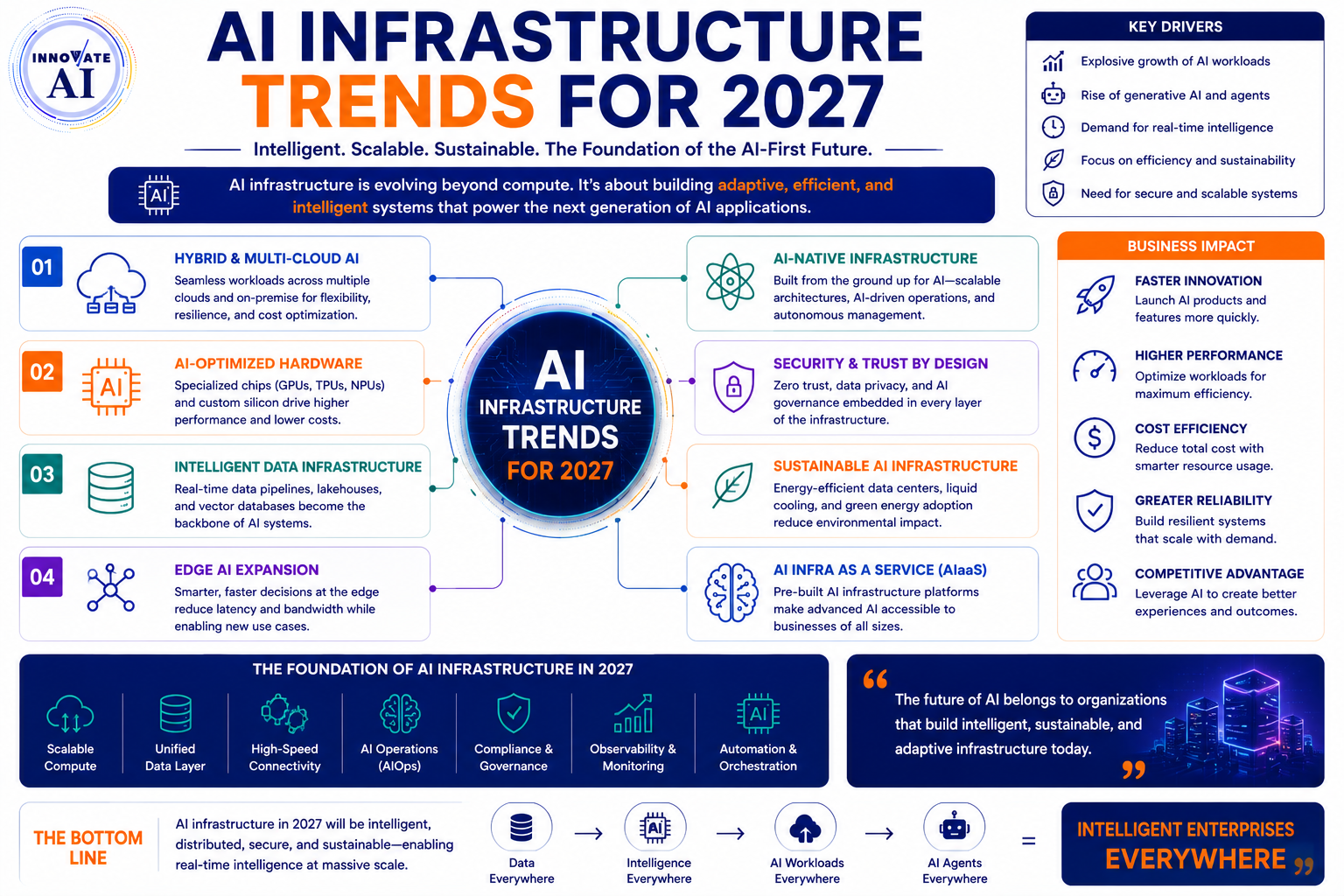
By 2027, 75% of enterprise AI workloads will be deployed on hybrid fit-for-purpose infrastructure to turbocharge time to value while optimizing performance, cost, and compliance . The future digital infrastructure fabric will be hybrid, spanning public and private clouds, non-cloud IT, and edge environments—each supporting a mix of AI models driving business value .
IDC research suggests C-suite buyers worldwide are most concerned about the cost, complexity, and potential risks associated with deploying AI workloads. Addressing these concerns boils down to making better decisions about AI-ready infrastructure choices, deployment models, and consumption models .
The Enterprise Adoption Reality
Enterprise AI has moved beyond experimentation into embedded operations. A TD Cowen survey of 689 U.S. enterprises found that 92% are now using at least one major AI platform, with Microsoft Copilot, Google Gemini, and ChatGPT forming the core triad of daily enterprise tooling .
Key findings include :
-
AI ROI is now widely positive: Three-quarters of respondents report positive ROI, with a meaningful share seeing multiples of return. AI budgets are becoming durable—this is no longer experimental spend.
-
Autonomous agents are on the horizon: Roughly a third of respondents already have semi-autonomous AI agents in production. By 2027, more than three-quarters expect to be running AI agents capable of executing multi-step workflows without human intervention.
-
Data consolidation is accelerating: Nearly all companies running autonomous agents rely on centrally governed data platforms such as data lakes and warehouses. Integration with systems of record is viewed as essential.
Cloud Infrastructure Modernization
IDC predicts that by 2027, the massive compute and data demands will force over 85% of organizations to transform traditional cloud environments into new platforms adapted for AI workloads . Traditional IaaS/PaaS-centric cloud architectures can no longer support AI application scaling; cloud infrastructure modernization is becoming a prerequisite for intelligent business operations .
IDC also predicts that by 2027, 80% of large enterprises will deploy agentic AI platforms for automated IT cloud operations—providing large-scale, continuous monitoring, analysis, and fault repair capabilities with minimal human intervention . Cloud operations are moving from "human-driven" to "agent-driven."
The Edge Revolution
Why Edge Is Becoming Central
AI demand is colliding with two hard constraints: grid capacity and local politics around hyperscale . Projected data center power demand for AI is expected to grow by at least 50% by 2027 and up to 165% by 2030, driven mainly by AI training and inference workloads .
Increasing power densities are pushing infrastructure requirements to new levels. Power densities that once centered around 10–20 kW per rack are being replaced by configurations nearing 40 kW, with dense AI racks pushing toward 85 kW today and credible roadmaps to 200–250 kW per rack by 2030 . This materially changes the electrical infrastructure required per room and per building.
Political and regulatory responses have followed the scale of this build-out. Research tracking local opposition campaigns shows data center projects representing tens of billions in planned investment have been delayed or blocked since 2024, while organized resistance has spread across dozens of proposed developments . Several dozen jurisdictions have adopted moratoriums or bans on new data centers, with a subset targeted specifically at large-scale facilities .
Edge as the Solution
Edge infrastructure offers a path forward :
Power Absorption: Instead of requiring tens or hundreds of megawatts at a single site, edge deployments often operate in the 10–500 kW range. That scale gives utilities more flexibility to serve new load through existing feeders rather than forcing immediate dependence on new high-voltage transmission buildouts.
Political Temperature: Distributed edge deployments sit below the threshold that triggers land-use conflict and public opposition. A sub-megawatt node inside an existing building does not trigger the same visibility or symbolic reaction as a hyperscale campus arriving as a new regional power load.
Risk Distribution: When AI capacity is spread across dozens or hundreds of smaller sites, the system becomes less exposed to a single interconnection delay, substation failure, or policy reversal.
CIOs Bet on Edge
IDC predicts that by 2027, 80% of CIOs will turn to edge services from cloud providers to meet the performance and compliance demands of AI inferencing . As generative AI moves from experimentation to execution, enterprises are confronting the limits of legacy infrastructure :
-
31% of organizations have already deployed GenAI applications into production
-
64% are in the testing or pilot phase
-
49% of enterprises struggle to manage multicloud environments
-
24% identify unpredictable rising cloud costs as a key challenge
In India, 82% of enterprises are conducting initial testing of GenAI and 16% are leveraging it in production. India is building out edge capabilities in tier 2 and 3 cities, with 91% of GenAI adopters relying on public cloud IaaS—but cost concerns and skills gaps are pushing demand for affordable, AI-ready infrastructure .
Sovereign AI: The Geopolitical Dimension
By 2027, 35% of geographies globally, including India, will be locked into region-specific AI platforms using proprietary contextual data . Regulatory pressure, geopolitics, cloud localization, national AI missions, corporate risks, and national security concerns are driving governments and corporations to accelerate investments in sovereign AI .
The Drivers of Sovereignty
Countries with digital sovereignty goals are increasing investment in domestic AI stacks as they look for alternatives to the closed U.S. model including computing power, data centers, infrastructure, and models aligned with local laws, culture, and region . Trust and cultural fit are emerging as key criteria. Decision makers are prioritizing AI platforms that align with local values, regulatory frameworks, and user expectations over those with the largest training datasets .
The Investment Requirement
Nations establishing a sovereign AI stack will need to spend at least 1% of their GDP on AI infrastructure by 2029 . Data centers and AI factory infrastructure form the critical backbone of the AI stack that enables AI sovereignty .
The Supply Chain Challenge
Construction Delays and Cancellations
Bernstein expects the pace of cancellations to accelerate into 2027 as developers reassess projects amid power, cooling, and supply-chain constraints . The firm estimates 35-40% of announced capacity globally is at risk of delay or cancellation, citing bottlenecks in grid connections, transformers, and liquid-cooling infrastructure needed for AI servers .
Power availability, not capital, is now the primary gating factor for new sites. In Northern Virginia, Frankfurt, and London, utility interconnection queues now stretch 3-4 years, forcing operators to look at secondary markets and retrofits .
Construction costs are a significant headwind. Bernstein estimates costs per MW have risen ~20-25% since 2023, driven by electrical equipment, steel, and specialized labor. Lead times for high-voltage transformers and switchgear remain at 80-100 weeks, limiting how fast delayed projects can restart .
The GPU Depreciation Risk
The AI infrastructure expansion is notable for its high ongoing costs due to the short 2-3 year lifespan of GPUs used in mission-critical AI tasks . This differs from previous tech cycles, and the sector faces risks of overcapacity and expensive idle assets if demand falls short, alongside potential AI price wars and aggressive capital raises reminiscent of past tech bubbles .
Implementation Roadmap
For Infrastructure Decision Makers
-
Assess your hybrid readiness: Can your infrastructure support workloads across public cloud, private cloud, and edge? The 75% hybrid mandate is approaching.
-
Plan for edge deployment: Edge infrastructure isn't just for telecommunications anymore. It's the solution to power constraints, permitting delays, and latency requirements.
-
Account for sovereign requirements: If you operate in multiple regions, understand the sovereign AI requirements emerging in each jurisdiction. Localized models will outperform global models in applications like education, legal compliance, and public services, especially in non-English languages .
-
Build with power constraints in mind: Power availability, not capital, is now the primary gating factor. Design infrastructure that can operate within available power budgets.
-
Plan for autonomous agents: By 2027, most enterprises will run AI agents capable of executing multi-step workflows without human intervention. Your infrastructure must support the compute intensity of multi-agent environments.
Frequently Asked Questions
Q1: How much will AI infrastructure spending reach by 2027?
Jamie Dimon projects $1 trillion in global AI infrastructure spending in 2027. Goldman Sachs estimates hyperscaler capex at $1.1 trillion, with upside to $1.4 trillion .
Q2: What's driving the shift to hybrid AI infrastructure?
By 2027, 75% of enterprise AI workloads will run on hybrid fit-for-purpose infrastructure. Organizations need to optimize performance, cost, and compliance across public cloud, private cloud, and edge environments .
Q3: Why is edge infrastructure becoming critical for AI?
Power constraints and local politics are making hyperscale campuses difficult to permit and power. Edge deployments in smaller increments (10-500 kW) can absorb power more easily, face less political opposition, and distribute risk .
Q4: What is sovereign AI and why does it matter?
Sovereign AI refers to a nation's ability to independently control how AI is developed, deployed, and used within its boundaries. By 2027, 35% of geographies will be locked into region-specific AI platforms due to regulatory, security, and geopolitical pressures .
Q5: What are the biggest risks to the AI infrastructure buildout?
Power availability, permitting delays, supply chain constraints, construction cost increases, and potential overcapacity if demand falls short .
Q6: How can Innovative AI Solutions help?
We help organizations design, build, and operationalize AI-ready infrastructure—from hybrid architecture and edge deployment to sovereign compliance and cost optimization. Based in Delhi, serving clients across India.
Why Delhi is a Great Hub for AI Development
Delhi is emerging as a significant hub for AI development, backed by concrete government support and infrastructure. The recent Delhi Budget 2026-27 allocated ₹8.20 crore for two Artificial Intelligence centres of excellence (AI-CoEs), functioning as hubs for research, innovation, and startup incubation.
Under the IndiaAI Mission, more than 10,000 GPUs have been onboarded at subsidized rates—among the lowest globally. India is also building out edge capabilities in tier 2 and 3 cities to meet GenAI demand and manage costs .
What We Offer at Innovative AI Solutions
-
Infrastructure Strategy: We help you assess your AI readiness and design a future-proof infrastructure roadmap
-
Hybrid Architecture Design: We help you balance public cloud, private cloud, and edge deployments
-
Edge Deployment: We help you build distributed AI infrastructure that navigates power and permitting constraints
-
Sovereign Compliance: We help you navigate region-specific AI platform requirements
-
Cost Optimization: We help you manage AI infrastructure costs while scaling
Final Thought
The AI infrastructure buildout of 2027 is unlike any previous technology cycle. Capital is flowing at unprecedented scale, but constraints are reshaping how and where that capital gets deployed. The winners will be those who understand that AI infrastructure isn't just about building bigger data centers—it's about building smarter, more distributed, and more resilient systems.
Contact Us:
Phone: +91 7464 099 059 / +91 9689967356
Email: info@innovativeais.com
Address: Netaji Subhash Place, Pitampura, Delhi – 110034
Website: https://innovativeais.com
About the Author
Abhishek Kumar
Founder & CEO, Innovative AI Solutions
5+ years building AI systems for enterprises. Based in Delhi, serving clients across India.