The Big Question
What happens when your competitors can access the same AI models as you for pennies? When a new open-source model matches your performance overnight? When the technology advantage you thought you had evaporates in six months?
This is the new reality of the AI economy. The question isn't whether you should use AI—it's whether you can build a defensible business around it.
The Myth of the Model Moat
Why Models Don't Create Defensibility
The assumption that superior AI models create durable competitive advantage is increasingly false for three reasons:
1. Models are commoditizing rapidly. Open-source models like Meta's Llama, DeepSeek, and Mistral are matching or approaching proprietary performance. The gap between frontier models is narrowing, and the cost of training is falling.
2. Model performance converges quickly. What was state-of-the-art six months ago is now table stakes. A significant technology advantage may last only 6-12 months.
3. Model access is universal. Any company can access frontier models through APIs or open-source downloads. The technology itself is not a differentiator.
When Models Can Be a Moat
Model defensibility is possible in specific contexts:
-
Training on proprietary, unique data that no one else can access
-
Serving specialized, vertical-specific tasks that general-purpose models handle poorly
-
Operating in highly regulated environments where compliance is a barrier to entry
For most businesses, however, the model itself is not the moat. It's the infrastructure around it.
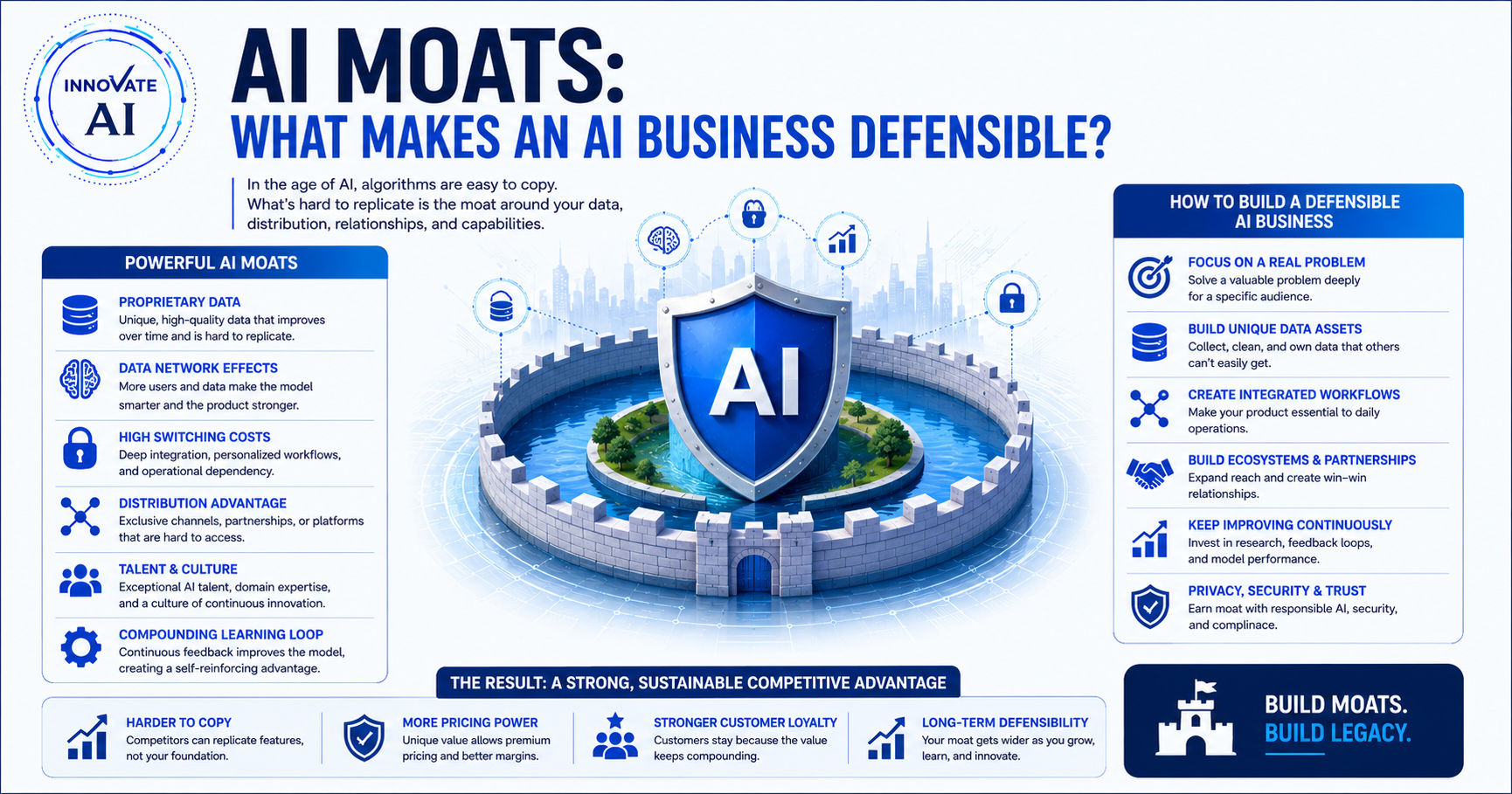
The Nine AI Moats That Actually Work
1. Proprietary Data — The Most Durable Moat
Why it works: The quality, uniqueness, and scale of your training and contextual data create a barrier that competitors cannot replicate. More users → more data → better AI → better UX → more users.
Examples: BloombergGPT (trained on Bloomberg's proprietary financial data), healthcare AI trained on exclusive medical records, legal AI trained on case law and firm-specific precedents.
In practice: Your proprietary data is your most valuable asset. Organizations with access to unique, high-quality data have a structural advantage that new entrants cannot easily overcome.
2. Workflow and Ecosystem Integration
Why it works: Embedding AI deeply into the user's existing workflows creates lock-in. When AI is integrated with CRM, ERP, communication, and project management tools, switching costs become prohibitive.
Examples: Microsoft's integration of Copilot across Office, Teams, Windows, and GitHub; Salesforce's Einstein across its entire platform.
In practice: The defensibility comes from the ecosystem—not the AI. Users don't switch because they can't easily replicate the integrated experience.
3. Network Effects
Why it works: AI products often improve with more users. Human feedback, usage data, and user-generated content create a self-reinforcing loop. Users attract users.
Examples: AI code assistant with a community of developers sharing prompts and solutions; AI marketplace where users contribute data or training.
In practice: Network effects create a structural advantage that is difficult for competitors to replicate. The value of the network grows with every new user.
4. Trust and Brand
Why it works: Trust takes years to build, and it's fragile. Enterprises need to trust that their data won't be compromised and outputs won't be hallucinated or biased.
Examples: Companies building trust through transparency, explainability, and compliance certifications.
In practice: Trust is a slow, expensive asset to build—and a fast, cheap one to destroy. For regulated industries, trust is non-negotiable and creates a significant barrier to entry.
5. Domain Expertise
Why it works: General-purpose AI lacks deep understanding of specialized domains. Industry-specific knowledge creates defensibility that models can't replicate.
Examples: Harvey (legal tech), Abridge (healthcare transcription), AlphaFold (biotech).
In practice: The defensibility comes from the 10 years of domain experience, the relationships, and the institutional knowledge—not the AI.
6. Human-in-the-Loop Expertise
Why it works: Some decisions require human judgment. The combination of AI efficiency + human judgment creates a moat in regulated or high-stakes domains.
Examples: Legal review, medical diagnosis, financial underwriting, security threat detection.
In practice: The defensibility comes from the trained human experts—not the AI. The AI handles the 80%; the humans handle the 20% that matters.
7. Ecosystem Lock-In
Why it works: Products that integrate AI across multiple complementary products create high switching costs. If you're using 10 tools from one vendor, you won't switch for just one.
Examples: Google's Gemini across Workspace; Meta's Llama across social platforms.
In practice: This is the classic enterprise lock-in, and it still works. The AI just makes the ecosystem more valuable.
8. Customer Switching Costs
Why it works: AI deeply integrated into workflows creates high switching costs. Retraining users, migrating data, and reconfiguring integrations are expensive.
Examples: Enterprise AI tools that require significant configuration and customization.
In practice: The defensibility comes from the pain of switching—not from the AI itself.
9. Regulatory Compliance and Certification
Why it works: Meeting regulatory requirements (HIPAA, GDPR, SOC2, etc.) in the AI era is expensive and time-consuming. Compliance creates a barrier to entry.
Examples: AI tools for healthcare with HIPAA compliance; AI for finance with regulatory approval.
In practice: The defensibility comes from the certifications and audits, not the AI. Compliance is a proxy for trust.
What's Not a Moat in AI
The "First Mover" Fallacy
Being first is rarely a defensible moat. Competitors will quickly copy what works, often with better execution.
The "Better Model" Fallacy
Models commoditize quickly. Model advantage is short-lived.
The "API-First" Fallacy
If your only differentiator is a thin wrapper around an API, you have no defensibility. Competitors can build the same thing in days.
Building Your AI Moat: Implementation Roadmap
Phase 1: Audit Your Current Position (Weeks 1-4)
-
Identify your current defensibility: What do you have that competitors can't easily replicate?
-
Assess your data assets: What proprietary data do you have? How can you increase its value?
-
Map your ecosystem: How embedded are you in customer workflows? Where can you deepen integration?
-
Evaluate your trust position: What compliance certifications do you have? How do customers perceive your trustworthiness?
Phase 2: Build Your Moat (Weeks 5-8)
-
Invest in proprietary data: Acquire, clean, and organize data that no one else has
-
Deepen workflow integration: Embed your AI into the tools your customers already use
-
Build trust through transparency: Invest in explainability, compliance, and security
-
Create switching costs: Make it painful for customers to leave
Phase 3: Scale and Defend (Weeks 9-12+)
-
Leverage network effects: Get more users generating more data
-
Deepen domain expertise: Hire experts, build institutional knowledge
-
Expand compliance: Pursue certifications that competitors don't have
-
Monitor competitive threats: Identify where competitors are building moats of their own
Frequently Asked Questions
Q1: What is the most defensible AI moat?
Proprietary data is the most durable moat. Organizations with unique, high-quality data that competitors cannot access have a structural advantage.
Q2: Can model performance be a moat?
Yes, but only in specific contexts: when training on proprietary data, when serving specialized vertical tasks, or when operating in highly regulated environments. For most businesses, the model itself is not the moat.
Q3: What's the difference between a moat and a temporary advantage?
A moat is durable—it continues to provide advantage over time. A temporary advantage is fleeting—competitors can replicate it quickly. Model performance is often a temporary advantage; data is often a moat.
Q4: Can an AI API wrapper be defensible?
No. If your only differentiator is a thin wrapper around an API, competitors can build the same thing in days. You need at least one of the nine moats to be defensible.
Q5: How can Innovative AI Solutions help?
We help organizations identify, build, and defend AI moats—from data strategy and workflow integration to trust building and compliance. Based in Delhi, serving clients across India.
Why Delhi is a Great Hub for AI Development
Delhi is emerging as a significant hub for AI development, backed by concrete government support and infrastructure. The recent Delhi Budget 2026-27 allocated ₹8.20 crore for two Artificial Intelligence centres of excellence (AI-CoEs), functioning as hubs for research, innovation, and startup incubation.
Under the IndiaAI Mission, more than 10,000 GPUs have been onboarded at subsidized rates—among the lowest globally. India is building its own sovereign LLM, and the government has announced a ₹350 crore startup policy over five years.
What We Offer at Innovative AI Solutions
-
AI Moat Strategy: We help you identify and build your defensible advantage in the AI economy
-
Data Strategy: We help you identify, acquire, and leverage proprietary data assets
-
Workflow Integration: We help you embed AI into existing customer workflows
-
Trust Building: We help you establish transparency, compliance, and security
-
Competitive Analysis: We help you understand your competitive position and identify threats
Final Thought
In the AI economy, defensibility doesn't come from model performance—it comes from the ecosystem around the model. The most defensible AI businesses don't compete on intelligence; they compete on proprietary data, workflow integration, network effects, and domain-specific trust.
Building a defensible AI business requires understanding what's actually defensible: data, distribution, trust, and workflow integration. The technology itself is just the entry ticket—the moat is everything else.
Contact Us:
Phone: +91 7464 099 059 / +91 9689967356
Email: info@innovativeais.com
Address: Netaji Subhash Place, Pitampura, Delhi – 110034
Website: https://innovativeais.com
About the Author
Abhishek Kumar
Founder & CEO, Innovative AI Solutions
5+ years building AI systems for enterprises. Based in Delhi, serving clients across India.
Related services: to apply this in your business, explore our AI development services and API development and integration.