The Big Question
What if you could trace a food product from farm to fork in seconds rather than weeks? What if a manufacturer could instantly verify the authenticity of components, or a regulator could audit compliance without manual paperwork? What if the biggest challenge in your supply chain wasn't logistics, but a lack of trust?
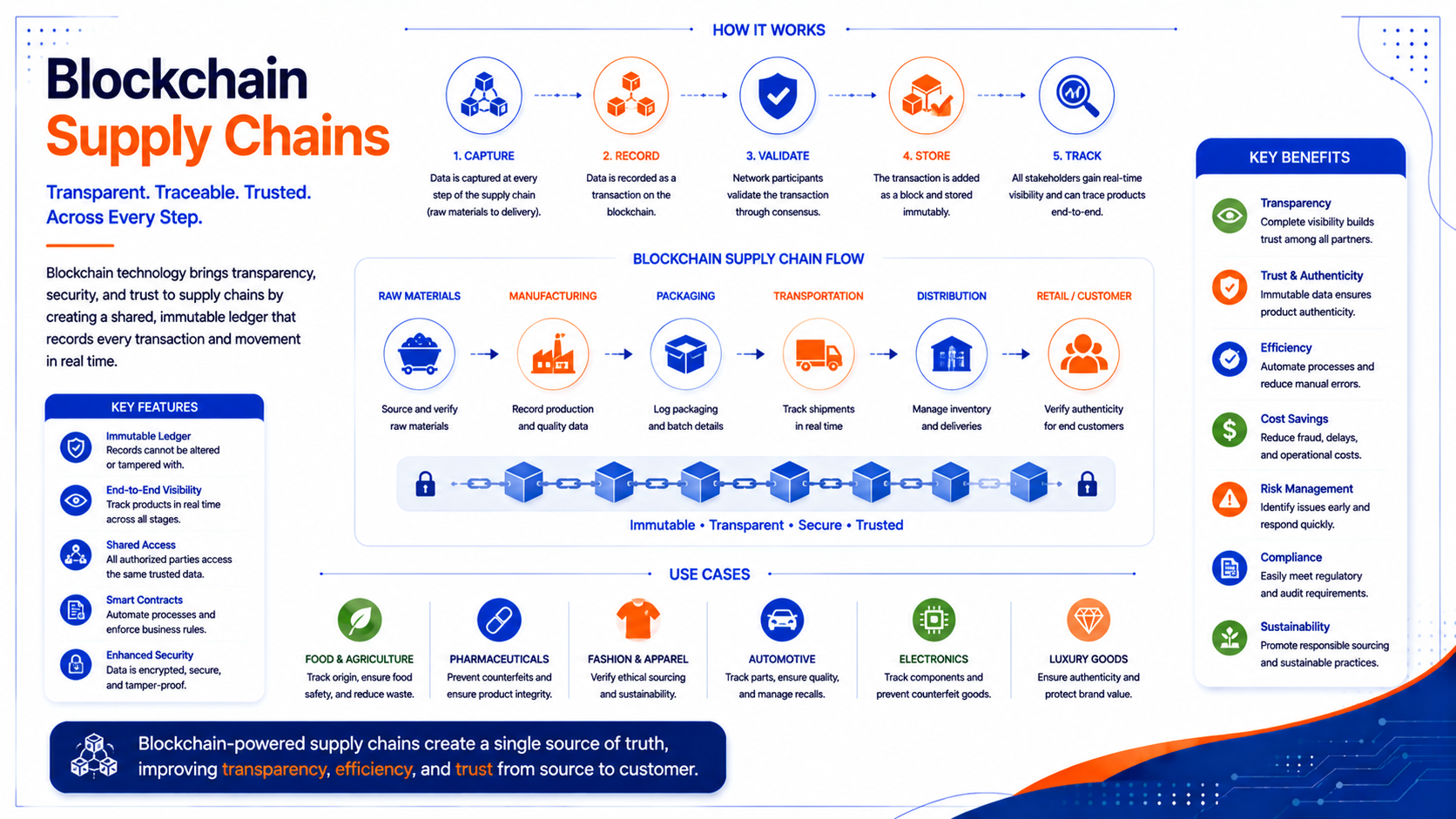
In an increasingly complex and globalized economy, supply chains are facing a crisis of trust. Traditional, centralized record-keeping systems are vulnerable to errors, fraud, and information asymmetry, making it difficult to verify product provenance, ensure ethical sourcing, and build confidence among stakeholders. Blockchain technology is emerging as a powerful solution to these challenges, offering a shared, immutable, and transparent ledger that can revolutionize how we manage supply chains.
The Core Value of Blockchain in Supply Chains
Blockchain's core attributes immutability, transparency, and decentralization—address the foundational weaknesses of traditional supply chain management. By providing a single, tamper-proof version of the truth accessible to all permissioned participants, it tackles long-standing issues like limited traceability, data security concerns, poor collaboration, and a lack of transparency.
Key Benefits
-
Enhanced Traceability and Transparency: Blockchain enables a complete, auditable history of a product's journey from origin to consumer. This verifiable provenance is critical for proving authenticity, combating counterfeiting, and ensuring the integrity of goods in sectors like pharmaceuticals, luxury goods, and food.
-
Improved Security and Trust: The decentralized and cryptographic nature of blockchain makes data tampering extremely difficult, if not impossible. This builds a high level of trust among stakeholders manufacturers, suppliers, logistics providers, regulators, and consumers who all rely on the same data.
-
Operational Efficiency and Cost Reduction: By automating processes with smart contracts, blockchain can drastically cut inefficiencies and reduce administrative overhead. For example, smart contracts can automatically trigger payments upon delivery verification, reducing manual reconciliation and paperwork.
-
Fraud Prevention and Risk Management: Blockchain's ability to verify the authenticity of products and transactions helps combat counterfeiting, price manipulation, and fraud. This is particularly valuable in high-value and safety-critical supply chains, such as those for aerospace components, medical devices, and fresh produce.
Key Drivers of Blockchain Adoption
| Driver | How Blockchain Helps |
|---|---|
| Data Integrity | Immutable, tamper-proof records ensure data has not been altered. |
| Regulatory Compliance | Transparent, auditable records simplify proof of compliance. |
| End-to-End Visibility | Provides a single source of truth for all stakeholders, reducing data silos. |
| Trust Among Partners | Creates a shared, trustworthy record of transactions and product history. |
How It Works: Key Components
A modern blockchain supply chain solution typically integrates several components to create a robust, end-to-end system.
Integration with IoT Devices
Internet of Things (IoT) sensors are critical for bridging the physical and digital worlds. They provide real-time monitoring and reporting of key parameters such as:
-
Environmental Conditions: Temperature, humidity, and shock for temperature-sensitive goods like pharmaceuticals and produce.
-
Location and Logistics: Geolocation and handling data to verify delivery conditions and routes.
-
Automated Data Capture: This eliminates manual data entry, reducing human error and providing verifiable evidence for smart contracts.
Smart Contracts
Smart contracts are self-executing agreements with the terms directly written into code. They automate processes and trigger actions automatically when predefined conditions are met.
-
Automated Payments: A smart contract can release payment to a supplier immediately upon confirmation of delivery from an IoT sensor.
-
Quality Assurance: It can log a quality alert if a temperature threshold is exceeded during transport, automatically adjusting compensation or flagging the shipment for inspection.
-
Compliance: A smart contract can verify that a customs declaration meets all regulatory requirements before processing.
Verifiable Credentials (VCs)
Verifiable Credentials are tamper-proof digital certificates used for identity and attestation. In a supply chain, a manufacturer can issue a VC to certify that a component meets a specific standard. This credential can be verified instantly by a downstream partner without contacting the issuer, streamlining compliance and quality checks.
Emerging and High-Impact Applications
Addressing Price Manipulation in Agriculture
A blockchain-based framework is being developed to combat price manipulation in agri-food supply chains, a persistent problem where intermediaries exploit information asymmetry to artificially inflate prices. This proposed system integrates:
-
Permissioned Blockchain: A private network (such as Hyperledger Fabric) where known stakeholders participate.
-
IoT-Enabled Monitoring: Real-time data on produce and environmental conditions is captured automatically.
-
Two-Party Confirmations: A system where both farmers and wholesalers must agree to confirm a transaction, ensuring fair pricing and accountability.
-
QR Codes for Consumers: Allows consumers to access a product's complete history, fostering transparency and trust.
The framework aims to ensure fair pricing, deter collusion, and promote equitable value distribution in agricultural markets, which has a direct impact on the incomes of farmers and the food security of consumers.
Boosting Internal Logistics Efficiency
Beyond end-to-end traceability, blockchain is proving its value in improving the efficiency of internal logistics operations. An integrated framework combining blockchain and IoT sensors was deployed within a Portuguese logistics company to enhance data integrity and audit processes. A pilot study demonstrated:
-
Low-Latency Event Registration: The system achieved event registration in approximately 5 seconds, supporting real-time operational monitoring.
-
Automated Evidence Generation: The blockchain automatically generated cryptographic proofs for all logged events, significantly reducing manual verification overhead in internal and external audits.
-
Enhanced Decision-Making: Logistics managers had access to cryptographically verifiable operational data, increasing decision-making transparency.
This application highlights how blockchain can be used not just for external transparency, but to streamline internal processes and reduce operational friction.
Challenges and Barriers to Adoption
Despite its immense potential, the widespread adoption of blockchain in supply chains faces significant challenges. Research consistently identifies several key barriers.
The "Big Three" Barriers
-
High Implementation and Customization Costs: The cost of designing, developing, and integrating a bespoke blockchain solution is a major hurdle, especially for small and medium-sized enterprises. This includes the cost of infrastructure, development, and integrating with existing systems.
-
Interoperability and Fragmentation: A fragmented ecosystem, where different blockchain platforms cannot easily communicate, creates silos and limits the value of the technology across a multi-enterprise supply chain. The challenge is to facilitate seamless integration across diverse platforms.
-
Non-Standardized Protocols: The lack of universally accepted standards and protocols creates uncertainty and hinders interoperability. For blockchain to reach its full potential, the industry needs to agree on common frameworks and data formats.
Other Critical Factors
-
Lack of Collaboration, Coordination, and Communication: Successful blockchain adoption requires active participation and buy-in from all stakeholders in the supply chain. A lack of coordination is a significant barrier.
-
Regulatory Uncertainty: The legal and regulatory landscape for blockchain is still evolving, creating hesitancy for organizations considering long-term investments.
Performance Metrics from Production Systems
Real-world and research implementations demonstrate that blockchain can deliver high performance in production-like conditions.
| Framework / Application | Platform | Key Performance Metric |
|---|---|---|
| AgroChain+ | Hyperledger Fabric | Write latency: 15.6 ms, Read latency: 8.12 ms |
| AgroChain+ | Hyperledger Fabric | Write throughput: 121 TPS, Read throughput: 227 TPS |
| Logistics Pilot | Permissioned Blockchain | Event Registration Latency: ~5 seconds |
AgroChain+ achieved a write latency of 15.6 ms and a throughput of 121 transactions per second, demonstrating that blockchain solutions can support the performance requirements of complex supply chains.
Implementation Roadmap
Phase 1: Assessment and Opportunity Identification (Weeks 1-4)
-
Map Your Supply Chain Ecosystem: Identify key stakeholders, data flows, and existing pain points. Where is the lack of trust or visibility most damaging?
-
Define High-Value Use Cases: Focus on a specific, high-impact area for your pilot. Food safety, anti-counterfeiting for luxury goods, or automating a complex customs process are strong starting points.
-
Establish a Consortium: As a successful blockchain relies on multi-party participation, early engagement with key partners is essential.
Phase 2: Prototype and Pilot (Weeks 5-8)
-
Select the Right Platform: Choose a permissioned blockchain platform like Hyperledger Fabric, which provides the privacy and access controls needed for enterprise supply chains.
-
Build the Data Model: Define what information you will record on the blockchain (e.g., product IDs, timestamps, GPS coordinates, temperature logs).
-
Integrate with IoT: If your use case requires it, start integrating IoT sensors to capture and automate data entry.
-
Develop Smart Contracts: Begin coding the automated logic for your pilot, starting with simple workflows.
Phase 3: Scaling and Integration (Weeks 9-12+)
-
Scale Across the Network: Once the pilot is validated, expand the solution to more partners in the supply chain.
-
Focus on User Experience: Ensure the system is accessible to all participants, from large corporations to small farmers. A poor user experience will kill adoption.
-
Enforce and Iterate Governance: Develop a governance model that ensures data is used responsibly and the integrity of the system is maintained.
Frequently Asked Questions
Q1: What is blockchain in supply chains?
Blockchain in supply chains is the use of a shared, immutable, and transparent ledger to record and track products, transactions, and data from the point of origin to the end consumer. It provides a single source of truth for all authorized participants.
Q2: What are the primary benefits?
The primary benefits include enhanced traceability and transparency, improved security and trust, operational efficiency and cost reduction, and better fraud prevention and risk management.
Q3: How can blockchain help combat price manipulation?
It helps by creating a transparent, immutable record of transactions. A blockchain-based framework can integrate IoT and QR/RFID technologies, implementing two-party confirmation mechanisms between farmers and wholesalers. This ensures fair pricing, deters collusion, and fosters trust among farmers, distributors, retailers, consumers, and regulators.
Q4: What are the main barriers to adoption?
The primary barriers are high implementation and customization costs, interoperability challenges between different blockchain platforms, a lack of standardized protocols, and the need for greater collaboration and regulatory clarity.
Q5: How can Innovative AI Solutions help?
We help organizations design, build, and operationalize blockchain solutions for supply chain management—from consortium formation and platform selection to prototype development and integration. Based in Delhi, serving clients across India.
Why Delhi is a Great Hub for Supply Chain Innovation
Delhi is a central hub for both technology and logistics in India, making it a natural epicenter for supply chain innovation. The region's vibrant mix of technology talent, enterprise, and global trade links creates a powerful ecosystem for developing and deploying solutions to real-world supply chain challenges.
What We Offer at Innovative AI Solutions
-
Blockchain Strategy: We help you identify high-value use cases and design a roadmap.
-
Platform Selection: We guide you in choosing the right blockchain platform for your needs.
-
Implementation: We help you build and integrate blockchain solutions, from smart contracts to IoT integration.
-
Consortium Building: We help you orchestrate the multi-party collaboration required for success.
Final Thought
The shift is clear: from fragmented, opaque supply chains to integrated, transparent networks of trust. Blockchain provides the foundational technology to make this vision a reality. While challenges like cost and interoperability remain, the benefits of enhanced traceability, efficiency, and trust are driving unprecedented interest and investment. Organizations that invest in blockchain for their supply chains now will be the ones that build stronger, more resilient, and more trusted businesses for the future.
Contact Us:
Phone: +91 7464 099 059 / +91 9689967356
Email: info@innovativeais.com
Address: Netaji Subhash Place, Pitampura, Delhi – 110034
Website: https://innovativeais.com
About the Author
Abhishek Kumar
Founder & CEO, Innovative AI Solutions
5+ years building AI, cloud, and blockchain systems. Based in Delhi, serving clients across India.
Related services: to apply this in your business, explore our AI development services and RAG development.