Why do business applications become obsolete so quickly?
The answer isn't technology. It's rigidity.
A fixed application encodes business rules directly into code. The approval threshold is a number in a function. The pricing logic is a series of conditional statements. The workflow is a sequence of hardcoded steps.
This works until the business changes. And the business always changes.
New compliance requirements. New pricing models. New approval hierarchies. New markets with different rules. Every change requires development work. Requirements gathering. Coding. Testing. Deployment. Weeks or months of delay.
The cost compounds. An application that took six months to build becomes a maintenance burden that consumes a growing share of engineering capacity. Eventually, the business work and services around the software instead of the software working for the business.
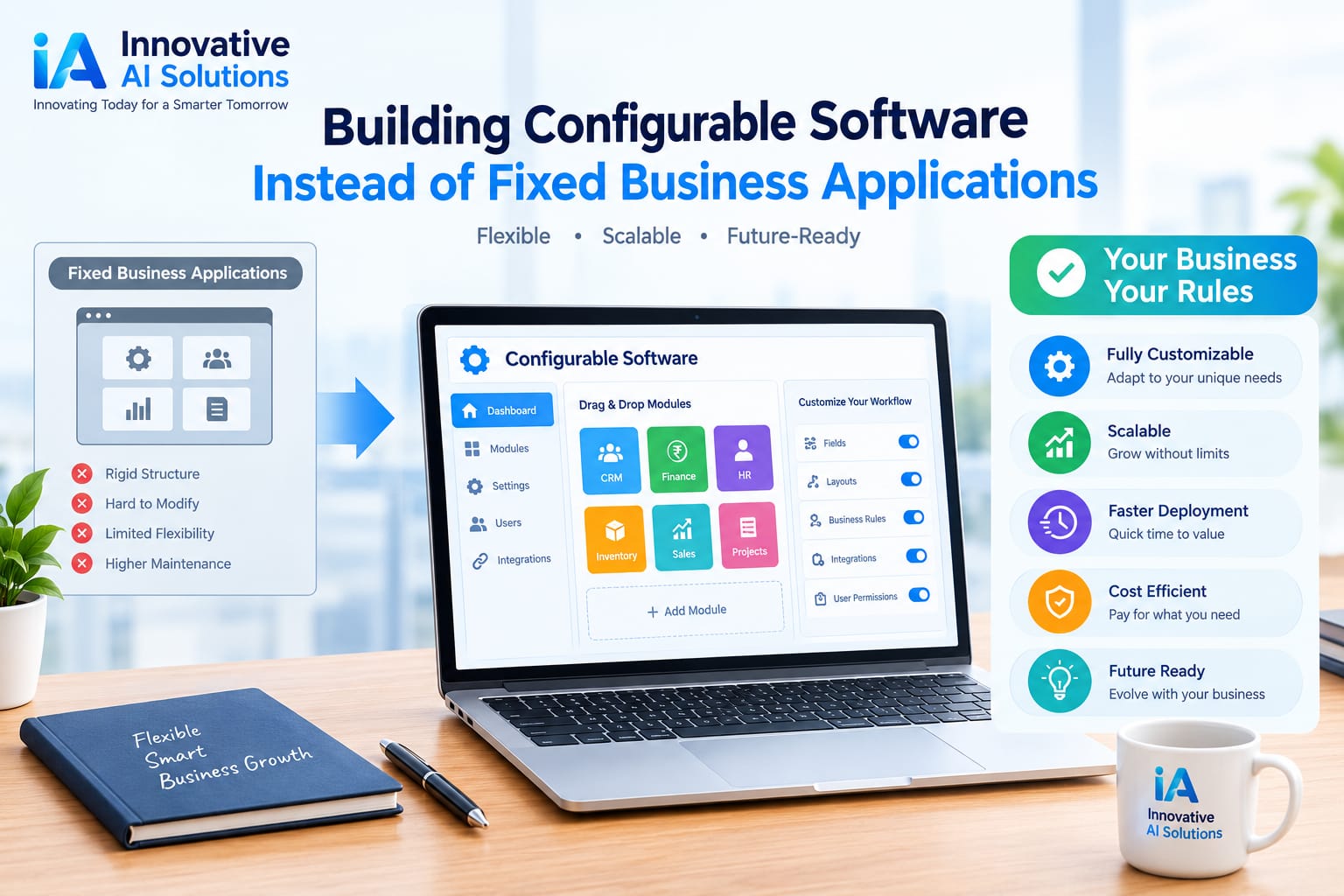
Configurable software solves this by design. It separates what the software does from how it does it. Business rules live in configuration metadata, rules,services, engines, workflow definitions not in code. Changes that once required development now require configuration.
The shift is fundamental. Instead of building fixed applications, you build platforms for configurability.
What Configurable Software Actually Means
Configurable software is designed so that business logic, workflows, and user interfaces can be modified without changing the underlying code. The system provides mechanisms for configuration that business users or administrators can use directly.
The core components of configurable software:
Metadata-Driven Architecture
The application's behavior is defined by metadata structured descriptions of entities, fields, relationships, validations, and UI layouts. The runtime engine reads this metadata and renders the application accordingly. Change the metadata, and the application changes.
This is how platforms like Salesforce, ServiceNow, and Microsoft Dynamics work. The underlying code is stable. The metadata defines what each customer sees and how it behaves.
Rules Engines
Business rules are extracted from code and stored in a rules engine. Rules are defined declaratively conditions and actions. The engine evaluates rules at runtime and executes the appropriate actions. Changing a rule doesn't require code changes.
Rules engines handle: pricing calculations, approval thresholds, eligibility determinations, compliance checks, and workflow routing.
Workflow Engines
Business processes are defined as workflows sequences of steps, decision points, and parallel paths. The workflow engine executes these definitions. Changing a process means changing the workflow definition, not the code.
Workflow engines handle: approval chains, task routing, escalation, SLA tracking, and process orchestration.
Plugin and Extension Architecture
While the core remains stable, extensions allow custom behavior to be added without modifying the core. Plugins are isolated modules that hook into defined extension points. They can be added, removed, or updated independently.
This is how platforms balance configurability with extensibility. The core provides the framework. Plugins provide the differentiation.
Template and Layout Configuration
User interfaces are defined through templates and layouts, not hardcoded screens. Fields can be added, removed, or rearranged. Layouts can be customized per role, per department, or per tenant.
Why Fixed Applications Fail
Fixed applications aren't inherently bad. They're appropriate when requirements are stable and well-understood. The problem is that few business requirements stay stable.
The Change Tax
Every change to a fixed application incurs a "change tax" the overhead of requirements, development, testing, and deployment. This tax is proportional to the change, not the value. A small rule change can require the same process as a major feature.
The change tax compounds over time. A system that requires 100 changes per year, each taking two weeks, consumes 200 weeks of engineering capacity. That's nearly four full-time engineers just maintaining existing functionality.
The Workaround Culture
When changes are expensive, users find workarounds. Spreadsheets supplement the system. Manual processes fill the gaps. Shadow IT emerges. The application becomes a partial solution, and the business becomes dependent on fragile manual workarounds.
The Replacement Cycle
Eventually, the accumulated workarounds and the growing backlog of change requests make the application untenable. The business decides to replace it. A new system is built. The cycle repeats because the new system is also fixed.
The Opportunity Cost
The most significant cost isn't maintenance. It's the changes that never happen. Ideas that could improve the business but aren't worth the development cost. Markets that could be entered but require system changes. Products that could be launched but need new pricing logic.
Fixed applications don't just cost money. They cost opportunity.
The Configurable Advantage
Configurable software changes the economics of change.
Faster Time to Change
Changes that required development now require configuration. A pricing rule update takes minutes, not weeks. An approval threshold change takes hours, not days. The business responds to market changes immediately.
Lower Cost of Change
Configuration is cheaper than development. No requirements gathering. No coding. No testing cycle. No deployment. The cost of change drops by an order of magnitude.
Business User Empowerment
Configurable systems can be designed for business users, not just developers. Administrators can add fields, modify workflows, and update rules without technical skills. This distributes the capacity for change across the organization.
Consistency and Governance
Configuration is auditable. Changes are logged. Who changed what, when, and why. This is harder to achieve with code changes scattered across repositories.
Extensibility Without Fragility
When custom behavior is needed, plugins provide it without modifying the core. The core remains stable and upgradeable. Customizations don't break on upgrade.
Building Configurable Software: The Architecture
Building configurable software requires different architectural decisions than building fixed applications.
Separate the Engine from the Content
The engine is the code that executes the application. The content is the metadata, rules, and workflows that define what the application does. Keep them separate. The engine is stable. The content changes frequently.
Define Extension Points
Identify where customization is allowed. Define clear interfaces for plugins. Document what plugins can and cannot do. This prevents customizations from breaking the core.
Invest in the Configuration Layer
The configuration layer the UI for defining metadata, rules, and workflows is as important as the application itself. If configuration is hard, users won't use it. Make it intuitive, documented, and safe.
Version Everything
Metadata, rules, and workflows should be versioned. Changes should be traceable. Rollback should be possible. This is as important for configuration as it is for code.
Test Configuration, Not Just Code
Configurable systems require testing configurations, not just code. Build a testing framework for configurations. Validate that changes produce expected behavior before they reach production.
When Configurable Software Makes Sense
Configurable software isn't right for every application. The decision depends on the nature of the requirements.
Configurable software is a good fit when:
Requirements change frequently. If the business rules evolve regularly, configurability pays for itself quickly.
Multiple variations exist. Different regions, customer segments, or product lines need different behavior. Configurability handles variations without separate codebases.
Business users need control. If the business wants to make changes without engineering involvement, configurability empowers them.
The application is a platform. If the goal is to support many use cases, configurability is essential.
Fixed software is appropriate when:
Requirements are stable. If the business rules are unlikely to change, the overhead of configurability isn't justified.
Performance is critical. Configurable systems add abstraction layers. For performance critical applications, fixed code may be necessary.
The application is highly specialized. If the application does one thing and does it well, configurability adds unnecessary complexity.
The team lacks configuration expertise. Building configurable software requires different skills than building fixed applications. Without expertise, the result may be worse than a fixed application.
What This Means for Your Business
For product leaders:
Configurability is a product decision. It affects how quickly you can respond to customer needs, how much engineering capacity you spend on maintenance, and how scalable your solution is. Consider configurability from the start it's hard to retrofit.
For engineering leaders:
Configurable software requires different architecture. Invest in the engine, the configuration layer, and the extension points. Test configurations, not just code. Version everything.
For business leaders:
Configurability reduces the cost of change. It empowers business users. It enables the business to respond to market changes without waiting for engineering. The investment pays off in agility.
For Indian businesses:
The platforms exist. Salesforce, ServiceNow, Microsoft Power Platform, and open-source options like Camunda and Drools provide configurability out of the box. The question is whether to build on these platforms or build configurable software from scratch. For most businesses, building on existing platforms is faster and cheaper.
Frequently Asked Questions
Q1: What is configurable software?
Configurable software is designed so business logic, workflows, and user interfaces can be modified without changing the underlying code. It separates what the software does from how it does it, using metadata, rules engines, and workflow definitions.
Q2: How is configurable software different from custom software?
Custom software is built for specific requirements, with business rules encoded in code. Configurable software provides mechanisms for changing behavior without code changes. Custom software is fixed. Configurable software adapts.
Q3: What is metadata-driven architecture?
An architecture where the application's behavior is defined by metadata structured descriptions of entities, fields, relationships, and UI layouts. The runtime engine reads this metadata and renders the application accordingly. Change the metadata, and the application changes.
Q4: What is a rules engine?
A component that extracts business rules from code and stores them declaratively conditions and actions. The engine evaluates rules at runtime and executes the appropriate actions. Changing a rule doesn't require code changes.
Q5: What is a plugin architecture?
A design where custom behavior is added through isolated modules that hook into defined extension points. Plugins can be added, removed, or updated independently without modifying the core.
Q6: When should I build configurable software?
When requirements change frequently, multiple variations exist, business users need control, or the application is a platform. Not when requirements are stable, performance is critical, or the application is highly specialized.
Q7: What platforms support configurability?
Salesforce, ServiceNow, Microsoft Dynamics, Microsoft Power Platform, and open-source options like Camunda and Drools. These platforms provide configurability out of the box.
Q8: How much does configurable software cost?
Building configurable software costs 20-40% more initially than fixed applications because of the investment in the configuration layer. The investment pays off through reduced cost of change over time.
Q9: What are the risks of configurable software?
Complexity, performance overhead, and the risk of misconfiguration. Configurable systems require testing configurations, not just code. They require versioning and governance.
Q10: Can configurable software be extended with custom code?
Yes. Plugin architectures allow custom behavior to be added without modifying the core. The core remains stable and upgradeable. Customizations don't break on upgrade.
Frequently Asked Questions (Continued)
Q11: What is the difference between configuration and customization?
Configuration changes behavior through supported mechanisms metadata, rules, workflows. Customization changes behavior through code modifications. Configuration is upgrade-safe. Customization is not.
Q12: How do I test configurable software?
Build a testing framework for configurations. Validate that changes produce expected behavior before they reach production. Test metadata, rules, and workflows not just code.
Q13: What is a workflow engine?
A component that executes business processes defined as workflows sequences of steps, decision points, and parallel paths. Changing a process means changing the workflow definition, not the code.
Q14: Can configurable software scale?
Yes, but it depends on the architecture. Metadata driven systems can scale to millions of users. Performance-critical applications may need fixed code for specific components.
Q15: Why should I choose Innovative AI Solutions?
Because we build software designed to adapt. Because we understand that configurability is an investment, not an overhead. Because we've delivered 100+ projects. Because your code is always yours.
Contact Us
Phone:
+91 7464 099 059
+91 9689967356
Email:
info@innovativeais.com
Address:
9th Floor, Pearls Best Heights-I,
Head Office: 904, Netaji Subhash Place,
Delhi – 11003