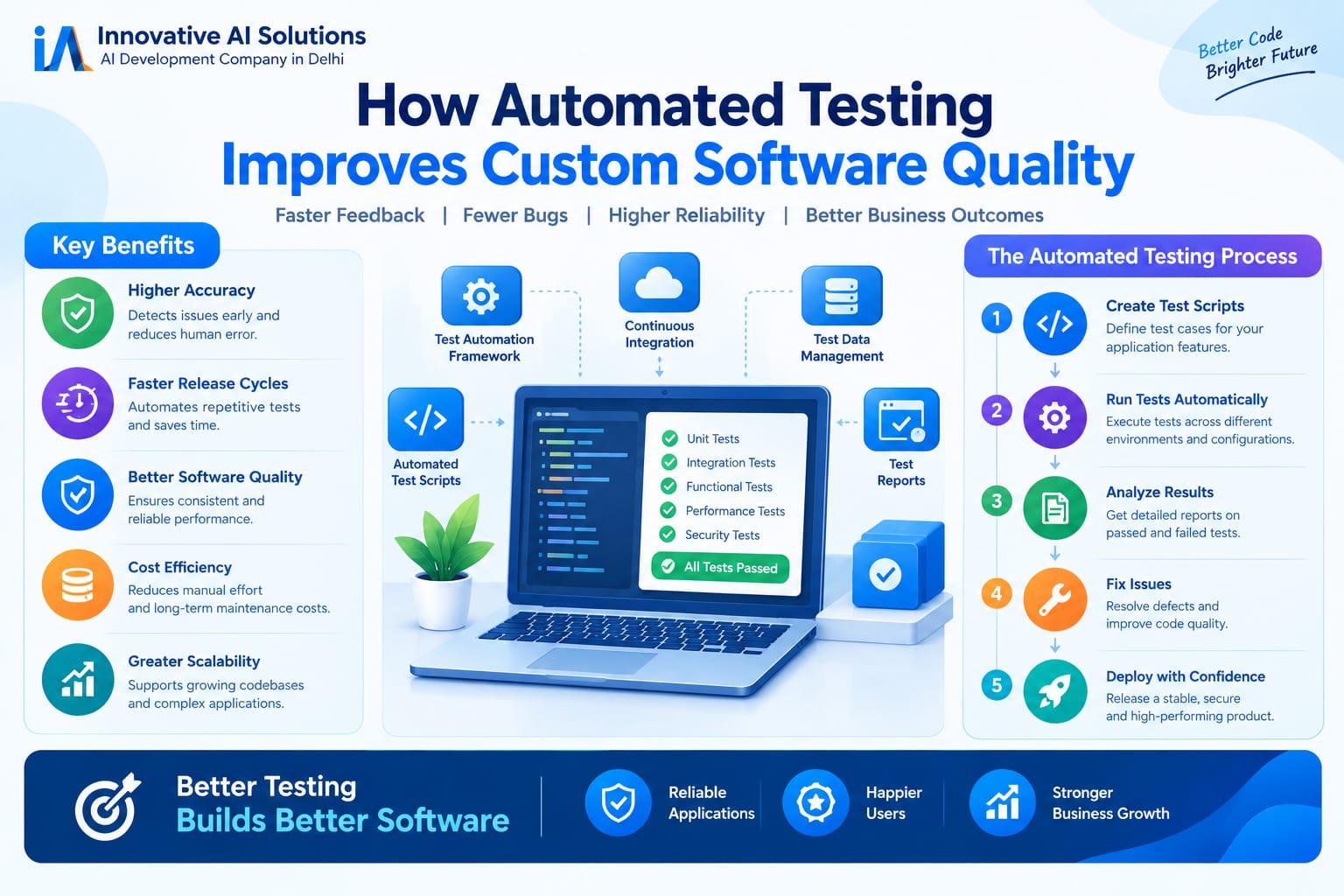
The Big Question
Why does custom software quality so often fall short?
The answer isn't talent. It's not technology. It's testing economics.
When you build custom software, every defect has a cost. That cost depends on when you find it. Research from the IBM System Science Institute shows that fixing a defect during design costs 1x. During testing, it costs 15x. In production, it costs 100x .
The economics are brutal. A bug caught in development is a minor inconvenience. The same bug caught by a customer is a support ticket, a hotfix, an emergency deployment, and possibly a lost customer.
And the scale of the problem is enormous. The Consortium for Information & Software Quality (CISQ) estimates that operational software failures cost the global economy roughly $1.56 trillion annually . In India, the software testing market is growing rapidly as organizations recognize that quality isn't optional it's a competitive requirement .
Automated testing is the lever that shifts defects from the expensive end of the spectrum to the cheap end. It runs continuously. It catches regressions. It validates every change before it reaches production. And it does this without the fatigue, inconsistency, and human error that plague manual testing at scale.
But automated testing isn't a silver bullet. It requires investment. It requires discipline. And it requires understanding where automation helps and where human judgment remains irreplaceable.
What Automated Testing Actually Means
Automated testing uses software to execute your code and compare actual results with expected results . It's the opposite of manual testing, where a human follows a test plan and verifies software behavior.
The distinction matters because manual testing doesn't scale. As your codebase grows, testing every feature manually including edge cases becomes repetitive, tedious, and error-prone . Humans get tired. They skip steps. They miss things.
Automated tests don't get tired. They run the same way every time. They catch the same regressions. They provide consistent feedback.
The test pyramid provides a framework for automated testing :
Unit tests verify individual functions, classes, or methods in isolation. They're fast, cheap, and form the foundation. Developers should write unit tests before writing production code a practice called test-driven development (TDD) .
Integration tests verify that components work together correctly. They catch issues at boundaries that unit tests miss.
End-to-end (E2E) tests verify complete workflows from the user's perspective. They're slower and more brittle, but essential for critical paths .
Acceptance tests verify that higher-level functionality operates as designed and that regression errors haven't been introduced. No one should declare work "dev complete" unless automated acceptance tests are passing .
The DORA research confirms that when developers are primarily responsible for creating and maintaining automated test suites and when it's easy for them to fix test failures software delivery performance improves significantly .
The ROI of Automated Testing
The business case for automated testing is measurable.
The 385% ROI Case
A large-scale technology company achieved 385% ROI within 8 months through comprehensive automation implementation. Enterprises report QA cost reductions up to 50% through faster testing, improved coverage, and reduced errors .
The 445% ROI Model
A worked cost-of-quality analysis shows that a blended manual-plus-automation program generates 445% ROI compared to baseline. The key: automation catches 40% more defects than manual alone, reducing external escapes from 400 to 250 per release. On a $82,500 combined program cost, that's **$367,500 per release in savings** .
The $4 Million Annual Benefit
IDC studied organizations using UiPath Test Cloud and found $4 million in average annual benefits, with a six-month payback period and 529% three-year ROI. QA staff efficiency improved by 36%. Development team productivity increased by 51% .
The Numbers That Drive the ROI
Test automation transforms quality assurance from labor-intensive manual processes to scalable automated validation. The economic case rests on three pillars :
Reduced execution time: Manual test execution time reduction of 70-90%. Regression test maintenance effort reduction of 50-80%. Test cycle duration reduction of 60-85%.
Improved coverage: Defect detection provides 10-100x cost savings from catching bugs earlier. Quality improvements lead to 40-70% reduction in production incidents.
Earlier defect detection: Developer productivity increases by 20-40% from reduced debugging.
For a mid-sized team with 5 QA engineers ($500,000 annual cost), automation investment of **$150,000-$250,000** typically generates **$400,000-$800,000 in annual value**, achieving payback in 3-6 months .
The Cost of Poor Quality
The ROI of automated testing becomes clearer when you understand what poor quality actually costs.
Organizations Report:
40% of global organizations believe poor software quality costs them $1M or more annually .
45% of financial services organizations pay upwards of $5M per year due to poor software quality .
63% of organizations ship code without completing all necessary testing .
32% say untested code reaches production because of top-down pressure to accelerate delivery. 30% say there is simply too much code to test .
One in five organizations reports that poor software quality costs the business as much as $5 million annually .
The pattern is consistent: speed is prioritized over quality. Development teams prioritize delivery speed (45%) far more than quality (13%) . The result is predictable: defects escape to production, where they're 100x more expensive to fix.
The Hidden Cost: Developer Productivity
Testing debt doesn't stay in QA. It spreads across every team that builds, ships, and supports software. Developers absorb it through late-cycle defect triage. Operations absorb it through incident response. The business absorbs it through downtime .
IDC's study found that when organizations modernized testing, troubleshooting teams saw a 93% efficiency improvement. Development team productivity increased by 51%. IT engineering teams saw a 13% improvement .
The cost of leaving testing bottlenecks in place is already being paid across multiple budget lines, teams, and systems.
What Automated Testing Does for Custom Software
Custom software has specific quality challenges. It's built for a unique business context. It evolves continuously. It integrates with existing systems. These characteristics make automated testing especially valuable.
Catches Regressions Immediately
When you change code, you risk breaking something that worked before. Automated regression tests catch these breaks immediately. Nykaa, a leading Indian e-commerce platform, runs 1,500 test cases nightly and 2,000 during releases. Tests that once took hours now wrap up in 2-5 minutes .
Enables Continuous Delivery
Automated tests are the foundation of CI/CD pipelines. Every change runs a build that executes unit tests and static analysis. If tests pass, the code moves forward. If they fail, developers know immediately .
Documents Expected Behavior
Automated tests serve as documentation. They specify inputs and expected outputs. They describe how software should behave. New developers can read the tests to understand what the system does .
Enables Safe Refactoring
When you have a passing test suite, you can refactor with confidence. The tests verify that behavior hasn't changed. Without tests, refactoring is a gamble .
Reduces Manual Testing Burden
Automated tests handle repetitive, high-volume verification. Manual testers focus on exploratory testing, usability, and edge cases the things humans do best .
Improves Release Confidence
86% of organizations report that testing teams have a say in release readiness. QA is embedded in Agile and DevOps decision loops, not treated as a downstream gate .
The Human Element: Why Oversight Still Matters
Automated testing doesn't eliminate the need for human judgment. It shifts where humans focus.
Applause's 2026 report found that AI adoption in testing has surged to 92%, up from 60% the prior year. Yet 29% of respondents reported an increase in the number or severity of functional testing defects .
The lesson: automation and AI are powerful, but they're not sufficient. 86% of respondents consider human involvement extremely important to functional testing. 57% said humans are critical for delivering qualitative feedback through peer review. The same proportion said humans are equally important to designing test strategies based on real-world user behaviour .
Where humans matter most:
Exploratory testing: Finding unexpected issues that scripted tests miss.
Usability testing: Evaluating whether the software is intuitive and pleasant to use.
Acceptance testing: Verifying that the software meets business needs, not just technical specifications.
Test strategy: Deciding what to test, what risks matter most, and where to focus effort .
Edge case identification: Recognizing scenarios that automated tests don't cover.
The most effective approach combines automated testing for regression, performance, and repetitive verification with human testing for exploration, usability, and business validation.
Risk-Based Testing: Where to Focus
Not all tests require equal rigor. Risk-based testing directs effort where failures matter most.
A tiered validation approach reduces costs while maintaining quality :
Fast smoke tests for every change. Comprehensive regression tests nightly. Deep validation weekly. This approach cuts test execution costs by 40-60% compared to running full suites on every commit .
Risk-based investment guidelines :
Low Impact components: 10-20% of dev cost. Automated unit tests, smoke testing.
Medium Impact components: 20-30% of dev cost. Integration tests, performance benchmarks.
High Impact components: 30-50% of dev cost. A/B testing, continuous monitoring, human review.
Mission-Critical components: 50-100% of dev cost. Formal verification, red team testing, regulatory compliance.
This risk-proportional approach prevents both over-testing of low-risk components and under testing of critical paths .
Frequently Asked Questions
Q1: What is automated testing?
Automated testing uses software to execute code and compare actual results with expected results. It replaces or supplements manual testing, which relies on humans following test plans .
Q2: How much does automated testing cost?
For a mid-sized team, automation investment of $150,000-$250,000 typically generates $400,000-$800,000 in annual value, with payback in 3-6 months . For a typical enterprise AI project with $1M development budget, testing investment is 13-23% of development budget .
Q3: What is the ROI of automated testing?
A large-scale technology company achieved 385% ROI within 8 months . IDC found 529% three-year ROI with six-month payback . A cost-of-quality model shows 445% ROI for blended manual-plus-automation programs .
Q4: What is the cost of poor software quality?
40% of organizations believe poor software quality costs them $1M or more annually**. **45% of financial services organizations pay upwards of $5M per year . Fixing defects in production costs 100x more than fixing them during design .
Q5: What is the test pyramid?
A framework for automated testing: unit tests (foundation, fast, cheap), integration tests (component boundaries), end-to-end tests (complete workflows). Focus most effort on lower levels .
Q6: Does automated testing replace manual testing?
No. Automated testing handles repetitive, high-volume verification. Manual testing handles exploratory, usability, and acceptance testing the things humans do best. The most effective approach combines both .
Q7: Why do developers need to own test automation?
DORA research shows that when developers are primarily responsible for creating and maintaining automated tests, performance improves. When other groups own test automation, test suites are frequently broken, and developers write code that is hard to test .
Q8: What is test-driven development (TDD)?
TDD is the practice of writing tests before writing code. The tests define the contract the code must fulfill. TDD is used by over 50% of agile teams .
Q9: How does AI affect automated testing?
92% of organizations use AI in testing. Common use cases: creating test cases (65%), writing automation scripts (62%), finding coverage gaps (48%) . But human oversight remains essential 29% report increased defects despite AI adoption .
Q10: What is risk-based testing?
A testing approach that prioritizes effort based on likelihood and business impact of failures. Rather than testing everything equally, teams focus on scenarios where failures would matter most .
Frequently Asked Questions (Continued)
Q11: What is shift-left testing?
Considering software quality and testing earlier in the development process. Tests are written as features are developed, not after. Bugs are caught sooner, when they're cheaper to fix .
Q12: What is continuous testing?
Running tests early and often as every change moves through the pipeline. Provides quick feedback and catches regressions immediately .
Q13: What metrics measure testing success?
Test automation coverage, payback period, defect reduction, and release frequency. These metrics show whether automation is reducing effort, improving feedback, and supporting delivery goals .
Q14: How much testing is enough?
The goal isn't 100% coverage. It's confidence. Enough tests that developers can make changes without fear. Prioritize high-frequency, stable tests where automation ROI is highest (300-500%) .
Q15: Why should I choose Innovative AI Solutions?
Because we build quality into custom software from the start. Because we understand that automated testing is an investment, not an overhead. Because we've delivered 100+ projects. Because your code is always yours.
Contact Us
Phone:
+91 7464 099 059
+91 9689967356
Email:
info@innovativeais.com
Address:
9th Floor, Pearls Best Heights-I,
Head Office: 904, Netaji Subhash Place,
Delhi – 110034