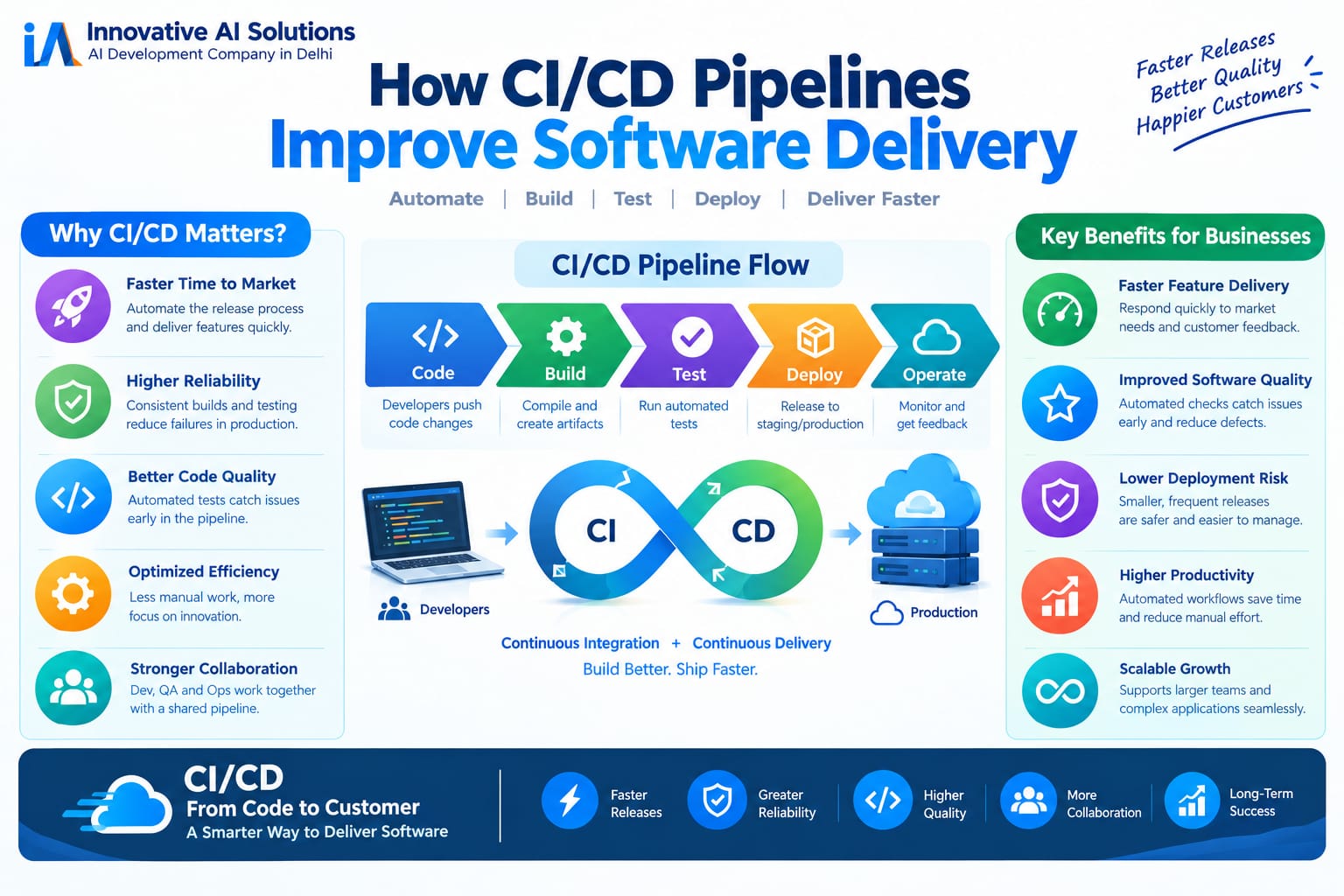
The Big Question
Why do some teams ship software effortlessly while others struggle with every release?
The answer isn't talent. It's not the technology stack. It's the pipeline.
Continuous Integration and Continuous Delivery (CI/CD) is the practice of automating the software delivery process—from code commit to production deployment. It's the assembly line for software .
The data is unambiguous. According to DORA research, elite performers deploy code 208 times more frequently than low performers. They have change failure rates 3 times lower. They recover from incidents 2,604 times faster .
These aren't marginal improvements. They're different operating models entirely.
The CD Foundation's State of CI/CD Report found that 83% of developers are involved in DevOps-related activities, and CI/CD tool usage is directly associated with better deployment performance across all DORA metrics .
But here's the gap: while adoption is widespread, performance is diverging. The proportion of low performers for each deployment metric is increasing. The tools are available. The practices are documented. Yet many organizations aren't capturing the value .
This guide explains what CI/CD actually is, why it improves delivery, and how to capture the value.
What CI/CD Actually Means
CI/CD is two practices that work together.
Continuous Integration (CI) is the practice and services of frequently merging code changes into a shared repository, where automated builds and tests verify every integration . Developers commit code at least daily. Each commit triggers an automated pipeline that builds the application and runs tests. Problems are caught immediately while the code is fresh in the developer's mind .
Continuous Delivery (CD) extends CI by automating the release process. Every change that passes CI is automatically prepared for deployment to production. The software is always in a deployable state .
Continuous Deployment goes further automatically deploying every change that passes the pipeline to production. No manual gate. No approval. Just automated, reliable deployment .
The distinction matters: delivery means "ready to deploy." Deployment means "deployed automatically."
The Pipeline: How It Works
A CI/CD pipeline is an automated assembly line for code . Each stage checks the software from a different angle, preventing errors from reaching users.
Stage 1: Build and Integration
When code is committed, the pipeline automatically builds the application and runs unit tests. This is the first line of defense it quickly tells developers if their changes break anything .
Stage 2: Test Automation
The pipeline runs a comprehensive test suite: functional tests, security tests, performance tests, compliance checks. Each type verifies a different dimension of quality .
Stage 3: Deployment Automation
Once quality is verified, the pipeline deploys to staging or production. Deployment becomes low-risk and predictable because previous stages have already validated quality .
Supporting Infrastructure
The pipeline also handles environment provisioning, configuration management,services and release orchestration. Environments are created automatically, consistently, and torn down when not needed .
Why CI/CD Improves Software Delivery
The benefits are structural, not incremental.
Catch Problems Early
The cost of fixing a defect grows exponentially with time. A bug caught in development costs 1x. In production, it costs 100x. CI/CD catches problems at the earliest possible stage when they're cheapest to fix .
Reduce Manual Errors
Manual deployments are error-prone. Humans skip steps. They forget configurations. They deploy the wrong version. CI/CD automates the process, eliminating human error and ensuring consistency .
Get Faster Feedback
Developers know immediately if their changes break something. The pipeline provides rapid feedback, enabling quick correction. No waiting for a manual QA cycle .
Enable Faster Delivery
Automation removes bottlenecks. Releases happen when they're ready, not when the release window opens. Elite teams deploy multiple times per day .
Improve Quality
Automated testing at every stage catches bugs, security issues, and performance problems before users encounter them. The pipeline becomes a quality gate .
The DORA Metrics: Measuring What Matters
CI/CD performance is measured through four metrics from DORA (DevOps Research and Assessment):
Deployment Frequency: How often code is deployed to production. Elite performers deploy multiple times per day.
Lead Time for Changes: How long it takes from code commit to production. Elite performers measure this in hours.
Change Failure Rate: What percentage of deployments cause failures. Elite performers are below 15%.
Time to Restore Service: How long it takes to recover from a failure. Elite performers recover in under an hour.
The CD Foundation's research found a strong correlation between the number of DevOps technologies used and the likelihood of being a top performer . CI/CD tool usage is associated with better deployment performance across all four DORA metrics .
The Cost of CI/CD
CI/CD pipelines require investment, but the costs are manageable and the ROI is clear.
Platform Costs
For a startup (5-10 developers), GitHub Actions or GitLab CI costs $0-50/month**. For a fast-growing startup (10-50 developers), **$200-500/month. For an enterprise (50+ developers), $1,000-5,000/month .
Azure DevOps costs $6/user/month** for Basic plans. Microsoft-hosted CI/CD agents include 1 free parallel job with 1,800 minutes/month; additional jobs cost **$40/month each. Self-hosted agents are free with unlimited parallel jobs .
Build vs. Buy
DIY pipelines require significant investment in senior engineering time and ongoing maintenance. Commercial platforms provide pre-built integrations, templates, and guardrails, saving internal teams from managing tooling .
The key question: "Are you in the business of building pipelines or shipping features?"
The ROI
CI/CD reduces deployment time, reduces failures, and increases release frequency. For a 10 developer team, the productivity gains from faster releases and fewer failures typically exceed the platform costs within months.
What This Means for Your Business
For engineering leaders:
Start simple. Begin with basic build and test automation. Add stages incrementally. The goal isn't a perfect pipeline it's a pipeline that improves over time .
For growing teams:
Document your pipeline. Automate versioning. Use lockfiles. Enforce quality gates. The practices that work for 5 developers don't scale to 50 without discipline .
For product leaders:
CI/CD affects roadmap predictability. A reliable pipeline delivers features when promised. An unreliable pipeline is a source of constant surprises. The investment pays off in faster time to market and higher quality.
For Indian businesses:
The tools are accessible. GitHub Actions, GitLab CI, and Azure Pipelines all have strong adoption in India. The challenge is discipline consistently applying CI/CD practices as teams grow. Start now. Don't wait until delivery chaos becomes a crisis.
Frequently Asked Questions
Q1: What is CI/CD?
CI/CD stands for Continuous Integration and Continuous Delivery (or Deployment). CI is the practice of frequently merging code into a shared repository with automated builds and tests. CD automates the release process, making software always deployable .
Q2: How does CI/CD improve software delivery?
CI/CD catches problems early (when they're cheapest to fix), reduces manual errors, provides faster feedback, enables faster releases, and improves quality through automated testing at every stage .
Q3: What are the DORA metrics?
Deployment Frequency, Lead Time for Changes, Change Failure Rate, and Time to Restore Service. These four metrics measure software delivery performance .
Q4: How much does CI/CD cost?
Startups: $0-50/month**. Growing startups: **$200-500/month. Enterprises: $1,000-5,000/month**. Azure DevOps costs **$6/user/month plus $40/month for additional parallel jobs .
Q5: What is the difference between Continuous Delivery and Continuous Deployment?
Continuous Delivery means software is always ready to deploy, but deployment may require manual approval. Continuous Deployment means every change that passes the pipeline is automatically deployed to production .
Q6: What are the stages of a CI/CD pipeline?
Build and Integration (compile code, run unit tests), Test Automation (functional, security, performance tests), and Deployment Automation (deploy to staging or production) .
Q7: What are the benefits of CI/CD?
Elite performers deploy 208x more frequently, have 3x lower change failure rates, and recover 2,604x faster than low performers. CI/CD tool usage correlates with better performance across all DORA metrics .
Q8: Should I build or buy a CI/CD pipeline?
Most companies should buy (use a managed platform). DIY requires ongoing investment in senior engineering time and creates a "second product" to maintain. The key question: are you in the business of building pipelines or shipping features?
Q9: What is a good CI/CD pipeline setup for a small team?
GitHub Actions or GitLab CI for startups. Keep the PR pipeline under 10 minutes. Cache dependencies. Run independent jobs in parallel. Move slow end-to-end suites to a separate trigger .
Q10: How long does it take to set up a CI/CD pipeline?
Basic build and test automation: 1-2 hours. A complete pipeline with deployment automation: days to weeks, depending on complexity. Start simple and add stages incrementally .
Frequently Asked Questions (Continued)
Q11: What is GitOps?
GitOps is a CD approach where infrastructure configuration files are managed in Git. A reconciler watches the repository and converges the target environment to the desired state. State is auditable and self-healing .
Q12: What tools are used for CI/CD?
GitHub Actions, GitLab CI, CircleCI, Jenkins, Azure Pipelines, and Bitbucket Pipelines. The choice depends on your repository, team size, and budget .
Q13: How does CI/CD improve security?
Security testing runs in the pipeline dependency scanning, container scanning, secret detection, and vulnerability checks. Security becomes part of the delivery process, not an afterthought .
Q14: What is the biggest mistake in CI/CD adoption?
Making the pipeline slow. If the PR pipeline takes too long, developers bypass it. Keep it under 10 minutes. Cache dependencies. Parallelize jobs .
Q15: Why should I choose Innovative AI Solutions?
Because we build CI/CD pipelines that deliver results. Because we understand that automation is an investment, not an overhead. Because we've delivered 100+ projects. Because your code is always yours.
Contact Us
Phone:
+91 7464 099 059
+91 9689967356
Email:
info@innovativeais.com
Address:
9th Floor, Pearls Best Heights-I,
Head Office: 904, Netaji Subhash Place,
Delhi – 110034