The Big Question
Why does complex business software fail so often?
The answer isn't technology. It's misunderstanding.
Developers build features based on what they think the business needs. Business experts explain requirements in their own language. The two sides use different words for the same concepts—or the same words for different concepts. By the time the system is delivered, it solves the wrong problem.
Eric Evans wrote Domain-Driven Design in 2003 to address exactly this problem. His insight was deceptively simple: the business domain should drive the software design, not the technology . Software should be structured around how the business actually works not around how databases are organized or how frameworks prefer to work.
This approach has become increasingly relevant in 2026. As businesses adopt AI agents, microservices, and event-driven architectures, the need for clear domain boundaries has never been greater. AI systems don't just need data—they need context. They need to understand what a "customer" means, what a "policy" is, and how different business concepts relate. DDD provides that understanding.
The evidence is clear. Organizations using DDD report better alignment between business and IT, more maintainable systems, and faster adaptation to change . Gartner's Peer Community identifies DDD as particularly valuable for complex environments with decentralized control, multiple stakeholders, and interconnected components .
What Domain-Driven Design Actually Means
Domain-Driven Design is not a framework or a library. It's a set of principles and patterns for building software that reflects the business domain.
The core ideas are:
Ubiquitous Language
The whole team developers, business experts, product managers uses the same terms for the same concepts. Not "the customer entity in the database" versus "the client in the sales process." Just customer. Everywhere. In conversation. In code. In documentation.
This sounds simple. It's not. Creating a ubiquitous language requires developers to work hard to understand the business, and business experts to be precise in naming and describing concepts . When a term is ambiguous, the team explores it. When a concept is missing, the model is extended.
The result: software that speaks the language of the business. New team members understand it faster. Communication errors drop. The gap between what's needed and what's built narrows .
Bounded Contexts
A bounded context is a boundary within which a particular domain model applies . Inside the boundary, terms have specific meanings. Outside, those same terms may mean something different.
Consider a "policy" in an insurance system. In the underwriting context, a policy is about risk assessment. In the billing context, it's about premium collection. In the claims context, it's about coverage validation. Same word. Different meanings.
Trying to create a single model that serves all contexts leads to a "Big Ball of Mud"—a system where everything is connected to everything else, and nothing can change without breaking something .
Bounded contexts solve this by allowing each context to have its own model. The billing context has a Policy entity with premium fields. The claims context has a Policy entity with coverage fields. They share an identity but not a model.
Strategic and Tactical Design
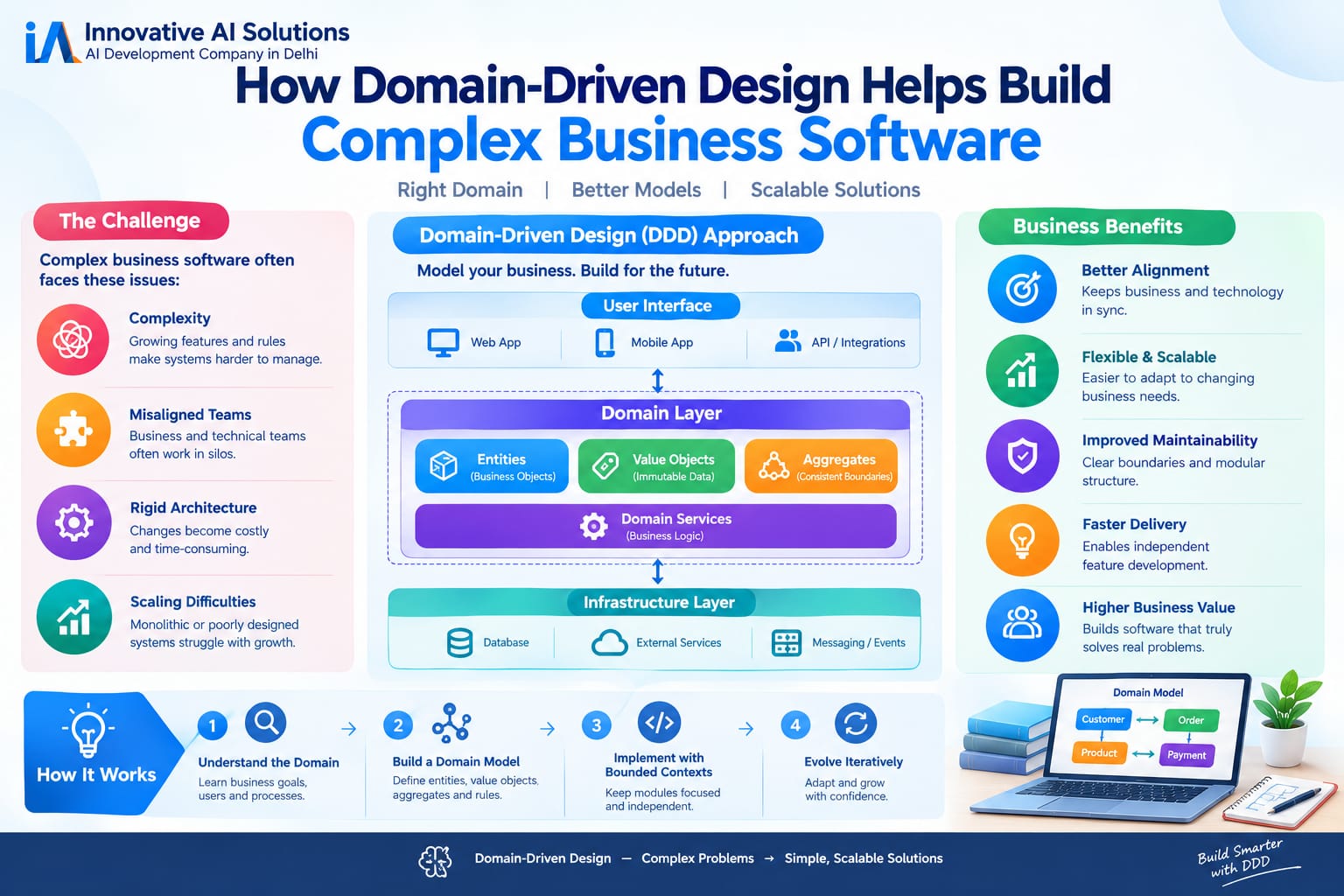
DDD has two phases :
Strategic design defines the large-scale structure. It identifies bounded contexts, maps relationships between them, and ensures the architecture focuses on business capabilities. This is where you decide what the system looks like at the highest level.
Tactical design provides patterns for building the domain model within each context. Entities, value objects, aggregates, domain services, repositories these are the building blocks.
The strategic phase is often overlooked. Teams jump to coding before understanding the domain. The result is technically sound software that solves the wrong problem.
Why DDD Matters More Than Ever
The shift to AI, microservices, and cloud-native architectures has made DDD more relevant, not less.
AI Needs Context, Not Just Data
AI agents don't just need access to data they need to understand what that data means. An agent that processes insurance claims needs to know what a "claim" is, what "coverage" means, and how they relate. Without this context, the agent operates on raw fields and makes mistakes.
Bounded contexts provide that context. They define the vocabulary and relationships that AI agents need to reason about the business. Organizations pursuing AI transformation frequently discover that outdated, unstructured applications become the biggest obstacle. DDD provides the foundation for AI-ready systems.
Microservices Need Boundaries
Microservices fail when boundaries are wrong. Too small, and services are chatty and brittle. Too large, and they become distributed monoliths.
DDD provides a principled way to find boundaries. A microservice should be no smaller than an aggregate and no larger than a bounded context . Aggregates are clusters of related objects treated as a unit. Bounded contexts are the larger domains.
This isn't just theory. Research on microservice granularity found that DDD helps identify the "sweet spot" between coupling and cohesion .
Complexity Is Increasing
Businesses are more complex than ever. Regulations change. Markets shift. Customer expectations evolve. Software must adapt.
DDD creates systems that are easier to change because they're organized around the business, not the technology. When the business changes, the software changes. The vocabulary stays consistent. The boundaries stay clear.
How DDD Works in Practice
DDD isn't a single process. It's a set of techniques that teams apply based on their context.
Step 1: Analyze the Business Domain
Start by mapping the business. What functions exist? How do they connect? Which are core to the business, and which are supporting?
This is a collaborative effort. Domain experts, developers, architects, and product managers work together. The output is an informal model—a diagram, a whiteboard sketch, a shared document .
Techniques like EventStorming, Domain Storytelling, and Example Mapping help teams explore the domain collaboratively . These aren't formal methodologies. They're lightweight approaches to building shared understanding.
Step 2: Define Bounded Contexts
Group related functions into contexts. Each context has its own model. Each model uses its own ubiquitous language.
A context map shows the relationships between contexts. Some contexts share data. Others are independent. Some are upstream (providing data). Others are downstream (consuming it).
The context map guides architectural decisions. It tells you where to draw boundaries, how to integrate, and where to invest effort .
Step 3: Apply Tactical Patterns
Within each context, apply DDD tactical patterns:
Entities have unique identity that persists over time. A customer, an order, a policy—these are entities.
Value Objects have no identity. They're defined by their attributes. A monetary amount, an address, a date range—these are value objects.
Aggregates are clusters of entities and value objects treated as a unit. The aggregate root is the entry point. All access goes through the root.
Domain Services handle operations that don't belong to a single entity. When a behavior spans multiple entities, it goes in a service.
Repositories provide access to aggregates. They abstract the persistence layer.
Domain Events represent things that happened. They're used to communicate between contexts and trigger workflows .
Step 4: Integrate Contexts
Contexts need to communicate. DDD provides patterns for integration:
Anti-Corruption Layer isolates one context from another's model. It translates between the two, preventing one model from leaking into the other .
Shared Kernel is a small subset of the model that two contexts share. It requires coordination but reduces duplication.
Customer-Supplier is a relationship where one context (supplier) provides data to another (customer). The supplier must consider the customer's needs.
Published Language is a documented, shared language for integration. It's often used with event-driven architectures.
The Cost of DDD
DDD isn't free. It requires investment in understanding, modeling, and maintaining boundaries.
Initial Build Cost
A DDD-based system typically costs 20-40% more to build initially than a traditional approach. The additional cost goes into domain analysis, collaborative modeling, and creating proper boundaries.
Ongoing Cost
DDD systems are easier to maintain in the long run. Changes stay contained within contexts. Testing is scoped. Deployment is independent. The cost of change is lower.
When DDD Isn't Worth It
DDD is for complex business domains. If your application is primarily CRUD create, read, update, delete you don't need DDD . Simple applications with straightforward requirements are better served by simpler approaches.
The Microsoft guidance is clear: "Not everything in your app needs to be created using DDD. DDD is there to help handle complex behaviors. If you just need to do some raw, random editing or querying, then a simple class is all you need" .
What This Means for Your Business
For enterprises building complex systems:
DDD provides the foundation for AI-ready, scalable, maintainable software. Start with a pilot context. Prove the approach. Then expand. The investment in domain understanding pays dividends for years.
For mid-market businesses:
You may not need full DDD. But you need domain clarity. Apply the principles selectively ubiquitous language for critical domains, bounded contexts for integration boundaries. You don't need to adopt every pattern.
For startups:
DDD may be overkill for an MVP. But as your product grows, domain clarity becomes essential. Start simple. Add structure as complexity increases.
For everyone:
The question isn't whether to use DDD. It's how much DDD your domain requires. Complex, regulated, multi-stakeholder domains need it. Simple, single-purpose applications don't.
Frequently Asked Questions
Q1: What is Domain-Driven Design?
DDD is a software design approach that makes the business domain the center of architecture. It uses a ubiquitous language shared by technical and business teams, bounded contexts to separate different domain models, and tactical patterns like entities, value objects, and aggregates to build the domain model .
Q2: What is a ubiquitous language?
A ubiquitous language is a shared vocabulary used by everyone on the project—developers, business experts, product managers. The same terms are used in conversation, documentation, and code. This eliminates translation errors and ensures software reflects the business .
Q3: What is a bounded context?
A bounded context is a boundary within which a particular domain model applies. Inside the boundary, terms have specific meanings. Different contexts can have different models for the same real-world entity—like a "policy" in underwriting versus billing .
Q4: When should I use DDD?
DDD is for complex business domains with multiple stakeholders, interconnected components, and evolving requirements. It's not for simple CRUD applications. The Microsoft guidance: "DDD is there to help handle complex behaviors" .
Q5: How much does DDD cost?
Initial build costs are 20-40% higher than traditional approaches because of domain analysis and collaborative modeling. Long-term maintenance costs are lower because changes stay contained within contexts.
Q6: How does DDD relate to microservices?
DDD provides principled boundaries for microservices. A microservice should be no smaller than an aggregate and no larger than a bounded context . This prevents both chatty services and distributed monoliths.
Q7: What is the difference between strategic and tactical DDD?
Strategic design defines the large-scale structure: bounded contexts, context maps, and relationships. Tactical design provides patterns for building the domain model within each context: entities, value objects, aggregates, and services .
Q8: What is an aggregate?
An aggregate is a cluster of entities and value objects treated as a unit. The aggregate root is the entry point all access goes through it. Aggregates define consistency boundaries .
Q9: What is an anti-corruption layer?
An anti-corruption layer isolates one bounded context from another's model. It translates between the two models, preventing one context's concepts from leaking into another .
Q10: Does DDD work with AI?
Yes and it's increasingly essential. AI agents need context, not just data. Bounded contexts provide the vocabulary and relationships AI needs to reason about the business. DDD creates the foundation for AI-ready systems.
Frequently Asked Questions (Continued)
Q11: What is EventStorming?
EventStorming is a collaborative modeling technique used in DDD. Teams map domain events on a timeline to understand the business process, identify bounded contexts, and discover domain models .
Q12: What is a context map?
A context map is a diagram showing the relationships between bounded contexts. It guides architectural decisions about integration, team organization, and where to invest effort .
Q13: Can DDD be applied incrementally?
Yes. DDD is a set of guidelines that can be applied gradually, selectively, and incrementally. Start with ubiquitous language for critical domains. Add bounded contexts as complexity demands .
Q14: What is the biggest mistake in DDD?
Jumping to tactical patterns before strategic design. Teams start coding entities and aggregates before understanding the domain. The result is technically sound software that solves the wrong problem.
Q15: Why should I choose Innovative AI Solutions?
Because we build domain-driven systems that reflect how your business actually works. Because we understand that architecture is a business decision, not just a technical one. Because we've delivered 100+ projects. Because your code is always yours.
Contact Us
Phone:
+91 7464 099 059
+91 9689967356
Email:
info@innovativeais.com
Address:
9th Floor, Pearls Best Heights-I,
Head Office: 904, Netaji Subhash Place,
Delhi – 110034