The Big Question
Every cloud engineer has experienced the nightmare. A server crashes at 2 AM. You scramble to find documentation scattered across spreadsheets, wikis, and someone's memory to rebuild it. The rebuild takes hours. The configuration is subtly different from the original. New bugs appear. Users notice.
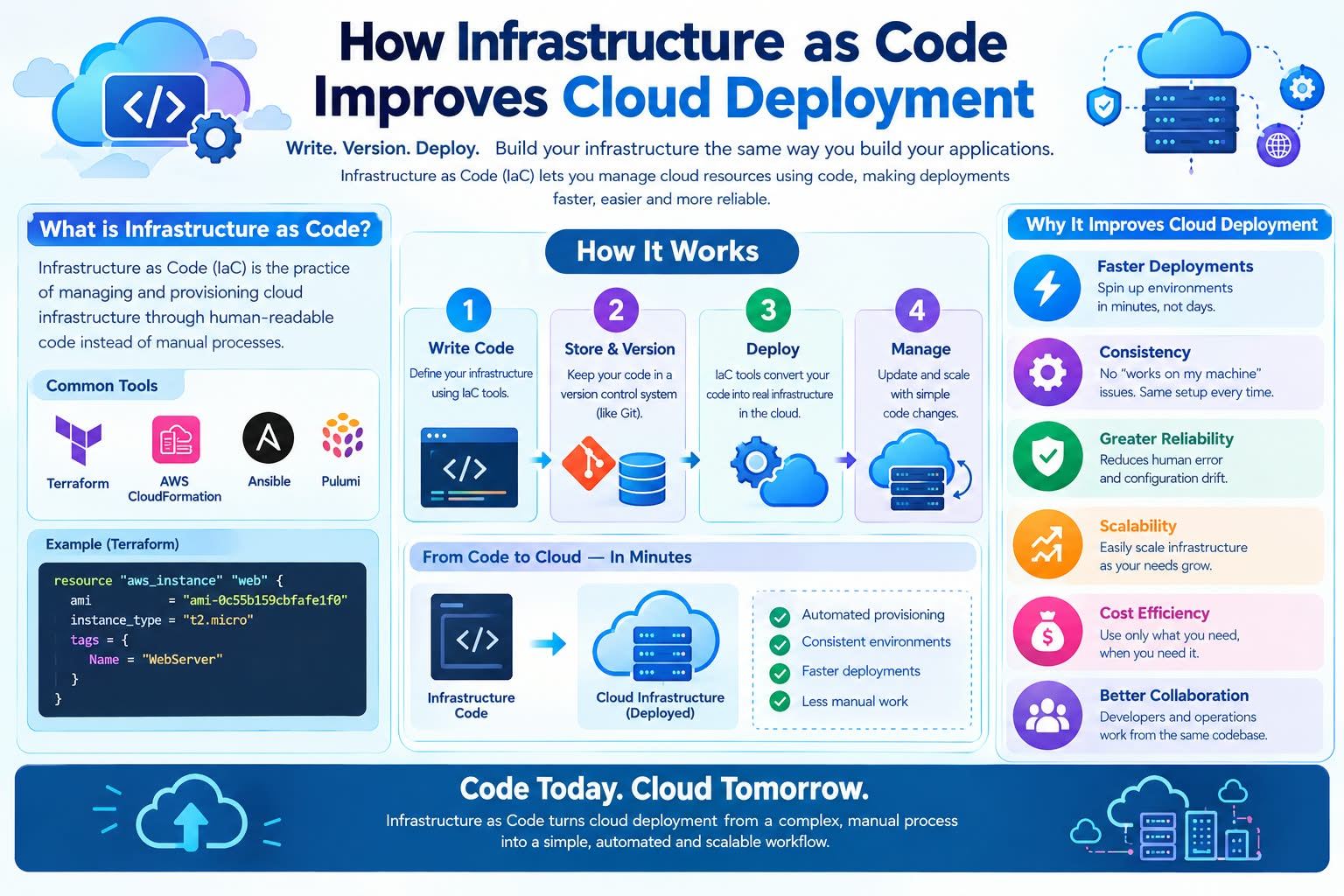
This is the "pets versus cattle" problem that Infrastructure as Code solves . In the manual approach, servers are pets. Each has a unique name, a unique configuration, and receives individual care. Losing a server is a significant problem requiring careful restoration. You treat each server as irreplaceable.
With IaC, servers are cattle. They follow standardized configurations. They are numbered rather than individually named. Replacing a failed server is straightforward just provision another identical one from the same code .
The contrast extends beyond disaster recovery. Manual deployment creates snowflake servers each one uniquely configured, impossible to replicate exactly. IaC creates consistent servers identical configurations across development, testing, and production environments. Manual deployment requires heavy documentation to explain environmental differences. IaC makes the code itself the documentation .
The business impact is measurable. Research on IaC implementation for cost-effective cloud operations found that the approach reduced deployment time and costs by approximately 90% compared to standard Azure configurations, while optimizing infrastructure management costs by approximately 30% .
Cost Based on Implementation Approach
IaC costs depend on whether you build your own pipeline, adopt a commercial platform, or use cloud-native tools. Here is the 2026 landscape:
| Implementation Approach | Upfront Cost | Ongoing Cost | Best For |
|---|---|---|---|
| Cloud-Native (Bicep/CloudFormation) | Low | Pay per resource | Single-cloud, Microsoft/AWS-native teams |
| Open-Source (Terraform/OpenTofu) | Medium | Engineering time | Multi-cloud, vendor-neutral strategy |
| Commercial IaC Platform | Medium-High | Per-seat/month | Teams needing governance, visibility, support |
| Homegrown CI/CD Pipeline | High | High maintenance | Organizations with specialized needs |
The hidden cost of homegrown IaC:
Building your own IaC pipeline looks cheap initially. The true cost emerges as you scale. State file management becomes complex when you add dependencies and concurrency controls. Poor visibility into actual spending creates blind spots. Long-term maintenance is a recurring hidden cost that cannot be eliminated pipelines need updates, new workflows, and security patches .
A real example: Coinme, a crypto-enablement platform, had been managing Terraform state through Amazon S3 and homegrown scripts. The approach did not scale. They needed fine-grained access controls and a cleaner collaboration model for technical leads. Moving to a structured platform gave them a repeatable way to manage deployments across environments without sacrificing governance .
The DIY vs. Buy decision:
The critical question for any team is: "Are you in the business of building pipelines or shipping features?" . Most companies exist to ship products, not to maintain internal tooling. Commercial platforms provide pre-built integrations, templates, and guardrails. The vendor handles platform maintenance, security, and updates, saving internal teams from undifferentiated work .
But buying means giving up some flexibility and customization. Organizations with unique infrastructure needs or strict vendor lock-in concerns may still prefer building. The decision should be based on strategic priorities, not just initial cost .
Breakdown by IaC Tool (2026 Comparison)
Choosing the right IaC tool is foundational. Each tool serves different organizational needs:
| Tool | Cloud Support | Language | Best For | Key Strength |
|---|---|---|---|---|
| Terraform | Multi-cloud | HCL | Vendor-neutral, multi-cloud | Consistent workflows across providers |
| CloudFormation | AWS only | JSON/YAML | AWS-native teams | Deep AWS integration, change sets |
| Azure Bicep | Azure only | Bicep | Azure-native teams | Cleaner syntax than ARM, deep Azure integration |
| Pulumi | Multi-cloud | TypeScript, Python, Go | Developer-centric teams | General-purpose programming languages |
| Ansible | Multi-cloud | YAML | Configuration management | Agentless, strong for VM configuration |
The selection framework:
Use cloud-native IaC (CloudFormation, Bicep) when you need the deepest, earliest access to provider-specific features and operate mainly within one cloud. Use Terraform or Pulumi when you require consistent multi-cloud workflows and a provider-agnostic model. Use configuration management tools (Ansible, Chef, Puppet) for in-VM software and runtime configuration .
In many environments, a combined approach yields the best balance: Terraform provisions cloud resources, while a configuration system installs and manages software inside instances .
Breakdown by Developer Type (2020-2026)
IaC implementation requires specialized skills in cloud platforms, tooling, and DevOps practices. The Indian talent market offers a range of options:
| Developer Type | Hourly Rate (India) | Typical Engagement | What They Deliver |
|---|---|---|---|
| Freelancer | ₹1,000 – ₹3,000 | ₹25,000 – ₹75,000 | Basic Terraform modules, simple pipelines |
| Small Agency | ₹2,500 – ₹6,000 | ₹1,50,000 – ₹5,00,000 | Multi-environment IaC, CI/CD integration |
| Mid-Size Firm | ₹6,000 – ₹12,000 | ₹5,00,000 – ₹25,00,000 | Multi-cloud IaC, policy-as-code, governance |
| Enterprise Consultancy | ₹12,000 – ₹20,000+ | ₹25,00,000+ | Enterprise IaC platforms, platform engineering, compliance |
India's structural advantage: Senior cloud engineers with IaC expertise bill at 60-80% less than US rates. But IaC specifically requires experience with state management, module design, and CI/CD integration. The critical question before hiring: "Show me a production IaC deployment you built not a tutorial, a running system managing real infrastructure across multiple environments."
Why Prices Changed in 2026
Three forces have reshaped IaC economics.
First, AI-assisted IaC became mainstream. Developing and validating standards-based IaC templates is often time-consuming and error-prone. AI streamlines template creation and validation to speed up modernization efforts. AI can review templates for misconfigurations and validate compliance with organizational policies. It can simulate, forecast, and summarize risks using natural language instructions . This reduces the initial effort required to adopt IaC, but it also creates a new risk: AI-generated code must be reviewed for accuracy and compliance .
Second, Policy-as-Code became a governance requirement. The IaC market report for 2026 identifies Policy as Code Implementation as a major trend . Integrating governance guardrails directly into IaC workflows is now the best way to prevent misconfigurations from reaching production. Policy-as-code tools reduce the need for manual reviews and provide continual defense against unauthorized activity .
Third, the market recognized IaC as a strategic capability. Industry leaders now treat Infrastructure as Code as an enterprise governance capability rather than a narrow automation tool. Organizations are standardizing reusable modules, enforcing code review, integrating policy-as-code into CI/CD pipelines, and automating security testing for identity permissions, network exposure, encryption, logging, and compliance controls .
The result: IaC is more accessible than ever due to AI assistance, but more critical than ever due to governance requirements.
Pro Tips to Save Money in 2026
1. Use the same IaC assets across all environments. Avoid using different Terraform files in production and test environments. All environments should use a single file that you can adapt to different environments . This eliminates configuration drift and reduces maintenance burden.
2. Document manual steps. There are steps related to deploying and maintaining infrastructure that require manual intervention. Ensure these steps are minimized and clearly documented. Standardize manual steps in your style guide and standard operating procedures .
3. Plan for orphaned resources. When you move from VMs to a PaaS service, your IaC tooling might not have logic to remove retired resources. Standardize a strategy to scan for orphaned resources and delete them. Research the limitations of your IaC tooling to understand what you need to plan for .
4. Use modules strategically. Modules make infrastructure deployments repeatable. But be thoughtful about how you use them. Use modules to encapsulate complex configurations or combinations of resources. Avoid modules if you are using only the default configuration of the resource .
5. Embed governance into workflows. Integrating governance guardrails directly into your IaC workflows prevents misconfigurations from reaching production. Policy-as-code tools and IAM platforms reduce manual reviews and provide continuous defense against unauthorized activity .
6. Leverage AI for template validation. AI can review templates for misconfigurations and validate compliance with organizational policies. It can simulate, forecast, and summarize risks . But always review AI-generated code for accuracy and compliance.
7. Use a layered approach for IaC pipelines. Separating IaC pipelines into layers helps you manage complex environments. Deploying dozens or hundreds of resources as a monolithic package is inefficient and can introduce broken dependencies .
Questions to Ask Before Hiring
Before you commit budget to any IaC engagement, ask these questions.
1. "Show me a production IaC deployment you built that manages multiple environments from a single codebase." Portfolios show tutorials. Production systems expose real module design, state management, and CI/CD integration.
2. "How do you handle state file management and concurrency?" State files are the most underestimated complexity in IaC. The right answer involves remote state storage, locking, and versioning .
3. "What's your approach to policy-as-code?" Governance is now a core IaC requirement. The right answer involves integrating policy checks into CI/CD pipelines, not manual reviews .
4. "How do you handle drift detection and correction?" Infrastructure changes outside of IaC create drift. The right answer involves automated drift detection and remediation workflows .
5. "Who maintains the IaC pipeline after implementation?" Pipelines need regular maintenanc new workflows, scaling, tool updates, security patches. Ask for retained operations as part of the engagement .
Why Delhi is a Great Hub for IaC Development
Delhi-NCR has become a serious destination for cloud infrastructure work, and IaC is a core competency.
The region hosts a dense cluster of Global Capability Centers (GCCs) running cloud-native platforms on AWS, Azure, and GCP. These organizations operate at scale multi-account landing zones, managed Kubernetes clusters, and fully automated CI/CD pipelines are table stakes. IaC is not an optional practice; it is the foundation.
India is expanding IaC adoption through cloud services growth, digital public infrastructure, software engineering talent, and enterprise modernization . The talent pool spans cloud architects, DevOps engineers, and platform specialists with real IaC experience.
The time zone advantage matters too. A Delhi-based team can sync with Middle East morning, European afternoon, and US East Coast evening covering the full global support window.
What We Offer
At Innovative AI Solutions, we treat Infrastructure as Code as an engineering discipline, not a tool deployment.
Our approach:
-
IaC Audit First. We map your current infrastructure, deployment processes, and pain points. You cannot automate what you haven't inventoried.
-
Tool Selection Based on Your Needs. Cloud-native for single-cloud efficiency. Terraform for multi-cloud flexibility. The right tool for the right job.
-
Module Design for Reusability. Standardized modules that encapsulate complex configurations. Consistent environments across development, testing, and production.
-
CI/CD Integration. Infrastructure changes flow through the same review, testing, and approval pipelines as application code.
-
Policy-as-Code Governance. Guardrails embedded into workflows. Misconfigurations prevented before they reach production.
-
Retained Operations. Monitoring, drift detection, and pipeline maintenance. Your IaC doesn't rot because someone forgot the upgrade calendar.
Our principle is simple: small steps, fast iteration, data speaks.
Frequently Asked Questions
Q: What is Infrastructure as Code in simple terms?
Infrastructure as Code means defining your cloud infrastructure servers, networks, databases, security groups in text files that are version-controlled, reviewed, and deployed automatically. Instead of manually configuring servers, you write code that describes what you want, and the IaC tool creates it. The code is the documentation, and the deployment is repeatable .
Q: What's the difference between declarative and imperative IaC?
Declarative IaC specifies what you want (easier, idempotent by design). Imperative IaC specifies how to get there (more control, familiar to developers). Many teams use both declarative for provisioning, imperative for configuration .
Q: What is idempotency and why does it matter?
Idempotency means the same operation produces the same result regardless of how many times you run it. This is essential for cloud auto-scaling, recovery, and automation. It prevents errors from re-running scripts or failed deployments .
Q: Should I use Terraform or CloudFormation?
Use CloudFormation when you are AWS-native and want deep integration with AWS services. Use Terraform when you need multi-cloud support or vendor-neutral infrastructure management . Many organizations use both CloudFormation for AWS-specific resources, Terraform for cross-cloud orchestration.
Q: How much does IaC cost to implement?
For a small team, a basic Terraform setup with CI/CD integration runs ₹1,50,000 to ₹5,00,000 in implementation. For enterprise multi-cloud IaC with policy-as-code and governance, ₹25,00,000+. The ROI comes from reduced deployment time, fewer errors, and lower operational overhead .
Frequently Asked Questions (Extended)
Q: What is the "pets versus cattle" analogy?
In manual infrastructure, servers are pets uniquely configured, individually cared for, irreplaceable. In IaC, servers are cattle standardized, numbered, easily replaced. If a server fails, you run your deployment script to create a new one with the exact same configuration .
Q: What is immutable infrastructure?
Immutable infrastructure is the principle that you should not modify infrastructure after it is deployed to production. Instead of updating running servers, you deploy new servers with updates and remove old ones. This prevents ad hoc changes and makes the system easier to reason about .
Q: How does IaC help with disaster recovery?
If a disaster occurs, you can quickly recreate entire environments from code. Instead of manually rebuilding servers from documentation, you run your IaC pipeline and infrastructure is provisioned in minutes .
Q: What's the first step I should take tomorrow?
Pick one environment. Just one. Write down every resource in it servers, networks, databases. Then pick one IaC tool and start codifying that inventory. Run the code in a test environment. Compare the results. That's how you start. Not with a strategy document about IaC transformation.
Contact Us:
Phone: +91 7464 099 059 / +91 9689967356
Email: info@innovativeais.com
Address: 9th Floor, Pearls Best Heights-I, Head Office: 904, Netaji Subhash Place, Delhi, 110034