The Big Question
The most common mistake is choosing architecture based on ambition rather than current reality.
A two-person startup building a scheduling tool deploys Kubernetes because "that's what serious companies use." A twelve-person team building an internal dashboard adopts microservices because they read about Netflix. A company with 400 users implements a multi-region active-active setup because "we need to be ready to scale."
The result is predictable. Engineering time that should go into the product gets spent on infrastructure. Costs that should be near zero become meaningful monthly line items. Complexity that was meant to enable scale becomes the reason scale is slow.
The second mistake is the opposite: under-building for known trajectory. A product with a signed enterprise contract that requires data residency, SSO, and 99.9% uptime cannot run on a single shared VPS. The architecture must match the commitments you have already made, not just the load you are currently serving.
The right question is not "what is the best cloud architecture?" It is:
What is the simplest architecture that meets your compliance requirements, your uptime commitments, and your 12-month scale trajectory without requiring a rewrite?
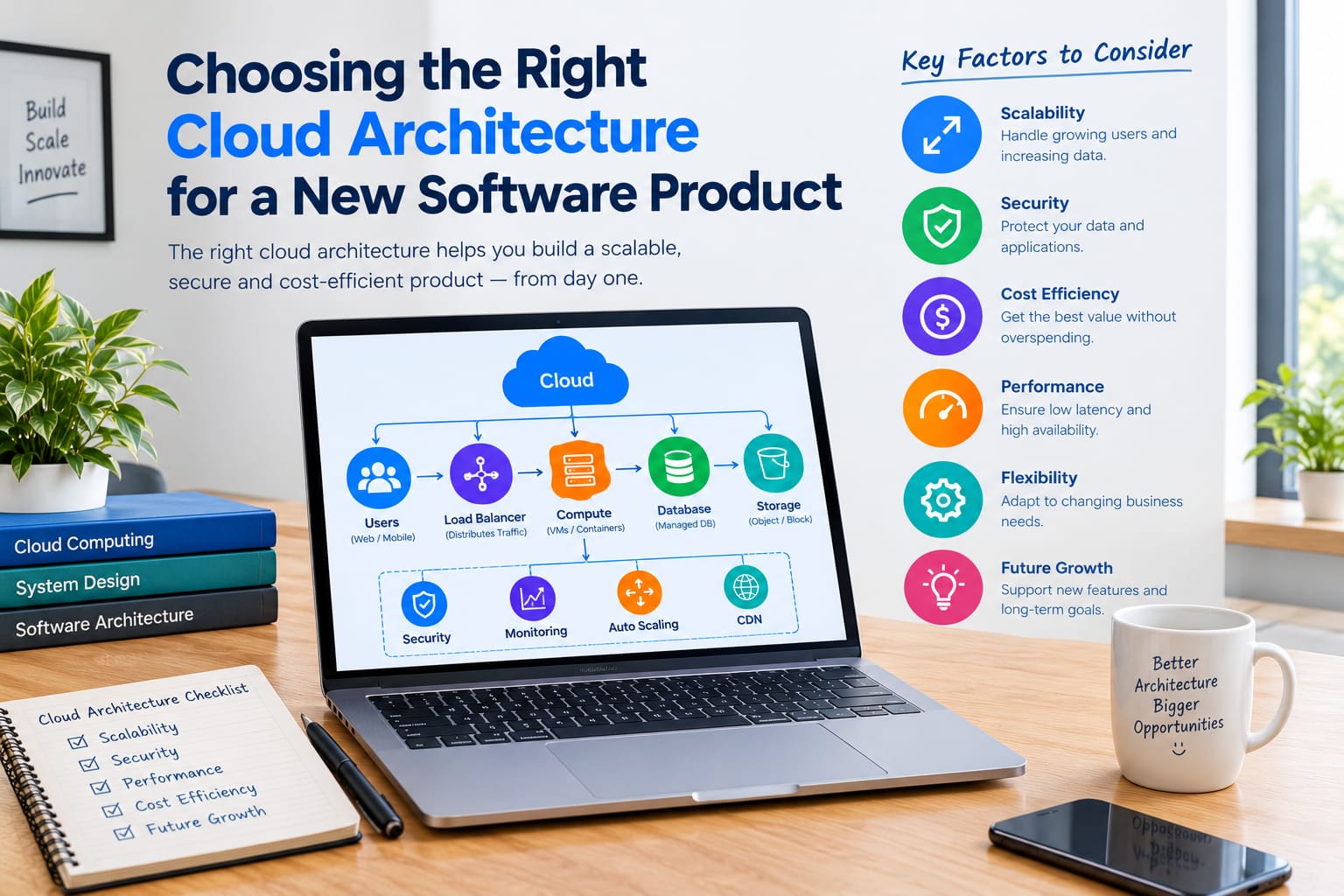
Architecture decisions should be driven by constraints, not preferences. The five constraints that matter most are: regulatory requirements, uptime SLAs, traffic predictability, team size and expertise, and cost sensitivity. Each one pushes you toward or away from specific architectures.
Cost Based on Architecture Type
Cloud architecture costs in India vary by an order of magnitude depending on the model. Here is the 2026 landscape:
| Architecture | Monthly Cost (India, Small Scale) | Build Complexity | Best For |
|---|---|---|---|
| Single VPS / Monolith | ₹2,000 – ₹15,000 | Low | MVPs, internal tools, <10K users |
| PaaS (managed platform) | ₹8,000 – ₹40,000 | Low-Medium | Small SaaS, rapid iteration |
| Containers (single cluster) | ₹25,000 – ₹1,00,000 | Medium | Growth-stage SaaS, multi-service |
| Serverless (function-based) | ₹500 – ₹50,000 (usage-based) | Medium | Spiky traffic, event-driven workloads |
| Microservices (multi-cluster) | ₹1,50,000 – ₹8,00,000+ | High | Enterprise, multi-team, independent scaling |
| Multi-Region Active-Active | ₹5,00,000 – ₹20,00,000+ | Very High | Mission-critical, global, zero-downtime |
The Mumbai region premium: AWS costs in Asia Pacific (Mumbai) run 5.21% higher for compute and 8.70% higher for S3 storage than US East (N. Virginia). Data transfer out runs 21.4% higher at the first 10 TB, and 60% higher above 150 TB which is where the real cost difference sits.
The hidden cost of over-architecture: A Kubernetes cluster running three microservices for a product with 5,000 users costs ₹40,000/month. The same product on a managed PaaS costs ₹12,000/month and requires no dedicated infrastructure engineer. That is ₹3.36 lakh per year in avoidable spend enough to fund a full-time developer in India.
The hidden cost of under-architecture: A single VPS that goes down for four hours costs ₹0 in infrastructure. It costs your reputation, your churn, and potentially your enterprise contract. If downtime costs $15,000 per minute, a four-hour outage is a **$3.6 million event**.
Breakdown by Architecture Pattern
Each architecture pattern solves a specific set of problems. Choosing the wrong one creates problems you did not have before:
| Pattern | Solves | Creates | When to Adopt |
|---|---|---|---|
| Monolith | Simplicity, fast iteration, low cost | Scaling limits, deployment coupling | MVP, <10K users, single team |
| Modular Monolith | Internal boundaries without distributed complexity | Requires discipline | Growth stage, preparing to split |
| Microservices | Independent scaling, team autonomy | Network complexity, distributed tracing, data consistency | Multiple teams, independent deploy cadence |
| Serverless | Zero idle cost, automatic scaling | Cold starts, vendor lock-in, execution limits | Spiky workloads, event-driven tasks |
| Event-Driven | Decoupling, async processing, resilience | Debugging complexity, eventual consistency | Workflows, integrations, real-time pipelines |
The modular monolith is the most underrated option. It gives you the internal boundaries of microservices without the operational overhead. You can split out a service later when you have a genuine reason not because you predicted one. Many successful SaaS products run on modular monoliths well past 100,000 users.
Serverless is not cheaper at scale. It is cheaper at zero. For steady high-volume workloads, containers on reserved capacity are typically 40-60% cheaper than equivalent serverless execution. Serverless wins when traffic is unpredictable or intermittent.
Breakdown by Developer Type (2020-2026)
Cloud architecture decisions require different levels of expertise. The Indian talent market reflects this:
| Role | India Hourly Rate | What They Decide |
|---|---|---|
| Full-Stack Developer | ₹1,500 – ₹4,000 | Can build on PaaS, may over-architect without guidance |
| Cloud Engineer | ₹3,000 – ₹7,000 | Container orchestration, IaC, deployment pipelines |
| Solutions Architect | ₹5,000 – ₹12,000 | Architecture selection, trade-off analysis, cost modeling |
| Principal / Enterprise Architect | ₹10,000 – ₹20,000+ | Multi-region strategy, compliance architecture, platform design |
The critical hire for architecture decisions is not a developer. It is someone who has operated systems at scale and understands the cost of complexity. A solutions architect who has run a monolith past 500,000 users will often recommend staying on a monolith longer than a developer who has only worked in microservices shops.
The question that reveals expertise: "Tell me about a time you migrated from a more complex architecture back to a simpler one." Architects who have only moved in one direction have never felt the cost of over-engineering.
Why Costs Changed in 2026
Three forces have reshaped architecture economics.
First, the extended support clock became a real cost line. Kubernetes clusters left on old versions incur extended support charges. A single EKS cluster on version 1.33 costs an extra $0.50 per hour $360 per month, or $4,380 per year. This is trivial for one cluster and material across a fleet of environments where non-production clusters are the ones nobody upgrades. Architecture choices that create many clusters now carry a recurring version-management tax.
Second, managed platforms closed the capability gap. Managed PaaS offerings now provide autoscaling, managed databases, CDN integration, and observability out of the box. The gap between "I need Kubernetes for control" and "the platform handles it" has narrowed significantly. For most products under 50,000 users, a managed platform is not a compromise it is the correct choice.
Third, AI-assisted development changed the build-cost calculus. AI coding tools reduce the effort to build and modify application code, but they do not reduce the operational cost of running distributed systems. This shifts the balance toward simpler architectures: the code is cheaper to write, but the operational complexity of microservices remains expensive.
Pro Tips to Save Money in 2026
1. Start with a modular monolith. Get the internal boundaries right. You can extract a service later when you have a genuine reason. Splitting a well-structured monolith is a two-week job. Fixing a tangled microservices mess takes six months.
2. Let compliance drive architecture, not preference. If you handle payments, health data, or Indian personal data, data residency and audit requirements will dictate your deployment model. Discover these constraints first, then design around them.
3. Match uptime architecture to uptime commitments. If your SLA promises 99.9% (about 43 minutes of downtime per month), you do not need multi-region active-active. You need a well-monitored single region with tested recovery. Multi-region is for 99.99% commitments with contractual penalties attached.
4. Right-size before you optimize. Most cost overruns come from over-provisioned resources, not from the wrong architecture. Right-size your instances and databases before you consider re-architecting.
5. Budget the version-management tax. Every cluster, runtime, and managed service has a deprecation calendar. Architecture choices that create many components create many upgrade obligations. Consolidate where you can.
6. Design for the migration you hope never to do. Even if you start simple, document the interfaces between modules. If you do need to extract a service later, clean boundaries make it a migration instead of a rewrite.
7. Revisit the decision annually. The architecture that fit your product at 5,000 users may not fit at 500,000. But the architecture you chose at 5,000 users should not be the reason you cannot reach 500,000. Review constraints each year not each sprint.
Questions to Ask Before Committing
Before you commit to any cloud architecture, ask these questions.
1. "What compliance requirements apply to our data?" Data residency, encryption, audit logging, and breach notification obligations constrain architecture before scale does. India's DPDP Act has no small-business exemption.
2. "What uptime have we actually promised?" Check your contracts and SLAs. If you have promised 99.99%, you have committed to multi-region or equivalent redundancy. If you have promised 99.9%, a single well-monitored region with tested recovery is sufficient.
3. "What is our realistic 12-month traffic trajectory?" Not the hockey-stick projection. The number your sales pipeline supports. Architecture should fit the realistic case with room to grow, not the optimistic case.
4. "How large is the team that will operate this?" Microservices require multiple teams with independent deployment cadence. A three-person team running microservices is a three-person team spending half its time on infrastructure.
5. "What is the cost of the simplest option, and what would force us to abandon it?" Write down the specific trigger traffic threshold, compliance requirement, team size that would justify the next level of complexity. If you cannot name the trigger, you do not need the complexity yet.
6. "Who on the team has operated at the next level of scale?" If nobody has run microservices in production, adopting microservices means learning on live customer traffic.
Why Delhi is a Great Hub for Cloud Architecture Work
Delhi-NCR hosts India's largest cluster of Global Capability Centers (GCCs), with 35% of NCR's GCCs forming the region's largest concentration of global financial captives. These organizations run cloud-native platforms across AWS, Azure, and GCP at genuine scale—multi-account landing zones, managed Kubernetes, and fully automated pipelines.
This matters for architecture decisions because it creates a talent pool that has seen the consequences of both over-engineering and under-engineering. Architects here have migrated products off Kubernetes as often as onto it.
The region also has a deep bench of solutions architects who understand Indian compliance requirements DPDP, CERT-In, and sectoral regulations as first-class architecture inputs rather than afterthoughts.
And the time zone advantage matters: a Delhi-based team can sync with Middle East morning, European afternoon, and US East Coast evening.
What We Offer
At Innovative AI Solutions, we treat cloud architecture as a business decision with technical consequences.
Our approach:
-
Constraint Mapping First. We document your compliance requirements, uptime commitments, traffic trajectory, team size, and cost ceiling before recommending anything.
-
Simplest Viable Architecture. We recommend the least complex architecture that meets your constraints, and we tell you what would justify moving to the next level.
-
Cost Modeling. We model monthly costs across at least two architecture options so you can see the financial trade-off, not just the technical one.
-
Migration Path Design. Even if you start simple, we define the boundaries and interfaces that would make a future migration a project instead of a rewrite.
-
Build and Hand Over. We build the architecture, document the decisions, and train your team to operate it.
-
Annual Architecture Review. We revisit the decision as your constraints change not as trends change.
Our principle is simple: small steps, fast iteration, data speaks.
Frequently Asked Questions
Q: What cloud architecture should a new software product start with?
For most new products under 10,000 users with a small team, a modular monolith on a managed platform is the right starting point. It is cheap, fast to iterate, and can be split later if needed. Only adopt containers or microservices when you have a specific constraint that requires them.
Q: Is serverless cheaper than containers?
At low or intermittent traffic, yes. At steady high volume, no. Containers on reserved capacity typically run 40-60% cheaper than equivalent serverless execution for consistent workloads. Serverless wins when traffic is unpredictable or when idle cost must be zero.
Q: When should I move from monolith to microservices?
When you have multiple teams that need to deploy independently, and when a specific component needs to scale separately from the rest. Not before. The signal is organizational, not technical: if one team can deploy the whole application without coordination, you do not need microservices.
Q: How much does cloud architecture cost in India?
A single VPS or monolith runs ₹2,000-₹15,000/month. A managed PaaS setup runs ₹8,000-₹40,000/month. A single Kubernetes cluster runs ₹25,000-₹1,00,000/month. Multi-cluster microservices run ₹1,50,000-₹8,00,000+/month. Multi-region active-active runs ₹5,00,000-₹20,00,000+/month.
Q: Does architecture choice affect compliance?
Yes. Data residency requirements dictate which regions you can use. Audit logging requirements dictate what you must capture. Breach notification timelines dictate how fast your recovery must work. Compliance should be an input to architecture design, not a review after it.
Frequently Asked Questions (Extended)
Q: What is a modular monolith?
A modular monolith is a single deployable application with clear internal boundaries between functional modules. It gives you the organizational benefits of separation without the operational cost of distributed systems. You can extract a module into a service later if needed.
Q: Should I use Kubernetes for a new product?
Only if you have a specific reason: multiple services needing independent scaling, a team with existing Kubernetes expertise, or a compliance requirement for portability. For most new products under 50,000 users, a managed platform is simpler and cheaper.
Q: How often should I revisit my cloud architecture?
Annually, at minimum. Revisit when a constraint changes: a new enterprise contract with uptime requirements, a compliance obligation, a traffic threshold, or a significant change in team size. Architecture is a decision that should be re-evaluated against current reality, not defended out of habit.
Q: What's the biggest architecture mistake you see?
Adopting complexity ahead of need. Teams implement Kubernetes, microservices, and multi-region before they have users, then spend their engineering capacity operating infrastructure instead of building product.
Q: What's the first step I should take tomorrow?
Write down your five constraints: compliance requirements, uptime commitments, realistic 12-month traffic, team size, and cost ceiling. Then ask whether your current or planned architecture is the simplest one that meets all five. If it is more complex than necessary, you have found your first optimization.
Contact Us:
Phone: +91 7464 099 059 / +91 9689967356
Email: info@innovativeais.com
Address: 9th Floor, Pearls Best Heights-I, Head Office: 904, Netaji Subhash Place, Delhi, 110034