Are low-code and pro-code really opposing choices?
The premise of that question is wrong.
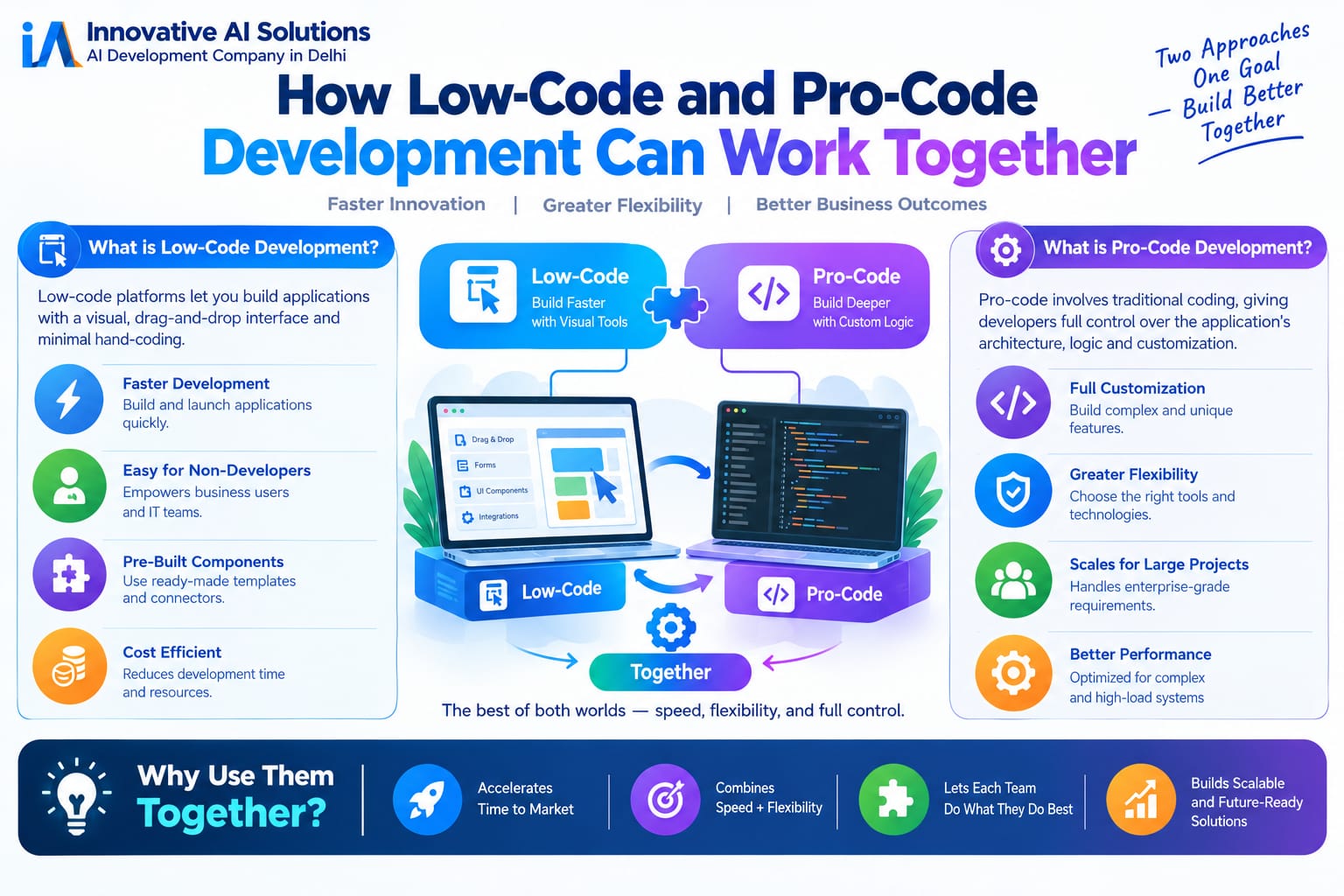
Low-code platforms let business users build applications quickly without waiting for engineering backlogs. Forms, approvals, simple workflows, internal tools these scenarios are delivered fast in low-code environments.
Pro-code development remains essential for complex business logic, high-performance systems, deep integrations, and differentiated user experiences. These scenarios require the skills and experience of professional developers.
The question isn't "which one?" The question is: how do you make both work together in the same architecture, each delivering maximum value?
This approach is called fusion development combining low-code and pro-code to create complete solutions. Successful fusion teams use both approaches and actively embrace the collaboration model.
The data supports the trend. Gartner predicts the global low-code development technology market will grow at roughly 20% annually, reaching nearly $40 billion. This growth isn't at the expense of pro-code the two are increasingly complementary.
What Fusion Development Actually Is
Fusion development is a collaboration model where low-code and pro-code developers build solutions together. Each uses the tools best suited to their skills and the problem at hand.
The core principles of fusion development:
Right tool for the right job. Low code platforms handle what fits their model: forms, approvals, simple workflows, quick integrations. Pro-code handles everything else: performance-critical systems, complex business logic, deep integrations, compliance requirements.
Collaboration, not replacement. Citizen developers build quickly in visual environments. Professional developers extend those solutions, adding what's missing custom components, API integrations, advanced logic.
Unified governance. Regardless of how they're built, all solutions follow the same governance, security, and lifecycle management standards. This is where professional developers play a critical role.
Microsoft's framework illustrates this collaboration clearly. Low-code platforms like Power Platform let citizen developers build apps fast. Professional developers can use Visual Studio to create custom controls, custom connectors, and integrate them into low-code environments.
When to Use Low-Code vs Pro-Code
This is the most critical decision in fusion development. Get it right, and efficiency doubles. Get it wrong, and you either over-engineer or hit an impassable bottleneck.
Where low-code fits:
Employee-facing internal apps. Forms, approval flows, internal tools, data collection. These apps serve internal employees, have modest performance requirements, but demand fast delivery.
Simple workflows and automation. Connecting SaaS tools, triggering notifications, coordinating tasks. Low-code platforms provide pre-built connectors that take minutes to set up.
Rapid prototyping and validation. Before investing heavy engineering resources, use low-code to validate a business concept. If it works, decide whether pro-code extension is needed.
Where pro-code fits:
Customer-facing applications. Handling tens of thousands of concurrent users, guaranteeing response times and user experience. Low-code abstraction layers limit performance optimization.
Complex business logic. Precise algorithms, encryption routines, multi-tenant security structures. Visual development platforms create serious bottlenecks and vendor lock-in risk in these scenarios.
Deep system integration. Connecting legacy systems, custom APIs, complex data pipelines. These require the architectural capabilities of professional developers.
Differentiated experiences. If the application is your competitive moat not an internal tool ro-code provides full control and optimization.
The key decision rule: Consider low-code first, especially for employee apps, because it's cheaper and faster to build. But don't expect low-code to do everything.
How Fusion Development Works
Fusion development isn't simply using both approaches. It requires clear collaboration patterns and governance frameworks.
Pattern 1: Low-Code Primary, Pro-Code Extension
Business teams build the core of the application in low-code. When they hit requirements the platform can't fulfill custom UI components, special integrations, advanced logic professional developers step in, write extension components, and embed them in the low-code environment.
Microsoft's practice: professional developers use Visual Studio to create custom controls for low-code UI. These controls are visible to citizen developers and can be dragged and dropped like standard components.
Pattern 2: Pro-Code Core, Low-Code Frontend
Professional developers build high-performance backend services microservices, APIs, data pipelines. Low-code platforms serve as the frontend, calling these services and handling user interaction. This is called the "Code Apps" model, now supported by Power Apps.
Pattern 3: Unified Lifecycle Management
Regardless of how solutions are built, they follow the same DevOps processes. GitHub or Azure DevOps handles source control and CI/CD pipelines. Low-code solutions also export to source control, using the same environment isolation and deployment processes.
This ensures professional and citizen developers use the same toolchain, reducing collaboration friction.
Governance: The Critical Success Factor
Many organizations underestimate governance when driving low-code adoption. The result is app sprawl, duplicate solutions, unmanaged connectors, and inconsistent security models.
AI accelerates development. Without governance, it also accelerates chaos.
What successful fusion development governance requires:
Environment strategy and isolation. Development, test, and production environments separated. Low-code solutions must follow the same standard.
Data Loss Prevention (DLP) policies. Define which connectors and data sources can be used, preventing sensitive data leakage.
Connector governance. Manage permissions for creating and using custom connectors.
Application Lifecycle Management (ALM). Low-code solutions also need version control, deployment pipelines, and rollback strategies.
Agent governance. As AI agents enter low-code ecosystems, organizations need to define where agents can be deployed, what data they can access, what actions they can take, and how their behavior is monitored.
The governance framework must cover both low-code and pro-code, ensuring unified control standards.
The Cost and Efficiency Reality
The economics of fusion development are straightforward.
The cost advantage of low-code: Shorter development time, lower initial learning curve, direct business user participation. For internal tools and simple workflows, low-code significantly reduces cost and delivery cycles.
The cost of pro-code: Longer development time, requires senior developers, but provides full control, better performance, and maintainability. For core business systems, pro-code has lower long-term cost.
The value of fusion: Let each tool focus on what it does best. Business teams deliver simple solutions fast. Professional developers focus on differentiated work, not pulled into every small request.
India's market data supports the trend. Nasscom reports India's low-code/no-code market has reached $400 million**, projected to grow to **$4 billion. Demand for low-code solutions in the Indian IT market is growing as more organizations adopt digital solutions but continue to face tech talent shortages.
Frequently Asked Questions
Q1: What is fusion development?
Fusion development is a model that combines low code and pro-code development to create complete solutions. Each person uses the tools best suited to their skills and the problem at hand.
Q2: Will low-code replace pro-code?
No. Low-code accelerates what fits its model, but pro-code remains essential for complex business logic, high performance systems, and deep integrations. They're complementary, not replacements.
Q3: When should I use low-code?
Employee-facing internal apps, simple workflows, rapid prototyping. Scenarios where speed matters more than performance and control.
Q4: When should I use pro-code?
Customer-facing applications, complex business logic, deep system integrations, differentiated experiences. Scenarios that require architectural capability and full control.
Q5: What governance does fusion development need?
Environment isolation, DLP policies, connector governance, ALM, and agent governance. The governance framework must cover both development approaches with unified controls.
Q6: Can low-code solutions use source control?
Yes. Modern low-code platforms support exporting solutions to source control. GitHub and Azure DevOps can serve both low-code and pro-code development.
Q7: How do professional developers extend low-code solutions?
Through custom controls, custom connectors, API integrations, and code components. Professional developers create extensions in Visual Studio; citizen developers use them in visual environments.
Q8: How big is India's low-code market?
Nasscom reports India's low-code/no-code market has reached $400 million**, projected to grow to **$4 billion. Growth is driven by accelerating digital transformation and tech talent shortages.
Q9: How does fusion development affect team structure?
It requires collaboration, not isolation. Business users and professional developers work within the same governance framework. Engineers who understand both boundaries become more valuable.
Q10: What are the limitations of low-code?
Performance below pro code, limited support for complex logic and deep integrations, vendor lock-in risk. Recognizing these limits avoids expensive rewrites later.
Frequently Asked Questions (Continued)
Q11: What are "Code Apps"?
Power Apps Code Apps let professional developers build apps using React, TypeScript, and Visual Studio Code while leveraging Power Platform connectors and governance.
Q12: How does AI affect fusion development?
AI accelerates both models. Natural language prompts generate workflows and code. Generative tools suggest next steps, fill in logic, and write integration code. But governance and review remain essential.
Q13: How do I start with fusion development?
Start with the governance model: define what apps can be built in which tool, by whom. Establish shared services: reusable APIs, identity, data access. Set up a platform engineering function to manage standards for both tools.
Q14: Is low-code suitable for core business systems?
Usually not. Core systems need performance, control, and maintainability—pro-code strengths. Low-code fits edge systems and internal tools.
Q15: Why choose Innovative AI Solutions?
Because we understand the value of fusion development. Because we help organizations build the right governance and collaboration models. Because we've delivered 100+ projects. Because your code is always yours.
Contact Us
Phone:
+91 7464 099 059
+91 9689967356
Email:
info@innovativeais.com
Address:
9th Floor, Pearls Best Heights-I,
Head Office: 904, Netaji Subhash Place,
Delhi – 110034