The Big Question
What happens when your customer isn't a person browsing your website, but an AI agent scanning your API for pricing, availability, and shipping rules? When the decision to buy isn't influenced by your brand story or emotional marketing, but by structured data and deterministic logic? When a negotiation with a supplier happens in milliseconds, not weeks?
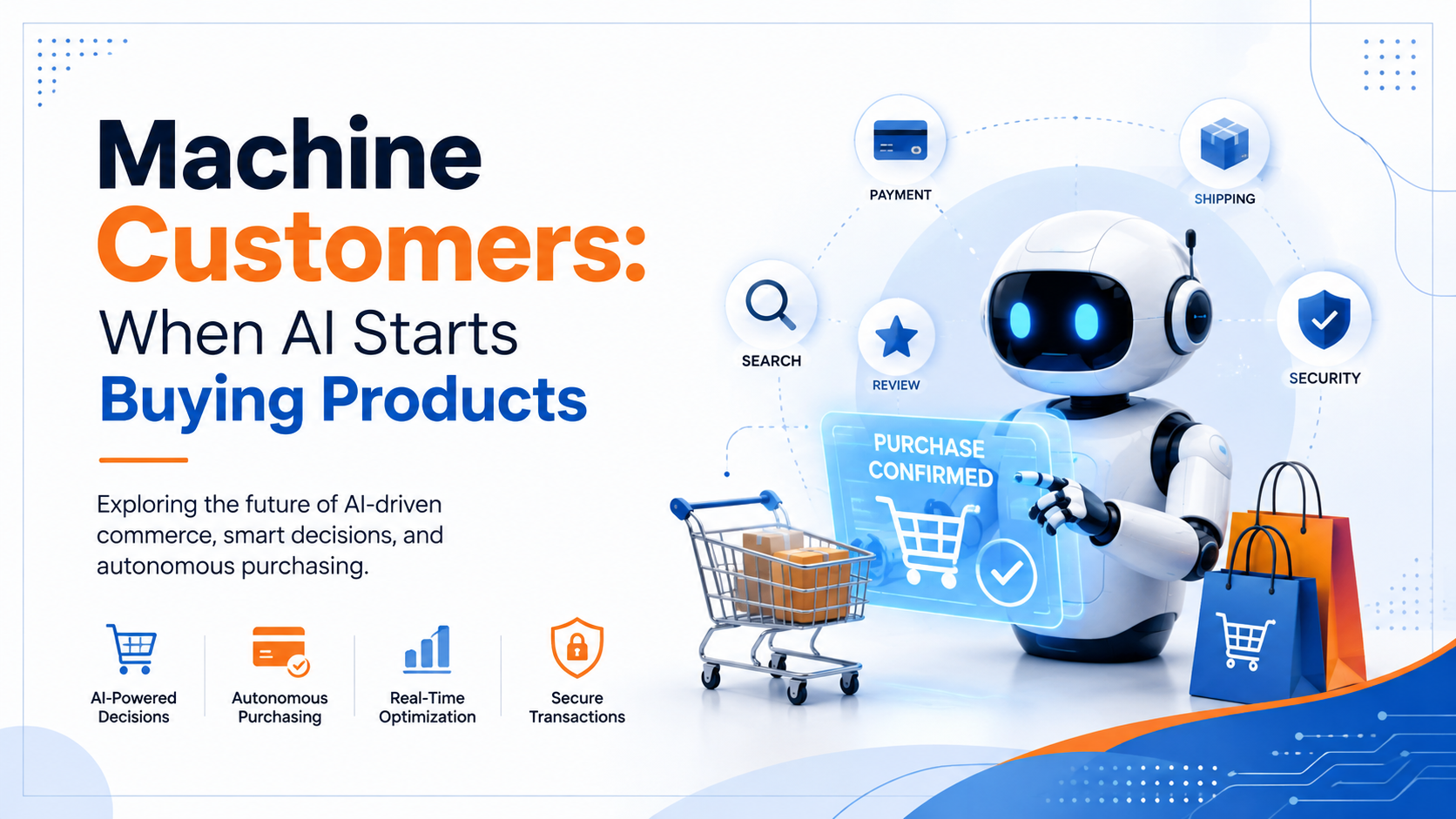
This is the reality of the machine customer economy and it's already unfolding across consumer and enterprise contexts. Gartner analyst Don Scheibenreif, who coined the term "machine customer," describes it as "a non-human economic actor that obtains goods or services in exchange for payment" . These aren't just smart devices; they are independent economic actors making purchasing decisions without human intervention.
The Machine Customer Journey: From Screens to Loops
Designing for machine customers requires a fundamental shift in thinking. Instead of screens, you design loops. Machine customers typically follow a cyclical pattern:
detect → evaluate → execute → verify → update
This pattern already operates in real-world contexts. In telemetry-driven replenishment, connected devices reorder supplies when needed. Amazon's Dash Replenishment Service (DRS) provides a model where devices transmit consumption data and trigger automated orders when supplies are low . Similarly, HP's Instant Ink subscription uses an internet-connected printer that monitors ink levels and triggers proactive shipment when ink runs low .
The key insight from these programs is that the behavioral "customer" in the moment of action is the monitoring loop and its rules, even if a human pays the bill. This distinction matters because it changes how businesses must think about the customer experience.
The $30 Trillion Opportunity
The scale of the machine customer opportunity is staggering. Gartner modeling predicts that by 2030:
-
Machine customers will directly influence or participate in $30 trillion worth of purchases
-
CEOs expect machine customers to generate at least 21% of their revenue
-
Over 50% of CEOs plan to have a strategy in place within two years to deal with machines as part of the buying or selling process
However, most businesses are not ready. Marketing activities traditionally rely on emotional selling an ineffective tactic for machine customers, which lack emotions . As Sirte Pihlaja, a leading CX expert, notes, machine customers "don't browse like humans they scan, analyze, and execute decisions instantly" .
The Emerging Infrastructure for Machine Commerce
Consumer Markets
In consumer markets, companies are cautiously building out agentic commerce capabilities. OpenAI initially introduced shopping capabilities within ChatGPT with an "Instant Checkout" feature, but has since steered developers toward routing purchases through merchant-controlled checkout systems rather than completing transactions inside ChatGPT . ChatGPT now functions primarily as a discovery and recommendation layer.
Amazon has introduced "Buy for Me," a feature that allows AI systems to place purchases from external brand websites when products are not available directly through Amazon . The feature remains in beta and is available only to a limited group of users. Amazon has also expanded Rufus, a generative AI shopping assistant designed to answer product questions and guide purchase decisions . Rufus can now handle deep product research, track prices, and automatically purchase products when they reach a set price target .
India's Agentic Payments Protocol
India is taking a unique approach to machine commerce infrastructure. Pine Labs has launched the Pine Labs Payment Protocol (P3P), an agentic payments protocol for UPI transactions . Pine Labs CEO Amrish Rau called for India-led standards in autonomous commerce, stating: "Our responsibility is to create the infrastructure... What is super important is India shouldn't get left behind in this game. India shouldn't be looking to the West to figure out what is the protocol they are doing and how this can be implemented" .
P3P provides payment and settlement rails for autonomous commerce, utilizing UPI Reserve Pay and one-time mandates for transactions triggered by AI agents. Use cases include an agent's ability to track prices of flights, precious metals, and concert tickets, and autonomously execute transactions if certain user conditions are met .
B2B and Autonomous Commerce
The shift toward machine customers is perhaps most advanced in B2B contexts. Keelvar, an agentic sourcing platform, serves over 150 global enterprises including Nestlé, Siemens, Maersk, and Mars . Its Sourcing Optimizer enables procurement teams to evaluate complex award scenarios involving thousands of line items, while Autonomous Sourcing automates recurring sourcing events from creation through bid analysis and award recommendations .
Organizations that have adopted AI and sourcing automation in the past 12 months were 3.7 times less likely to suffer major demand contraction during periods of disruption than those that had not . However, fewer than one-quarter of B2B suppliers currently use agentic AI technologies .
How to Prepare Your Business for Machine Customers
1. Add Machine Identity to Your Data Model
Your CRM needs a way to distinguish humans from machines. Add fields for customer_type, machine_type, parent_account, and confidence scores . For authentication, treat machines with the same seriousness you'd give a human login API keys, OAuth, and mutual TLS are essential controls .
2. Expose Machine-Specific Surfaces
Agents don't care about beautifully designed CTAs. They want:
-
Clean pricing data
-
Stock and availability information
-
Shipping rules and SLAs
-
Any other structured data that helps them rank suppliers
If this information is hard to find or inconsistent, machines will simply skip you. As one source notes, "data is the storefront" for machine customers .
3. Build Machine-Aware Scoring
The old scoring frameworks don't apply to bots. Break scoring into two tracks:
Human scoring: opens, clicks, recency, multi-touch engagement
Machine scoring: error-free API calls, consistency of task completion, order cadence, reaction to price or SLA adjustments, stability of machine-originated revenue
4. Design for Both Humans and Machines
The collision of machine customers and sales doesn't mean human customers will cease to exist. You still need to design for people who care about emotion. But you also need to design for the other buyer journey one that needs structure, speed, and consistency .
As Scheibenreif explains: "A brand for a machine will be different than a brand for a human. The machine's going to care about: Is the product available when I need it? What's the pricing? What is your environmental record? What is your DEI record?"
5. Implement Bot Hygiene Controls
Set hard frequency caps per machine ID, suppress duplicate retries, build anomaly detection specifically for agents, and create a kill switch. A pricing glitch can trigger a bot swarm and drain inventory fast .
Frequently Asked Questions
Q1: What is a machine customer?
A machine customer is a non-human economic actor that obtains goods or services in exchange for payment . It's a specialized AI agent designed specifically to autonomously purchase goods, negotiate transactions, and influence commercial decisions.
Q2: How big is the machine customer opportunity?
Gartner predicts machine customers will directly influence or participate in $30 trillion worth of purchases by 2030 . CEOs expect them to generate at least 21% of their revenue.
Q3: Are machine customers the same as AI assistants?
No. AI assistants help humans make decisions. Machine customers make decisions independently. Gartner notes that machine customers are a subset of AI agents "designed specifically to autonomously purchase goods, negotiate transactions and influence commercial decisions" .
Q4: Is this already happening?
Yes. Telemetry-driven replenishment (like printers reordering ink), AI procurement agents negotiating with suppliers, and platforms like Amazon's "Buy for Me" are all examples of machine customers in action .
Q5: How can Innovative AI Solutions help?
We help organizations design strategies to engage with machine customers from building machine-readable data infrastructure to developing AI-native customer experiences. Based in Delhi, serving clients across India.
Final Thought
The machine customer economy is not a distant future it's already here. From connected devices reordering supplies to AI agents negotiating procurement contracts, software is increasingly making purchasing decisions on behalf of humans. The organizations that thrive will be those that treat machine customers as a distinct customer segment with their own needs, behaviors, and expectations.
Contact Us:
Phone: +91 7464 099 059 / +91 9689967356
Email: info@innovativeais.com
Address: Netaji Subhash Place, Pitampura, Delhi – 110034
Website: https://innovativeais.com
About the Author
Abhishek Kumar
Founder & CEO, Innovative AI Solutions
5+ years building AI and enterprise systems. Based in Delhi, serving clients across India.
Related services: to apply this in your business, explore our AI agent development and AI development services.