The Big Question
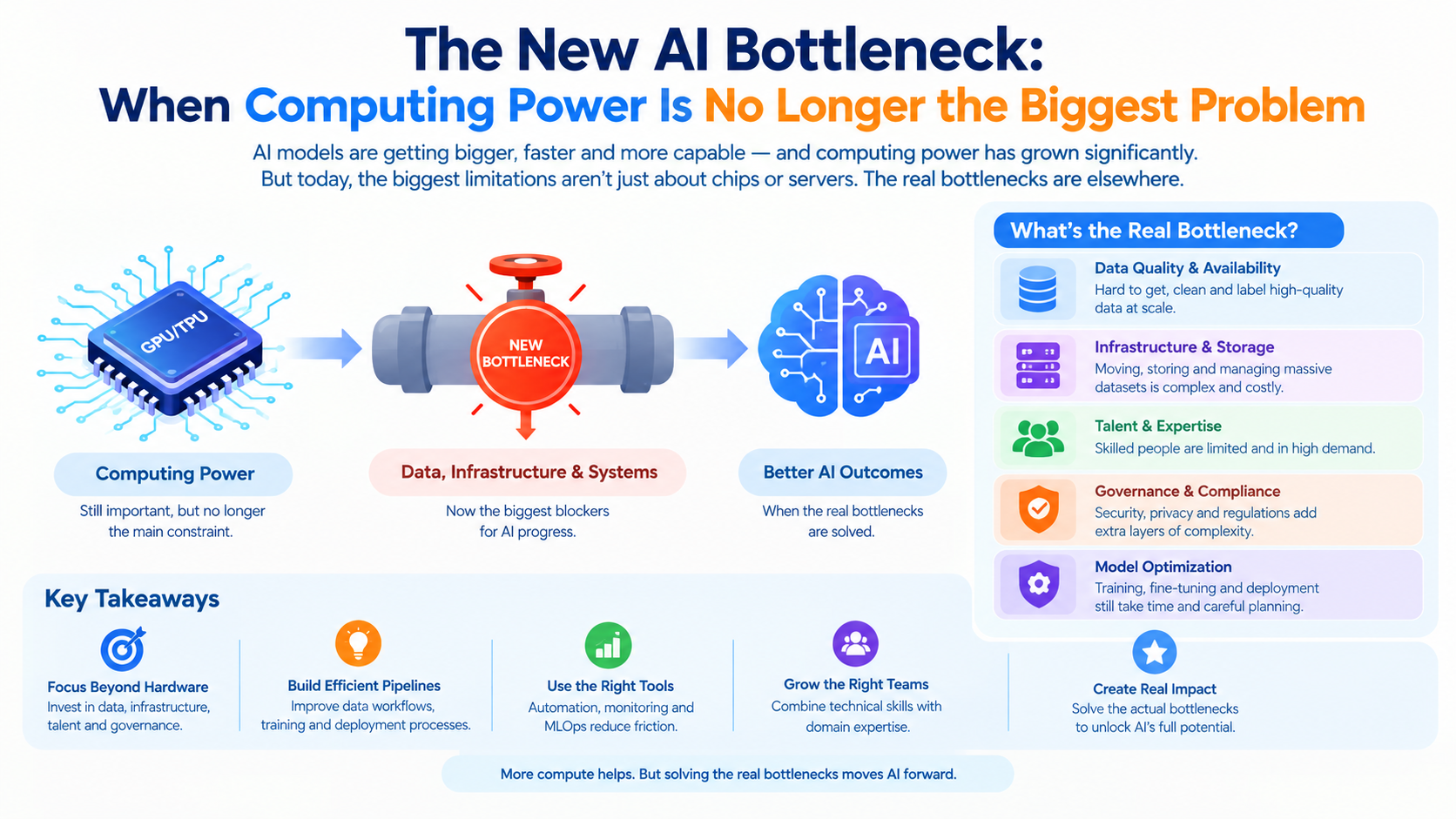
What happens when you finally secure the GPUs, deploy the model, and discover the real constraint was never compute? When your legacy infrastructure cannot support the workload, your data is not ready, your power budget is exhausted, and no one on the team knows how to evaluate whether the model is actually working?
The bottleneck has moved. The question is no longer "do we have enough GPUs?" but "can our infrastructure, data, and workforce actually support the AI we're trying to build?"
The Bottleneck Has Moved
The current reality is straightforward: compute remains a constrained resource, but it is no longer the only constraint. Power bottlenecks, political bottlenecks, and labour bottlenecks now place limits on supply that are just as binding.
A more useful framing has emerged from the industry: the right question is not "how many GPUs do we have?" It is "can our infrastructure support the AI workloads we need, at the latency, reliability, security, and cost our business requires?"
That reframing matters because an enterprise can have access to powerful accelerators and still struggle with low utilisation, poor workload scheduling, insufficient memory, network bottlenecks, inadequate storage throughput, unpredictable inference costs, and weak coordination between infrastructure and application teams.
The Infrastructure Gap
A survey of 945 CIOs and CTOs at companies with at least $500 million in annual revenue across 19 countries produced findings that are difficult to ignore.
| Finding | Percentage |
|---|---|
| Say legacy system limitations caused an AI pilot or project to be cancelled | 84% |
| Believe failing to modernize before running AI will eventually trigger an enterprise-wide security crisis | 93% |
| Say other C-suite executives and board members fully understand the security risks of running AI on legacy systems | Only 20% |
For many organizations, legacy infrastructure has become a real constraint — not only on innovation, but also on security and scalability.
The Hidden Layers of the Infrastructure Gap
Data architecture. AI systems require data that is accurate, current, accessible, traceable, and governed. Enterprise data is often spread across databases, documents, applications, APIs, and departmental systems with different definitions, permissions, and update cycles. A knowledge assistant can produce a fluent but incorrect answer if it retrieves an outdated policy.
Model operations. A model that works in a test environment needs a repeatable path into production: version control, evaluation datasets, automated testing, deployment pipelines, rollback procedures, monitoring for quality and drift, and controls for changing models or providers. Without these, every model update becomes a new experiment rather than a controlled operational change.
Network and storage. AI workloads move large volumes of data between applications, data stores, models, and users. Poor data locality increases latency and cost. Insufficient network capacity undermines real-time applications. Slow storage limits training, retrieval, and batch-processing performance. For multimodal and agentic systems, these demands increase because the application may process text, images, audio, video, structured records, and tool outputs in one workflow.
The Data Readiness Crisis
A global survey of 10,000 businesses across 32 countries reveals a structural gap: 97% of organizations report active AI initiatives, but only 5% say their data is adequately ready to support them.
| Obstacle | Percentage Citing |
|---|---|
| Limited data access | 50% |
| Privacy and compliance risks | 44% |
| Data quality and integrity concerns | 40% |
| Lack of integration across systems | 38% |
| Shortage of skilled AI professionals | 37% |
The deeper issue is that while models can generate insights, they cannot reliably act without a consistent and verified understanding of the entities they operate on. These constraints are systemic, not incremental, and point to the need for a shared identity layer that resolves entities consistently across every system AI touches.
The Energy Wall
AI deployment is increasingly constrained by physical bottlenecks, including energy.
| Metric | Value |
|---|---|
| Global data center electricity consumption (2025) | 485 TWh |
| Projected consumption (2030) | ~950 TWh |
| AI-specific consumption projection | Could triple by 2030 |
| Power draw of one AI server rack (by 2027) | Equivalent to 65 average households |
| Deployed AI capacity today | ~32 GW of power draw |
A single frontier training run is projected to require energy comparable to the annual output of a large power plant by the end of the decade. Energy infrastructure is the most consequential near-term constraint on frontier compute growth.
This is why technology companies are shifting from energy consumers to energy producers. In 2025, tech sector renewable energy purchase agreements accounted for approximately 40% of the global corporate total. Data centers are investing heavily in battery storage systems, with 20–25 GW expected to be deployed by 2030. Small modular reactor capacity planned for data centers grew from 25 GW at the end of 2024 to 45 GW at the end of 2025.
The CPU Comeback: Agentic AI's Hidden Demand
While the industry fixated on GPUs, agentic AI created an unexpected CPU bottleneck.
The reason: agentic AI systems spawn sub-agents, make API calls, and use tools. The CPU handles parsing output, figuring out which tool to invoke, making the API call or running the code, collecting the result, and feeding it back.
In realistic agentic AI pipelines, seven of eight stages run entirely on the CPU. The pattern is counterintuitive: the CPU is often idle while inference executes on a GPU, and the GPU is often idle when tool calls execute on the CPU. Scheduling optimizations can cut end-to-end latency by up to 1.8 times under sustained load, but the gains chase a moving target as agentic systems generate work at machine speed.
The Memory Crunch
Memory has become another critical chokepoint.
| Metric | Value |
|---|---|
| 2026 semiconductor forecast growth | 62.7% |
| HBM suppliers sold out for 2026 | All three |
| HBM capacity gap | 50–60% |
| DDR4 and DDR5 price increase (Sept–Nov 2025) | Up to 4x |
The cause: HBM production for AI accelerators delivers lower volumes but commands significantly higher prices. This creates a zero-sum game for wafer and packaging capacity that reshapes the global supply chain. Consumer memory supply is being squeezed as manufacturers prioritize AI-grade memory.
The Human Bottleneck: A Calibration Crisis
Perhaps the most overlooked constraint is human.
When AI practitioners were asked to name their biggest bottleneck in advancing AI safety and alignment work, the top answer was human feedback limitations at 30% covering quality, scalability, and consistency. Evaluation challenges came next at 24%. Theoretical gaps followed at 22%. Compute and resource constraints trailed at 15%.
The role of humans in AI development has quietly inverted. When asked which human contributions they rely on most, practitioners named designing evaluation methodologies (47%) and subject matter expert validation. Both rank above the contributions that defined the previous decade: curating datasets, providing preference feedback, and creating ground truth labels.
Designing an evaluation methodology is not annotation work. It requires someone who understands what the model is supposed to do well, where it tends to fail, and what edge cases would expose breakdowns that matter in deployment. A good evaluation methodology is, in effect, a theory of the model's intended behaviour.
The same logic applies to subject matter expert validation. Generalists can tell you whether a sentence is grammatical. They cannot tell you whether a legal argument cites the correct precedent, whether a clinical recommendation accounts for a relevant contraindication, or whether a block of code introduces a subtle security regression. As models take on tasks requiring professional judgment, the only useful feedback comes from people who have that judgment.
The Model Is Not the Architecture
One of the most common mistakes is treating model selection as the primary architecture decision. The most powerful available model is not always the best enterprise choice.
A sensible architecture may combine:
-
Conventional software for predictable tasks
-
Smaller models for high-volume operations
-
Specialist models for domain-specific work
-
Larger models for complex, low-volume reasoning
-
Human review for high-impact or uncertain decisions
This approach can improve cost, latency, privacy, portability, and reliability.
Inference costs for GPT-3.5-level performance fell more than 280 times between November 2022 and October 2024. Falling prices make AI more accessible, but they can also encourage uncontrolled usage. If a workflow expands from thousands of requests to millions, total spending may rise even when cost per request falls.
What This Means for Enterprises
The bottleneck has moved from compute to a constellation of interconnected constraints: infrastructure readiness, data quality, energy supply, memory availability, and human expertise.
Organizations that treat AI as a model selection problem will keep hitting these walls. Those that treat it as an infrastructure and organizational readiness problem will build the foundation that makes AI sustainable.
The enterprises creating value with AI are treating it as a ground-up investment rather than a layer added atop outdated infrastructure, governance, and workforce strategies. Building the foundation first is what makes the value and speed that comes later sustainable and scalable.
Implementation Roadmap
Phase 1: Assess (Weeks 1-4)
-
Audit infrastructure readiness. Can current systems support AI workloads at required latency, reliability, and cost?
-
Assess data readiness. Is data accurate, current, accessible, traceable, and governed?
-
Evaluate energy and capacity constraints. What are the power, memory, and network limits?
-
Assess human capability. Do you have people who can design evaluations and validate outputs?
Phase 2: Build the Foundation (Weeks 5-12)
-
Modernize legacy systems where they block AI deployment.
-
Build the data foundation quality, lineage, governance, and identity resolution.
-
Establish model operations versioning, evaluation, deployment, monitoring, rollback.
-
Plan capacity power, memory, network, and storage.
-
Build human capability evaluation design and domain validation.
Phase 3: Operate (Weeks 13-16+)
-
Monitor cost per request and total spend.
-
Review architecture decisions as models and costs evolve.
-
Expand capability to additional workloads.
-
Continue investing in the foundation.
Frequently Asked Questions
Q1: Is compute no longer a constraint?
Compute remains constrained, but it is no longer the only constraint. Power, memory, data readiness, and human expertise now place limits that are just as binding.
Q2: What is the biggest hidden bottleneck?
Data readiness. 97% of organizations report active AI initiatives, but only 5% say their data is adequately ready.
Q3: Why is energy a constraint?
Global data center electricity consumption is projected to double to approximately 950 TWh by 2030. A single AI server rack is expected to draw as much peak load as 65 average households by 2027.
Q4: Why is the CPU suddenly a bottleneck?
Agentic AI pipelines run most of their stages on the CPU parsing output, invoking tools, and feeding results back. GPUs are often idle during these stages.
Q5: What is the human bottleneck?
Designing evaluation methodologies and providing subject matter expert validation. These are the contributions practitioners rely on most, and they cannot be done by generalists.
Q6: How can Innovative AI Solutions help?
We help organizations assess AI readiness and build the infrastructure foundation from data architecture and model operations to capacity planning and evaluation design. Explore our services to see how we approach enterprise AI. Based in Delhi, serving clients across India.
Why Delhi is a Great Hub for Enterprise AI
Delhi is emerging as a hub for enterprise AI adoption, backed by India's AI Mission, subsidized GPU access through empanelled providers, and a thriving IT services ecosystem. As Indian enterprises move AI from pilots into production, understanding the real constraints beyond compute becomes the difference between sustainable AI and stalled initiatives.
What We Offer at Innovative AI Solutions
-
AI Readiness Assessment: We evaluate infrastructure, data, capacity, and human capability.
-
Data Foundation: We build quality, lineage, governance, and identity resolution.
-
Model Operations: We implement versioning, evaluation, deployment, and monitoring.
-
Capacity Planning: We plan power, memory, network, and storage requirements.
-
Evaluation Design: We help build the human capability to evaluate AI outputs.
Final Thought
The shift is clear: from computing power as the primary constraint to a constellation of interconnected constraints. The AI bottleneck is no longer about having enough GPUs. It is about whether your organization can actually absorb and operationalize the intelligence that computing power makes possible. Organizations that build the foundation first will scale AI sustainably. Those that rush ahead of their own infrastructure will move the risk downstream.
Contact Us:
Phone: +91 7464 099 059 / +91 9689967356
Email: info@innovativeais.com
Address: 904, 9th floor Pearls Best Heights-I, Netaji Subhash Place, Delhi-110034
Website: https://innovativeais.com
About the Author
Abhishek Kumar
Founder & CEO, Innovative AI Solutions
5+ years building AI, cloud, and enterprise systems. Based in Delhi, serving clients across India.