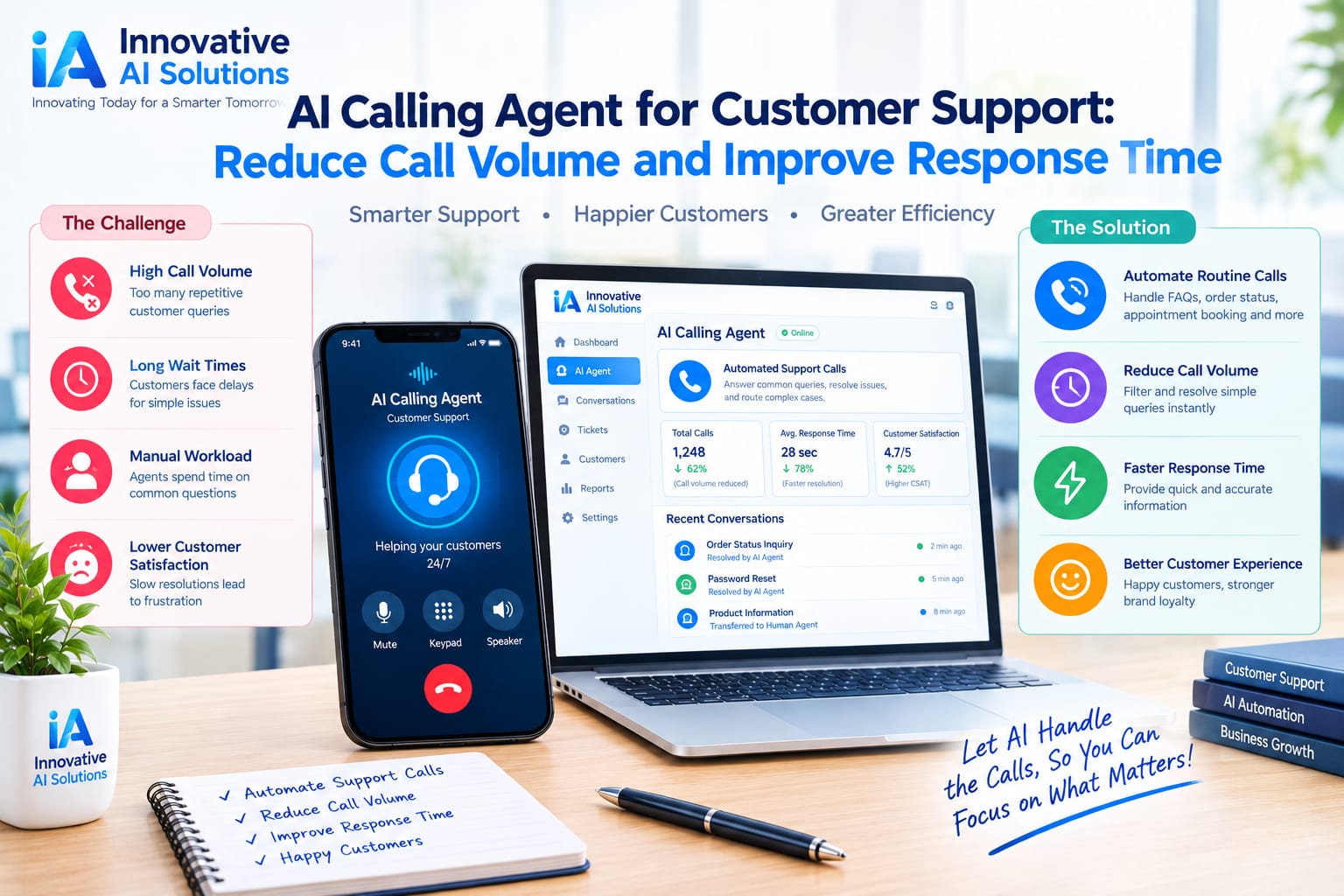
Why is your support volume growing while your team struggles to keep up?
The pressure is intense. Gartner found that 91% of customer service leaders are under executive pressure to implement AI in 2026 a sharp increase in urgency . AI spending by customer service leaders has surged by 38%, despite overall service budgets growing just 2% .
The reason is structural. Routine queries order status, password resets, appointment confirmations, account lookups consume the majority of agent time. These calls follow predictable resolution paths. They don't need human judgment. They need immediate answers.
AI calling agents handle this. They answer instantly, resolve autonomously, and hand off complex issues to humans with full context. The result: lower call volume, faster response times, and higher customer satisfaction.
The numbers are compelling. A European telecom achieved 50% call deflection in eight weeks . TripCity cut live call volume in half with an AI agent . Ringg's agents resolve up to 65% of customer calls with an average CSAT of 4.8 .
This isn't experimental. It's production.
What AI Calling Agents Do for Customer Support
An AI calling agent for customer support handles the repetitive, high-volume queries that consume agent capacity.
Instant Answer, No Hold Time
The agent answers immediately. No queue. No hold music. No "your call is important to us." The caller gets a response in seconds, not minutes.
Autonomous Resolution
The agent resolves routine queries end-to-end. Order status. Password reset. Appointment confirmation. Account lookup. The caller doesn't wait for a callback or a transfer.
Intelligent Deflection
When a query can be resolved without a human, the agent resolves it. When it can't, the agent escalates with full context transcript, intent, account details. The human agent doesn't start from scratch.
24/7 Availability
The agent works every hour of every day. The 3 AM call. The weekend rush. The holiday surge. No overtime. No shift gaps.
Consistent Quality
Every call gets the same quality of response. No variance based on agent experience or fatigue. The agent follows the same script, the same logic, the same escalation rules every time.
Real Results: What Businesses Are Seeing
OTE (Cosmote TV): 50% Deflection, 30% Lower Handle Time
OTE Group, Greece's largest telecom provider, deployed an AI voice agent for Cosmote TV support .
Results:
-
50% deflection rate (nearly 3x the baseline)
-
30% reduction in average handle time
-
Production-grade agent handling tens of thousands of calls in under two months
The agent covers 10 skill domains: user authentication, troubleshooting and satellite reset, package and pricing information, profile management, service deactivation, TV program queries, and post-call surveys. The architecture integrated custom ETL processes with Genesys telephony and backend APIs .
TripCity: 54% Call Volume Handled by AI
TripCity, a car-sharing marketplace with just five support agents, was overwhelmed by 5,000-6,000 calls per month .
Results:
-
54% of calls handled by AI without human intervention
-
87% of those calls resolved without escalation
-
10% deflection in first test period, jumping to 54% after expansion
The agent, "Miles," handles new driver onboarding, billing, and active rental queries. It attempts resolution three times before escalating .
Ringg: 65% Resolution, 4.8 CSAT
Ringg, an AI voice and chat platform, handles 7 million+ connected calls monthly .
Results:
-
65% resolution rate by AI agents
-
4.8 average CSAT score
-
90% cost reduction vs GPT-4.1 for some workloads
Ringg's agents handle insurance purchases, appointment booking, account inquiries, and CRM updates—all autonomously .
Benefits Administration Firm: 45% to 80% Automation in One Week
A benefits administration firm faced an urgent staffing gap 80-100 agents needed in two days .
Results:
-
45% call automation on day one
-
Nearly 80% automation within one week
-
CSAT improved through live surveys
-
Human agents focused on complex, higher-value calls
The AI absorbed call volume at scale while humans handled complex interactions. Handle times dropped. Customer satisfaction increased .
Nabis: 100% Automation in 6 Weeks
Nabis, a cannabis wholesale platform, automated delivery confirmation calls .
Results:
-
100% of calls automated in six weeks
-
45% of confirmation team reallocated to core CX
-
99% success rate in understanding intent
The AI handles background noise from noisy dispensaries, understands industry acronyms like "COD," and verifies authorization before discussing financial data .
How It Works: The Support Workflow
A production AI calling agent for customer support follows a defined sequence.
Step 1: Intent Capture
The agent greets the caller in natural language. No menu. No keypress. It captures intent "I want to check my order status" or "I need to reset my password."
Step 2: Identity Verification
Before disclosing account data, the agent verifies identity. This is both security and compliance. For financial services, this step is non-negotiable .
Step 3: Resolution Attempt
The agent attempts to resolve the query. It queries backend systems order management, CRM, billing and provides the answer.
Step 4: Multi-Step Workflows
For complex queries, the agent guides the caller through multiple steps. Troubleshooting a set-top box. Rescheduling an appointment. Updating account details .
Step 5: Escalation with Context
When the agent can't resolve or when the caller requests a human it escalates with full context. The human agent sees the transcript, the intent, the account details. The caller doesn't repeat themselves .
Step 6: Post-Call Logging
Transcript, recording, and outcome are written to the CRM. No manual data entry. No "the agent forgot to log it" .
What to Look For in an AI Calling Agent for Support
Instant Handoff Quality
The quality of escalation determines whether automation reduces call volume or raises it. Twilio research found only 15% of consumers experience a smooth handoff from AI to a person, while 78% say being able to switch matters . Transfer without context is worse than no automation.
Confidence-Based Escalation
When recognition or intent confidence drops below a threshold, the agent should transfer rather than guess. In India, word error rates above 20% on several languages mean this fires more often than teams plan for .
Repetition Detection
A customer repeating themselves is the earliest reliable signal of a failing conversation. The agent should detect this and escalate before frustration builds .
CRM Integration
The agent must read from and write to your CRM. Without it, the agent can only route, not resolve. Integration depth is the biggest reason deployments slip .
Compliance Built In
Consent logging. Call recording. Disclosure evidence. These aren't optional they're requirements for regulated industries .
India-Specific Capabilities
Native support for Hindi, Tamil, Telugu, and code-mixed Hinglish. DLT registration for outbound calls. DPDP Act compliance. These matter for Indian deployments .
The Cost Reality
Managed Platform (SaaS)
Per-minute pricing: ₹2 to ₹12 all-in, with ₹3 to ₹6 the most common mid-market band . But effective cost is 2 to 4 times the headline once telephony, connect-rate losses, and compliance are added .
What drives cost:
-
Telephony markup (carrier charges, number rental)
-
Connect-rate losses (30-50% of outbound dials may not connect)
-
Model upgrades for Indian accents and Hinglish
-
Platform and seat fees
Custom Development
Custom builds range from ₹75,000 to ₹8,00,000+ one-time, with monthly running costs of ₹4,000 to ₹40,000+ .
The Crossover Point
Cost curves hit an inflection point around 10,000 minutes per month. Below that, bundled platforms win. Above it, building becomes more economical .
What This Means for Your Business
Start with one high-volume query type.
Don't automate everything. Pick the query type that consumes the most agent time order status, password reset, appointment confirmation. Prove value. Then expand .
Measure deflection rate and CSAT, not just cost per minute.
A cheap agent that resolves nothing is more expensive than a costly one that deflects 50% of calls. Track deflection rate, resolution rate, CSAT, and average handle time .
Plan for handoff from day one.
AI makes mistakes. Build escalation paths before you need them. Confidence thresholds. Repetition detection. Category-based routing. RBI recommends human handling for complaints and financial decisions .
Own your data and exit plan.
Whatever platform you choose, ensure you can export your data and conversation logic. Vendor lock-in is a strategic risk.
Run a monitored pilot.
Deploy on one query type. Monitor deflection rate, escalation rate, and CSAT for four weeks before expanding scope .
Frequently Asked Questions
Q1: What is an AI calling agent for customer support?
An AI calling agent for customer support handles inbound calls autonomously greeting callers, capturing intent, verifying identity, resolving routine queries, and escalating complex issues to humans with full context .
Q2: How much does an AI calling agent cost for customer support?
Managed platforms: ₹2-12 per minute all-in, with ₹3-6 the most common mid-market band. Effective cost is often 2-4x the headline . Custom builds: ₹75,000-8,00,000+ one-time.
Q3: What deflection rates can I expect?
OTE achieved 50% deflection. TripCity achieved 54% of calls handled by AI. Ringg resolves up to 65% of calls. A benefits firm reached 80% automation in one week .
Q4: How does AI improve response time?
The agent answers instantly no queue, no hold time. Average handle time dropped 30% at OTE. Handle times dropped at the benefits firm, with CSAT improving simultaneously .
Q5: Can the AI handle Hindi and regional languages?
Yes. Cars24 runs agents across 13 languages . Ringg supports multilingual conversations . For Indian deployments, ensure native support for Hinglish code-mixing.
Q6: What happens when the AI can't resolve a call?
Good systems escalate with full context transcript, intent, account details. The human agent doesn't start from scratch. TripCity's agent attempts resolution three times before escalating .
Q7: How do I measure ROI?
Track deflection rate (calls resolved without human), resolution rate (calls fully resolved), CSAT, and average handle time. The formula: cost per resolved call vs cost per human-resolved call .
Q8: What compliance requirements apply?
Consent logging, call recording disclosures, DPDP Act compliance, and for BFSI, RBI Fair Practices Code and 1600-series numbering .
Q9: How long does it take to deploy?
Basic deployment: days to weeks. Full optimization with stable deflection rates: 4-8 weeks .
Q10: What's the biggest mistake in AI support deployment?
Skipping handoff quality. Twilio found only 15% of consumers experience smooth handoff from AI to human. Transfer without context is worse than no automation .
Frequently Asked Questions (Continued)
Q11: Can the AI update my CRM automatically?
Yes. Post-call logging writes transcripts, recordings, and outcomes to the CRM without manual entry .
Q12: What query types work best for AI resolution?
Information retrieval, identity verification, logistics lookups, order status, password resets, appointment confirmations. Queries where the answer is already in a database .
Q13: What query types should escalate to humans?
Complaints, disputes, emotionally sensitive interactions, and anything with financial consequence. RBI recommends human handling for these .
Q14: How does AI support handle peak volumes?
The agent scales instantly. A benefits firm deployed AI to cover an 80-100 agent staffing gap in two days. The AI absorbed call volume while humans focused on complex interactions .
Q15: Why should I choose Innovative AI Solutions?
Because we build production systems, not demos. Because we focus on India-specific capabilities Indic languages, DLT, DPDP compliance. Because we've delivered 100+ projects. Because your code is always yours.
Contact Us
Phone:
+91 7464 099 059
+91 9689967356
Email:
info@innovativeais.com
Address:
9th Floor, Pearls Best Heights-I,
Head Office: 904, Netaji Subhash Place,
Delhi – 110034