The Big Question
What if your internet applications didn't depend on servers controlled by a single company? What if you could own your data, interact with services directly, and trust the system itself rather than the entity running it?
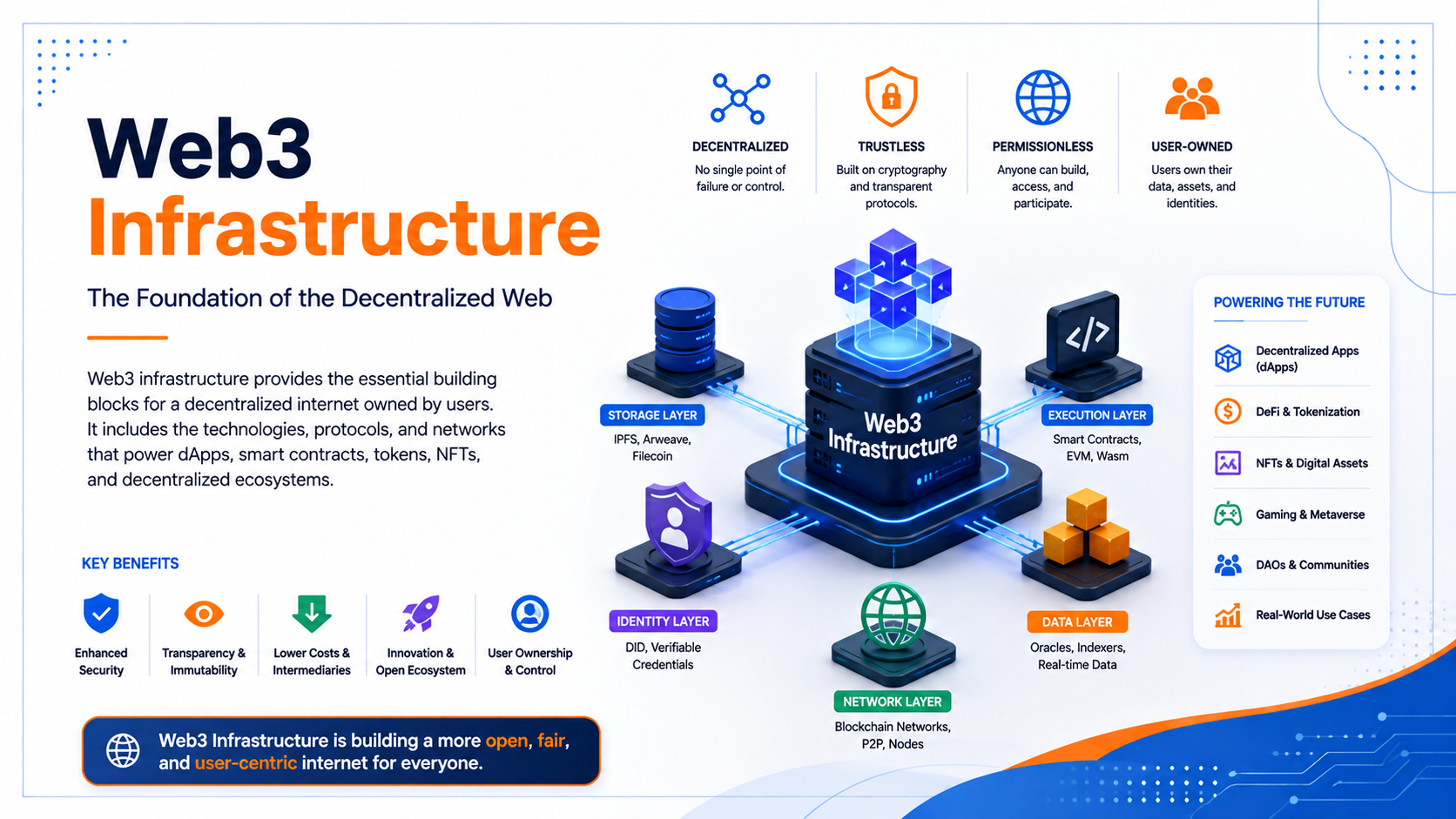
Web3 infrastructure enables this by replacing centralized control with a decentralized network of participants. It builds on blockchain technology to create applications that are transparent, resilient, and user-owned . For the first time since the commercialization of the internet, we have an architecture that separates control from service provision users can access decentralized apps (dApps) directly, removing the need for a central authority .
What Is Web3 Infrastructure?
Web3 infrastructure is the collection of protocols, services, and tools that support decentralized applications (dApps) on the internet. It represents a fundamental shift from the Web2 model where a few companies own and control most of the world's data and digital infrastructure. In Web3, power is distributed across a network of participants, with blockchain technology at its core .
The Core Promise
Traditional infrastructure requires centralized entities to provide, own, and maintain services like cloud computing, data storage, and networking. Web3 infrastructure replaces this with a decentralized model where independent participants contribute resources bandwidth, storage, compute power, sensors, or energy and earn token rewards for doing so .
Key characteristics:
-
User Ownership: You control your identity and data, which are not stored in a central database owned by a corporation.
-
Transparency: Transactions and code are often open-source and auditable by anyone.
-
Censorship Resistance: No single entity can unilaterally prevent you from interacting with the network.
-
Trustlessness: You don't need to trust an intermediary. Trust is placed in the protocol and its cryptographic guarantees .
The Layered Web3 Stack
Web3 infrastructure is complex, often structured in layers that build on one another. Understanding this stack is crucial for making informed architecture decisions .
1. Protocol Layer (The Foundation)
The protocol layer is the bedrock. It consists of the core blockchain networks, often called Layer 1 (L1) blockchains like Ethereum, Solana, or Bitcoin. This is the "source of truth" .
-
Function: Provides consensus, transaction processing, and smart contract execution.
-
Key Players: Ethereum, Solana, and Bitcoin serve as foundational L1 chains .
-
L2s: To address scalability, Layer 2 networks like Arbitrum and Optimism process transactions off-chain and settle proofs back to the L1, inheriting its security .
2. Node and Data Access Layer
This layer connects applications to the blockchain. Since running and maintaining your own blockchain node is complex and resource-intensive, node access providers like Alchemy, Infura, and QuickNode offer managed RPC (Remote Procedure Call) endpoints .
-
Function: Applications send RPC requests (e.g., checking a balance) through these providers, which route them to healthy, synced nodes .
-
Node-as-a-Service (NaaS): NaaS providers abstract away the complexities of node maintenance, allowing developers to focus on building their apps .
-
Challenge: A significant contradiction exists most NaaS providers operate on centralized hyperscaler cloud infrastructure (like AWS), creating a centralizing force within a system designed for decentralization .
3. Data Indexing and Query Layer
Raw blockchain data is difficult to work with at scale. Indexers process every block and transaction, structuring the data in a queryable database. The Graph is the leading decentralized indexing protocol .
-
Function: Indexers decode and store blockchain data, enabling efficient and complex queries that are impossible using RPC alone.
-
Role of Subgraphs: On The Graph, developers create "subgraphs" to define how to index specific contract events, creating custom APIs for their dApp .
4. Application and Services Layer
This is the top layer where user-facing decentralized applications (dApps) live. It integrates the building blocks below to deliver a seamless experience.
-
Key Services:
-
Authentication: Solutions like WalletConnect allow users to connect their blockchain wallet to a dApp, verifying their identity without a traditional username/password .
-
Oracles: Services like Chainlink feed real-world data (e.g., the current price of a stock) into smart contracts, bridging the on-chain and off-chain worlds .
-
Storage: Decentralized storage networks like IPFS and Filecoin store off-chain data (like images and documents) in a distributed manner .
-
DePIN: The New Frontier in Infrastructure
One of the most significant developments in Web3 infrastructure is Decentralized Physical Infrastructure Networks, or DePIN. DePIN projects use blockchain incentives to coordinate the deployment and maintenance of real-world physical infrastructure like wireless networks, energy grids, and GPU compute clusters .
How DePIN Works
Instead of a single company building and owning physical infrastructure, a global network of independent participants contributes hardware resources and earns token rewards .
-
Example: Imagine a decentralized 5G network. Instead of one telecom company spending billions to build towers, thousands of individuals set up small hotspots. They are rewarded in tokens for providing reliable coverage, creating a community-owned network at a fraction of the cost.
Why DePIN Matters
-
Lower Costs: Leverages a distributed workforce rather than centralized capital expenditure.
-
Global Reach: Can scale more quickly and reach underserved areas.
-
Resilience: No single point of failure.
Key DePIN Categories :
-
Compute & GPU Networks: Aggregate idle GPU capacity for AI training and inference.
-
Wireless & Connectivity Networks: Decentralized 5G and IoT hotspots.
-
Storage Networks: Decentralized file storage like Filecoin.
-
Sensor & Data Networks: Distributed sensors for environmental monitoring and mapping.
Challenges and Considerations
Despite its promise, Web3 infrastructure faces significant hurdles.
Scalability
The larger the number of users on decentralized networks, the higher the transaction volumes. Poor infrastructure leads to delays, higher costs, and poor user experiences . This is what L2 solutions and more efficient L1 chains aim to solve.
Infrastructure Paradox
A critical issue is the reliance of many Web3 infrastructure providers on centralized cloud services like AWS or Azure . If these centralized services go down, a significant portion of Web3 can become unavailable, contradicting the core principles of decentralization .
Complexity and Tooling
Developing on Web3 is more complex than traditional web development. However, the ecosystem of tooling is rapidly evolving with better infrastructure providers, indexers, and AI-driven development tools to automate and optimize smart contract development and query building .
Implementation Roadmap
Phase 1: Foundation (Weeks 1-4)
-
Define your core requirements: What blockchain (Ethereum, Solana) will you support? What are your scalability goals?
-
Select your blockchain network: Choose an L1 and any L2s you will use.
-
Choose an infrastructure provider: Select a node access provider (Alchemy, Infura, QuickNode) for reliable RPC endpoints .
Phase 2: Build Core Capabilities (Weeks 5-8)
-
Implement smart contracts: Develop the core business logic of your dApp.
-
Set up data indexing: Use an indexer like The Graph to process and structure your blockchain data .
-
Integrate storage and oracles: Use services like IPFS/Filecoin and Chainlink for off-chain data and real-world information .
Phase 3: Develop and Scale (Weeks 9-12+)
-
Build your dApp UI: Connect your frontend to your smart contracts and indexed data.
-
Ensure security: Perform thorough smart contract audits and implement robust monitoring.
-
Scale: Use your infrastructure provider's tools to monitor performance and scale your application.
Frequently Asked Questions
Q1: What is the difference between Web2 and Web3 infrastructure?
Web2 infrastructure is controlled by a few large corporations who own servers and data. Web3 infrastructure is decentralized, with data and services distributed across a network of independent participants governed by blockchain protocols .
Q2: Why are node access providers important for Web3 development?
Running your own blockchain nodes is operationally complex and expensive. Node access providers offer managed RPC endpoints, handling all the infrastructure so developers can build applications without managing the underlying network .
Q3: What is a DePIN?
A Decentralized Physical Infrastructure Network (DePIN) is a project that uses token incentives to coordinate the deployment and maintenance of real-world physical infrastructure, like wireless networks, compute power, or energy grids .
Q4: What is the main challenge for Web3 infrastructure?
One of the main challenges is the "infrastructure paradox" many critical Web3 services still rely on centralized cloud providers, creating a central point of failure . Scalability and user experience also remain significant hurdles .
Q5: How can Innovative AI Solutions help?
We help organizations navigate the Web3 landscape from evaluating blockchain networks and infrastructure providers to building, deploying, and scaling decentralized applications. Based in Delhi, serving clients across India.
Why Delhi is a Great Hub for Web3 Innovation
Delhi and India are emerging as a hub for technology innovation, with a growing developer and entrepreneur community eager to experiment with emerging technologies. As the adoption of blockchain technologies accelerates globally, India's deep pool of IT talent positions it to play a significant role in the development of the Web3 infrastructure stack.
What We Offer at Innovative AI Solutions
-
Web3 Strategy: We help you identify use cases and design a technology roadmap.
-
Infrastructure Selection: We guide you in choosing the right protocols, networks, and providers for your needs.
-
Node and Data Management: We help you set up and manage RPC endpoints and data indexing pipelines.
-
Implementation Support: We assist in building and deploying your decentralized applications.
Final Thought
Web3 infrastructure is rewriting the rules for digital services, replacing centralized control with a resilient, user-owned architecture. The layer of node providers, indexers, and DePIN networks is the critical bridge between the promise of blockchain and the application experiences that will drive mainstream adoption.
Contact Us:
Phone: +91 7464 099 059 / +91 9689967356
Email: info@innovativeais.com
Address: Netaji Subhash Place, Pitampura, Delhi – 110034
Website: https://innovativeais.com
About the Author
Abhishek Kumar
Founder & CEO, Innovative AI Solutions
5+ years building AI, cloud, and enterprise systems. Based in Delhi, serving clients across India.
Related services: to apply this in your business, explore our RAG development and AI development services.