The Big Question
Let me start with a question that every business leader must answer in 2026.
"We have deployed AI tools across our organization. But we still treat AI like a tool—something we use when we need it and put away when we don't. Is there a different way to think about AI's role?"
The honest answer:
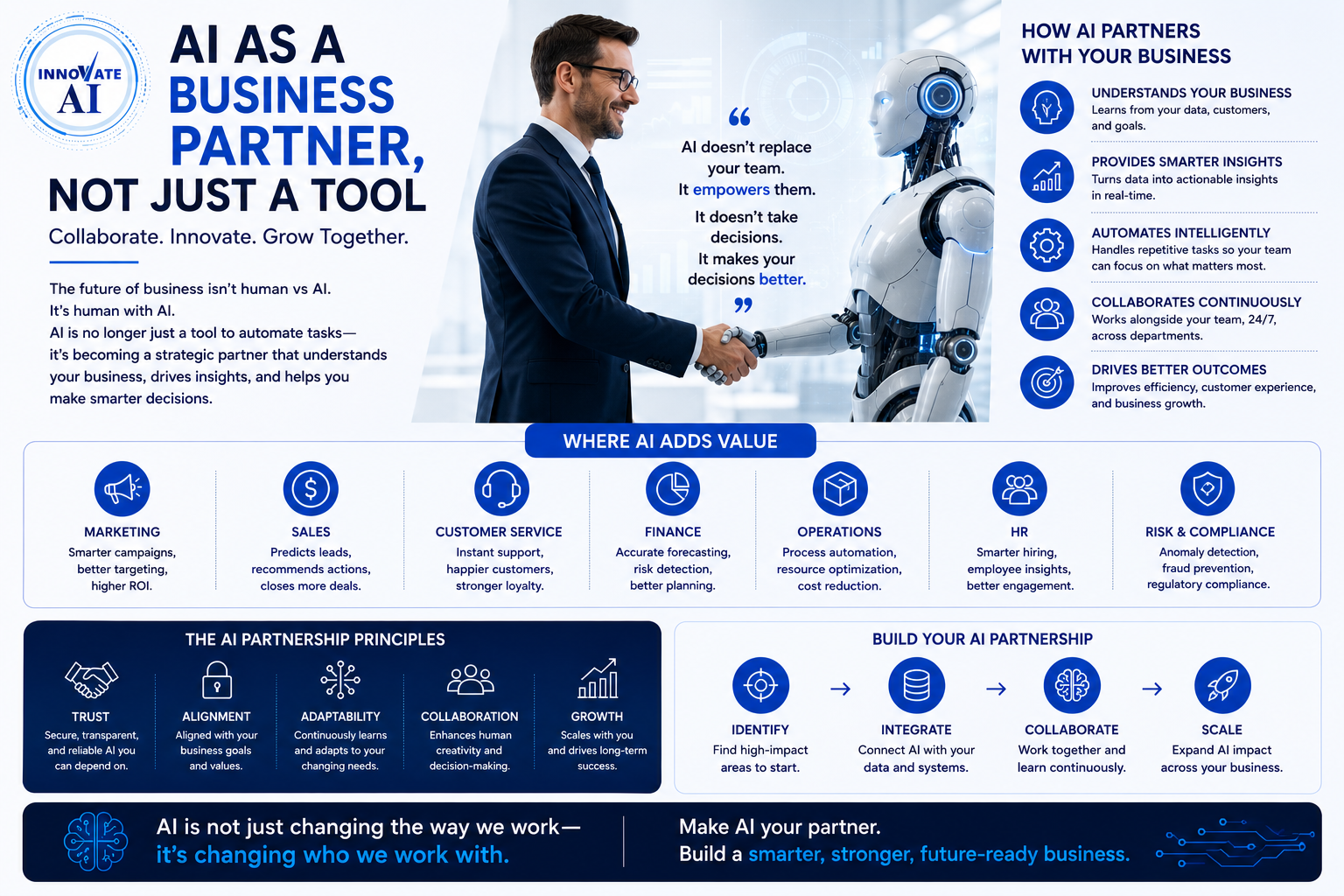
Yes. The most advanced enterprises are treating AI as a partner, not just a tool.
Here is the truth:
AI is no longer just a tool that executes instructions. It is a collaborator that reasons, plans, and adapts. The shift is from "AI as a feature" to "AI as a member of the team."
Step 3: What Is an AI Business Partner?
The Core Concept
An AI business partner is an AI system that actively collaborates with humans to achieve business outcomes. It does not just respond to prompts—it reasons about goals, plans actions, learns from outcomes, and engages in the work alongside humans.
The Key Distinction
| AI as a Tool | AI as a Partner |
|---|---|
| Follows instructions | Reasons about goals |
| Responds to prompts | Plans and executes |
| Stops when the task is done | Learns and improves |
| Human gives direction | Human and AI collaborate |
| One-way relationship | Two-way partnership |
| Ad-hoc usage | Embedded in workflows |
The Partner Mindset
When AI is treated as a partner, the relationship changes:
-
Human and AI share accountability for outcomes
-
AI explains its reasoning so humans can trust and refine
-
AI learns from feedback and improves over time
-
Humans guide the AI with strategic direction
-
Both adapt to each other over time
Step 4: The Evolution of AI's Role
The Three Waves of Enterprise AI
| Wave | Capability | Role |
|---|---|---|
| Wave 1 | Automation | AI executes predetermined tasks |
| Wave 2 | Assistance | AI suggests and recommends |
| Wave 3 | Partnership | AI collaborates, learns, and adapts |
The Shift is Structural
Today, AI is only as useful as the work we ask of it. But this is not a technology limitation—it is a mindset limitation. As one strategy director put it:
"We will start with the question 'how can AI help us reach our goals?' But soon, we will ask 'how can we and AI achieve our goals together?' We are on the threshold of a partnership—if we choose to see it that way."
The intelligence that acts is at hand. But it is not just intelligence that will work—it is partnerships. The brain is only as good as the hands that turn it into action.
Step 5: What an AI Business Partner Actually Does
Core Capabilities
| Capability | What It Means | Business Impact |
|---|---|---|
| Reasoning | Understands goals and context | Better decisions |
| Planning | Breaks goals into actions | Efficient execution |
| Action | Executes tasks autonomously | Faster delivery |
| Memory | Learns from experience | Continuous improvement |
| Collaboration | Works alongside humans | Enhanced productivity |
Examples of AI as a Partner
Sales and Customer Relationships
An AI partner doesn't just recommend next actions—it actively engages in the sales process. It researches prospects, drafts personalized communications, schedules follow-ups, and learns which approaches work best for each customer segment.
Financial Operations
An AI partner monitors cash flow, identifies optimization opportunities, and proactively suggests adjustments to improve margins. It doesn't wait to be asked—it continuously scans for opportunities and risks.
Talent and HR
An AI partner doesn't just screen resumes—it engages in the hiring process, provides interview guidance, tracks candidate sentiment, and adapts its approach based on hiring outcomes and retention data.
Product Development
An AI partner analyzes user feedback, identifies feature gaps, suggests product improvements, and collaborates with product teams to test hypotheses and validate decisions.
Strategic Planning
An AI partner models business scenarios, stress-tests assumptions, and surfaces insights that inform executive decisions. It doesn't just provide data—it actively participates in the strategic conversation.
Step 6: The Human Partner's Role
The Shift in Human Work
When AI becomes a partner, the human role shifts from execution to strategy:
| Human Role | What It Means |
|---|---|
| Intent Setter | Defines goals and desired outcomes |
| Verifier | Validates AI decisions and catches errors |
| Governor | Sets boundaries and ethical constraints |
| Learner | Adapts alongside the AI |
| Collaborator | Works with AI to achieve shared goals |
Skills for the AI Partnership Era
-
Strategic thinking: Defining goals and outcomes
-
Judgment: Knowing when to trust AI and when to intervene
-
Communication: Guiding AI effectively
-
Evaluation: Assessing AI performance and adapting
-
Ethics: Ensuring AI acts in alignment with values
Step 7: Why Partnership Matters
Reason 1: Shared Accountability
When AI is a partner, accountability is shared. The AI is not a black box—it explains its reasoning and surfaces its limitations. Humans and AI together own the outcomes.
Reason 2: Adaptive Capability
AI partners learn from experience. They adapt to changing conditions and improve over time. This is the difference between a tool that does what it's told and a partner that grows with you.
Reason 3: Trust and Transparency
When AI explains its reasoning, trust follows. Transparency is the foundation of partnership—without it, collaboration is impossible.
Reason 4: Scaled Insight
AI partners bring intelligence to every decision, at every scale. They don't replace human judgment—they augment it.
Reason 5: Collective Intelligence
The combination of human and AI intelligence is greater than either alone. This is the promise of partnership—not just efficiency, but new capabilities.
Step 8: The Road to AI Partnership
Phase 1: Tool (Current State)
AI is used as a tool—executing specific, defined tasks. Humans initiate, and AI responds.
Phase 2: Assistant (Emerging)
AI suggests and recommends. Humans approve or adapt. The relationship is still one-way.
Phase 3: Partner (Destination)
AI and humans collaborate. Both initiate, both adapt, both learn. Accountability is shared.
The Partnership Test
Ask yourself: "If this AI system stopped working today, would our operations slow down, or would we lose a genuine collaborator?"
-
If you lose a tool, you replace it.
-
If you lose a partner, you feel the absence.
Step 9: Implementation Roadmap—90 Days
Phase 1: Assess (Weeks 1-4)
| Action | Output |
|---|---|
| Identify workflows where AI currently operates as a tool | Current state map |
| Evaluate where AI could take on more responsibility | Partner opportunities |
| Assess trust and transparency gaps | Readiness assessment |
Phase 2: Design (Weeks 5-8)
| Action | Output |
|---|---|
| Redesign workflows around AI as partner | New workflow design |
| Define decision boundaries and governance | Trust framework |
| Build explainability into AI outputs | Transparency baseline |
Phase 3: Deploy (Weeks 9-12)
| Action | Output |
|---|---|
| Launch pilot partnership with one team | Working prototype |
| Measure outcomes and adaptation | Performance data |
| Iterate and expand | Scaled partnership |
Step 10: Frequently Asked Questions
Q1: What is the difference between AI as a tool and AI as a partner?
A tool executes instructions. A partner reasons, plans, learns, and collaborates. The relationship is two-way, not one-way.
Q2: Can AI truly be a partner?
Yes—when it reasons about goals, explains its decisions, learns from feedback, and adapts its behavior over time.
Q3: What is the human role when AI is a partner?
Humans define goals, govern boundaries, verify decisions, and collaborate strategically. The role shifts from execution to strategy.
Q4: What is the biggest barrier to AI partnership?
Trust. Without explainability and transparency, partnership is impossible. Organizations must invest in AI that can explain itself.
Q5: How can Innovative AI Solutions help?
We help organizations design, build, and deploy AI partners—systems that reason, plan, learn, and collaborate alongside humans. Based in Delhi, serving clients across India.
Step 11: Final Tagline
"The intelligence that acts is at hand. But it is not just intelligence that will work—it is partnerships. The brain is only as good as the hands that turn it into action. The most successful organizations will be those that treat AI not as a tool to be used, but as a partner to be worked with."
Short version:
AI as a business partner, not just a tool—from execution to collaboration in 2026.
Hashtags:
#AIBusinessPartner #AIandHumans #CollaborativeAI #EnterpriseAI #AIStrategy #InnovativeAISolutions
Primary Keyword: AI as a business partner not just a tool
Meta Description:
"AI as a business partner, not just a tool—from execution to collaboration in 2026. How to shift from 'what can AI do?' to 'how can we work together?'"
Contact Us
Phone: +91 7464 099 059 / +91 96899 67356
Email: info@innovativeais.com
Address: Netaji Subhash Place, Pitampura, Delhi – 110034
Website: https://innovativeais.com
About the Author
Abhishek Kumar
Founder & CEO, Innovative AI Solutions
5+ years building AI systems for enterprises. Based in Delhi, serving clients across India.
Related services: to apply this in your business, explore our AI development services.