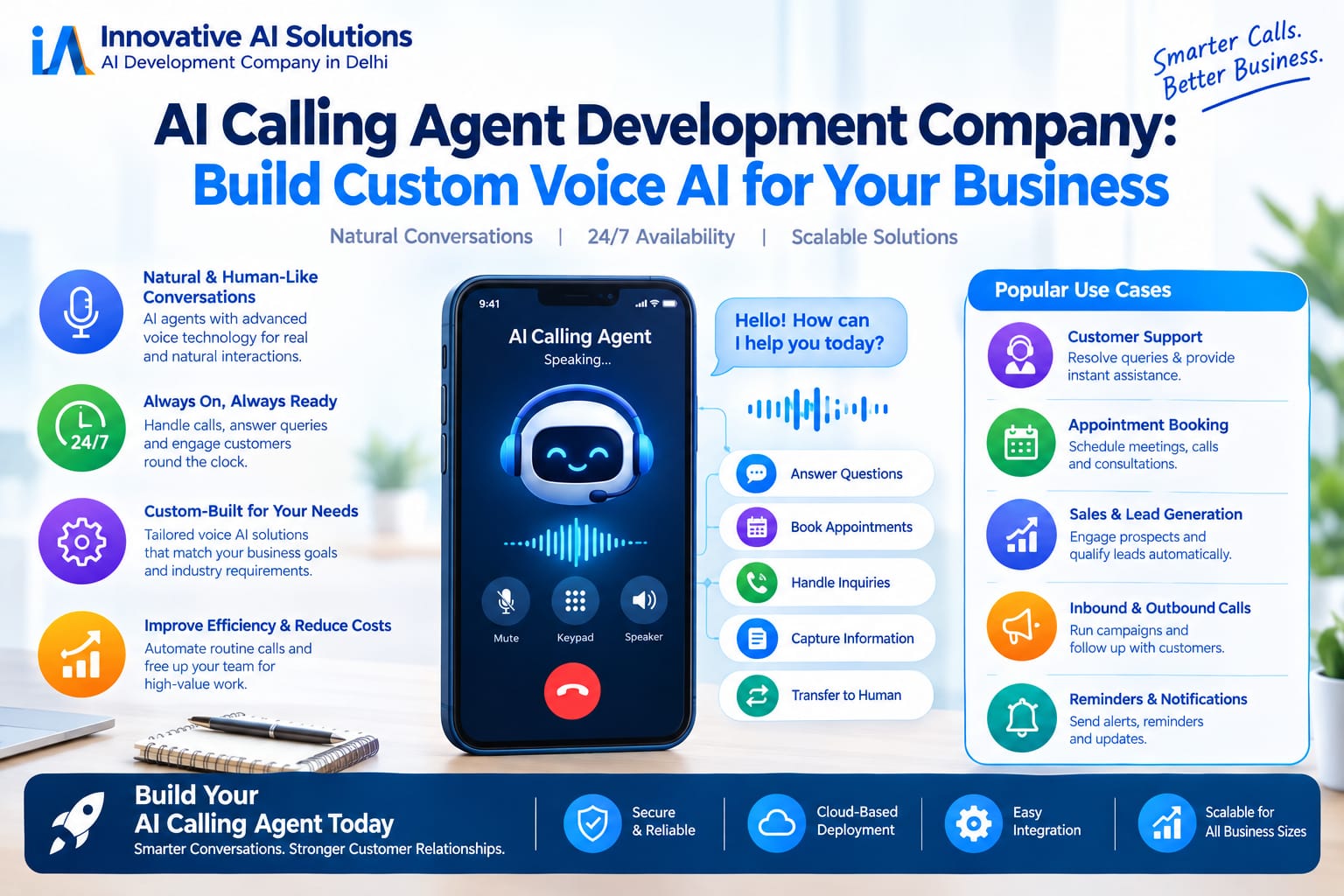
What is an AI calling agent, and why should your business care?
An AI calling agent is a voice-powered virtual agent that handles inbound and outbound calls the way a human would: greeting callers, understanding their needs, services, answering questions, scheduling appointments, and routing calls to the right person.
The difference from traditional IVR? Natural language understanding. Instead of "press 1 for sales, press 2 for support," callers simply speak. They say "I need to reschedule my appointment for next Tuesday," and the AI understands, checks availability, and confirms the new time.
The business case is compelling. Enterprises deploying voice AI report 60-70% reduction in call center costs and 90% first-call resolution rates. A single AI agent can handle thousands of concurrent calls, work 24/7, and never takes a sick day.
But here's the reality most vendors don't tell you: AI calling agents aren't replacements for human teams. They're force multipliers. They handle the repetitive, predictable calls so humans can focus on the conversations that actually require judgment.
The market is responding. India's voice AI ecosystem is growing rapidly, with companies like Sarvam AI, Gnani, and Bolna AI building production-grade voice agents specifically for Indian languages and use cases.
Cost Based on Business Type
Let's talk numbers. What does it actually cost to build and run an AI calling agent in India in 2026?
Per-Minute Pricing (Volume Spiky or Unknown)
₹7 to ₹9 per minute for AI voice agents in India. This includes telephony, speech recognition, language model, and voice synthesis.
For businesses with unpredictable call volumes, per-minute pricing aligns cost with usage. A business handling 1,000 minutes per month pays ₹7,000-9,000.
Real-World Cost Breakdown
One Indian SMB deployed an outbound voice AI agent and calculated the real cost at ₹10-20 per minute. For 40-50 calls daily at ~5 minutes each, that's ₹75,000-1,50,000 per month. At that price point, a human sales rep at ₹30,000-40,000/month is more economical.
The honest truth: AI voice agents are currently optimized for enterprise, not Indian SMBs. Until the STT + LLM + TTS stack becomes India-priced (₹2-5/min), adoption will stay experimental for smaller businesses.
Custom Development Costs
For businesses building their own AI calling agent, development costs vary by complexity:
| Tier | One-Time Build | Monthly Running | Best For |
|---|---|---|---|
| Starter Agent | ₹75,000 – ₹1,25,000 | ₹4,000 – ₹6,000 | SMBs, single workflow |
| Business Agent | ₹1,50,000 – ₹2,50,000 | ₹6,000 – ₹10,000 | Multi-channel, CRM sync |
| Enterprise Agent | ₹3,00,000 – ₹8,00,000 | ₹12,000 – ₹40,000 | Multi-agent orchestration |
| Custom / Voice | ₹8,00,000+ | Varies | Voice AI, on-prem, regulated |
SaaS vs Build Comparison
SaaS receptionists cost $50-300/seat/month** plus **$0.15-0.40 per call minute. Agent-builder platforms cost $0.05-0.20 per call minute** all-in with no seat fee. DIY stacks cost **$0.04-0.15 per minute. Above 300 minutes/month, building beats SaaS within two months.
Breakdown by Developer Type (2020-2026 Rates)
How has AI calling agent development talent costs evolved?
2020-2021: The Pre-Boom Era
Voice AI was rare. Conversational AI meant simple IVR. Custom voice agents were expensive research projects. Freelance developers charged ₹2,000-3,500 per hour.
2022-2023: The Chatbot Wave
Businesses wanted conversational AI. Demand surged. But voice AI remained niche—reserved for large enterprises with big budgets.
2024-2025: The Voice AI Awakening
Frameworks matured. Sarvam AI launched production-grade Voice Agents for Indian languages. Bolna AI pivoted to voice AI orchestration, onboarding 2,500+ paying customers. Development accelerated. Rates stabilized around ₹2,500-5,000 per hour for mid-level AI engineers.
2026: The Production Era
Today, building an AI calling agent is faster and cheaper than ever. Here's what you should expect to pay:
Freelance AI Developers: Mid-level rates run $25-50 per hour**. Senior specialists with voice AI experience command **$50-80 per hour.
Dedicated Teams (Offshore): A dedicated team through a vetted firm runs $30-55 per hour per person. You get AI engineers, backend developers, and QA working exclusively on your project.
Full-Time Salaries in India: Mid-level AI engineers earn ₹8-15 LPA. Senior voice AI architects can command ₹20-40 LPA.
Why Prices Changed in 2026
AI calling agent costs have shifted. Here's why.
Reason 1: Speech Recognition Improved
Modern STT systems handle accents, background noise, and natural speech patterns. Deepgram Nova-2 processes audio in ~200ms. This quality directly impacts understanding and it's now production-ready.
Reason 2: TTS Voices Became Natural
ElevenLabs and Cartesia produce voices nearly indistinguishable from humans. Callers don't feel like they're talking to a robot.
Reason 3: Orchestration Frameworks Matured
Frameworks like Pipecat and LiveKit Agents simplify development. Bolna AI offers model-agnostic orchestration every STT, LLM, TTS, and telephony stack available on one platform.
Reason 4: The Market Matured
In 2024, every vendor claimed to do "AI voice." In 2026, buyers ask for production references. They want call recordings. They want metrics. Competition has forced honesty.
Reason 5: Sarvam AI Opened the Stack
Sarvam AI, India's sovereign AI lab, launched Voice Agents to everyone previously enterprise-only. The platform handles messy telephony lines, code-mixed speech, services and mid-sentence language switching. From blank agent to live phone call, everything is in one workspace.
Reason 6: The India Advantage
India-focused providers process millions of calls daily in Hindi, Tamil, Telugu, and code-mixed languages. Gnani.ai specializes in Indic speech recognition, processing millions of calls across banking, NBFCs, and retail.
Pro Tips for Building AI Calling Agents
After building these systems, here's what actually works.
Tip 1: Start with a Narrow Scope
Don't build an agent that does everything. Build one that handles a single use case well: appointment booking, order status, or lead qualification. Add capabilities later based on user feedback.
Tip 2: Choose the Right Stack
For Indian businesses, consider:
-
STT: Deepgram Nova-2 or Sarvam's Indic models
-
LLM: Claude Haiku for simple flows (lowest latency), Sonnet for complex reasoning
-
TTS: ElevenLabs for premium, Cartesia for speed
-
Orchestration: Pipecat (open source), Bolna AI (managed), or Sarvam Voice Agents
Tip 3: Target Under 800ms Latency
End-to-end latency budget: Telephony (~50ms) + STT (~200ms) + LLM (~200ms) + TTS (~100ms) + Server (~50ms) = ~600ms. This feels conversational. Anything above 1 second feels robotic.
Tip 4: Build for Mid-Call Language Switching
In India, conversations move between English, Hinglish, and regional languages often mid-sentence. An AI built in one language with a translation layer breaks. Build for native switching.
Tip 5: Implement Human-in-the-Loop from Day One
AI makes mistakes. Build fallback mechanisms. If the agent can't handle a request, route it to a human. This reduces risk and builds user trust.
Tip 6: Own Your Data and Integration Logic
Platform-native agents are convenient but can lock you in. Build your integration layer so you can switch platforms without rebuilding everything.
Tip 7: Plan for Maintenance
AI systems need tuning. Call patterns change. Business rules evolve. Budget 15-20% of development cost annually for maintenance.
Questions to Ask Before Hiring
Before you hire an AI calling agent development partner, ask these questions.
1. "Can you show me a live AI calling agent handling real calls?"
Not a demo. Not a prototype. A live system processing actual calls. If they can't show you, walk away.
2. "How do you handle Indic languages and code-mixed speech?"
The answer should include native support for Hindi, regional languages, and mid-call switching—not translation layers.
3. "What's your latency?"
Target is under 800ms end-to-end. Anything above 1 second feels robotic. Ask for measured latency, not theoretical.
4. "How do you handle escalation to a human?"
The answer should include defined triggers, warm handoff, and context transfer. "It just transfers" isn't enough.
5. "Who owns the code and conversation data?"
You do. Full transfer. No exceptions.
6. "What's your pricing model?"
Per-minute (₹7-9/min), per-resolved-call, or flat monthly. Understand what's included and what's extra.
7. "How do you prevent the AI from hallucinating?"
Look for RAG-based knowledge retrieval, confidence thresholds, and fallback responses.
8. "Can I start with a pilot and scale later?"
You should be able to. Start with one use case. Prove value. Then expand.
9. "What integrations do you support?"
Calendar (Google, Outlook), CRM (Salesforce, HubSpot, Zoho), WhatsApp, and custom APIs.
10. "What's your track record on missed calls and customer satisfaction?"
Look for measurable outcomes: call capture rate, CSAT improvement, wait time reduction.
Why Delhi is a Great Hub for AI Development
I run an AI company in Delhi. I'm biased. But there are real reasons why Delhi NCR is a powerhouse for AI calling agent development.
Talent Density
Delhi-NCR is second only to Bengaluru in tech talent concentration. IIT Delhi, DTU, and NSIT produce thousands of graduates annually. Many specialize in AI, speech, and telephony.
Voice AI Ecosystem
Delhi is home to multiple voice AI startups: LiaPlus AI (built for B2B enterprises, 18+ languages), TalkerIQ (AI-powered virtual agents for inbound/outbound calls), Leadicious AI (automated voice and chat agents), and Uservox (voice-based AI agents for customer support).
Multilingual Talent
Delhi's workforce includes native speakers of Hindi, English, Punjabi, and other languages. Building multilingual agents is easier when your team speaks the languages.
Enterprise Client Base
Delhi is India's administrative and corporate capital. Government agencies, PSUs, and large enterprises are here. For voice AI serving regulated industries, proximity matters.
Cost Advantage
Delhi offers a 20-30% cost advantage over Bengaluru and Mumbai. Office rents are lower. Salaries are competitive.
What We Offer
At Innovative AI Solutions, we've spent five years building AI systems that actually work. Not hype. Not buzzwords. Results.
AI Calling Agent Development
We build voice powered agents that handle inbound and outbound calls appointment booking, lead qualification, customer support, and order status. Integrated with your calendar, CRM, and payment systems.
Multi-Language Support
English, Hindi, Hinglish, and regional Indian languages with mid-call switching.
CRM and Calendar Integration
Google Calendar, Outlook, Salesforce, HubSpot, Zoho, and custom APIs.
Human Handoff Logic
Defined escalation triggers. Warm transfers. Context preservation.
Ongoing Support
Agents need tuning. We offer flexible support packages to keep your systems performing.
What Sets Us Apart
We focus on Small AI. Practical solutions. Right-sized for your actual problem. Affordable pricing. Fast delivery. And a team that actually cares about your success.
Frequently Asked Questions
Q1: What is an AI calling agent?
An AI calling agent is a voice-powered virtual agent that handles inbound and outbound calls greeting callers, answering questions, scheduling appointments, and routing to the right person using natural language understanding instead of rigid menus.
Q2: How much does an AI calling agent cost in India?
Per-minute pricing: ₹7-9 per minute. Custom development: Starter ₹75,000-1,25,000 build + ₹4,000-6,000/month. Business: ₹1,50,000-2,50,000 + ₹6,000-10,000/month. Enterprise: ₹3,00,000-8,00,000 + ₹12,000-40,000/month.
Q3: How does AI calling agent cost compare to hiring a human?
A human sales rep costs ₹30,000-40,000/month in India. At ₹10-20 per minute, an AI agent handling 200-250 minutes daily costs ₹75,000-1,50,000/month more than a human for SMB volumes. For enterprises with higher volumes or 24/7 needs, the math changes.
Q4: Can the AI handle Hindi and regional languages?
Yes. Sarvam AI provides production-grade Voice Agents trained on Indic languages and code-switching telephony audio. Gnani.ai specializes in Indic speech recognition for banking and retail.
Q5: What's the typical latency for AI calling agents?
Target is under 800ms end-to-end. Deepgram Nova-2 STT processes in ~200ms. Claude Haiku LLM adds ~150ms. Cartesia TTS adds ~100ms. Telephony adds ~50ms. Total: ~600ms.
Q6: How long does it take to build an AI calling agent?
Proof of concept: 1-2 days. Single use case production agent: 1-2 weeks. Full multi-use-case platform: 4-8 weeks.
Q7: What are common use cases for AI calling agents?
Appointment booking and reminders, lead qualification, order status inquiries, customer support, payment reminders, and virtual receptionist duties.
Q8: Do I need to build from scratch or can I use a platform?
No-code options: Vapi, Bland AI, Synthflow. Managed platforms: Bolna AI, Sarvam Voice Agents. DIY: Pipecat + Deepgram + Claude + ElevenLabs + Twilio.
Q9: What happens when the AI can't handle a call?
Good systems have escalation triggers. Complex, emotional, or multi-stakeholder conversations get routed to humans with full context.
Q10: What's the ROI of an AI calling agent?
Enterprises report 60-70% reduction in call center costs and 90% first-call resolution rates. For SMBs, ROI depends on call volume and whether the alternative is hiring additional staff.
Frequently Asked Questions (Continued)
Q11: Can the AI book appointments directly on my calendar?
Yes. Integration with Google Calendar, Outlook, Calendly, and CRM systems enables real time availability checking and booking.
Q12: Can the AI send summaries after each call?
Yes. WhatsApp or email summaries with caller details, intent, and action taken are standard in production deployments.
Q13: Is my data safe with AI calling agents?
Reputable vendors use encryption, secure APIs, and comply with data protection regulations. For healthcare, HIPAA compliance is essential. For Indian businesses, DPDP Act compliance.
Q14: What happens after the project is delivered?
We provide ongoing support and tuning. Call patterns change. Business rules evolve. We adjust.
Q15: Why should I choose Innovative AI Solutions?
Because we build voice AI systems that actually work for Indian businesses. Because we focus on practical solutions, not hype. Because we've delivered 100+ projects. Because your code is always yours.
Contact Us
Phone:
+91 7464 099 059
+91 9689967356
Email:
info@innovativeais.com
Address:
9th Floor, Pearls Best Heights-I,
Head Office: 904, Netaji Subhash Place,
Delhi – 110034