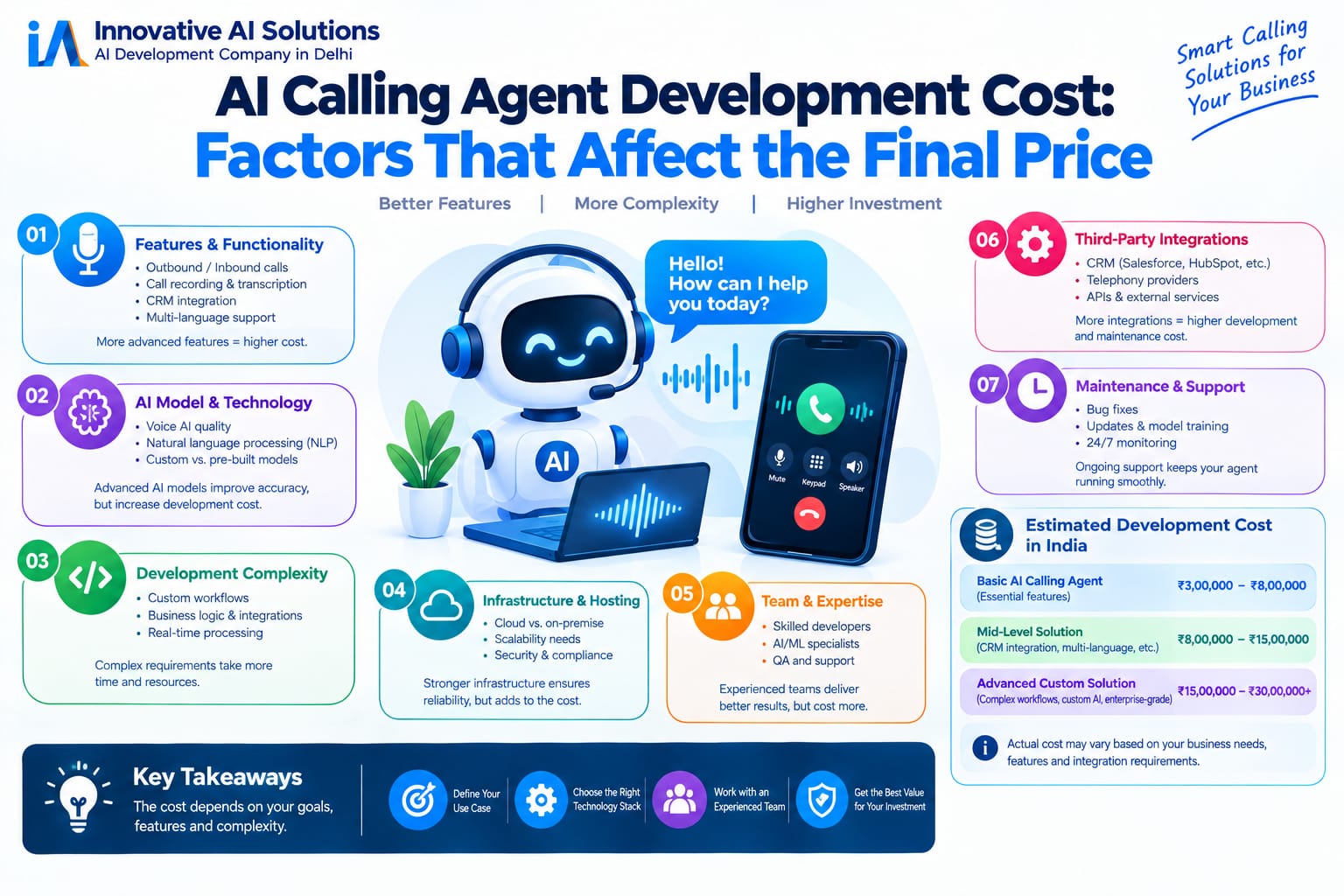
Why does an AI calling agent cost ₹2 per minute for one business and ₹20 per minute for another?
The answer is simple: it's not the same thing.
A basic order-status bot that handles 2,000 calls a month in English is fundamentally different from an enterprise-grade agent that handles 200,000 minutes across Hindi, Tamil, and Hinglish, integrates with a core banking system, and maintains DPDP compliance logs.
Both are "AI calling agents." But they share almost nothing in terms of architecture, infrastructure, or operational overhead.
Published per-minute rates in India range from ₹2 to ₹12 all-in, with ₹3 to ₹6 being the most common mid-market band . But the effective cost in production is often 2 to 4 times the headline rate once telephony,services, connect-rate losses, and compliance work are factored in .
This guide walks through every factor that moves the price so you can separate what you actually need from what vendors are trying to sell.
Factor 1: Per-Minute Rate vs. Effective Cost
The headline rate is not what you'll pay.
Vendors advertise per-minute pricing that looks simple. But the effective cost includes components that don't appear in the marketing materials.
What's included in the headline rate:
-
Speech-to-text (STT)
-
Large language model (LLM) inference
-
Text-to-speech (TTS)
-
Platform access
What's often charged separately:
-
Telephony (₹1-5 per minute)
-
LLM token costs (₹2-8 per minute depending on model)
-
STT charges (₹1-3 per minute)
-
TTS charges (₹2-6 per minute)
A ₹3 per minute quote can easily become ₹6 to ₹9 per minute in production .
Connect-rate losses are another hidden cost. In outbound campaigns, 30% to 50% of dials may not connect but you're still billed for ring time . A policy that requires three attempts to reach a borrower triples the dialing cost for that account.
Factor 2: Call Volume and Scale
The math changes dramatically with volume.
Low Volume (Under 10,000 minutes/month)
At this scale, SaaS platforms win. Agent-builder platforms charge $0.05-0.20 per call minute all-in** . DIY stacks cost **$0.04-0.15 per minute .
For an SMB handling 200-250 minutes daily (roughly 40-50 calls at 5 minutes each), the real cost lands at ₹75,000-1,50,000 per month . That's ₹10-20 per minute higher than enterprise rates because infrastructure costs are distributed across fewer minutes.
Mid Volume (10,000-100,000 minutes/month)
Cost curves hit their first inflection point around 10,000 minutes per month. Above this threshold, building on APIs beats SaaS on total cost .
A D2C brand handling 60,000 minutes/month (30,000 calls at 2 minutes each) could pay ₹3,70,000/month on an India-first platform like Edesy, versus ₹15,10,000/month on a stacked Vapi deployment .
High Volume (100,000+ minutes/month)
Enterprise rates start at ₹1.75 per minute . At scale, companies building in-house achieve gross margins exceeding 80% .
A healthy benchmark for profitability is 60,000-90,000 connected call minutes per single use case .
Factor 3: Language and Code-Mixing
India's linguistic reality adds cost.
English-only: Baseline pricing.
Hindi and regional languages: Multilingual adds 15-25% to running costs due to longer token counts . Hindi written in Devanagari takes more tokens than English, increasing LLM costs.
Code-mixed speech (Hinglish): This is where Indian deployments get complicated. Callers open in English, slip into Hindi for difficult parts, and say numbers in whichever language they count in . An agent that locks to a single language loses them in the first 30 seconds.
Building for mid-call language switching requires:
-
STT models trained on code-mixed speech
-
LLM prompts that handle language shifts
-
TTS that can switch voices mid-conversation
Indian providers like Sarvam AI and Gnani specialize in Indic speech recognition, but they charge accordingly.
Factor 4: Build vs. Buy Architecture
The single biggest cost decision.
Pure Buy (SaaS Platform)
Time to first live flow: 6-10 weeks. Year-1 cost (mid volume): ₹70 Lakh to ₹1.4 Crore .
You pay a premium for not owning the stack. The platform handles DLT compliance, DPDP consent, STT drift, and on-call rotation. This is the right choice for organizations below 500 headcount with narrow use cases and volumes under 200,000 calls per month .
Pure Build (Custom Development)
Time to first live flow: 6-10 months. Year-1 cost (mid volume): ₹3.5 to ₹5.5 Crore .
Direct-build estimates often land in six-figure labor ranges: $540K in engineering, $24K in infrastructure, $30K-$120K in ASR and TTS API passthrough, and $20K-$80K in compliance audits, landing around $650K-$850K in Year 1 .
A fully custom build breaks even only past 500,000 monthly minutes a threshold that usually makes sense only when voice is a core product differentiator .
Hybrid (Recommended for Most)
Time to first live flow: 8-12 weeks. Year-1 cost (mid volume): ₹1.0 to ₹1.8 Crore .
License the platform for telephony, DLT, STT/TTS, dialog orchestration, and consent ledger roughly 70-80% of the stack. Own the prompts, conversation policy, and per-campaign tuning your IP. Own the data layer in your own warehouse. Build the 2-3 flows that touch your proprietary edge as plugins .
This shape gives you platform leverage on what doesn't differentiate you, and ownership of what does.
Factor 5: Integrations and Operations Surface
The core voice pipeline isn't what costs money. The operational skin is.
Telephony-only prototype: 2-4 weeks. Twilio + LiveKit + OpenAI Realtime API integration. No dashboard, no CRM, no call history .
Operational dashboard: 8-12 weeks. Live call monitor, transcription viewer, single-tenant agent config, stripped-down CRM sync .
Full back-office platform: 20+ weeks. Multi-user auth, rich transcripts, agent design tools, full CRM integration, campaign analytics, services, role-based settings .
Every integration adds cost:
-
CRM sync (Salesforce, HubSpot, Zoho): ₹15,000-40,000
-
Calendar integration: ₹15,000-40,000
-
Payment gateway: ₹15,000-40,000
-
Custom API: varies
Runtime costs dwarf one-time build costs the moment you go live with real call volume .
Factor 6: Compliance and Regulatory Requirements
For BFSI and regulated industries, compliance can matter more than the per-minute rate .
1600-series numbering: TRAI required BFSI entities to move service calls to the 1600 series. A platform that cannot originate from 1600-series numbers adds migration cost .
Consent and audit infrastructure: DPDP Act consent logs, call recordings, transcripts, and disclosure evidence must be stored and retrievable for RBI or IRDAI inspection .
Approved-content governance: Every disclosure about EMIs, penal charges, or foreclosure must come from versioned, approved content requiring legal review time .
DLT registration: TRAI's DLT adoption under TCCCPR requires registration that adds time that is hard to predict. Teams that underestimate this phase miss launch dates .
For a pure-buy path, the vendor handles these. For build, your engineer owns them roughly 15-25% of one engineer's time, all year .
Factor 7: Outcome-Based vs. Per-Minute Pricing
A new model is emerging that changes the cost equation.
SquadStack.ai introduced outcome-based pricing in September 2026. Instead of paying per minute, customers pay based on revenue generated loans disbursed, cards issued, sales closed .
How it works: Fixed base fee for running the AI agent, plus a success fee linked to business outcomes. The split is negotiated per customer and use case .
The vendor's argument: "Two rupees a minute is a trap. Per-minute pricing turns voice AI into a BPO with better margins and pays vendors not to care whether the call is converted" .
The results: DMI Finance disbursed ₹700 crore through the platform, with disbursals 30% higher than human agents. BankBazaar engaged 8 crore leads while halving customer acquisition cost .
This model only works for high-value sales where conversion matters more than call volume. For support or reminders, per-minute still makes sense.
What This Means for Your Business
The cost formula: Monthly call volume × average call duration × per-minute rate = AI cost. If AI cost < 50% of human cost, build it .
Where ROI works:
-
Order status calls: 200 calls/day × 2 min × ₹3 = ₹36,000/month vs ₹90,000/month human cost. Savings: ₹54,000/month
-
COD confirmation: 500 calls/day × 1 min × ₹3 = ₹45,000/month with ₹1.5L RTO savings = 3.3x ROI
Where ROI fails:
-
Custom consultations: 10 calls/day × 15 min × ₹3 = ₹13,500/month. But human close rate (40%) beats AI close rate (8%). Revenue loss exceeds savings
The biggest mistake: "Automating what's cool instead of what's expensive" .
Frequently Asked Questions
Q1: What is the average cost of an AI calling agent in India?
Published rates range from ₹2 to ₹12 per minute all-in, with ₹3 to ₹6 the most common mid-market band. Effective cost in production is often 2 to 4 times the headline rate once telephony, connect-rate losses, and compliance are added .
Q2: What factors affect AI calling agent development cost?
Call volume and scale (higher volume = lower rate), language complexity (multilingual adds 15-25%), build vs. buy architecture, integrations and operations surface, compliance requirements, and pricing model (per-minute vs. outcome-based).
Q3: Why is my per-minute rate higher than quoted?
Connect-rate losses (30-50% of outbound dials may not connect but are still billed), telephony markups, LLM token costs charged separately, and retries/callbacks all add to the effective rate .
Q4: How much does a custom AI calling agent cost to build?
Telephony-only prototype: 2-4 weeks. Operational dashboard: 8-12 weeks. Full back-office platform: 20+ weeks . Year-1 costs for a mid-volume custom build range from ₹3.5 to ₹5.5 Crore .
Q5: When does building beat buying?
Above 10,000 minutes/month, building on APIs beats SaaS on total cost . A fully custom build breaks even past 500,000 monthly minutes . For most businesses, a hybrid approach is recommended.
Q6: What's the cheapest way to get an AI calling agent?
SaaS platforms with pay-as-you-go credits. Agent-builder platforms charge $0.05-0.20 per call minute all-in with no seat fee . India-first platforms like Edesy bundle everything for ₹6/minute .
Q7: How do I calculate ROI for an AI calling agent?
Monthly call volume × average call duration × per-minute rate = AI cost. If AI cost < 50% of human cost, build it. For order status calls: 200 calls/day × 2 min × ₹3 = ₹36,000/month vs ₹90,000/month human cost .
Q8: What hidden costs should I watch for?
Connect-rate losses, telephony markups, LLM token charges, prompt drift maintenance, and integration retainers. Advertised platform rates represent only about 20% of true TCO .
Q9: What is outcome-based pricing for AI calling agents?
Instead of paying per minute, you pay based on revenue generated loans disbursed, cards issued, sales closed. SquadStack offers this model for BFSI sales. DMI Finance saw 30% higher disbursals than human agents .
Q10: How does call volume affect pricing?
At low volume (under 10,000 minutes/month), SaaS platforms win. Above 10,000 minutes, building on APIs wins. Enterprise rates start at ₹1.75 per minute . Scale is king the math only works at high volumes.
Frequently Asked Questions (Continued)
Q11: What's the biggest mistake in AI calling agent budgeting?
Underestimating LLM token costs and overestimating call complexity handling. Start with simple, high-volume use cases where ROI is clear. "Automating what's cool instead of what's expensive" is the biggest mistake .
Q12: How does language affect cost?
Multilingual adds 15-25% to running costs due to longer token counts. Hindi and regional languages cost more than English. Code-mixed speech (Hinglish) requires specialized STT models .
Q13: What compliance costs should I expect?
1600-series numbering, consent and audit infrastructure (DPDP logs, recordings, transcripts), approved-content governance, and DLT registration. For build paths, compliance owns 15-25% of one engineer's time annually .
Q14: Can I start with a pilot and scale later?
Yes. Most platforms offer pay-as-you-go credits. Test one use case, measure results, then scale. A proof of concept takes 1-2 days; a production agent for one use case takes 1-2 weeks .
Q15: Why should I choose Innovative AI Solutions?
Because we understand the real unit economics for Indian businesses. Because we help you separate what you actually need from what vendors want to sell. Because we've delivered 100+ projects. Because your code is always yours.
Contact Us
Phone:
+91 7464 099 059
+91 9689967356
Email:
info@innovativeais.com
Address:
9th Floor, Pearls Best Heights-I,
Head Office: 904, Netaji Subhash Place,
Delhi – 110034