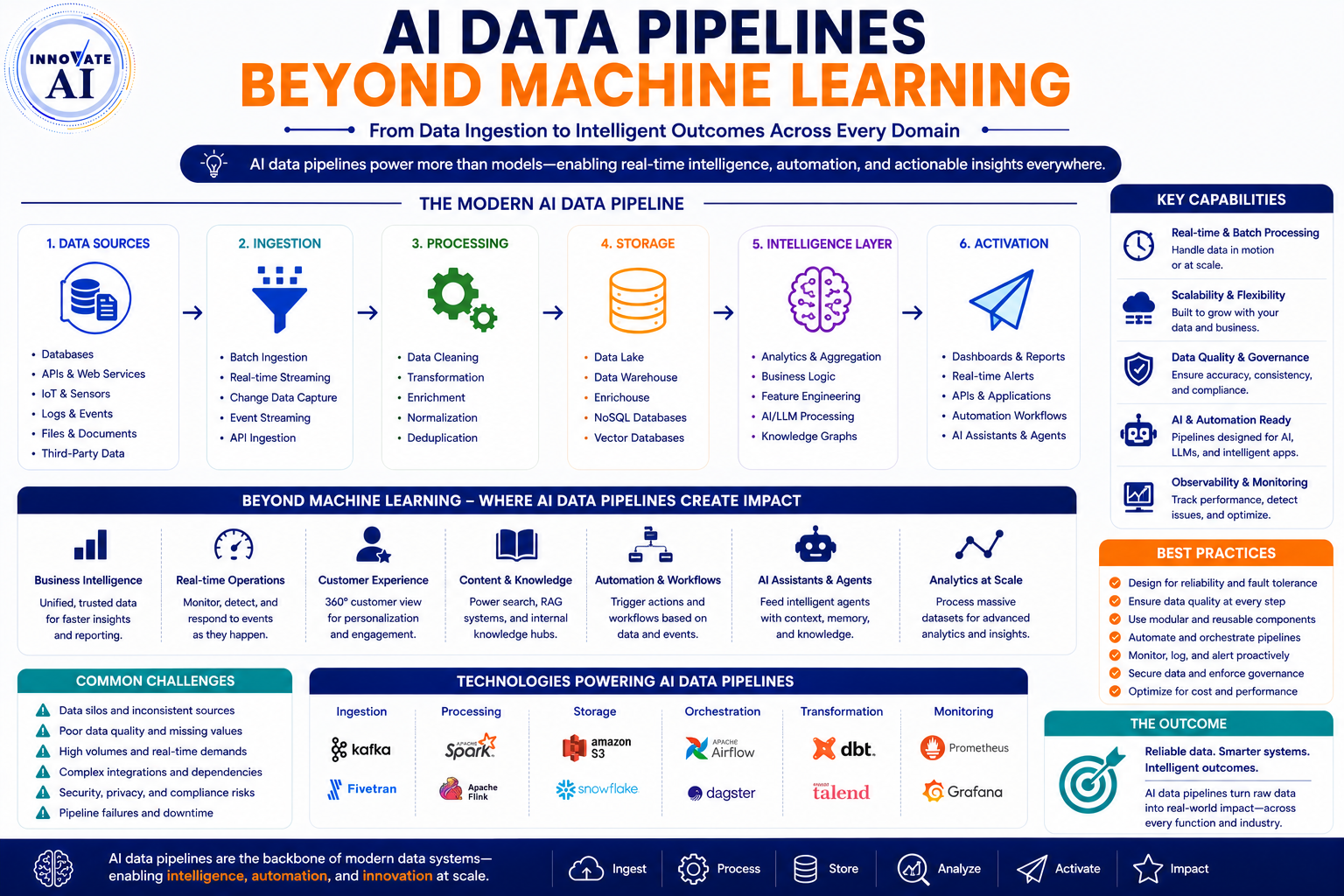
The Big Question
What happens when the infrastructure that moves your data becomes intelligent enough to build, optimize, and repair itself? What if your data engineers could spend their days on strategy instead of debugging brittle transformation scripts? And what if business users could create complex data pipelines simply by describing what they need in plain English?
The answers to these questions are reshaping the data engineering landscape. And they have very little to do with machine learning.
The Traditional Pipeline Problem: 80% of Time Wasted
Despite AI's transformative potential, data scientists and engineers still spend between 50% to 80% of their time cleaning and preparing data rather than building models or generating insights. This isn't a talent problem—it's an infrastructure problem.
Traditional ETL pipelines suffer from several structural failures:
Brittleness: Pipelines break when schemas change, requiring manual fixes. Opacity: Transformation logic is scattered across scripts, making troubleshooting difficult. Technical debt: Business logic hardcoded in transformations creates semantic drift across teams. Manual dependency: Every change requires specialized engineering intervention.
These challenges stem from architectural design choices, not limitations of underlying technologies. As one research paper notes, semantic ownership is unclear, accountability is diffuse, and governance becomes a set of external processes rather than an intrinsic property of the platform.
What Makes a Pipeline "AI-Native"?
AI-native data pipelines are fundamentally different from traditional ETL. Instead of static, manually-maintained code, they operate through:
Prompt-to-Pipeline Generation: Business users can describe what they want in plain English, and the AI creates the integration pipeline. A demand planner can say: "Extract product inventory from Oracle, combine it with daily sales from Shopify, calculate stock turnover per SKU, and load it into Snowflake for reporting." AI generates the pipeline on demand from the prompt.
Dynamic Adaptation: AI-native pipelines understand the context of the data, learn from existing integration patterns, and generate optimized workflows on the fly. They automatically adjust to schema changes or new data sources—no manual intervention required.
Continuous Learning: Unlike traditional pipelines that remain static until manually updated, autonomous data orchestration introduces continuous learning, enabling the pipeline to evolve further and adapt to changing business requirements and data ecosystems.
The Core Capabilities of AI-Powered Data Pipelines
Autonomous Pipeline Generation: AI models can analyze data structure and content, identify relevant processing steps, generate code, and explain decisions in a manner that aligns with the business context. This shifts data engineers from code writers to orchestrators and quality managers rather than scripters.
Real-world implementation: Capgemini, Google Cloud (BigQuery Dataform, Vertex AI), AWS (Glue Studio, Bedrock), Microsoft Azure (Data Factory, Synapse Copilot), Databricks (Lakeflow, Agent Bricks), and Snowflake (Cortex) are all embedding AI directly into pipeline creation and monitoring.
Conversational ETL with MCP: The Model Context Protocol (MCP) enables conversational interactions with AWS services to build end-to-end ETL pipelines much more quickly, increasing productivity while maintaining security standards and best practices.
AWS implementation: Using Amazon Q Developer with Redshift, S3, and Data Processing MCP servers, data engineers can list and analyze storage resources via natural language, explore database schemas and table structures, generate and execute optimized SQL queries, facilitate seamless data export between systems, and create reusable parameterized scripts for production use.
AI Functions for Data Transformation: Databricks Lakeflow introduces built-in AI functions that integrate directly into ETL workflows. These include ai_extract (extract specific entities from input text), ai_classify (classify input text according to provided labels), ai_translate (translate text to a target language), ai_parse_document (parse text, extract tables, reason over figures, turn images into descriptions), and ai_query (run AI-driven transformations across large datasets using any LLM).
These functions handle tasks that previously required custom ML models, brittle NLP, or manual parsing—all without leaving the data pipeline.
Agent-Scale Data Ingestion: Modern platforms are designed for AI agents as primary data consumers. Ocient's platform provides enterprise-scale data, instantly available to agents without staging and lag. This addresses a critical gap: agent workloads can create databases at 1,000× the rate of human engineers, requiring infrastructure designed for machine-scale concurrency.
Beyond ML: AI Pipelines for Operational Use Cases
Automating Transaction Categorization: Kard, a New York-based fintech company, uses Databricks Agent Bricks AI functions to power a scalable, accurate transaction categorization system that replaces manual and inconsistent legacy methods. This enables them to efficiently process billions of transactions, deliver personalized rewards, and provide richer insights.
Turning Raw Transcripts into Business Insights: Sales teams can use AI functions to automatically analyze sentiment across call transcripts, extract key information (customer name, company, job title), classify call types (urgency, topic), generate 120-word summaries of each call, and draft personalized follow-up notes.
Claims Processing Automation: Insurance providers can use ai_parse_document to automatically extract, normalize, and consolidate data from incoming emails as part of their ETL pipelines, enabling reliable, end-to-end automation that reduces manual review, accelerates decisions, and integrates seamlessly into existing data workflows.
Governance by ConstructionOne of the most significant advances in AI-driven pipelines is governance by construction—quality, lineage, and access controls enforced through domain interfaces and contracts, reducing reliance on after-the-fact controls.
The Domain-Driven Model: A research paper introduces a domain-driven architecture where data products, pipelines, features, and models are treated as first-class domain artifacts.
The key abstraction is the domain data product, defined by a semantic definition agreed upon by the domain, a clearly identified owning team, a published interface (schema, API, or event stream), declared quality, freshness, and completeness guarantees, and explicit usage contracts.
Domain pipelines are internal implementation details—downstream consumers interact only with the published interface, allowing domains to refactor without causing ripple effects. This reduces MTTD (Mean Time to Detect) and repair in large environments.
Unified Governance for AI Pipelines: Platforms like VAST Data and Ocient embed governance at the infrastructure layer. VAST ensures every stage of the workflow—from raw data to vector—is secured with identity-based access control, enabling organizations to build AI applications that are not only fast and intelligent, but also fully compliant and secure.
The Cost and Productivity Impact
Speed and Efficiency: Generative AI for ETL delivers significant benefits. Speed: AI generates and updates ETL logic in minutes, not days. Consistency: AI-driven pipelines are less prone to human error. Adaptability: They automatically adjust to schema changes. Time-to-value: Data products go live faster.
Performance Metrics: Databricks Lakeflow with Fusion engine (written in Rust) delivers up to 30× faster parsing, 2× quicker compilation, 29% average compute cost reduction through selective execution, and up to 60-70% cost reduction in internal testing.
Democratized Access: By applying natural language understanding, organizations can describe what they want in plain English, and the AI creates the integration pipeline. This approach democratizes data integration. Non-technical users can launch and manage complex workflows with simple input requests.
Implementation Roadmap
Phase 1: Foundation (Weeks 1-4)
Audit your current pipeline estate: Measure time spent on maintenance vs. new development. Identify high-friction use cases: Where are the most brittle, manual, or error-prone pipelines? Assess AI readiness: Do you have a semantic layer? Is data lineage documented? Select starting point: Choose one pipeline for an AI-native pilot (non-critical, high-value).
Phase 2: Pilot AI Capabilities (Weeks 5-8)
Deploy AI functions for one transformation task (ai_classify, ai_extract, ai_parse_document). Enable conversational pipeline generation using MCP or platform-specific AI capabilities. Establish governance by construction: Define domain data products and interfaces. Measure impact: Track time saved, error reduction, and adoption.
Phase 3: Scale Across Organization (Weeks 9-12+)
Expand to additional domains and teams. Implement autonomous orchestration with continuous learning. Train data engineers as orchestrators and quality managers. Continuous optimization: Refine prompts, governance, and monitoring.
Frequently Asked Questions
Q1: What's the difference between a traditional pipeline and an AI-native pipeline?
Traditional pipelines are static, manually-maintained code. AI-native pipelines generate transformation logic from natural language, adapt to schema changes automatically, and incorporate continuous learning.
Q2: How much time do data engineers spend on pipeline maintenance?
Data scientists and engineers spend 50% to 80% of their time cleaning and preparing data rather than building models or generating insights.
Q3: What is governance by construction?
Quality, lineage, and access controls enforced through domain interfaces and contracts, reducing reliance on after-the-fact controls. Domain data products have explicit owners and published contracts.
Q4: What are AI functions in data pipelines?
Pre-built capabilities like ai_extract, ai_classify, ai_parse_document, and ai_query that integrate directly into ETL workflows—handling tasks that previously required custom ML models or manual parsing.
Q5: What results can organizations expect from AI-powered pipelines?
Speed improvements: ETL logic generated in minutes instead of days. Cost reductions: up to 60-70% compute cost reduction. Productivity: data engineers shift from debugging to strategy.
Q6: How can Innovative AI Solutions help?
We help organizations design and operationalize AI-native data pipelines—from platform selection and governance frameworks to implementation and change management. Based in Delhi, serving clients across India.
Why Delhi is a Great Hub for AI Development
Delhi is emerging as a significant hub for AI development, backed by concrete government support and infrastructure. The recent Delhi Budget 2026-27 allocated ₹8.20 crore for two Artificial Intelligence centres of excellence (AI-CoEs), functioning as hubs for research, innovation, and startup incubation.
The city's AI infrastructure is expanding rapidly. Under the IndiaAI Mission, more than 10,000 GPUs have been onboarded and are available at subsidized rates—reportedly less than $1 per hour, among the lowest globally. The government has also announced a ₹350 crore startup policy over five years, aiming to support the emergence of at least 5,000 startups by 2035, with key focus areas including AI and machine learning.
The AI ecosystem in Delhi combines: cost-effective infrastructure, government support, a growing talent pool, and proximity to the country's business decision-makers.
What We Offer at Innovative AI Solutions
AI-Native Pipeline Strategy: We help you assess your pipeline estate and design an AI-powered roadmap. Platform Selection: We help you choose between Databricks Lakeflow, AWS, Snowflake, or open-source solutions. Governance Design: We help you implement domain-driven architecture and governance by construction. AI Function Implementation: We help you deploy ai_extract, ai_classify, ai_parse_document, and ai_query capabilities. MCP Integration: We help you enable conversational ETL with Model Context Protocol. Change Management: We help your organization shift from code-writers to orchestrators.
Final Thought
Data engineers building pipelines are often a bottleneck in organizations. According to data from Amazon, 76% of data engineers are blocked building new ETL pipelines today. But AI is shifting this dynamic. The shift is clear: from writing and maintaining endless scripts to orchestrating intelligent, self-adapting pipelines.
Generative AI is changing the game. The concept of "ETL pipelines" will be replaced by intelligent agents that continuously ingest, transform, and validate data in real time, guided by policies and context, not hardcoded rules.
The script is changing. The prompt is the new interface. And the future of data integration might just be zero-code, zero-friction, and all impact.
Contact Us:
Phone: +91 7464 099 059 / +91 9689967356
Email: info@innovativeais.com
Address: Netaji Subhash Place, Pitampura, Delhi – 110034
Website: https://innovativeais.com
About the Author
Abhishek Kumar
Founder & CEO, Innovative AI Solutions
5+ years building AI systems for enterprises. Based in Delhi, serving clients across India.
Related services: to apply this in your business, explore our AI development services and AI agent development.