The Big Question
What happens when an AI system gives a confident answer and no one can explain where it came from? When a regulator asks which data supported a decision and the answer is "the model said so"? When a hallucinated fact contaminates a business report, a legal filing, or a medical summary and there is no way to trace the error back to its source?
This is the provenance problem. AI systems are increasingly making decisions that affect customers, finances, health, and legal outcomes. Yet most organizations cannot answer the most basic accountability question: What evidence informed this output?
AI data provenance is the discipline that closes this gap.
What Is AI Data Provenance?
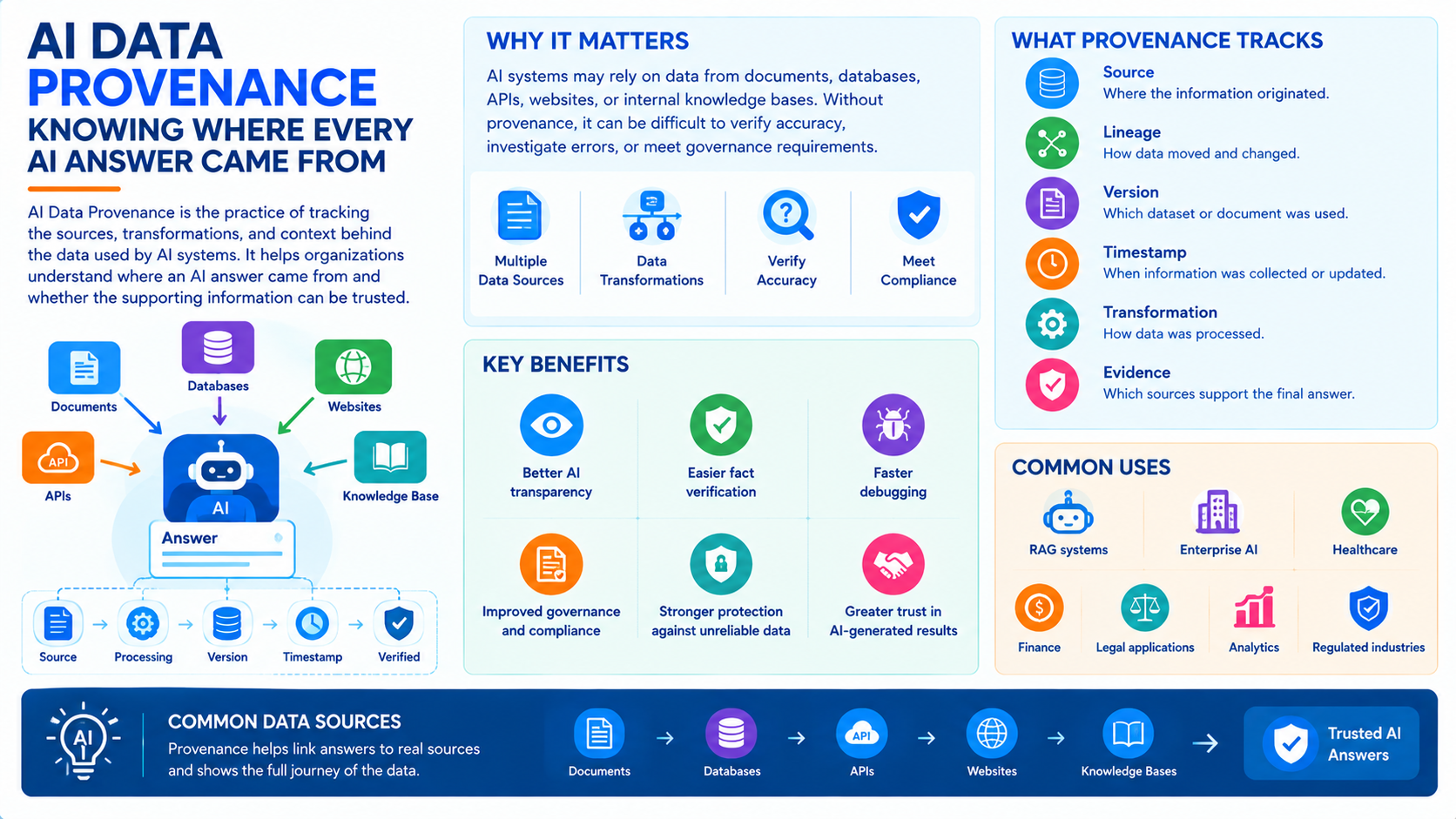
AI data provenance is the tracking of the origin, movement, transformation, and use of data across the entire AI lifecycle from the raw sources that trained a model, to the documents retrieved during a specific inference, to the reasoning steps that produced a final output.
It extends traditional data lineage into territory that only AI creates:
-
Training provenance: Which datasets, versions, and filters shaped the model?
-
Retrieval provenance: Which documents, chunks, and records were retrieved for this specific query?
-
Inference provenance: Which model version, prompt template, and parameters were used?
-
Reasoning provenance: What steps, tool calls, and intermediate conclusions led to the answer?
-
Usage provenance: Who consumed the output, and what did they do with it?
The goal is a complete, auditable chain from source to answer.
Why Provenance Matters Now
Regulatory Pressure
The EU AI Act, effective from August 2026, imposes explicit requirements on high-risk AI systems, including traceability, record-keeping, and the ability to explain how outputs were produced. Similar expectations are appearing in financial services regulation, healthcare compliance, and public sector procurement. Provenance is no longer a technical nicety it is a compliance obligation.
The Trust Problem
Enterprises have learned the hard way that fluent AI outputs are not necessarily correct outputs. When employees encounter an AI response that sounds authoritative but turns out to be wrong, they stop trusting the system entirely. Provenance is what allows a user to verify an answer rather than merely believe it.
The Correction Problem
Without provenance, correcting an AI system is guesswork. If a model produces a wrong answer, the team must speculate about why was it the training data, the retrieval, the prompt, or the model itself? With provenance, the failure can be traced to a specific source and fixed at the point of origin.
The Data Quality Connection
Provenance and data quality are inseparable. A model trained on undocumented, unverified, or corrupted data will produce outputs that cannot be defended. Provenance makes data quality visible and enforceable.
The Layers of AI Provenance
Layer 1: Training Data Provenance
Every model is a product of the data it was trained or fine-tuned on. Training provenance captures:
-
The source datasets and their owners
-
The collection methods and consent basis
-
The filters, deduplication, and cleaning steps applied
-
The versions and snapshots used for each training run
-
The known limitations and biases of the data
This layer answers: What shaped this model's behavior?
Layer 2: Retrieval Provenance
For retrieval-augmented generation (RAG) systems, provenance must capture what was retrieved for each query:
-
Which documents, chunks, or records were returned
-
Their source systems and last-updated timestamps
-
The relevance scores and ranking decisions
-
Any filtering, deduplication, or re-ranking applied
This layer answers: What evidence was available to the model at inference time?
Layer 3: Inference Provenance
The mechanics of the inference itself:
-
The model version and configuration
-
The prompt template and system instructions
-
The parameters (temperature, top-p, max tokens)
-
Tool calls and their results
-
Timestamps and execution environment
This layer answers: How was the answer produced?
Layer 4: Reasoning Provenance
For agentic and multi-step systems, provenance must capture the reasoning chain:
-
The sequence of steps taken
-
Intermediate conclusions and their supporting evidence
-
Which sources informed which steps
-
Where human judgment was inserted
This layer answers: What chain of reasoning led here?
Layer 5: Usage and Outcome Provenance
The final layer tracks what happened after the output was produced:
-
Who consumed the output and in what context
-
Whether it was accepted, edited, or rejected
-
The downstream business outcome
-
Any corrections or feedback
This layer answers: What happened as a result?
How Provenance Is Implemented
Content Hashing and Signing
Every data asset document, chunk, or record receives a cryptographic hash at ingestion. When a model retrieves and cites that asset, the hash is recorded alongside the citation. Any later change to the asset is detectable because the hash no longer matches.
Immutable Citation Records
Each AI output is stored with an immutable record of its citations: source identifiers, hashes, timestamps, and relevance scores. This record becomes the evidence trail for the output.
Model and Prompt Versioning
Models, prompts, and configuration are versioned with the same discipline as application code. Every inference records exactly which versions were used, enabling reproduction and comparison.
Lineage Graphs
Provenance data is stored as a graph linking sources, transformations, retrievals, inferences, and outputs. This graph allows a question about any output to be traced backward to its origins and a question about any source to be traced forward to every output it influenced.
Trace Standards and Interoperability
Emerging standards and frameworks are converging on consistent ways to represent provenance. OpenTelemetry-style tracing is being adapted for AI reasoning chains, and content provenance standards (such as those used for media authenticity) are influencing how AI-generated content is labeled and tracked.
Provenance in Practice: What It Enables
Auditable AI Decisions
When a decision is challenged by a regulator, a customer, or an internal auditor the provenance record shows exactly what data supported it, which model version produced it, and what reasoning chain was followed.
Faster Incident Response
When an AI system produces a harmful or incorrect output, provenance allows the team to identify the source, determine the scope of impact, and remediate at the point of origin rather than broadly disabling the system.
Continuous Quality Improvement
By tracking which sources correlate with accepted versus rejected outputs, teams can improve retrieval, refine prompts, and identify unreliable data sources.
Regulatory Compliance
Provenance provides the traceability and record-keeping that frameworks like the EU AI Act require, with evidence that is machine-readable and auditable rather than narrative and unverifiable.
Debugging and Reproducibility
With full provenance, any output can be reproduced by replaying the same retrieval, prompt, and model version turning an irreproducible anomaly into a debuggable event.
Challenges and Practical Considerations
Scale
Recording provenance for every inference in a high-volume system generates substantial data. Storage and query strategies must be designed for this volume often through sampling, tiered retention, and aggregation.
Latency
Provenance capture must not meaningfully slow down inference. Asynchronous logging and streaming architectures keep the overhead low.
Privacy and Security
Provenance records can themselves contain sensitive information. They must be access-controlled, encrypted, and subject to the same retention policies as the underlying data.
Multi-System Complexity
AI outputs frequently draw on multiple systems vector databases, APIs, internal tools, and external sources. Provenance must span these boundaries, which requires consistent identifiers and integration across systems.
Human Factors
Provenance is only useful if it is surfaced to the people who need it. User interfaces must make citations, confidence, and reasoning visible without overwhelming the user.
Implementation Roadmap
Phase 1: Foundation (Weeks 1-4)
-
Inventory AI systems and data sources. Identify every model, retrieval source, and inference path.
-
Define provenance requirements. Which outputs need full traceability, and to what standard?
-
Establish identifiers. Adopt consistent IDs for models, prompts, documents, and inference events.
-
Select storage and tracing tooling.
Phase 2: Capture (Weeks 5-8)
-
Implement content hashing at ingestion for all retrieval sources.
-
Instrument inference to record model version, prompt, parameters, and citations.
-
Build citation records for every output.
-
Version models and prompts with the same rigor as application code.
Phase 3: Surface and Govern (Weeks 9-12+)
-
Expose provenance to users through citations, confidence signals, and reasoning displays.
-
Build lineage graphs that connect sources to outputs and outputs to outcomes.
-
Connect provenance to governance with audit reports, retention policies, and access controls.
-
Test the audit trail. Attempt to reconstruct how a specific output was produced.
Frequently Asked Questions
Q1: What is AI data provenance?
AI data provenance is the tracking of the origin, transformation, and use of data across the AI lifecycle—from training data to retrieval, inference, and final output. It provides an auditable chain from source to answer.
Q2: How is it different from data lineage?
Data lineage traces data movement across systems. AI data provenance extends this to include model versions, prompts, retrieval decisions, reasoning chains, and the specific evidence behind individual outputs.
Q3: Why is provenance a regulatory requirement?
The EU AI Act and similar frameworks require traceability, record-keeping, and explainability for high-risk AI systems. Provenance provides the evidence needed to demonstrate compliance.
Q4: Can provenance be captured without slowing down inference?
Yes. Asynchronous logging and streaming architectures allow provenance to be captured in the background with negligible impact on latency.
Q5: What is the single most valuable provenance control?
Content hashing at ingestion combined with immutable citation records. This lets you detect any change to a source and prove exactly what was cited for any output.
Q6: How can Innovative AI Solutions help?
We help organizations design, build, and operationalize AI provenance from ingestion hashing and inference instrumentation to lineage graphs and governance integration. Based in Delhi, serving clients across India.
Why Delhi is a Great Hub for AI Governance Innovation
Delhi is emerging as a hub for enterprise AI adoption, backed by a thriving IT services ecosystem and increasing regulatory focus on data protection and AI accountability. As Indian enterprises deploy AI in regulated sectors financial services, healthcare, and government provenance becomes essential for trust, compliance, and operational reliability.
What We Offer at Innovative AI Solutions
-
Provenance Strategy: We help you define what must be traced and to what standard.
-
Ingestion and Hashing: We implement content hashing and immutable source records.
-
Inference Instrumentation: We capture model, prompt, and citation data for every output.
-
Lineage Graphs: We build the graphs that connect sources to outputs to outcomes.
-
Governance Integration: We connect provenance to audit, retention, and compliance workflows.
Final Thought
The shift is clear: from AI systems that answer questions to AI systems that can prove where their answers came from. Provenance transforms AI from a black box into an accountable system whose reasoning can be inspected, verified, and corrected. As AI takes on consequential decisions, the ability to trace an answer to its source will become as fundamental as the ability to produce the answer itself.
Contact Us:
Phone: +91 7464 099 059 / +91 9689967356
Email: info@innovativeais.com
Address: 904, 9th floor Pearls Best Heights-I, Netaji Subhash Place, Delhi-110034
Website: https://innovativeais.com
About the Author
Abhishek Kumar
Founder & CEO, Innovative AI Solutions
5+ years building AI, cloud, and enterprise systems. Based in Delhi, serving clients across India.