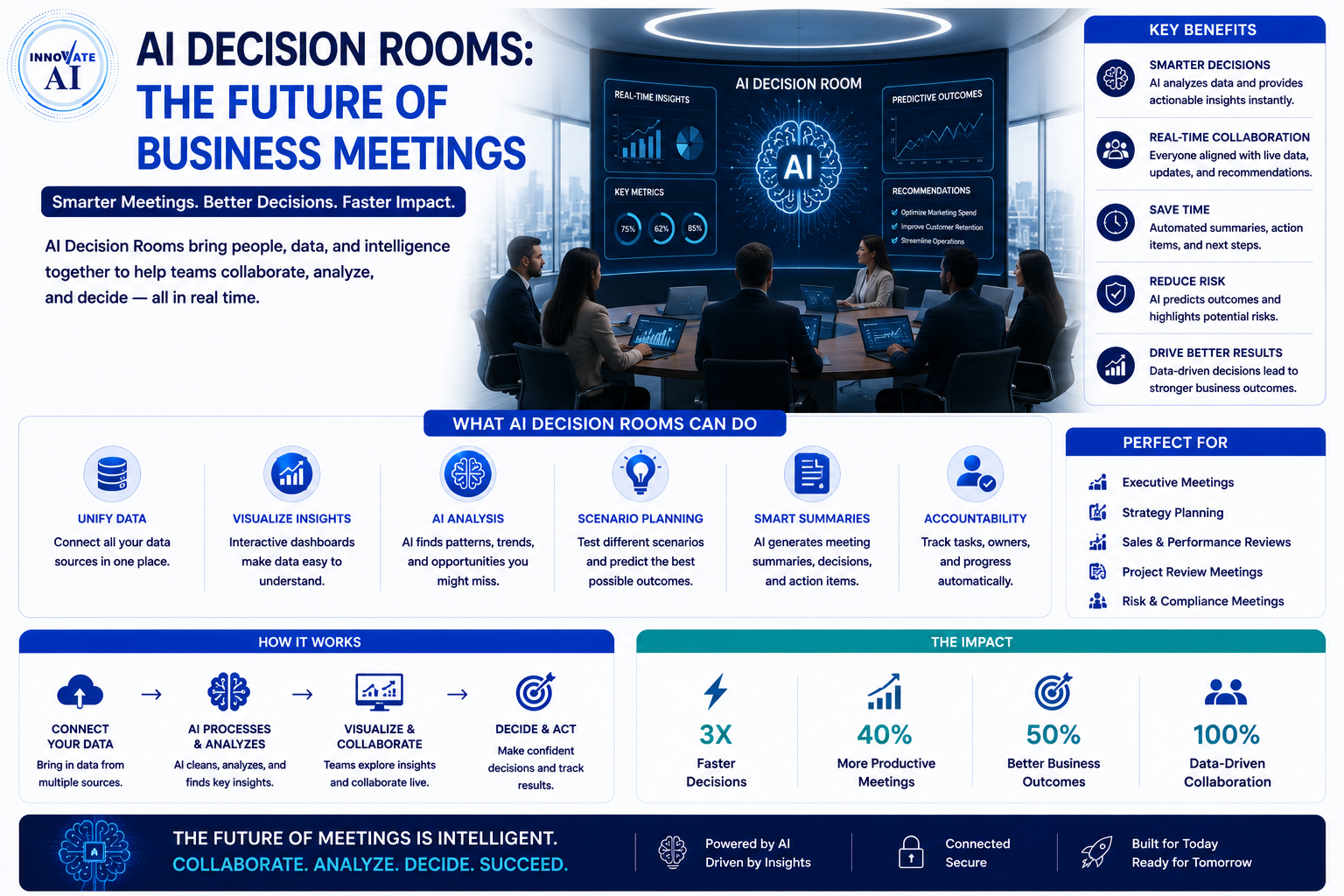
The Big Question
What happens when your meetings don't just produce notes, but actually execute decisions in real time? What if every discussion generated not just action items, but completed actions? And how do you ensure AI participation enhances rather than undermines collective decision-making?
These questions are no longer futuristic speculation. They're business imperatives.
The Problem: Broken Meetings Are Costing You Billions
The scale of the meeting problem is staggering. Unproductive meetings cost $375 billion annually in the US and £50 billion in the UK .
92% of companies are increasing AI investment—yet only 1% feel mature in their AI capabilities .
71% of employees already use AI tools without approval. 57% hide that usage from leadership .
AI is already in your meeting rooms, whether you've approved it or not .
Here's what's happening: data is flowing into unvetted systems. Decisions are being shaped by outputs no one is governing . The governance needed to control that power is far behind the technology adoption.
The Shift: From Assistant to Teammate
For the last two years, AI in meetings meant passive assistance—summaries, transcripts, and action item capture . That era is ending. What's arriving in 2026 is radically different .
The Three Waves of Meeting AI
-
Passive Assistant (2022-2024): AI that summarizes meetings after they end
-
Active Participant (2025-2026): AI that joins calls, contributes, and coordinates tasks
-
Agentic Teammate (2026+): AI with permissions to execute tasks during the meeting
Agentic AI participants can:
-
Schedule follow-up meetings by checking calendars and sending invites during the call
-
Update Jira tickets in real-time while you discuss them
-
Find and share relevant files without being asked
-
Interact with Salesforce, ServiceNow, Slack, Box, Google Drive, and OneDrive
These are not assistants. They are teammates .
What AI Decision Rooms Actually Look Like
The Pre-Meeting: Smart Preparation
AI Decision Rooms begin working before the meeting starts:
Automated pre-reads are generated and delivered directly to participants before key meetings . The AI pulls together relevant context from past meetings, documents, and data sources.
Agendas write themselves. In platforms like Decisions, AI can draft agendas based on meeting context, past recaps, and connected data. You can insert recaps from any previous meeting to keep discussions connected .
MeetingOS from Contio drafts the perfect game plan for you, prompts you to get the right people in the room, and gathers relevant data at your fingertips .
During the Meeting: Real-Time Decision Acceleration
AI Decision Rooms transform the live meeting experience:
Live, updating notes. Microsoft Teams' Facilitator Agent produces meeting notes that update during the call rather than after it . Decisions AI summarizes discussions and provides recaps .
Intelligent camera direction. New-generation room intelligence uses gaze attention and attention-based switching. Cameras don't just track who's talking—they track who's reacting. If you speak and turn to look at a colleague for approval, the AI can catch their reaction or place both of you in the same frame .
Real-time sentiment coaching. AI can analyze vocal tones and micro-expressions, providing private feedback on how your message is landing and when engagement drops .
Voice-to-action. MeetingOS lets you use voice mode to rapidly describe what you need to accomplish .
Agentic execution. AI agents with permissions execute tasks during the meeting—scheduling, updating systems, finding files—without waiting for follow-up .
The Decision Packet: Complete Record
The meeting ends with a comprehensive Decision Packet that includes :
-
Selected path or decision
-
Minority report (dissenting perspectives)
-
Remaining risks
-
Reopen conditions (when to revisit)
-
Action items
This packet is exportable and reusable in the next discussion .
The AI Roundtable: Multiple Perspectives in One Room
One particularly innovative approach comes from the AI Roundtable Room concept . Instead of a single AI providing one answer, this approach uses several AI roles to deliberate on a hard question:
-
Moderator: Frames the discussion
-
Strong Opinion Holders: Present different perspectives
-
Risk Reviewer: Identifies potential issues
-
Evidence Checker: Verifies factual claims
-
User Perspective: Considers user impact
-
Final Synthesizer: Produces the decision packet
The system tracks disagreements, evidence status, open questions, risks, and action items throughout .
How it differs from a single prompt: A single prompt gives you an answer. The Roundtable keeps the decision trail: which role argued for what, where evidence is missing, which disagreement changes the recommendation, and what should trigger a new review .
The Human Challenge: Why AI Meetings Fail
A five-month study involving 60 managers from 12 companies revealed why AI meetings often fail—and how to fix them .
The Three Traps Teams Fall Into
1. Treating AI like a chat buddy, not a teammate. Teams didn't introduce themselves or explain their roles to the AI. Result: AI responded as if supporting only the person typing, not the whole team .
2. Assigning AI a single, fixed role. Most teams relegated AI to "researcher" or "expert," using it as a knowledge base rather than a thinking partner. They never asked it to play devil's advocate or challenge assumptions .
3. Fragmenting the interaction. Teams used brief, transactional inputs ("OK, continue," "give another example"), never explaining their reasoning to the AI .
The Solution: Three Key Practices
1. Introduce your team. Participants should introduce themselves to the AI, explaining roles and expertise. This helps AI understand team dynamics .
2. Give AI multiple roles. AI should be a flexible team member—brainstorming partner, challenger, client perspective, competitor perspective—switching roles based on the discussion stage .
3. Keep collective ownership. Teams should pause, debate directions internally, and evaluate AI outputs collectively rather than passively following AI suggestions .
The Results
After applying these practices :
-
Average engagement improved by 30%
-
Two-thirds of participants said team dialogue, consensus, and collaboration improved
-
Three-fifths said collective judgment reduced typical AI pitfalls (over-trust, blind following)
The Platform Landscape
Enterprise Platforms
Zoom AI Companion 3.0: Dedicated tab in Zoom Workplace, Custom AI Companion agent builder for no-code orchestration. Prebuilt agents for sales, IT, and marketing. Interacts with Salesforce, ServiceNow, Slack, Box, Google Drive, and OneDrive .
Microsoft Teams: Facilitator Agent (live updating notes), AI Video Recap (narrated highlight reels with timestamped decision points), automatic spoken-language detection, custom industry dictionaries. Copilot draws across chat history, transcripts, and calendar context .
Google Workspace: Gemini connects to Gmail, Drive, and Calendar to prepare meeting context automatically .
Dedicated Platforms
Contio MeetingOS: "World's first AI-powered Decision Acceleration Platform." Serves as your brilliant meeting strategist, superhuman memory, and hyper-intelligent Chief of Staff. General availability for everyone planned in 2026 .
Decisions: AI Assistant with automated pre-reads and post-meeting summaries. AI Assistant can instantly find common meeting times and schedule meetings .
Workday Adaptive Decision Intelligence: Teams can ask questions in natural language, model scenarios in minutes, and commit decisions directly to the governed plan—without spreadsheets or waiting days .
Hardware
Logitech Rally AI Camera Pro: 20-megapixel sensor for AI-driven digital PTZ with mechanical PTZ lens for speaker close-ups .
Jabra PanaCast 55 VBS: 180-degree panoramic camera with multi-camera system .
HP IQ: Runs a 20-billion-parameter model locally on device and captures meeting notes without app switching .
The Executive Decision Partner
A new category of AI is emerging specifically for executive decision-making. NBBOSS's AI Decision Robot R1 is positioned as the "first AI decision partner designed for business owners" .
The device addresses four pain points :
-
Information overload: AI analyzes multiple information sources simultaneously, distilling key insights
-
Limited presence: One account, multiple devices—send different units to different meetings, with mobile as central knowledge base
-
Decision isolation: AI actively challenges bad proposals in negotiations, flags contradictions in candidate resumes
-
Emotional regulation: Emotion sensing system intervenes when decision-makers are overly stressed or complacent
The market response: over 10,000 units pre-ordered on launch day .
Governance: The Critical Gap
AI is already in your meeting rooms. Governance isn't. This is the critical challenge of AI Decision Rooms .
What Must Be Governed
-
Data boundaries: What can AI access?
-
Approved AI stack: Which tools are approved for meeting use?
-
Human accountability: Who's responsible for AI-influenced decisions?
-
Training: Teams trained on when and why to use AI
The "Remove the AI" Test
As we've discussed in previous posts, the simplest test of AI-native decision making: If you remove the AI, does the decision process collapse? If the meeting can still function normally, you're not AI-native. If the AI is integral to how decisions get made, you've built around intelligence.
Implementation Roadmap: The First 90 Days
Phase 1: Foundation (Weeks 1-4)
-
Audit current meeting practices: Where are meetings failing? Which decisions take too long?
-
Assess AI governance: What AI is already in your rooms? What's unvetted?
-
Define approved AI stack: Choose platforms (Zoom, Teams, Contio, Decisions) with governance capability
-
Set data boundaries: What can meeting AI access?
Phase 2: Pilot (Weeks 5-8)
-
Run an AI Meeting pilot: One team, one meeting type, measured improvement
-
Apply human-AI teaming practices: Team introductions, multiple AI roles, collective ownership
-
Measure results: Time saved, decision quality, participant engagement
-
Refine governance based on learnings
Phase 3: Scale (Weeks 9-12+)
-
Expand to additional meeting types and teams
-
Integrate with workflows: Connect AI meeting outputs to Salesforce, Slack, Jira
-
Build decision packets: Create reusable records of decisions, disagreements, and risks
-
Continuous improvement: Review chat logs, measure engagement, refine practices
Frequently Asked Questions
Q1: What is an AI Decision Room?
An AI-powered meeting environment where agentic AI participants actively contribute to discussions, execute tasks during the meeting, and produce comprehensive decision packets.
Q2: How much do unproductive meetings cost?
$375 billion annually in the US and £50 billion in the UK .
Q3: What's the difference between an AI assistant and an AI teammate?
Assistants wait for prompts and produce summaries. Teammates have permissions to execute tasks—scheduling meetings, updating systems, finding files—without being asked .
Q4: What are the three practices for effective human-AI teaming?
Introduce your team to the AI, give AI multiple flexible roles, and keep collective ownership of the interaction .
Q5: What's the governance challenge with AI in meetings?
AI is already in meeting rooms, but governance is far behind. Organizations need data boundaries, approved AI stacks, human accountability, and training .
Q6: How can Innovative AI Solutions help?
We help organizations design, pilot, and scale AI Decision Rooms—from platform selection and governance frameworks to human-AI teaming practices and workflow integration. Based in Delhi, serving clients across India.
Why Delhi is a Great Hub for AI Development
Delhi is emerging as a significant hub for AI development, backed by concrete government support and infrastructure. The recent Delhi Budget 2026-27 allocated ₹8.20 crore for two Artificial Intelligence centres of excellence (AI-CoEs), functioning as hubs for research, innovation, and startup incubation.
The city's AI infrastructure is expanding rapidly. Under the IndiaAI Mission, more than 38,000 high-end GPUs have been onboarded and are available at approximately ₹65 per hour—roughly one-third of the global average cost. This makes AI development remarkably cost-effective compared to other tech hubs.
The government has also announced a ₹350 crore startup policy over five years, aiming to support the emergence of at least 5,000 startups by 2035, with key focus areas including artificial intelligence, machine learning, and automation.
The AI ecosystem in Delhi combines: cost-effective infrastructure, government support, a growing talent pool, and proximity to the country's business decision-makers. For businesses looking to develop practical AI solutions, it's becoming an increasingly attractive location.
What We Offer at Innovative AI Solutions
After five years of building AI solutions for businesses, we've developed a practical approach that focuses on what actually works:
-
AI Meeting Strategy: We help you assess your meeting practices and design AI Decision Room pilots
-
Platform Selection: We help you choose the right platforms for your organization (Zoom, Teams, Contio, Decisions)
-
Governance Frameworks: We help you establish data boundaries, approved AI stacks, and accountability structures
-
Human-AI Teaming Training: We help teams learn the practices that make AI meetings effective
-
Workflow Integration: We connect AI meeting outputs to your existing systems
-
Change Management: We help shift your organization from passive meeting culture to active decision acceleration
Our approach is built on the reality that meetings are where decisions happen—and AI can transform them from cost centers into value drivers.
Final Thought
AI in the meeting room is inevitable. The question isn't whether it will arrive, but whether organizations will be ready to govern it effectively. AI is already listening, summarizing, nudging, and influencing decisions in rooms we designed. It's on us to make sure it's doing that responsibly, transparently, and in a way people can trust .
The organizations that act now will set the standards everyone else ends up following .
Contact Us:
Phone: +91 7464 099 059 / +91 9689967356
Email: info@innovativeais.com
Address: Netaji Subhash Place, Pitampura, Delhi – 110034
Website: https://innovativeais.com
About the Author
Abhishek Kumar
Founder & CEO, Innovative AI Solutions
5+ years building AI systems for enterprises. Based in Delhi, serving clients across India.
Hashtags: #AIDecisionRooms #FutureOfMeetings #AgenticAI #MeetingAI #DecisionAcceleration #AIStrategy #InnovativeAISolutions
Related services: to apply this in your business, explore our AI development services and AI agent development.