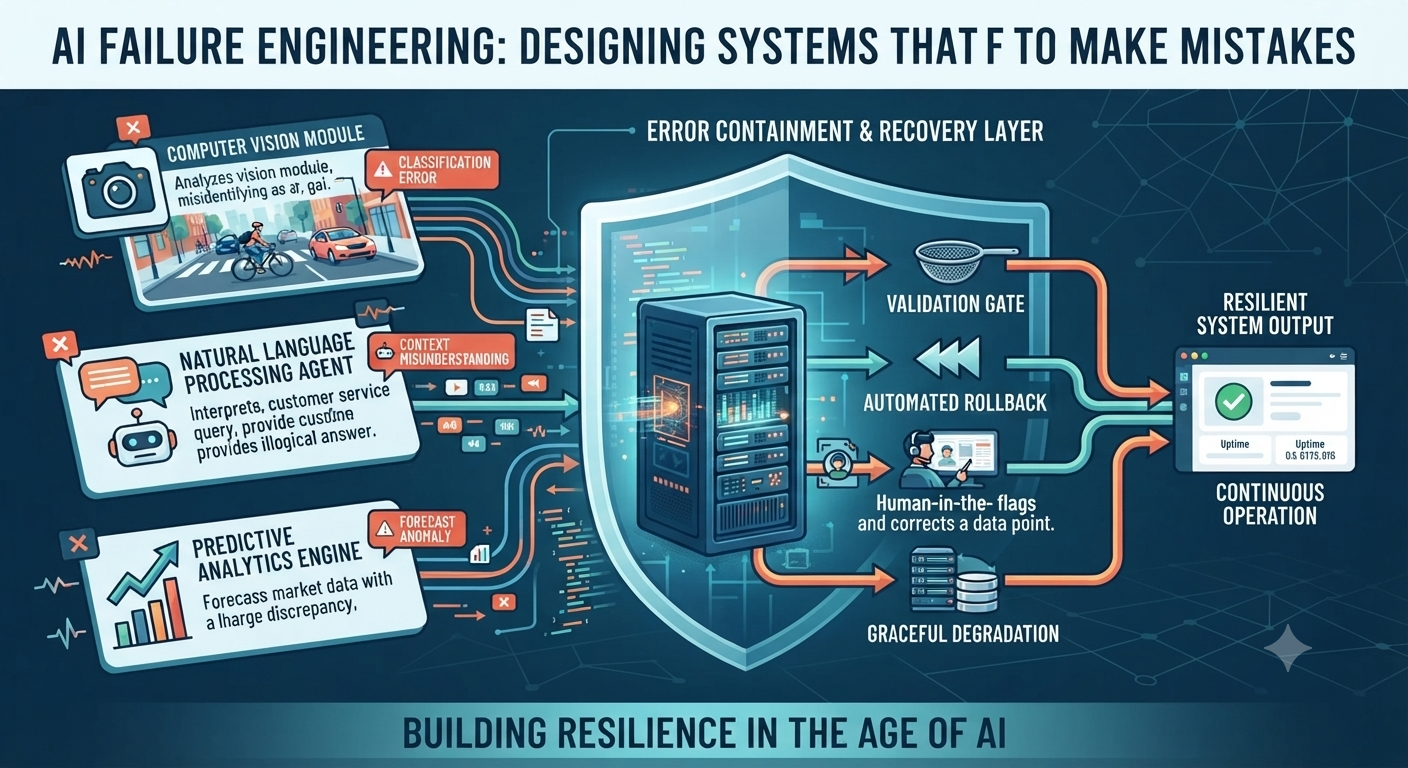
The Big Question
What happens when your AI system fails silently? When it produces a confidently wrong answer that no error handler catches, no monitoring alerts on, and no user immediately notices? When the failure propagates through downstream systems before anyone realizes something went wrong?
Traditional software fails loudly. Exceptions are thrown, logs are written, alerts fire. AI fails differently. It fails with fluent, plausible, incorrect output. The most dangerous AI failures are indistinguishable from success until the consequences surface.
AI failure engineering is the discipline of designing for this reality.
Why Traditional Reliability Engineering Falls Short
For decades, software reliability has rested on a set of assumptions that AI violates.
| Traditional Assumption | AI Reality |
|---|---|
| Correctness is achievable | Correctness is probabilistic |
| Failures produce errors | Failures produce fluent output |
| Deterministic replay is possible | Outputs vary between runs |
| Root cause is traceable | Reasoning is often opaque |
| Testing validates behavior | Testing samples a distribution |
The consequence is that conventional reliability practices—unit tests, exception handling, circuit breakers, and uptime monitoring are necessary but insufficient. An AI system can report 100% uptime while being systematically wrong.
The core insight: You cannot prevent AI failures. You can only design systems that detect, contain, and recover from them.
The Failure Taxonomy
Before designing defenses, it helps to categorize how AI systems fail.
Failure Mode 1: Hallucination
The model produces content that is fluent, confident, and factually wrong. Hallucinations are not random noise they are statistically plausible completions that happen to be untrue.
Failure Mode 2: Silent Degradation
The model continues to produce plausible output, but quality declines over time because upstream data changed, retrieval went stale, or a model version introduced a subtle regression. There is no error, only a gradual decline in usefulness.
Failure Mode 3: Confidence Inversion
The model is most confident when it is most wrong. This is especially dangerous because confidence signals are often used to determine when human review is needed.
Failure Mode 4: Boundary Errors
The model handles the common case well but fails at the edges edge cases, unusual inputs, rare conditions. These are precisely the cases where errors matter most.
Failure Mode 5: Cascading Errors
In agentic systems, an error in one step is propagated through subsequent steps, compounding into a final output that is far from correct.
Failure Mode 6: Context Misinterpretation
The model retrieves or interprets context incorrectly using a superseded document, misreading an instruction, or applying the wrong policy.
Failure Mode 7: Tool Misuse
In agentic systems, the model calls the wrong tool, passes incorrect parameters, or uses a tool in a way that causes unintended side effects.
The Design Principles of AI Failure Engineering
Principle 1: Separate Reasoning from Enforcement
The probabilistic reasoning of the model should be separated from deterministic enforcement of constraints. A model may propose an action; a deterministic layer decides whether that action is permitted.
This is the "Brain and Governor" pattern: the model reasons, and a separate, verifiable component enforces safety.
Principle 2: Contain the Blast Radius
Every AI action should be scoped so that a wrong decision causes bounded harm. If a model can only read data, its worst failure is an incorrect recommendation. If it can write or transact, its worst failure is significantly larger.
Design so that the potential damage of any single AI decision is known, limited, and reversible.
Principle 3: Make Failure Detectable
A silent failure is worse than a loud one. Systems should be designed so that AI failures surface through confidence signals, validation checks, cross-referencing, or human review gates.
Detection requires knowing what "normal" looks like. Baselines for output quality, distribution, and behavior make deviations visible.
Principle 4: Design for Reversibility
Prefer actions that can be undone. Drafts before publication. Proposals before execution. Staged rollouts before full deployment. Irreversible actions should require explicit human approval.
Principle 5: Require Progressive Trust
Autonomy should be earned incrementally. A new AI system should begin with narrow scope and heavy oversight, expanding autonomy only as its reliability is demonstrated in production. Trust must be justified by evidence, not assumed by design.
Principle 6: Assume Every Component Fails
Every model, retrieval source, tool, and data feed will eventually fail. The system should be designed so that any single failure degrades gracefully rather than causing systemic collapse.
Practical Patterns
The Verification Layer
Insert a verification step between AI generation and AI action. The verification layer may be:
-
Deterministic: Schema validation, range checks, policy enforcement
-
Model-based: A second model evaluates the first model's output against criteria
-
Human: A person reviews high-stakes outputs before they are acted upon
The verification layer's job is not to improve quality it is to catch errors before they cause harm.
Confidence Thresholds
Classify outputs by confidence and route them differently:
| Confidence | Action |
|---|---|
| High | Proceed automatically within scope |
| Medium | Proceed with verification or notification |
| Low | Require human review before action |
| Very low | Escalate to human or decline to answer |
The critical requirement: confidence must be calibrated. A model that reports high confidence on wrong answers makes this pattern actively dangerous. Calibration must be measured and maintained.
Checkpoint and Resume
For multi-step agentic workflows, persist state after each step. If a step fails or produces an invalid result, the workflow can resume from the last known good state rather than restarting from scratch.
This pattern limits the cost of failures and prevents duplicate side effects.
Idempotency and Side-Effect Guards
Every action taken by an AI system should be idempotent wherever possible. If the system attempts the same action twice because of a retry or a misunderstanding the result should be the same as performing it once.
Where idempotency is impossible, explicit guards should prevent duplicate side effects such as double charges or duplicate notifications.
Human Escalation Paths
Define clear paths for escalating AI uncertainty to humans. Escalation should be:
-
Fast: Low friction for the user to request review
-
Contextual: The reviewer receives the input, output, sources, and confidence
-
Accountable: The reviewer's decision is recorded and feeds back into the system
Fallback Hierarchies
Define what happens when the primary approach fails. For a given task, the fallback might be a smaller model, a rules-based implementation, a cached response, or a graceful "I don't know."
Behavioral Monitoring
Track what the AI system actually does, not just whether it is running:
-
Output distribution shifts
-
Confidence calibration over time
-
Refusal and escalation rates
-
Downstream acceptance or rejection rates
-
Error patterns by input category
This is what makes silent degradation visible.
The Organizational Dimension
AI failure engineering is not purely technical. It requires organizational choices.
Governance. Who decides what an AI system is allowed to do? Who owns the risk? Who reviews failures?
Incentives. If teams are rewarded for adoption and not for reliability, they will deploy AI systems that have not been designed to fail safely.
Culture. Reporting an AI failure must be safe. If failures are punished, they will not be reported and unreported failures cannot be fixed.
Accountability. Even when an AI system takes action autonomously, accountability remains human. The system must have a named owner for each component and a clear escalation path.
Implementation Roadmap
Phase 1: Classify and Assess (Weeks 1-4)
-
Inventory AI systems and their failure modes. Which of the taxonomy patterns apply?
-
Assess blast radius. For each system, what is the worst that can happen if it is wrong?
-
Define risk tiers. Which systems require which level of containment?
Phase 2: Design Containment (Weeks 5-8)
-
Separate reasoning from enforcement where risk is elevated.
-
Implement verification layers appropriate to each risk tier.
-
Define confidence thresholds and measure calibration.
-
Implement checkpoint and resume for multi-step workflows.
-
Build escalation paths with proper context.
Phase 3: Detect and Improve (Weeks 9-12+)
-
Establish behavioral baselines for output quality and distribution.
-
Deploy monitoring that detects silent degradation.
-
Establish feedback loops so failures improve the system.
-
Review failures regularly and adjust containment accordingly.
-
Expand autonomy only when reliability is demonstrated.
Frequently Asked Questions
Q1: What is AI failure engineering?
AI failure engineering is the discipline of designing AI systems that expect the AI to make mistakes focusing on containment, detection, and recovery rather than prevention alone.
Q2: Why can't we just prevent AI failures?
Because AI systems are probabilistic. They infer rather than execute, and they will produce wrong outputs in ways that cannot be fully anticipated. Prevention reduces frequency; containment reduces consequence.
Q3: What is the most important design principle?
Separate reasoning from enforcement. Let the model reason, but let a deterministic layer decide whether its proposed action is permitted.
Q4: How do I detect a silent AI failure?
Establish behavioral baselines output distribution, confidence calibration, refusal rates, downstream acceptance and monitor for deviations. Silent failures are invisible without baselines.
Q5: Should AI systems ever act autonomously?
Yes, within defined scope and with demonstrated reliability. Autonomy should be earned progressively based on evidence, and irreversible actions should require explicit human approval.
Q6: How can Innovative AI Solutions help?
We help organizations design, build, and operationalize AI failure engineering from failure taxonomy and blast radius assessment to verification layers, monitoring, and governance. Based in Delhi, serving clients across India.
Why Delhi is a Great Hub for AI Reliability Innovation
Delhi is emerging as a hub for enterprise AI adoption, backed by a thriving IT services ecosystem and growing regulatory focus on AI accountability. As Indian enterprises move AI from pilots into production especially in regulated sectors like financial services, healthcare, and government designing for graceful failure becomes essential for trust, compliance, and operational continuity.
What We Offer at Innovative AI Solutions
-
Failure Mode Assessment: We classify how your AI systems can fail and what is at stake.
-
Containment Design: We build verification layers, confidence thresholds, and escalation paths.
-
Behavioral Monitoring: We establish baselines and detect silent degradation.
-
Governance Frameworks: We define accountability, escalation, and oversight structures.
-
Autonomy Progression: We design progressive trust models that expand autonomy responsibly.
Final Thought
The shift is clear: from designing AI systems that assume correctness to designing systems that expect mistakes. AI failure engineering is not pessimism it is realism. The organizations that master it will deploy AI with confidence, knowing that when the system is wrong, the failure will be contained, detected, and corrected rather than catastrophic.
Contact Us:
Phone: +91 7464 099 059 / +91 9689967356
Email: info@innovativeais.com
Address: 904, 9th floor Pearls Best Heights-I, Netaji Subhash Place, Delhi-110034
Website: https://innovativeais.com
About the Author
Abhishek Kumar
Founder & CEO, Innovative AI Solutions
5+ years building AI, cloud, and enterprise systems. Based in Delhi, serving clients across India.