The Big Question
"We have supply chain visibility tools. We have dashboards. We can see problems when they happen. But we still can't respond fast enough. What is the next step?"
The honest answer:
Visibility alone is not enough. The goal must shift from seeing problems to having the system solve them automatically.
Jeannette Song, professor at Duke University's Fuqua School of Business, describes the shift: "AI is reshaping supply chains in four connected ways: expanding automation across the chain, changing how humans and machines work together, raising new questions about privacy and accountability, and pointing toward a future of more autonomous, agentic systems" .
The distinction is simple: static maps give you one route and assume the world will cooperate. Live navigation keeps checking traffic, accidents, and road closures, then recalculates along the way. Supply-chain AI works more like the second model—it helps companies adjust as demand shifts, congestion builds, weather changes, or a supplier runs into trouble .
Step 3: What Is a Self-Optimizing Supply Chain?
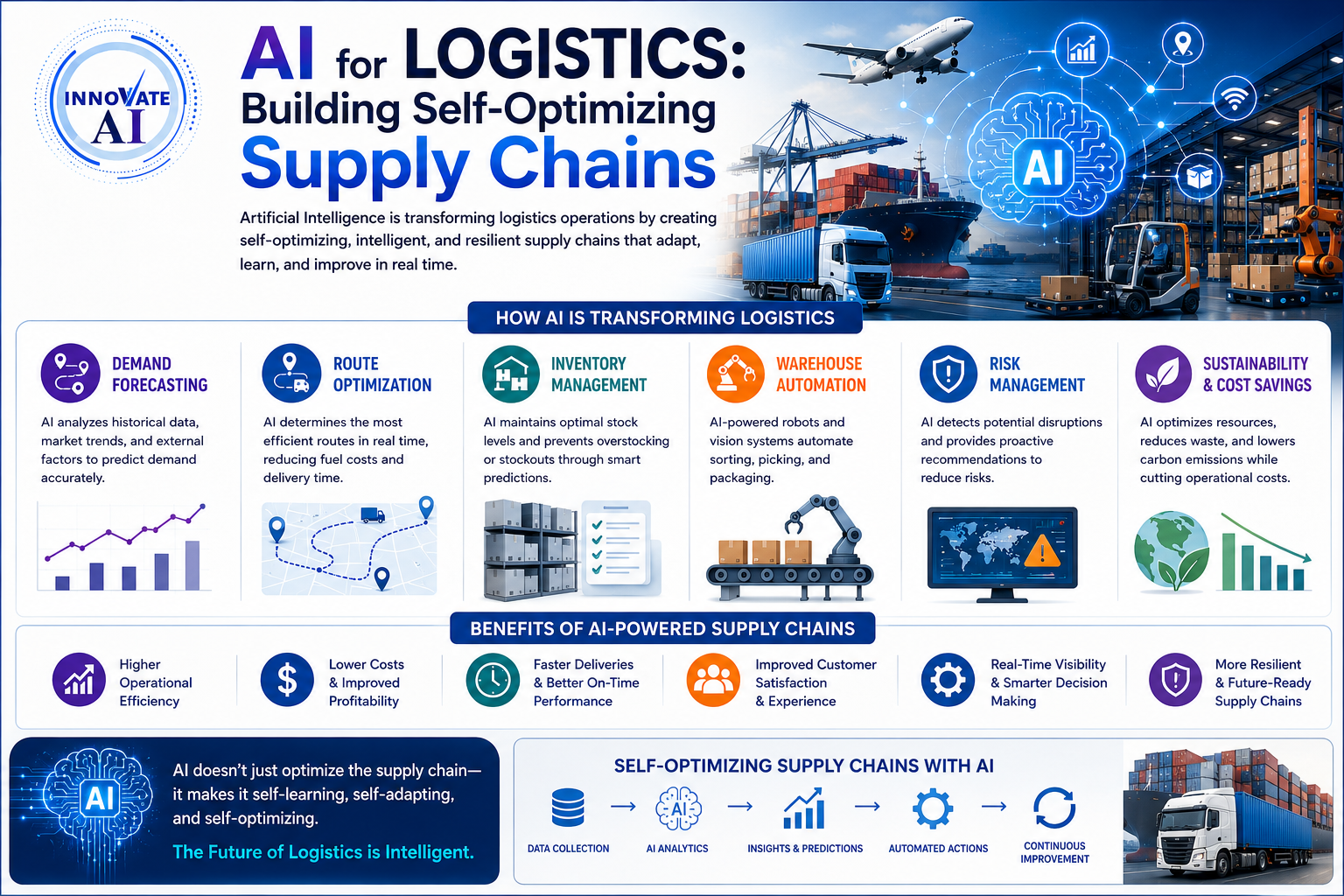
A self-optimizing supply chain is an AI-driven system that learns, adapts, and acts autonomously. Unlike traditional automation that follows fixed rules, these systems interpret data, update forecasts, and revise decisions as new information arrives.
The Evolution of Supply Chain Intelligence
According to Duke University research, supply chains are moving through four connected waves of AI transformation :
| Wave | Capability | What It Means |
|---|---|---|
| Rule-Based Automation | Fixed logic: "if X, do Y" | Fast but inflexible |
| Predictive Analytics | Data-driven forecasting | Better visibility but still reactive |
| Agentic AI | Autonomous decision-making | Systems that sense, plan, and act |
| Self-Optimizing Networks | Continuous learning and adaptation | Supply chains that heal and improve themselves |
The Mechanics of Self-Correction
According to supply chain technology leaders, self-correcting systems rely on an integrated foundation :
-
Specialized AI models that can forecast, simulate, and adjust outcomes in real time
-
Closed-loop feedback mechanisms that enable systems to learn from every adjustment
-
Governance frameworks including version control, audit trails, and simulation-before-deployment to ensure transparency and safety
A practical example: automatic inventory transfers between stocking locations during vendor shortages or shipment delays, and recommending updated inventory policies if the turbulence continues and proves systemic .
Step 4: The Technology Stack for Self-Optimizing Supply Chains
The Agentic AI Architecture
Agentic AI systems represent the next evolution beyond traditional automation. Unlike traditional AI models that are task-specific and reactive, agentic AI systems :
-
Understand goals
-
Break them down into sub-tasks
-
Make real-time decisions
-
Learn from outcomes
-
Collaborate with other agents
Key Components of Agentic Supply Chain Systems
| Component | Function | Example |
|---|---|---|
| Perception Layer | IoT sensors, data streams, real-time tracking | Monitor inventory, shipments, supplier performance |
| AI Agents | Autonomous decision-makers | Demand forecasting agent, procurement agent, logistics agent |
| Orchestration Layer | Coordinates multiple agents | Ensures agents work toward shared goals |
| Governance Layer | Guardrails, audit trails, human oversight | Ensures autonomous decisions remain accountable |
Real-Time Data Foundation
Agentic AI agents work with live data from IoT sensors, inventory systems, ERP and TMS platforms, and supplier networks. They don't wait for human analysis. Instead, they act immediately to resolve exceptions and seize opportunities .
Step 5: Key Capabilities of Self-Optimizing Supply Chains
1. Self-Healing Operations
When unexpected events occur—weather delays, raw material shortages, or labor strikes—agentic AI agents can detect these disruptions, analyze their impact, and instantly reroute shipments, adjust schedules, or switch suppliers .
Example: A shipment of parts is delayed at a port. An agent automatically notifies production managers, finds alternative parts from a different warehouse, and adjusts the delivery route—all in real time .
Measured Impact: According to a 2023 survey, 43% of companies utilizing AI-enabled logistics reported a 40% reduction in downtime by leveraging self-healing processes .
2. Continuous Self-Optimization
Systems that don't just execute but continuously improve. The Lean AI Engineer from C.H. Robinson assesses an entire supply chain in 25 to 30 minutes, significantly faster than traditional assessments that can take weeks and typically analyze past performance rather than predict future outcomes .
The key insight: The technology runs continuously, improves the operation it is running, and heals itself when something breaks—without an alert or a human noticing a problem first .
3. Predictive and Proactive Response
AI can replicate human behavior in situations where data is sparse or uncertain. This enables quick automation of routine, heuristic-driven actions. More importantly, different AI technologies can infer or estimate missing data using probabilistic or stochastic models, allowing both AI-driven and traditional optimization systems to run more effectively .
4. Collaborative Intelligence Across Agents
Multiple agentic AIs can operate in tandem to manage a domain while coordinating across the broader supply chain :
-
A demand forecasting agent predicts demand surges
-
A procurement agent pre-orders stock
-
A logistics agent secures early transport
Together, they orchestrate outcomes that traditional, siloed systems cannot achieve.
Step 6: Real-World Deployments
C.H. Robinson – Agentic Supply Chain
C.H. Robinson has built an AI-powered logistics ecosystem designed to think, learn, and act on its own. The Agentic Supply Chain uses real-time decision-making, contextual awareness, and continuous self-optimization to manage complex logistics networks at global scale .
Key Results:
-
The system autonomously handles 92% of 4PL shipments globally across multiple transportation modes, including trucking, ocean, air, and rail
-
Shipment planning reduced from hours to seconds
-
Smarter cost optimization and predictive rerouting that prevents delays before they happen
-
The Lean AI Engineer can assess an entire supply chain in 25 to 30 minutes
The Architecture: The platform builds on C.H. Robinson's Always-On Logistics Planner, a digital workforce of more than 30 AI agents already performing millions of shipping tasks once thought too complex to automate .
The Lean AI Engineer works alongside the Lean AI Planner to create a closed-loop system. The Planner executes in real time while the Engineer studies the results, identifies patterns, adapts logic, and influences future decisions .
How It Works:
"The Lean AI Engineer will run continuously, improve the operation it's running and heal itself when something breaks — without an alert or a human noticing a problem first." — Jordan Kass, President of Managed Solutions, C.H. Robinson
Walmart – Trend-to-Product
Walmart uses generative AI and visual analytics to detect emerging fashion trends and turn them into viable product concepts more quickly. This represents a shift from reactive to proactive supply chain intelligence .
Amazon – AI-Coordinated Warehouses
Amazon has replaced static storage with mobile shelves guided by AI-coordinated robotics. Workers no longer search for products; the shelves come to them .
Smart Factory Deployments
Companies including BYD, Foxconn, and BMW are combining robotics with AI for tasks such as welding, assembly, and quality inspection. Siemens reported that using agentic AI in factory automation resulted in a 25% reduction in operational delays and a 10% increase in output efficiency .
Step 7: The Human Role—Partners, Not Replacements
Despite fears of automation, leading research points to a future defined by human-machine collaboration, not replacement .
Human Roles Are Shifting
According to Duke University research, human roles are shifting away from repetitive execution and toward supervision, exception handling, and judgment .
The Airport Control Tower Model: In high-stakes environments—like air traffic control—human decision-making remains essential. Teams track different signals and coordinate in real time to keep everything running smoothly. As AI absorbs more routine analysis and coordination, managers are more likely to investigate anomalies and decide when a recommendation should be accepted, modified, or overruled .
The Autopilot Model: This evolution mirrors how pilots oversee autopilot systems in aviation. AI handles the routine; humans manage the unexpected and are responsible for getting passengers safely to their destination .
The Accountability Imperative
The core hesitation in delegating to autonomous systems lies in accountability and trust. AI agents cannot be held responsible because they lack judgment, ethics, and moral context. Users struggle to hand over authority for major business decisions to systems when they still bear full accountability for the outcomes .
The Solution: Autonomy must be earned through trust, accountability, and proven reliability .
Step 8: The Realities of Adoption
The AI Project Gap
Despite years of AI experimentation, few companies have achieved continuous, adaptive optimization. According to industry reports, 90% of AI projects are stuck in experimentation, and only 26% have scaled beyond pilots. These projects are stalling mainly due to common barriers, such as data quality, limited budgets, and talent gaps .
Key Industry Statistics
| Statistic | Source |
|---|---|
| 68% of supply chain executives believe AI will be critical to future operations | Industry survey |
| 51% have already started pilot programs involving autonomous agents | Industry survey |
| 60–70% of work hours could already be automated with today's technologies | Industry analysis |
| Organizations with real-time agentic AI systems experience 25% faster exception handling | Gartner |
| AI-driven inventory optimization leads to 20–30% improvement in inventory accuracy | McKinsey |
Measured Benefits of Agentic AI
| Metric | Improvement |
|---|---|
| Logistics costs | 20% reduction |
| Stockouts | 30–40% fewer |
| Time-to-market | 35% faster |
| Order accuracy | 22% improvement |
| Operational delays | 25% reduction (Siemens) |
Step 9: The Risks Beneath the Promise
Privacy and Data Governance
AI often depends on large amounts of information, moving across suppliers, warehouses, carriers, and platforms. This raises fundamental questions about who owns the data, who can see it, and how it can be shared .
Explainability
Some AI models operate as black boxes, making it difficult for people to understand how AI recommendations were reached. This becomes a serious problem when companies need to audit decisions or intervene quickly .
Cybersecurity Risks
As supply chains become more autonomous, the attack surface expands. Securing agentic AI systems against adversarial attacks becomes a growing concern .
Integration Challenges
Agents require access to accurate and timely data across various systems. Integrating legacy platforms can be a barrier. According to a survey, 46% of executives identified talent shortages as the top barrier to the adoption of Agentic AI in supply chains .
Step 10: Implementation Roadmap—90 Days
Phase 1: Assessment and Foundation (Weeks 1-4)
| Action | Output |
|---|---|
| Audit current supply chain systems and data readiness | Baseline assessment |
| Identify high-impact, high-frequency failure points | Priority roadmap |
| Define success metrics (downtime, cost reduction, on-time delivery) | KPI baseline |
| Establish governance framework for AI decisions | Security and accountability framework |
Phase 2: Pilot (Weeks 5-8)
| Action | Output |
|---|---|
| Deploy one agentic AI capability for a bounded use case | Working prototype |
| Start with low-risk, repetitive adjustments before tackling high-value decisions | Proven reliability |
| Implement human oversight and audit trails | Governance controls |
| Measure performance against baseline | Early ROI data |
Phase 3: Scale and Optimize (Weeks 9-16)
| Action | Output |
|---|---|
| Expand to additional use cases and agents | Multi-agent system |
| Integrate closed-loop feedback mechanisms | Continuous learning |
| Deploy digital twins for simulation | Enhanced planning |
| Establish continuous improvement cycles | Ongoing optimization |
Step 11: Frequently Asked Questions
Q1: What is the difference between traditional supply chain automation and agentic AI?
Traditional automation follows fixed rules: "if X, do Y." Agentic AI systems understand goals, break them down, make real-time decisions, learn from outcomes, and collaborate with other agents .
Q2: Is AI in supply chains ready for production?
Yes—but with governance. C.H. Robinson's system already autonomously handles 92% of 4PL shipments globally . However, Gartner cautions that many agentic projects may be canceled due to unclear ROI and weak governance. Autonomy must be earned through trust, accountability, and proven reliability .
Q3: Will AI replace supply chain professionals?
No. Human roles are shifting from repetitive execution to supervision, exception handling, and judgment. AI handles the routine; humans manage the unexpected and carry final accountability .
Q4: What is the biggest barrier to adoption?
Data quality and governance. Agents require accurate, timely data across multiple systems. Integrating legacy platforms and establishing trust in autonomous decisions are the primary challenges .
Q5: What is a self-healing supply chain?
A system where AI agents detect disruptions, analyze their impact, and instantly reroute shipments, adjust schedules, or switch suppliers—all without human intervention .
Q6: How can Innovative AI Solutions help?
We help logistics and supply chain companies design, build, and deploy agentic AI systems—from data foundation and governance to agent architecture and production monitoring.
Step 12: Final Tagline
"The future is not magic. It is the next step in a longer progression from static rules to optimized decision models, to systems that can update and execute those models continuously as new information arrives. Supply-chain AI is turning rigid workflows into adaptive, decision-making systems that learn, adapt, and act. The organizations that treat autonomy as a strategic capability—embedding intelligence across planning, procurement, logistics, and fulfillment—will define the next chapter of industrial competitiveness" .
Short version:
AI for logistics—building self-optimizing supply chains in 2026. From static rules to agentic systems, real-world deployments (C.H. Robinson, Amazon, Walmart), and implementation roadmap.
Hashtags:
#AISupplyChain #AgenticAI #LogisticsAI #SelfOptimizing #SupplyChainInnovation #DigitalLogistics #InnovativeAISolutions
Ready to Build a Self-Optimizing Supply Chain?
The shift from visibility to autonomy is happening now. Let us help you design the architecture that will define your supply chain competitiveness.
Contact Us
Phone: +91 7464 099 059 / +91 96899 67356
Email: info@innovativeais.com
Address: Netaji Subhash Place, Pitampura, Delhi – 110034
Website: https://innovativeais.com
About the Author
Abhishek Kumar
Founder & CEO, Innovative AI Solutions
5+ years building AI systems for enterprise. Based in Delhi, serving clients across India.
Related services: to apply this in your business, explore our AI agent development and machine learning and predictive analytics.